Kirjojen hintavertailu. Mukana 12 595 353 kirjaa ja 12 kauppaa.

Kirjailija

Yan Xu

Kirjat ja teokset yhdessä paikassa: 4 kirjaa, julkaisuja vuosilta 2016-2025, suosituimpien joukossa Intelligent Systems for Stability Assessment and Control of Smart Power Grids. Vertaile teosten hintoja ja tarkista saatavuus suomalaisista kirjakaupoista.

4 kirjaa

Kirjojen julkaisuhaarukka 2016-2025.

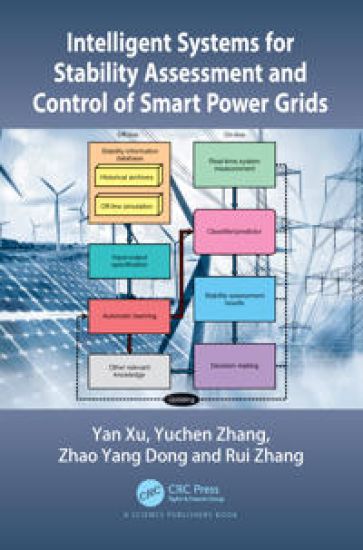
Intelligent Systems for Stability Assessment and Control of Smart Power Grids

Intelligent Systems for Stability Assessment and Control of Smart Power Grids

Yan Xu; Yuchen Zhang; Zhao Yang Dong; Rui Zhang

CRC Press
2022
nidottu
Power systems are evolving towards the Smart Grid paradigm, featured by large-scale integration of renewable energy resources, e.g. wind and solar power, deeper participation of demand side, and enhanced interaction with electric vehicles. While these emerging elements are inherently stochastic in nature, they are creating a challenge to the system’s stability and its control. In this context, conventional analysis tools are becoming less effective, and necessitate the use alternative tools that are able to deal with the high uncertainty and variability in the smart grid. Smart Grid initiatives have facilitated wide-spread deployment of advanced sensing and communication infrastructure, e.g. phasor measurement units at grid level and smart meters at household level, which collect tremendous amount of data in various time and space scales. How to fully utilize the data and extract useful knowledge from them, is of great importance and value to support the advanced stability assessment and control of the smart grid. The intelligent system strategy has been identified as an effective approach to meet the above needs. This book presents the cutting-edge intelligent system techniques and their applications for stability assessment and control of power systems. The major topics covered in this book are: Intelligent system design and algorithms for on-line stability assessment, which aims to use steady-state operating variables to achieve fast stability assessment for credible contingencies. Intelligent system design and algorithms for preventive stability control, which aims at transparent and interpretable decision-making on preventive control actions to manipulate system operating condition against possible contingencies. Intelligent system design and algorithms for real-time stability prediction, which aims to use synchronized measurements to foresee the stability status under an ongoing disturbance. Intelligent system design and algorithms for emergency stability control, which aims at fast decision-making on stability control actions at emergency stage where instability is propagating. Methodologies and algorithms for improving the robustness of intelligent systems against missing-data issues.This book is a reference and guide for researchers, students, and engineers who seek to study and design intelligent systems to resolve stability assessment and control problems in the smart grid age.
Intelligent Systems for Stability Assessment and Control of Smart Power Grids

Intelligent Systems for Stability Assessment and Control of Smart Power Grids

Yan Xu; Yuchen Zhang; Zhao Yang Dong; Rui Zhang

CRC Press
2020
sidottu
Power systems are evolving towards the Smart Grid paradigm, featured by large-scale integration of renewable energy resources, e.g. wind and solar power, deeper participation of demand side, and enhanced interaction with electric vehicles. While these emerging elements are inherently stochastic in nature, they are creating a challenge to the system’s stability and its control. In this context, conventional analysis tools are becoming less effective, and necessitate the use alternative tools that are able to deal with the high uncertainty and variability in the smart grid. Smart Grid initiatives have facilitated wide-spread deployment of advanced sensing and communication infrastructure, e.g. phasor measurement units at grid level and smart meters at household level, which collect tremendous amount of data in various time and space scales. How to fully utilize the data and extract useful knowledge from them, is of great importance and value to support the advanced stability assessment and control of the smart grid. The intelligent system strategy has been identified as an effective approach to meet the above needs. This book presents the cutting-edge intelligent system techniques and their applications for stability assessment and control of power systems. The major topics covered in this book are: Intelligent system design and algorithms for on-line stability assessment, which aims to use steady-state operating variables to achieve fast stability assessment for credible contingencies. Intelligent system design and algorithms for preventive stability control, which aims at transparent and interpretable decision-making on preventive control actions to manipulate system operating condition against possible contingencies. Intelligent system design and algorithms for real-time stability prediction, which aims to use synchronized measurements to foresee the stability status under an ongoing disturbance. Intelligent system design and algorithms for emergency stability control, which aims at fast decision-making on stability control actions at emergency stage where instability is propagating. Methodologies and algorithms for improving the robustness of intelligent systems against missing-data issues.This book is a reference and guide for researchers, students, and engineers who seek to study and design intelligent systems to resolve stability assessment and control problems in the smart grid age.
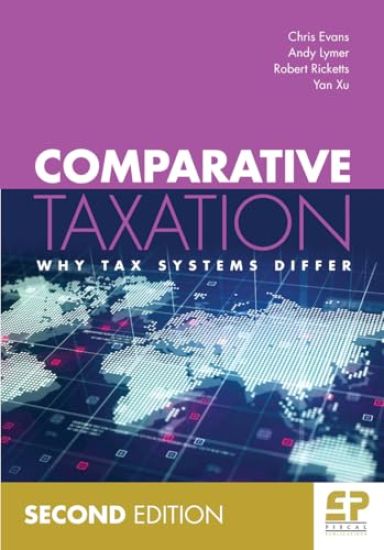
Comparative Taxation (2nd edition)

Comparative Taxation (2nd edition)

Chris Evans; Andy Lymer; Robert Ricketts; Yan Xu

Fiscal Publications
2025
nidottu
This book explores a number of critical issues related to tax systems around the world. Drawing upon a wealth of literature, it compares and contrasts modern tax systems in developed and developing countries, identifying factors that suggest they are converging and others that continue to distinguish them. It addresses the taxation of incomes (personal and corporate), wealth and consumption at the local, national, supranational and international levels; considers the use of environmental taxes; provides an analysis of modern trends in tax administration including issues of tax complexity and of tax compliance; and addresses the process and outcomes of tax reform. Readers will include anyone interested in how tax systems are formed, how they operate in practice, and how they are reformed. An ideal text for academic study at the intermediate or advanced levels This text explores and answers questions including: Why are the tax systems of developing and developed countries converging and how do they still differ? How do countries adapt their tax systems to deal with external shocks such as wars, pandemics, climate change and financial crises? Why is the property tax the most widely used tax for local government? Why has income become the predominant tax base in developed countries? Do we need corporate income taxes? Why are wealth taxes relatively under-utilised in all countries? Why have so many countries adopted a VAT or GST as their general consumption tax? How do taxes help governments to deliver environmental objectives? Can we avoid complexity in tax system design or are we stuck with it if we want effective taxes? Why do taxpayers comply, or not comply, with their tax obligations? Where should we go next in designing tax systems for the 21st century? ... and many others.
GPS

GPS

Guochang Xu; Yan Xu

Springer-Verlag Berlin and Heidelberg GmbH Co. K
2016
sidottu
This reference and handbook describes theory, algorithms and applications of the Global Positioning System (GPS/Glonass/Galileo/Compass). It is primarily based on source-code descriptions of the KSGsoft program developed at the GFZ in Potsdam. The theory and algorithms are extended and verified for a new development of a multi-functional GPS/Galileo software. Besides the concepts such as the unified GPS data processing method, the diagonalisation algorithm, the adaptive Kalman filter, the general ambiguity search criteria, and the algebraic solution of variation equation reported in the first edition, the equivalence theorem of the GPS algorithms, the independent parameterisation method, and the alternative solar radiation model reported in the second edition, the modernisation of the GNSS system, the new development of the theory and algorithms, and research in broad applications are supplemented in this new edition. Mathematically rigorous, the book begins with the introduction, thebasics of coordinate and time systems and satellite orbits, as well as GPS observables, and deals with topics such as physical influences, observation equations and their parameterisation, adjustment and filtering, ambiguity resolution, software development and data processing and the determination of perturbed orbits.