Kirjojen hintavertailu. Mukana 12 595 353 kirjaa ja 12 kauppaa.

Kirjailija

Yasmin Gunaratnam

Kirjat ja teokset yhdessä paikassa: 5 kirjaa, julkaisuja vuosilta 2003-2017, suosituimpien joukossa Death and the Migrant. Vertaile teosten hintoja ja tarkista saatavuus suomalaisista kirjakaupoista.

5 kirjaa

Kirjojen julkaisuhaarukka 2003-2017.

Go Home?

Go Home?

Hannah Jones; Yasmin Gunaratnam; Gargi Bhattacharyya; William Davies; Sukhwant Dhaliwal; Kirsten Forkert; Emma Gleadhill; Roiyah Saltus

Manchester University Press
2017
sidottu
In July 2013, the UK government arranged for a van to drive through parts of London carrying the message 'In the UK illegally? GO HOME or face arrest.' This book tells the story of what happened next. The vans were short-lived, but they were part of an ongoing trend in government-sponsored communication designed to demonstrate toughness on immigration. The authors set out to explore the effects of such performances: on policy, on public debate, on pro-migrant and anti-racist activism, and on the everyday lives of people in Britain. This book presents their findings, and provides insights into the practice of conducting research on such a charged and sensitive topic.An electronic edition of this book is freely available under a Creative Commons (CC BY-NC-ND) licence.

Go Home?

Go Home?

Hannah Jones; Yasmin Gunaratnam; Gargi Bhattacharyya; William Davies; Sukhwant Dhaliwal; Kirsten Forkert; Emma Gleadhill; Roiyah Saltus

Manchester University Press
2017
nidottu
In July 2013, the UK government arranged for a van to drive through parts of London carrying the message 'In the UK illegally? GO HOME or face arrest.' This book tells the story of what happened next. The vans were short-lived, but they were part of an ongoing trend in government-sponsored communication designed to demonstrate toughness on immigration. The authors set out to explore the effects of such performances: on policy, on public debate, on pro-migrant and anti-racist activism, and on the everyday lives of people in Britain. This book presents their findings, and provides insights into the practice of conducting research on such a charged and sensitive topic.An electronic edition of this book is freely available under a Creative Commons (CC BY-NC-ND) licence.
Death and the Migrant

Death and the Migrant

Yasmin Gunaratnam

Bloomsbury Academic
2015
nidottu
This book is available as open access through the Bloomsbury Open Access programme and is available on www.bloomsburycollections.com.Death and the Migrant is a sociological account of transnational dying and care in British cities. It chronicles two decades of the ageing and dying of the UK’s cohort of post-war migrants, as well as more recent arrivals. Chapters of oral history and close ethnographic observation, enriched by photographs, take the reader into the submerged worlds of end-of-life care in hospices, hospitals and homes. While honouring singular lives and storytelling, Death and the Migrant explores the social, economic and cultural landscapes that surround the migrant deathbed in the twenty-first century. Here, everyday challenges - the struggle to belong, relieve pain, love well, and maintain dignity and faith – provide a fresh perspective on concerns and debates about the vulnerability of the body, transnationalism, care and hospitality. Blending narrative accounts from dying people and care professionals with insights from philosophy and feminist and critical race scholars, Yasmin Gunaratnam shows how the care of vulnerable strangers tests the substance of a community. From a radical new interpretation of the history of the contemporary hospice movement and its ‘total pain’ approach, to the charting of the global care chain and the affective and sensual demands of intercultural care, Gunaratnam offers a unique perspective on how migration endows and replenishes national cultures and care. Far from being a marginal concern, Death and the Migrant shows that transnational dying is very much a predicament of our time, raising questions and concerns that are relevant to all of us.
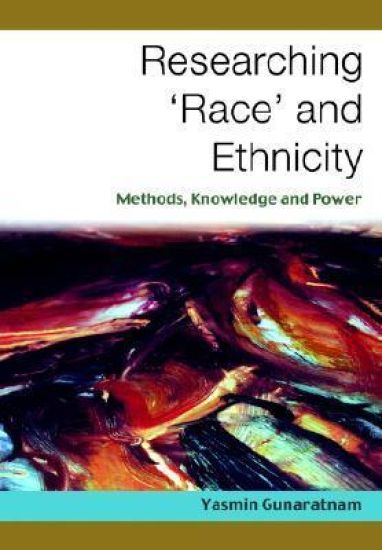
Researching 'Race' and Ethnicity

Researching 'Race' and Ethnicity

Yasmin Gunaratnam

SAGE Publications Inc
2003
nidottu
'Gunaratnam's framework is rich in its examination and synthesis of approaches to the study of "race"… the reward for the reader who does pick up the book is that the author deftly articulates the complicated view of research on "race" first from the quantitative perspective and then skilfully moves the reader to issues of "race" in qualitative research' - Studies in Ethnicity and Nationalism 'This is a welcome book for those engaged in policy and empirical work with an active research agenda… there is a level of theoretical sophistication in the text which is often missing from texts concerned with methods in this area' - Race Relations Abstracts `The particular value of this book to readers lies in the discussion of "race", ethnicity and research issues within a political and social context. The author states her intention to explore some of the theoretical and practical dilemmas of researching "race" and ethnicity. This is, without question, achieved. I recommend it as essential reading for those concerned with increasing their awareness of issues relating to race, ethnicity and research practice' - Nurse Researcher 'This is a thought-provoking and challenging book which demonstrated the fractured and fluid nature of difference and power in the research process. Importantly it offers a guide to the ways in which research can be effectively and productively used in challenging the status quo' - Diversity in Health and Social Care Researching `Race' and Ethnicity provides an innovative discussion of the methodological, epistemological and ethical challenges of doing qualitative research that is informed by questions of `race', ethnicity and social difference. By identifying and challenging `categorical thinking' and many longstanding assumptions about the meanings of `race' and ethnicity, the author gets to the heart of many of the everyday dilemmas and difficulties that researchers confront in the field, but are rarely theorised or openly discussed. Yasmin Gunaratnam's insistence that `race' and ethnicity are a significant part of all qualitative research, and are not the `specialist' concerns of those whose work is explicitly focussed upon `race', provokes a radical rethinking of current methological debates. How do racial and ethnic categories inform our approaches to research? How does the racialised indentity of the researcher and the research participants affect the research interaction and the knowledge that we produce? What are the assumptions that are made about racialised subjectivity and inter-subjectivity? How can we make sense of accounts in which `race' and ethnicity are silent or are non-manifest? How can we work ethically across difference? In examining these and other questions, the wide-ranging discussions in the book are animated by examples drawn from the author's ethnographic research with white and minoritized research participants. Through these examples readers will be able to engage with some of the complexities of research relationships, power relations and ethical concerns about engagement, disconnection and complicity in research. The attention that the book gives to the excluded experiences of minoritized researchers will be of particular value to many readers. Researching `Race' and Ethnicity is essential reading for students and academics in the social sciences.
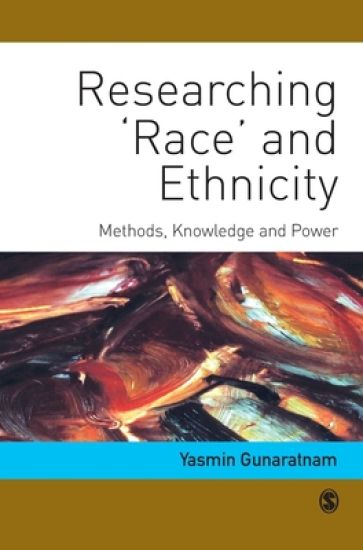
Researching 'Race' and Ethnicity

Researching 'Race' and Ethnicity

Yasmin Gunaratnam

SAGE Publications Inc
2003
sidottu
'Gunaratnam's framework is rich in its examination and synthesis of approaches to the study of "race"… the reward for the reader who does pick up the book is that the author deftly articulates the complicated view of research on "race" first from the quantitative perspective and then skilfully moves the reader to issues of "race" in qualitative research' - Studies in Ethnicity and Nationalism 'This is a welcome book for those engaged in policy and empirical work with an active research agenda… there is a level of theoretical sophistication in the text which is often missing from texts concerned with methods in this area' - Race Relations Abstracts `The particular value of this book to readers lies in the discussion of "race", ethnicity and research issues within a political and social context. The author states her intention to explore some of the theoretical and practical dilemmas of researching "race" and ethnicity. This is, without question, achieved. I recommend it as essential reading for those concerned with increasing their awareness of issues relating to race, ethnicity and research practice' - Nurse Researcher 'This is a thought-provoking and challenging book which demonstrated the fractured and fluid nature of difference and power in the research process. Importantly it offers a guide to the ways in which research can be effectively and productively used in challenging the status quo' - Diversity in Health and Social Care Researching `Race' and Ethnicity provides an innovative discussion of the methodological, epistemological and ethical challenges of doing qualitative research that is informed by questions of `race', ethnicity and social difference. By identifying and challenging `categorical thinking' and many longstanding assumptions about the meanings of `race' and ethnicity, the author gets to the heart of many of the everyday dilemmas and difficulties that researchers confront in the field, but are rarely theorised or openly discussed. Yasmin Gunaratnam's insistence that `race' and ethnicity are a significant part of all qualitative research, and are not the `specialist' concerns of those whose work is explicitly focussed upon `race', provokes a radical rethinking of current methological debates. How do racial and ethnic categories inform our approaches to research? How does the racialised indentity of the researcher and the research participants affect the research interaction and the knowledge that we produce? What are the assumptions that are made about racialised subjectivity and inter-subjectivity? How can we make sense of accounts in which `race' and ethnicity are silent or are non-manifest? How can we work ethically across difference? In examining these and other questions, the wide-ranging discussions in the book are animated by examples drawn from the author's ethnographic research with white and minoritized research participants. Through these examples readers will be able to engage with some of the complexities of research relationships, power relations and ethical concerns about engagement, disconnection and complicity in research. The attention that the book gives to the excluded experiences of minoritized researchers will be of particular value to many readers. Researching `Race' and Ethnicity is essential reading for students and academics in the social sciences.