Kirjojen hintavertailu. Mukana 12 390 323 kirjaa ja 12 kauppaa.

Kirjailija

Yinyu Ye

Kirjat ja teokset yhdessä paikassa: 7 kirjaa, julkaisuja vuosilta 1997-2022, suosituimpien joukossa Linear and Nonlinear Programming. Vertaile teosten hintoja ja tarkista saatavuus suomalaisista kirjakaupoista.

7 kirjaa

Kirjojen julkaisuhaarukka 1997-2022.

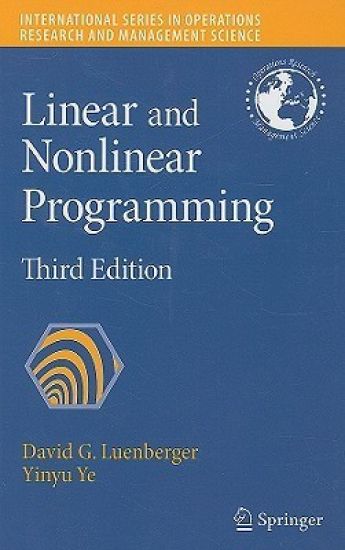
Linear and Nonlinear Programming

Linear and Nonlinear Programming

David G. Luenberger; Yinyu Ye

Springer-Verlag New York Inc.
2010
nidottu
"Linear and Nonlinear Programming" is considered a classic textbook in Optimization. While it is a classic, it also reflects modern theoretical insights. These insights provide structure to what might otherwise be simply a collection of techniques and results, and this is valuable both as a means for learning existing material and for developing new results. One major insight of this type is the connection between the purely analytical character of an optimization problem, expressed perhaps by properties of the necessary conditions, and the behavior of algorithms used to solve a problem. This was a major theme of the first and second editions. Now the third edition has been completely updated with recent Optimization Methods. The new co-author, Yinyu Ye, has written chapters and chapter material on a number of these areas including Interior Point Methods.
Linear and Nonlinear Programming

Linear and Nonlinear Programming

David G. Luenberger; Yinyu Ye

Springer Nature Switzerland AG
2022
nidottu
The 5th edition of this classic textbook covers the central concepts of practical optimization techniques, with an emphasis on methods that are both state-of-the-art and popular. One major insight is the connection between the purely analytical character of an optimization problem and the behavior of algorithms used to solve that problem. End-of-chapter exercises are provided for all chapters. The material is organized into three separate parts. Part I offers a self-contained introduction to linear programming. The presentation in this part is fairly conventional, covering the main elements of the underlying theory of linear programming, many of the most effective numerical algorithms, and many of its important special applications. Part II, which is independent of Part I, covers the theory of unconstrained optimization, including both derivations of the appropriate optimality conditions and an introduction to basic algorithms. This part of the book explores the general properties of algorithms and defines various notions of convergence. In turn, Part III extends the concepts developed in the second part to constrained optimization problems. Except for a few isolated sections, this part is also independent of Part I. As such, Parts II and III can easily be used without reading Part I and, in fact, the book has been used in this way at many universities. New to this edition are popular topics in data science and machine learning, such as the Markov Decision Process, Farkas’ lemma, convergence speed analysis, duality theories and applications, various first-order methods, stochastic gradient method, mirror-descent method, Frank-Wolf method, ALM/ADMM method, interior trust-region method for non-convex optimization, distributionally robust optimization, online linear programming, semidefinite programming for sensor-network localization, and infeasibility detection for nonlinear optimization.
Linear and Nonlinear Programming

Linear and Nonlinear Programming

David G. Luenberger; Yinyu Ye

Springer Nature Switzerland AG
2021
sidottu
The 5th edition of this classic textbook covers the central concepts of practical optimization techniques, with an emphasis on methods that are both state-of-the-art and popular. One major insight is the connection between the purely analytical character of an optimization problem and the behavior of algorithms used to solve that problem. End-of-chapter exercises are provided for all chapters. The material is organized into three separate parts. Part I offers a self-contained introduction to linear programming. The presentation in this part is fairly conventional, covering the main elements of the underlying theory of linear programming, many of the most effective numerical algorithms, and many of its important special applications. Part II, which is independent of Part I, covers the theory of unconstrained optimization, including both derivations of the appropriate optimality conditions and an introduction to basic algorithms. This part of the book explores the general properties of algorithms and defines various notions of convergence. In turn, Part III extends the concepts developed in the second part to constrained optimization problems. Except for a few isolated sections, this part is also independent of Part I. As such, Parts II and III can easily be used without reading Part I and, in fact, the book has been used in this way at many universities. New to this edition are popular topics in data science and machine learning, such as the Markov Decision Process, Farkas’ lemma, convergence speed analysis, duality theories and applications, various first-order methods, stochastic gradient method, mirror-descent method, Frank-Wolf method, ALM/ADMM method, interior trust-region method for non-convex optimization, distributionally robust optimization, online linear programming, semidefinite programming for sensor-network localization, and infeasibility detection for nonlinear optimization.
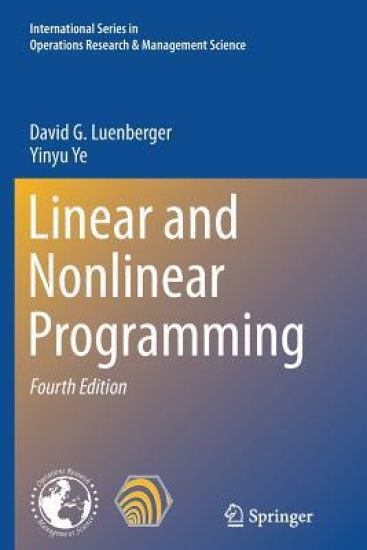
Linear and Nonlinear Programming

Linear and Nonlinear Programming

David G. Luenberger; Yinyu Ye

Springer International Publishing AG
2016
nidottu
This new edition covers the central concepts of practical optimization techniques, with an emphasis on methods that are both state-of-the-art and popular. One major insight is the connection between the purely analytical character of an optimization problem and the behavior of algorithms used to solve a problem. This was a major theme of the first edition of this book and the fourth edition expands and further illustrates this relationship. As in the earlier editions, the material in this fourth edition is organized into three separate parts. Part I is a self-contained introduction to linear programming. The presentation in this part is fairly conventional, covering the main elements of the underlying theory of linear programming, many of the most effective numerical algorithms, and many of its important special applications. Part II, which is independent of Part I, covers the theory of unconstrained optimization, including both derivations of the appropriate optimality conditions and an introduction to basic algorithms. This part of the book explores the general properties of algorithms and defines various notions of convergence. Part III extends the concepts developed in the second part to constrained optimization problems. Except for a few isolated sections, this part is also independent of Part I. It is possible to go directly into Parts II and III omitting Part I, and, in fact, the book has been used in this way in many universities.New to this edition is a chapter devoted to Conic Linear Programming, a powerful generalization of Linear Programming. Indeed, many conic structures are possible and useful in a variety of applications. It must be recognized, however, that conic linear programming is an advanced topic, requiring special study. Another important topic is an accelerated steepest descent method that exhibits superior convergence properties, and for this reason, has become quite popular. The proof of the convergence property for both standard and accelerated steepest descent methods are presented in Chapter 8. As in previous editions, end-of-chapter exercises appear for all chapters.From the reviews of the Third Edition:“… this very well-written book is a classic textbook in Optimization. It should be present in the bookcase of each student, researcher, and specialist from the host of disciplines from which practical optimization applications are drawn.” (Jean-Jacques Strodiot, Zentralblatt MATH, Vol. 1207, 2011)
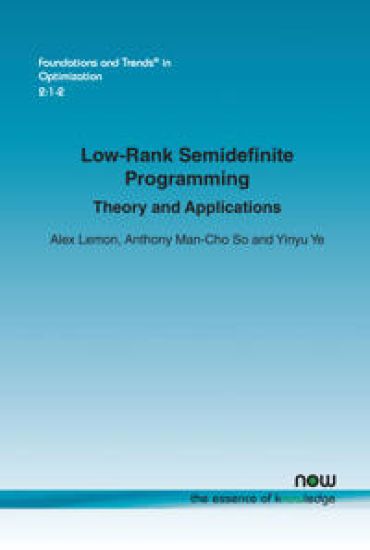
Low-Rank Semidefinite Programming

Low-Rank Semidefinite Programming

Alex Lemon; Anthony Man-Cho So; Yinyu Ye

now publishers Inc
2016
nidottu
Finding low-rank solutions of semidefinite programs is important in many applications. For example, semidefinite programs that arise as relaxations of polynomial optimization problems are exact relaxations when the semidefinite program has a rank-1 solution. Unfortunately, computing a minimum-rank solution of a semidefinite program is an NP-hard problem.This monograph reviews the theory of low-rank semidefinite programming, presenting theorems that guarantee the existence of a low-rank solution, heuristics for computing low-rank solutions, and algorithms for finding low-rank approximate solutions. It then presents applications of the theory to trust-region problems and signal processing.
Linear and Nonlinear Programming

Linear and Nonlinear Programming

David G. Luenberger; Yinyu Ye

Springer-Verlag New York Inc.
2008
sidottu
"Linear and Nonlinear Programming" is considered a classic textbook in Optimization. While it is a classic, it also reflects modern theoretical insights. These insights provide structure to what might otherwise be simply a collection of techniques and results, and this is valuable both as a means for learning existing material and for developing new results. One major insight of this type is the connection between the purely analytical character of an optimization problem, expressed perhaps by properties of the necessary conditions, and the behavior of algorithms used to solve a problem. This was a major theme of the first and second editions. Now the third edition has been completely updated with recent Optimization Methods. The new co-author, Yinyu Ye, has written chapters and chapter material on a number of these areas including Interior Point Methods.
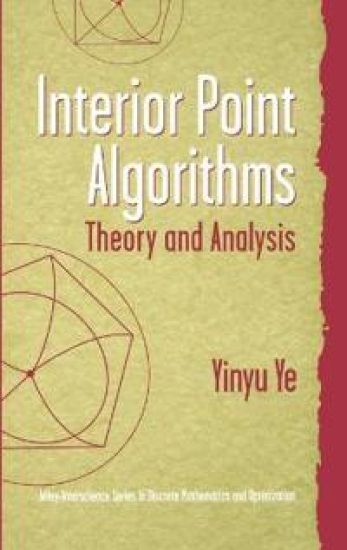
Interior Point Algorithms

Interior Point Algorithms

Yinyu Ye

John Wiley Sons Inc
1997
sidottu
The first comprehensive review of the theory and practice of one of today's most powerful optimization techniques. The explosive growth of research into and development of interior point algorithms over the past two decades has significantly improved the complexity of linear programming and yielded some of today's most sophisticated computing techniques. This book offers a comprehensive and thorough treatment of the theory, analysis, and implementation of this powerful computational tool. Interior Point Algorithms provides detailed coverage of all basic and advanced aspects of the subject. Beginning with an overview of fundamental mathematical procedures, Professor Yinyu Ye moves swiftly on to in-depth explorations of numerous computational problems and the algorithms that have been developed to solve them. An indispensable text/reference for students and researchers in applied mathematics, computer science, operations research, management science, and engineering, Interior Point Algorithms: *Derives various complexity results for linear and convex programming *Emphasizes interior point geometry and potential theory *Covers state-of-the-art results for extension, implementation, and other cutting-edge computational techniques *Explores the hottest new research topics, including nonlinear programming and nonconvex optimization.