Kirjojen hintavertailu. Mukana 12 595 353 kirjaa ja 12 kauppaa.

Kirjailija

Yongwan Chun

Kirjat ja teokset yhdessä paikassa: 3 kirjaa, julkaisuja vuosilta 2013-2019, suosituimpien joukossa Spatial Statistics and Geostatistics. Vertaile teosten hintoja ja tarkista saatavuus suomalaisista kirjakaupoista.

3 kirjaa

Kirjojen julkaisuhaarukka 2013-2019.

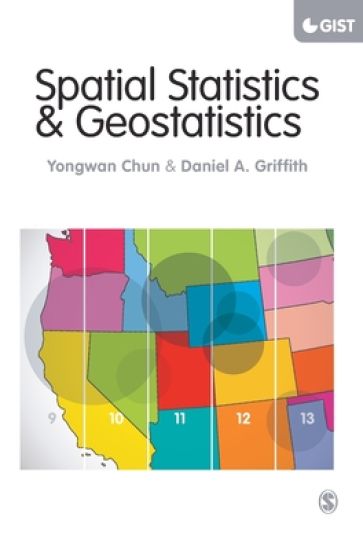
Spatial Statistics and Geostatistics

Spatial Statistics and Geostatistics

Yongwan Chun; Daniel A. Griffith

SAGE Publications Ltd
2013
sidottu
"Ideal for anyone who wishes to gain a practical understanding of spatial statistics and geostatistics. Difficult concepts are well explained and supported by excellent examples in R code, allowing readers to see how each of the methods is implemented in practice" - Professor Tao Cheng, University College London Focusing specifically on spatial statistics and including components for ArcGIS, R, SAS and WinBUGS, this book illustrates the use of basic spatial statistics and geostatistics, as well as the spatial filtering techniques used in all relevant programs and software. It explains and demonstrates techniques in: spatial samplingspatial autocorrelationlocal statisticsspatial interpolation in two-dimensionsadvanced topics including Bayesian methods, Monte Carlo simulation, error and uncertainty. It is a systematic overview of the fundamental spatial statistical methods used by applied researchers in geography, environmental science, health and epidemiology, population and demography, and planning. A companion website includes digital R code for implementing the analyses in specific chapters and relevant data sets to run the R codes.
Spatial Statistics and Geostatistics

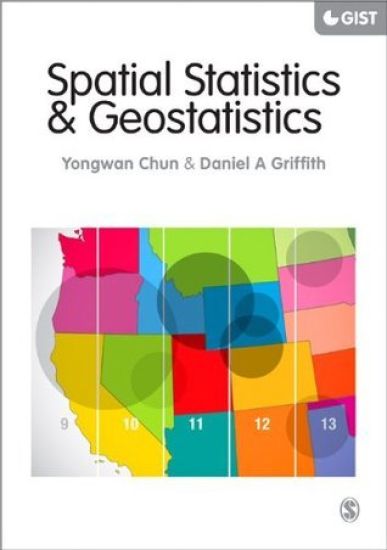
Spatial Statistics and Geostatistics

Yongwan Chun; Daniel A. Griffith

SAGE Publications Ltd
2013
nidottu
"Ideal for anyone who wishes to gain a practical understanding of spatial statistics and geostatistics. Difficult concepts are well explained and supported by excellent examples in R code, allowing readers to see how each of the methods is implemented in practice" - Professor Tao Cheng, University College London Focusing specifically on spatial statistics and including components for ArcGIS, R, SAS and WinBUGS, this book illustrates the use of basic spatial statistics and geostatistics, as well as the spatial filtering techniques used in all relevant programs and software. It explains and demonstrates techniques in: spatial samplingspatial autocorrelationlocal statisticsspatial interpolation in two-dimensionsadvanced topics including Bayesian methods, Monte Carlo simulation, error and uncertainty. It is a systematic overview of the fundamental spatial statistical methods used by applied researchers in geography, environmental science, health and epidemiology, population and demography, and planning. A companion website includes digital R code for implementing the analyses in specific chapters and relevant data sets to run the R codes.
Spatial Regression Analysis Using Eigenvector Spatial Filtering

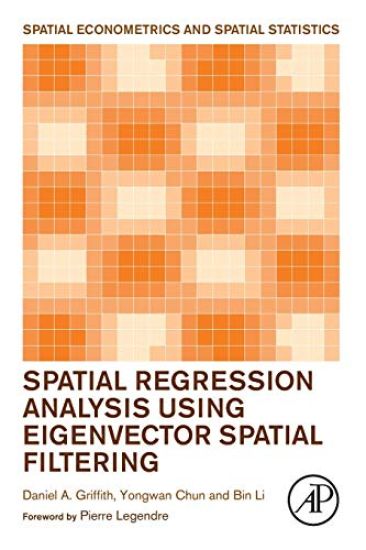
Spatial Regression Analysis Using Eigenvector Spatial Filtering

Daniel A. Griffith; Yongwan Chun; Bin Li

Academic Press Inc
2019
nidottu
Spatial Regression Analysis Using Eigenvector Spatial Filtering provides theoretical foundations and guides practical implementation of the Moran eigenvector spatial filtering (MESF) technique. MESF is a novel and powerful spatial statistical methodology that allows spatial scientists to account for spatial autocorrelation in their georeferenced data analyses. Its appeal is in its simplicity, yet its implementation drawbacks include serious complexities associated with constructing an eigenvector spatial filter. This book discusses MESF specifications for various intermediate-level topics, including spatially varying coefficients models, (non) linear mixed models, local spatial autocorrelation, space-time models, and spatial interaction models. Spatial Regression Analysis Using Eigenvector Spatial Filtering is accompanied by sample R codes and a Windows application with illustrative datasets so that readers can replicate the examples in the book and apply the methodology to their own application projects. It also includes a Foreword by Pierre Legendre.