Kirjojen hintavertailu. Mukana 12 595 353 kirjaa ja 12 kauppaa.

Kirjailija

Yuanming Shi

Kirjat ja teokset yhdessä paikassa: 5 kirjaa, julkaisuja vuosilta 2020-2025, suosituimpien joukossa Low-overhead Communications in IoT Networks. Vertaile teosten hintoja ja tarkista saatavuus suomalaisista kirjakaupoista.

5 kirjaa

Kirjojen julkaisuhaarukka 2020-2025.

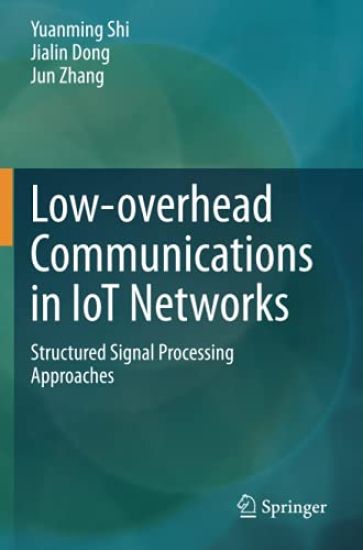
Low-overhead Communications in IoT Networks

Low-overhead Communications in IoT Networks

Yuanming Shi; Jialin Dong; Jun Zhang

Springer Verlag, Singapore
2021
nidottu
The recent developments in wireless communications, networking, and embedded systems have driven various innovative Internet of Things (IoT) applications, e.g., smart cities, mobile healthcare, autonomous driving and drones. A common feature of these applications is the stringent requirements for low-latency communications. Considering the typical small payload size of IoT applications, it is of critical importance to reduce the size of the overhead message, e.g., identification information, pilot symbols for channel estimation, and control data. Such low-overhead communications also help to improve the energy efficiency of IoT devices. Recently, structured signal processing techniques have been introduced and developed to reduce the overheads for key design problems in IoT networks, such as channel estimation, device identification, and message decoding. By utilizing underlying system structures, including sparsity and low rank, these methods can achieve significant performance gains.This book provides an overview of four general structured signal processing models: a sparse linear model, a blind demixing model, a sparse blind demixing model, and a shuffled linear model, and discusses their applications in enabling low-overhead communications in IoT networks. Further, it presents practical algorithms based on both convex and nonconvex optimization approaches, as well as theoretical analyses that use various mathematical tools.

Machine Learning for Low-Latency Communications

Machine Learning for Low-Latency Communications

Yong Zhou; Yinan Zou; Youlong Wu; Yuanming Shi; Jun Zhang

ELSEVIER SCIENCE PUBLISHING CO INC
2024
nidottu
Machine Learning for Low-Latency Communications presents the principles and practice of various deep learning methodologies for mitigating three critical latency components: access latency, transmission latency, and processing latency. In particular, the book develops learning to estimate methods via algorithm unrolling and multiarmed bandit for reducing access latency by enlarging the number of concurrent transmissions with the same pilot length. Task-oriented learning to compress methods based on information bottleneck are given to reduce the transmission latency via avoiding unnecessary data transmission. Lastly, three learning to optimize methods for processing latency reduction are given which leverage graph neural networks, multi-agent reinforcement learning, and domain knowledge. Low-latency communications attracts considerable attention from both academia and industry, given its potential to support various emerging applications such as industry automation, autonomous vehicles, augmented reality and telesurgery. Despite the great promise, achieving low-latency communications is critically challenging. Supporting massive connectivity incurs long access latency, while transmitting high-volume data leads to substantial transmission latency.
Low-overhead Communications in IoT Networks

Low-overhead Communications in IoT Networks

Yuanming Shi; Jialin Dong; Jun Zhang

Springer Verlag, Singapore
2020
sidottu
The recent developments in wireless communications, networking, and embedded systems have driven various innovative Internet of Things (IoT) applications, e.g., smart cities, mobile healthcare, autonomous driving and drones. A common feature of these applications is the stringent requirements for low-latency communications. Considering the typical small payload size of IoT applications, it is of critical importance to reduce the size of the overhead message, e.g., identification information, pilot symbols for channel estimation, and control data. Such low-overhead communications also help to improve the energy efficiency of IoT devices. Recently, structured signal processing techniques have been introduced and developed to reduce the overheads for key design problems in IoT networks, such as channel estimation, device identification, and message decoding. By utilizing underlying system structures, including sparsity and low rank, these methods can achieve significant performance gains.This book provides an overview of four general structured signal processing models: a sparse linear model, a blind demixing model, a sparse blind demixing model, and a shuffled linear model, and discusses their applications in enabling low-overhead communications in IoT networks. Further, it presents practical algorithms based on both convex and nonconvex optimization approaches, as well as theoretical analyses that use various mathematical tools.
Federated Edge Learning

Federated Edge Learning

Yong Zhou; Wenzhi Fang; Yuanming Shi; Khaled B. Letaief

Springer International Publishing AG
2025
sidottu
This book presents various effective schemes from the perspectives of algorithms, architectures, privacy, and security to enable scalable and trustworthy Federated Edge Learning (FEEL). From the algorithmic perspective, the authors elaborate various federated optimization algorithms, including zeroth-order, first-order, and second-order methods. There is a specific emphasis on presenting provable convergence analysis to illustrate the impact of learning and wireless communication parameters. The convergence rate, computation complexity and communication overhead of the federated zeroth/first/second-order algorithms over wireless networks are elaborated. From the networking architecture perspective, the authors illustrate how the critical challenges of FEEL can be addressed by exploiting different architectures and designing effective communication schemes. Specifically, the communication straggler issue of FEEL can be mitigated by utilizing reconfigurable intelligent surface and unmanned aerial vehicle to reconfigure the propagation environment, while over-the-air computation is utilized to support ultra-fast model aggregation for FEEL by exploiting the waveform superposition property. Additionally, the multi-cell architecture presents a feasible solution for collaborative FEEL training among multiple cells. Finally, the authors discuss the challenges of FEEL from the privacy and security perspective, followed by presenting effective communication schemes that can achieve differentially private model aggregation and Byzantine-resilient model aggregation to achieve trustworthy FEEL. This book is designed for researchers and professionals whose focus is wireless communications. Advanced-level students majoring in computer science and electrical engineering will also find this book useful as a reference.
Mobile Edge Artificial Intelligence

Mobile Edge Artificial Intelligence

Yuanming Shi; Kai Yang; Zhanpeng Yang; Yong Zhou

Academic Press Inc
2021
nidottu
Mobile Edge Artificial Intelligence: Opportunities and Challenges presents recent advances in wireless technologies and nonconvex optimization techniques for designing efficient edge AI systems. The book includes comprehensive coverage on modeling, algorithm design and theoretical analysis. Through typical examples, the powerfulness of this set of systems and algorithms is demonstrated, along with their abilities to make low-latency, reliable and private intelligent decisions at network edge. With the availability of massive datasets, high performance computing platforms, sophisticated algorithms and software toolkits, AI has achieved remarkable success in many application domains. As such, intelligent wireless networks will be designed to leverage advanced wireless communications and mobile computing technologies to support AI-enabled applications at various edge mobile devices with limited communication, computation, hardware and energy resources.