Kirjailija
Yuk Hui
Kirjat ja teokset yhdessä paikassa: 18 kirjaa, julkaisuja vuosilta 2016-2026, suosituimpien joukossa Jenseits von West und Ost. Vertaile teosten hintoja ja tarkista saatavuus suomalaisista kirjakaupoista.
18 kirjaa
Kirjojen julkaisuhaarukka 2016-2026.
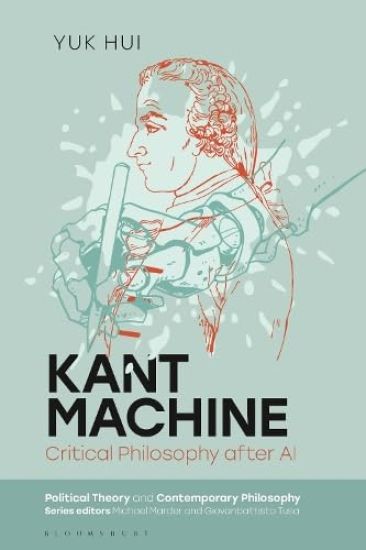
Rethinking the philosophy of Immanuel Kant in the age of artificial intelligence. What could be called an intelligent machine? Are machines capable of being moral? Does an algorithm for perpetual peace exist? In this groundbreaking new work, Yuk Hui considers how current debates on artificial intelligence echo historical philosophical discussions about the workings of the mind, with the philosophy of Immanuel Kant emerging as a lens through which to consider the ethical and political implications of AI and robotics in a new light. Addressing fundamental questions around machine intelligence and morality, transcendental idealism and learning, and the metaphysics of machines, the history of AI and Kantian ideas are expertly woven together alongside an array of figures in the histories of technology and philosophy: from Gottfried Wilhelm Leibniz and Alan Turing to Hubert Dreyfus and Jacques de Vaucanson. In asking how we can understand AI in light of the challenges Kant posed to both rationalism and empiricism, and how revisiting Kant can help us better comprehend the nature and limitations of contemporary technologies, Kant Machine is an essential critical contribution both to Kant studies and to the philosophy of digital technology.

Developing a new political thought to address today’s planetary crises What is “planetary thinking” today? Arguing that a new approach is urgently needed, Yuk Hui develops a future-oriented mode of political thought that encompasses the unprecedented global challenges we are confronting: the rise of artificial intelligence, the ecological crisis, and intensifying geopolitical conflicts. Machine and Sovereignty starts with three premises. The first affirms the necessity of developing a new language of coexistence that surpasses the limits of nation-states and their variations; the second recognizes that political forms, including the polis, empire, and the state, are technological phenomena, which Lewis Mumford terms “megamachines.” The third suggests that a particular political form is legitimated and rationalized by a corresponding political epistemology. The planetary thinking that this book sketches departs from the opposition between mechanism and organism, which characterized modern thought, to understand the epistemological foundations of Hegel’s political state and Schmitt’s Großraum and their particular ways of conceiving the question of sovereignty. Through this reconstruction, Hui exposes the limits of the state and reflects on a new theoretical matrix based on the interrelated concepts of biodiversity, noodiversity, and technodiversity. Arguing that we are facing the limit of modernity, of the eschatological view of history, of globalization, and of the human, Hui conceives necessary new epistemological and technological frameworks for understanding and rising to the crises of our present and our future. Retail e-book files for this title are screen-reader friendly.
Teknodiversitet innebærer for den innflytelsesrike Hong Kong filosofen Yuk Hui å vise andre retninger inn i framtiden, nye veier vi kan slå inn på. I en serie geopolitiske essays, som samtidig er tidsbilder fra de siste årene, kobler han sammen dagsaktuelle problemstillinger om kring kunstig intelligens, høyreekstremisme, pandemi og økologisk krise med de dypeste tanketradisjonene fra både Østen og Vesten.
In light of current discourses on AI and robotics, what do the various experiences of art contribute to the rethinking of technology today?Art and Cosmotechnics addresses the challenge of technology to the existence of art and traditional thought, especially in light of current discourses on artificial intelligence and robotics. It carries out an attempt on the cosmotechnics of Chinese landscape painting in order to address this question, and further asks: What is the significance of shanshui (mountain and water) in face of the new challenges brought about by the current technological transformation? Thinking art and cosmotechnics together is an attempt to look into the varieties of experiences of art and to ask what these experiences might contribute to the rethinking of technology today.
This book employs recursivity and contingency as two principle concepts to investigate into the relation between nature and technology, machine and organism, system and freedom. It reconstructs a trajectory of thought from an Organic condition of thinking elaborated by Kant, passing by the philosophy of nature (Schelling and Hegel), to the 20th century Organicism (Bertalanffy, Needham, Whitehead, Wiener among others) and Organology (Bergson, Canguilhem, Simodnon, Stiegler), and questions the new condition of philosophizing in the time of algorithmic contingency, ecological and algorithmic catastrophes, which Heidegger calls the end of philosophy. The book centres on the following speculative question: if in the philosophical tradition, the concept of contingency is always related to the laws of nature, then in what way can we understand contingency in related to technical systems? The book situates the concept of recursivity as a break from the Cartesian mechanism and the drive of system construction; it elaborates on the necessity of contingency in such epistemological rupture where nature ends and system emerges. In this development, we see how German idealism is precursor to cybernetics, and the Anthropocene and Noosphere (Teilhard de Chardin) point toward the realization of a gigantic cybernetic system, which lead us back to the question of freedom. It questions the concept of absolute contingency (Meillassoux) and proposes a cosmotechnical pluralism. Engaging with modern and contemporary European philosophy as well as Chinese thought through the mediation of Needham, this book refers to cybernetics, mathematics, artificial intelligence and inhumanism.
Inscription
Akram Zaatari; Amalia Ulman; Anne de Vries; Cecilia Grönberg; D-M Wither; Hannah Quinlan; Jenna Sutela; Karl-Magnus Johansson; Lori Emerson; Martin Kohout; Martine Syms; Monira al Qadiri; Rosie Hastings; Yuk Hui
Landsarkivet i Göteborg
2018
sidottu
What conditions inscription? Why are certain statements allowed to emerge in archival substrates? These questions are asked in this publication as it explores the concept of inscription—the archival moment that is constituted by the materialization of statements. It does so by including approaches from a variety of academic fields such as media theory, philosophy and critical theory, as well as works by practitioners of contemporary art. The publication includes contributions by Akram Zaatari, Amalia Ulman, Anne de Vries, Cecilia Grönberg, D-M Withers, Hannah Quinlan, Jenna Sutela, Karl-Magnus Johansson, Lori Emerson, Martin Kohout, Martine Syms, Monira al Qadiri, Rosie Hastings, and Yuk Hui.
A systematic historical survey of Chinese thought is followed by an investigation of the historical-metaphysical questions of modern technology, asking how Chinese thought might contribute to a renewed questioning of globalized technics.Heidegger's critique of modern technology and its relation to metaphysics has been widely accepted in the East. Yet the conception that there is only one-originally Greek-type of technics has been an obstacle to any original critical thinking of technology in modern Chinese thought.Yuk Hui argues for the urgency of imagining a specifically Chinese philosophy of technology capable of responding to Heidegger's challenge, while problematizing the affirmation of technics and technologies as anthropologically universal.This investigation of the historical-metaphysical question of technology, drawing on Lyotard, Simondon, and Stiegler, and introducing a history of modern Eastern philosophical thinking largely unknown to Western readers, including philosophers such as Feng Youlan, Mou Zongsan, and Keiji Nishitani, sheds new light on the obscurity of the question of technology in China. Why was technics never thematized in Chinese thought? Why has time never been a real question for Chinese philosophy? How was the traditional concept of Qi transformed in its relation to Dao as China welcomed technological modernity and westernization?In The Question Concerning Technology in China, a systematic historical survey of the major concepts of traditional Chinese thinking is followed by a startlingly original investigation of these questions, in order to ask how Chinese thought might today contribute to a renewed, cosmotechnical questioning of globalized technics.
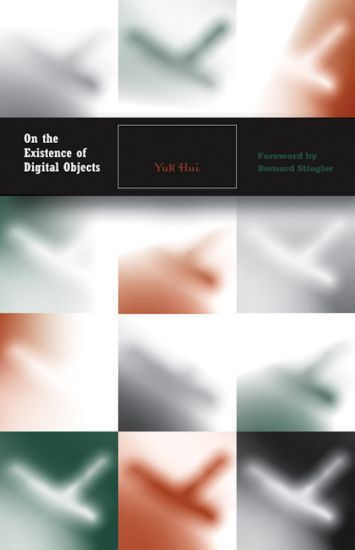
Digital objects, in their simplest form, are data. They are also a new kind of industrial object that pervades every aspect of our life today-as online videos, images, text files, e-mails, blog posts, Facebook events.Yet, despite their ubiquity, the nature of digital objects remains unclear.On the Existence of Digital Objects conducts a philosophical examination of digital objects and their organizing schema by creating a dialogue between Martin Heidegger and Gilbert Simondon, which Yuk Hui contextualizes within the history of computing. How can digital objects be understood according to individualization and individuation? Hui pursues this question through the history of ontology and the study of markup languages and Web ontologies; he investigates the existential structure of digital objects within their systems and milieux. With this relational approach toward digital objects and technical systems, the book addresses alienation, described by Simondon as the consequence of mistakenly viewing technics in opposition to culture.Interdisciplinary in philosophical and technical insights, with close readings of Husserl, Heidegger, and Simondon as well as the history of computing and the Web, Hui’s work develops an original, productive way of thinking about the data and metadata that increasingly define our world.