Kirjojen hintavertailu. Mukana 12 390 323 kirjaa ja 12 kauppaa.

Kirjailija

Yuri Corrigan

Kirjat ja teokset yhdessä paikassa: 4 kirjaa, julkaisuja vuosilta 2017-2026, suosituimpien joukossa Dostoevsky and the Riddle of the Self. Vertaile teosten hintoja ja tarkista saatavuus suomalaisista kirjakaupoista.

4 kirjaa

Kirjojen julkaisuhaarukka 2017-2026.

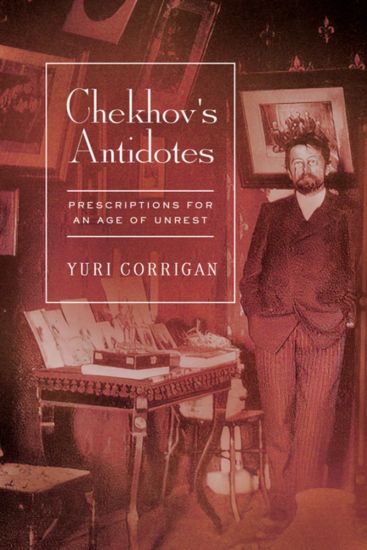
Chekhov's Antidotes

Chekhov's Antidotes

Yuri Corrigan

STANFORD UNIVERSITY PRESS
2026
sidottu
For all his immense literary fame, Anton Chekhov is unknown as a thinker. In Chekhov's Antidotes, Corrigan offers a bold reassessment of why Chekhov's thought matters, both for his own time and for ours. Widely regarded as a purveyor of gloom and indecision, Chekhov was in fact a reparative moral philosopher who fought back against the pathologies of a divided and troubled age. In the face of emergent revolution and civil war, Chekhov studied the polarization, apathy, and fanaticism that were driving his society towards self-destruction. Corrigan tells the story of Chekhov's career in a new light, reading the short stories and plays as antidotes to looming catastrophe. The book uncovers Chekhov's practical meditations on how to heal and resist culture war; on how to alleviate modern strains of sloth, loneliness, and despair; and how to conceive of robust forms of activism when confronting what cannot be healed or repaired. As Corrigan reveals, Chekhov offers no panaceas for the pathologies of modern life, only pragmatic meditations on how to salvage an irreparably broken world, and on how to cultivate meaning, dignity, and integrity as incurably fragmented human subjects—lessons we can all use in our current divisive era, under the shadow of our own looming crises.
Dostoevsky and the Riddle of the Self

Dostoevsky and the Riddle of the Self

Yuri Corrigan

Academic Studies Press
2026
pokkari
Dostoevsky and the Riddle of the Self charts a unifying path through Dostoevsky's artistic journey to solve the “mystery” of the human being. Starting from the unusual forms of intimacy shown by characters seeking to lose themselves within larger collective selves, Yuri Corrigan approaches the fictional works as a continuous experimental canvas on which Dostoevsky explored the problem of selfhood through recurring symbolic and narrative paradigms. Presenting new readings of such works as The Idiot, Demons, and The Brothers Karamazov, Corrigan tells the story of Dostoevsky’s career-long journey to overcome the pathology of collectivism by discovering a passage into the wounded, embattled, forbidding, revelatory landscape of the psyche
Dostoevsky and the Riddle of the Self

Dostoevsky and the Riddle of the Self

Yuri Corrigan

Academic Studies Press
2023
sidottu
Dostoevsky and the Riddle of the Self charts a unifying path through Dostoevsky's artistic journey to solve the “mystery” of the human being. Starting from the unusual forms of intimacy shown by characters seeking to lose themselves within larger collective selves, Yuri Corrigan approaches the fictional works as a continuous experimental canvas on which Dostoevsky explored the problem of selfhood through recurring symbolic and narrative paradigms. Presenting new readings of such works as The Idiot, Demons, and The Brothers Karamazov, Corrigan tells the story of Dostoevsky’s career-long journey to overcome the pathology of collectivism by discovering a passage into the wounded, embattled, forbidding, revelatory landscape of the psyche
Dostoevsky and the Riddle of the Self

Dostoevsky and the Riddle of the Self

Yuri Corrigan

Northwestern University Press
2017
nidottu
Dostoevsky was hostile to the notion of individual autonomy, and yet, throughout his life and work, he vigorously advocated the freedom and inviolability of the self. This ambivalence has animated his diverse and often self-contradictory legacy: as precursor of psychoanalysis, forefather of existentialism, postmodernist avant la lettre, religious traditionalist, and Romantic mystic. Dostoevsky and the Riddle of the Self charts a unifying path through Dostoevsky's artistic journey to solve the “mystery” of the human being. Starting from the unusual forms of intimacy shown by characters seeking to lose themselves within larger collective selves, Yuri Corrigan approaches the fictional works as a continuous experimental canvas on which Dostoevsky explored the problem of selfhood through recurring symbolic and narrative paradigms. Presenting new readings of such works as The Idiot, Demons, and The Brothers Karamazov, Corrigan tells the story of Dostoevsky’s career-long journey to overcome the pathology of collectivism by discovering a passage into the wounded, embattled, forbidding, revelatory landscape of the psyche.Corrigan’s argument offers a fundamental shift in theories about Dostoevsky's work and will be of great interest to scholars of Russian literature, as well as to readers interested in the prehistory of psychoanalysis and trauma studies and in theories of selfhood and their cultural sources.