Kirjojen hintavertailu. Mukana 12 155 674 kirjaa ja 12 kauppaa.

Kirjailija

Yves Robert

Kirjat ja teokset yhdessä paikassa: 8 kirjaa, julkaisuja vuosilta 2000-2020, suosituimpien joukossa Klinik des Augeninnendrucks. Vertaile teosten hintoja ja tarkista saatavuus suomalaisista kirjakaupoista.

Mukana myös kirjoitusasut: Yves. Robert

8 kirjaa

Kirjojen julkaisuhaarukka 2000-2020.

Klinik des Augeninnendrucks

Klinik des Augeninnendrucks

Yves Robert

De Gruyter
2015
sidottu
St rungen des Augeninnendrucks k nnen zu gravierenden Augenerkrankungen wie z.B. dem Glaukom f hren. Das Verst ndnisf r dieEntstehung des Augeninnendrucks und dessen klinische Bedeutung als Kreislaufparameter ist daher f r die Fr herkennung von Augeninnendruckst rungen unerl sslich. Dieses Buch vermittelt grundlegende Kenntnisse der Entstehung von Augeninnendruckst rungen im klinischen Gesamtzusammenhang. Folgende Fragen werden beantwortet: Wie kommt der Augeninnendruck zustande? Wie kann man ihn diagnostisch als Hilfsmittel einsetzen? Welche Aussagekraft hat er? Wie ist der Augeninnendruck mit dem allgemeinen Kreislauf verkn pft? Wie ist der Augeninnendruck mit dem Hirnkreislauf verkn pft? Wie ist der Augeninnendruck mit dem Liquor cerebrospinalis verkn pft? Dar ber hinaus werden Methoden zur korrekten Messung des Augeninnendrucks umfassend erl utert und die geschichtliche Entwicklung der verschiedenen Messmethoden dargestellt.
Parallel Algorithms

Parallel Algorithms

Henri Casanova; Arnaud Legrand; Yves Robert

CRC Press
2020
nidottu
Focusing on algorithms for distributed-memory parallel architectures, Parallel Algorithms presents a rigorous yet accessible treatment of theoretical models of parallel computation, parallel algorithm design for homogeneous and heterogeneous platforms, complexity and performance analysis, and essential notions of scheduling. The book extracts fundamental ideas and algorithmic principles from the mass of parallel algorithm expertise and practical implementations developed over the last few decades.In the first section of the text, the authors cover two classical theoretical models of parallel computation (PRAMs and sorting networks), describe network models for topology and performance, and define several classical communication primitives. The next part deals with parallel algorithms on ring and grid logical topologies as well as the issue of load balancing on heterogeneous computing platforms. The final section presents basic results and approaches for common scheduling problems that arise when developing parallel algorithms. It also discusses advanced scheduling topics, such as divisible load scheduling and steady-state scheduling. With numerous examples and exercises in each chapter, this text encompasses both the theoretical foundations of parallel algorithms and practical parallel algorithm design.
A Guide to Algorithm Design

A Guide to Algorithm Design

Anne Benoit; Yves Robert; Frédéric Vivien

CRC Press Inc
2013
sidottu
Presenting a complementary perspective to standard books on algorithms, A Guide to Algorithm Design: Paradigms, Methods, and Complexity Analysis provides a roadmap for readers to determine the difficulty of an algorithmic problem by finding an optimal solution or proving complexity results. It gives a practical treatment of algorithmic complexity and guides readers in solving algorithmic problems.Divided into three parts, the book offers a comprehensive set of problems with solutions as well as in-depth case studies that demonstrate how to assess the complexity of a new problem. Part I helps readers understand the main design principles and design efficient algorithms.Part II covers polynomial reductions from NP-complete problems and approaches that go beyond NP-completeness.Part III supplies readers with tools and techniques to evaluate problem complexity, including how to determine which instances are polynomial and which are NP-hard.Drawing on the authors’ classroom-tested material, this text takes readers step by step through the concepts and methods for analyzing algorithmic complexity. Through many problems and detailed examples, readers can investigate polynomial-time algorithms and NP-completeness and beyond.
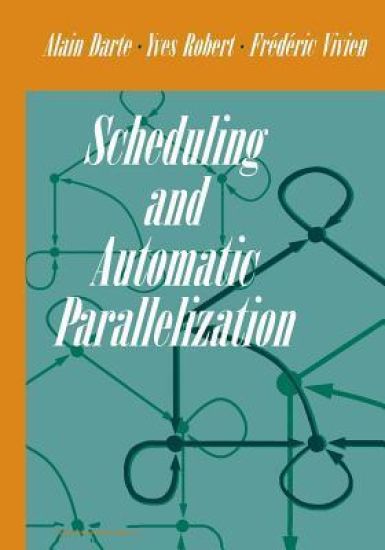
Scheduling and Automatic Parallelization

Scheduling and Automatic Parallelization

Alain Darte; Yves. Robert; Frederic Vivien

Springer-Verlag New York Inc.
2012
nidottu
Readership This book is devoted to the study of compiler transformations that are needed to expose the parallelism hiddenin a program. This book is notan introductory book to parallel processing, nor is it an introductory book to parallelizing compilers. Weassume thatreaders are familiar withthebooks High Performance Compilers for Parallel Computingby Wolfe [121] and Super- compilers for Parallel and Vector Computers by Zima and Chapman [125], and that they want to know more about scheduling transformations. In this book we describe both task graph scheduling and loop nest scheduling. Taskgraphschedulingaims atexecuting tasks linked by prece- dence constraints; it is a run-time activity. Loop nest scheduling aims at ex- ecutingstatementinstances linked bydata dependences;it is a compile-time activity. We are mostly interested in loop nestscheduling,butwe also deal with task graph scheduling for two main reasons: (i) Beautiful algorithms and heuristics have been reported in the literature recently; and (ii) Several graphscheduling, like list scheduling, are the basis techniques used in task ofthe loop transformations implemented in loop nest scheduling. As for loop nest scheduling our goal is to capture in a single place the fantastic developments of the last decade or so. Dozens of loop trans- formations have been introduced (loop interchange, skewing, fusion, dis- tribution, etc.) before a unifying theory emerged. The theory builds upon the pioneering papers of Karp, Miller, and Winograd [65] and of Lam- port [75], and it relies on sophisticated mathematical tools (unimodular transformations, parametric integer linear programming, Hermite decom- position, Smithdecomposition, etc.).
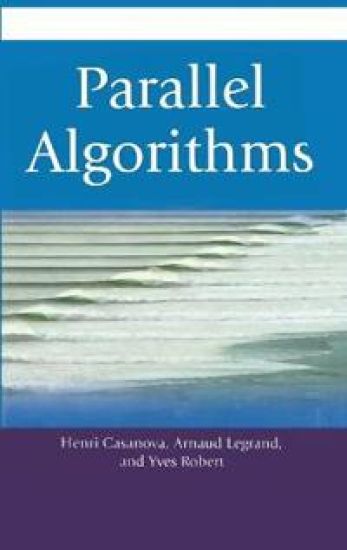
Parallel Algorithms

Parallel Algorithms

Henri Casanova; Arnaud Legrand; Yves Robert

Chapman Hall/CRC
2008
sidottu
Focusing on algorithms for distributed-memory parallel architectures, Parallel Algorithms presents a rigorous yet accessible treatment of theoretical models of parallel computation, parallel algorithm design for homogeneous and heterogeneous platforms, complexity and performance analysis, and essential notions of scheduling. The book extracts fundamental ideas and algorithmic principles from the mass of parallel algorithm expertise and practical implementations developed over the last few decades.In the first section of the text, the authors cover two classical theoretical models of parallel computation (PRAMs and sorting networks), describe network models for topology and performance, and define several classical communication primitives. The next part deals with parallel algorithms on ring and grid logical topologies as well as the issue of load balancing on heterogeneous computing platforms. The final section presents basic results and approaches for common scheduling problems that arise when developing parallel algorithms. It also discusses advanced scheduling topics, such as divisible load scheduling and steady-state scheduling. With numerous examples and exercises in each chapter, this text encompasses both the theoretical foundations of parallel algorithms and practical parallel algorithm design.
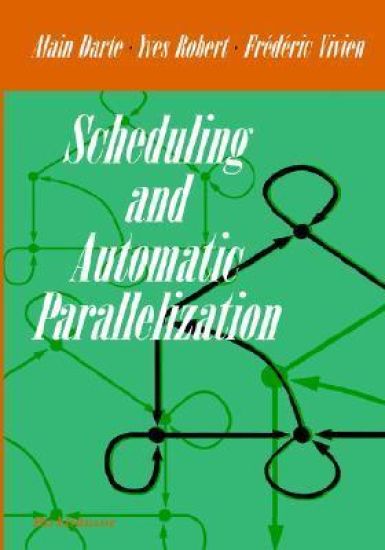
Scheduling and Automatic Parallelization

Scheduling and Automatic Parallelization

Alain Darte; Yves. Robert; Frederic Vivien

Birkhauser Boston Inc
2000
sidottu
Readership This book is devoted to the study of compiler transformations that are needed to expose the parallelism hiddenin a program. This book is notan introductory book to parallel processing, nor is it an introductory book to parallelizing compilers. Weassume thatreaders are familiar withthebooks High Performance Compilers for Parallel Computingby Wolfe [121] and Super- compilers for Parallel and Vector Computers by Zima and Chapman [125], and that they want to know more about scheduling transformations. In this book we describe both task graph scheduling and loop nest scheduling. Taskgraphschedulingaims atexecuting tasks linked by prece- dence constraints; it is a run-time activity. Loop nest scheduling aims at ex- ecutingstatementinstances linked bydata dependences;it is a compile-time activity. We are mostly interested in loop nestscheduling,butwe also deal with task graph scheduling for two main reasons: (i) Beautiful algorithms and heuristics have been reported in the literature recently; and (ii) Several graphscheduling, like list scheduling, are the basis techniques used in task ofthe loop transformations implemented in loop nest scheduling. As for loop nest scheduling our goal is to capture in a single place the fantastic developments of the last decade or so. Dozens of loop trans- formations have been introduced (loop interchange, skewing, fusion, dis- tribution, etc.) before a unifying theory emerged. The theory builds upon the pioneering papers of Karp, Miller, and Winograd [65] and of Lam- port [75], and it relies on sophisticated mathematical tools (unimodular transformations, parametric integer linear programming, Hermite decom- position, Smithdecomposition, etc.).