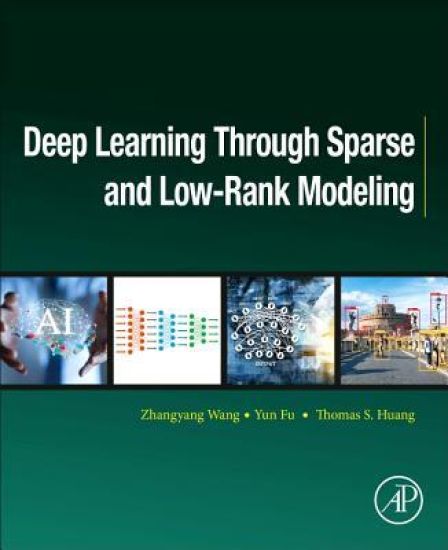
Kirjojen hintavertailu. Mukana 12 595 353 kirjaa ja 12 kauppaa.

Kirjailija

Zhangyang Wang

Kirjat ja teokset yhdessä paikassa: 2 kirjaa, julkaisuja vuosilta 2015-2019, suosituimpien joukossa Deep Learning through Sparse and Low-Rank Modeling. Vertaile teosten hintoja ja tarkista saatavuus suomalaisista kirjakaupoista.

2 kirjaa

Kirjojen julkaisuhaarukka 2015-2019.

Deep Learning through Sparse and Low-Rank Modeling

Deep Learning through Sparse and Low-Rank Modeling

Zhangyang Wang; Yun Fu; Thomas S. Huang

Academic Press Inc
2019
nidottu
Deep Learning through Sparse Representation and Low-Rank Modeling bridges classical sparse and low rank models—those that emphasize problem-specific Interpretability—with recent deep network models that have enabled a larger learning capacity and better utilization of Big Data. It shows how the toolkit of deep learning is closely tied with the sparse/low rank methods and algorithms, providing a rich variety of theoretical and analytic tools to guide the design and interpretation of deep learning models. The development of the theory and models is supported by a wide variety of applications in computer vision, machine learning, signal processing, and data mining. This book will be highly useful for researchers, graduate students and practitioners working in the fields of computer vision, machine learning, signal processing, optimization and statistics.

Sparse Coding And Its Applications In Computer Vision

Sparse Coding And Its Applications In Computer Vision

Zhaowen Wang; Jianchao Yang; Haichao Zhang; Zhangyang Wang; Thomas S Huang; Ding Liu; Yingzhen Yang

World Scientific Publishing Co Pte Ltd
2015
sidottu
This book provides a broader introduction to the theories and applications of sparse coding techniques in computer vision research. It introduces sparse coding in the context of representation learning, illustrates the fundamental concepts, and summarizes the most active research directions. A variety of applications of sparse coding are discussed, ranging from low-level image processing tasks such as super-resolution and de-blurring to high-level semantic understanding tasks such as image recognition, clustering and fusion.The book is suitable to be used as an introductory overview to this field, with its theoretical part being both easy and precious enough for quick understanding. It is also of great value to experienced researchers as it offers new perspective to the underlying mechanism of sparse coding, and points out potential future directions for different applications.