Kirjojen hintavertailu. Mukana 12 390 323 kirjaa ja 12 kauppaa.

Kirjailija

Zhao Zhang

Kirjat ja teokset yhdessä paikassa: 4 kirjaa, julkaisuja vuosilta 2017-2026, suosituimpien joukossa Computational Aspects of Social Networks. Vertaile teosten hintoja ja tarkista saatavuus suomalaisista kirjakaupoista.

4 kirjaa

Kirjojen julkaisuhaarukka 2017-2026.

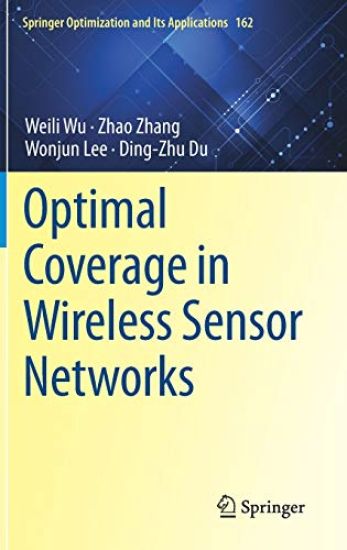
Optimal Coverage in Wireless Sensor Networks

Optimal Coverage in Wireless Sensor Networks

Weili Wu; Zhao Zhang; Wonjun Lee; Ding-Zhu Du

Springer Nature Switzerland AG
2020
sidottu
This book will serve as a reference, presenting state-of-the-art research on theoretical aspects of optimal sensor coverage problems. Readers will find it a useful tool for furthering developments on theory and applications of optimal coverage; much of the content can serve as material for advanced topics courses at the graduate level. The book is well versed with the hottest research topics such as Lifetime of Coverage, Weighted Sensor Cover, k-Coverage, Heterogeneous Sensors, Barrier, Sweep and Partial Coverage, Mobile Sensors, Camera Sensors and Energy-Harvesting Sensors, and more. Topics are introduced in a natural order from simple covers to connected covers, to the lifetime problem. Later, the book begins revisiting earlier problems ranging from the introduction of weights to coverage by k sensors and partial coverage, and from sensor heterogeneity to novel problems such as the barrier coverage problem. The book ends with coverage of mobile sensors, camera sensors, energy-harvesting sensors, underwater sensors, and crowdsensing.
Lie Group Machine Learning

Lie Group Machine Learning

Fanzhang Li; Li Zhang; Zhao Zhang

De Gruyter
2018
sidottu
This book explains deep learning concepts and derives semi-supervised learning and nuclear learning frameworks based on cognition mechanism and Lie group theory. Lie group machine learning is a theoretical basis for brain intelligence, Neuromorphic learning (NL), advanced machine learning, and advanced artifi cial intelligence. The book further discusses algorithms and applications in tensor learning, spectrum estimation learning, Finsler geometry learning, Homology boundary learning, and prototype theory. With abundant case studies, this book can be used as a reference book for senior college students and graduate students as well as college teachers and scientific and technical personnel involved in computer science, artifi cial intelligence, machine learning, automation, mathematics, management science, cognitive science, financial management, and data analysis. In addition, this text can be used as the basis for teaching the principles of machine learning. Li Fanzhang is professor at the Soochow University, China. He is director of network security engineering laboratory in Jiangsu Province and is also the director of the Soochow Institute of industrial large data. He published more than 200 papers, 7 academic monographs, and 4 textbooks. Zhang Li is professor at the School of Computer Science and Technology of the Soochow University. She published more than 100 papers in journals and conferences, and holds 23 patents. Zhang Zhao is currently an associate professor at the School of Computer Science and Technology of the Soochow University. He has authored and co-authored more than 60 technical papers.
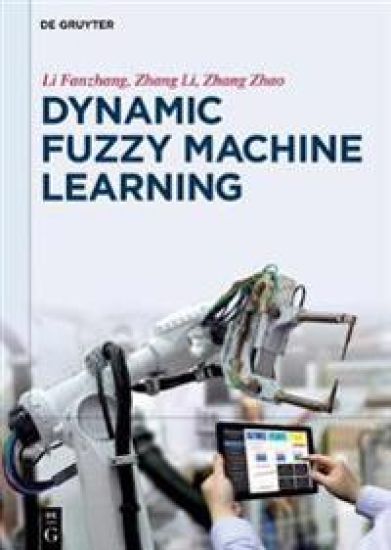
Dynamic Fuzzy Machine Learning

Dynamic Fuzzy Machine Learning

Fanzhang Li; Li Zhang; Zhao Zhang

De Gruyter
2017
sidottu
Machine learning is widely used for data analysis. Dynamic fuzzy data are one of the most difficult types of data to analyse in the field of big data, cloud computing, the Internet of Things, and quantum information. At present, the processing of this kind of data is not very mature. The authors carried out more than 20 years of research, and show in this book their most important results. The seven chapters of the book are devoted to key topics such as dynamic fuzzy machine learning models, dynamic fuzzy self-learning subspace algorithms, fuzzy decision tree learning, dynamic concepts based on dynamic fuzzy sets, semi-supervised multi-task learning based on dynamic fuzzy data, dynamic fuzzy hierarchy learning, examination of multi-agent learning model based on dynamic fuzzy logic. This book can be used as a reference book for senior college students and graduate students as well as college teachers and scientific and technical personnel involved in computer science, artificial intelligence, machine learning, automation, data analysis, mathematics, management, cognitive science, and finance. It can be also used as the basis for teaching the principles of dynamic fuzzy learning.