Kirjojen hintavertailu. Mukana 12 595 353 kirjaa ja 12 kauppaa.

Kirjailija

Zhi-Hua Zhou

Kirjat ja teokset yhdessä paikassa: 5 kirjaa, julkaisuja vuosilta 2012-2025, suosituimpien joukossa Evolutionary Learning: Advances in Theories and Algorithms. Vertaile teosten hintoja ja tarkista saatavuus suomalaisista kirjakaupoista.

5 kirjaa

Kirjojen julkaisuhaarukka 2012-2025.

Evolutionary Learning: Advances in Theories and Algorithms

Evolutionary Learning: Advances in Theories and Algorithms

Zhi-Hua Zhou; Yang Yu; Chao Qian

Springer Verlag, Singapore
2019
sidottu
Many machine learning tasks involve solving complex optimization problems, such as working on non-differentiable, non-continuous, and non-unique objective functions; in some cases it can prove difficult to even define an explicit objective function. Evolutionary learning applies evolutionary algorithms to address optimization problems in machine learning, and has yielded encouraging outcomes in many applications. However, due to the heuristic nature of evolutionary optimization, most outcomes to date have been empirical and lack theoretical support. This shortcoming has kept evolutionary learning from being well received in the machine learning community, which favors solid theoretical approaches. Recently there have been considerable efforts to address this issue. This book presents a range of those efforts, divided into four parts. Part I briefly introduces readers to evolutionary learning and provides some preliminaries, while Part II presents general theoretical tools for the analysis of running time and approximation performance in evolutionary algorithms. Based on these general tools, Part III presents a number of theoretical findings on major factors in evolutionary optimization, such as recombination, representation, inaccurate fitness evaluation, and population. In closing, Part IV addresses the development of evolutionary learning algorithms with provable theoretical guarantees for several representative tasks, in which evolutionary learning offers excellent performance.
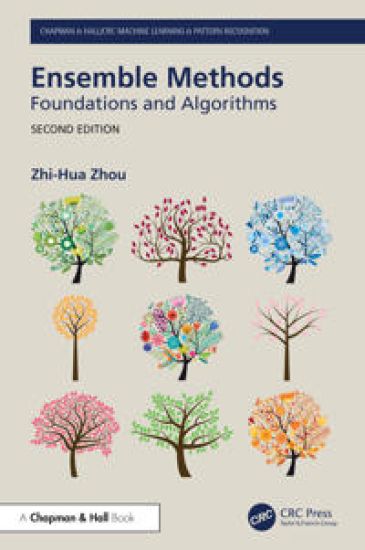
Ensemble Methods

Ensemble Methods

Zhi-Hua Zhou

TAYLOR FRANCIS LTD
2025
sidottu
Ensemble methods that train multiple learners and then combine them to use, with Boosting and Bagging as representatives, are well-known machine learning approaches. It has become common sense that an ensemble is usually significantly more accurate than a single learner, and ensemble methods have already achieved great success in various real-world tasks.Twelve years have passed since the publication of the first edition of the book in 2012 (Japanese and Chinese versions published in 2017 and 2020, respectively). Many significant advances in this field have been developed. First, many theoretical issues have been tackled, for example, the fundamental question of why AdaBoost seems resistant to overfitting gets addressed, so that now we understand much more about the essence of ensemble methods. Second, ensemble methods have been well developed in more machine learning fields, e.g., isolation forest in anomaly detection, so that now we have powerful ensemble methods for tasks beyond conventional supervised learning.Third, ensemble mechanisms have also been found helpful in emerging areas such as deep learning and online learning. This edition expands on the previous one with additional content to reflect the significant advances in the field, and is written in a concise but comprehensive style to be approachable to readers new to the subject.
Machine Learning

Machine Learning

Zhi-Hua Zhou

SPRINGER VERLAG, SINGAPORE
2022
nidottu
Machine Learning, a vital and core area of artificial intelligence (AI), is propelling the AI field ever further and making it one of the most compelling areas of computer science research. This textbook offers a comprehensive and unbiased introduction to almost all aspects of machine learning, from the fundamentals to advanced topics. It consists of 16 chapters divided into three parts: Part 1 (Chapters 1-3) introduces the fundamentals of machine learning, including terminology, basic principles, evaluation, and linear models; Part 2 (Chapters 4-10) presents classic and commonly used machine learning methods, such as decision trees, neural networks, support vector machines, Bayesian classifiers, ensemble methods, clustering, dimension reduction and metric learning; Part 3 (Chapters 11-16) introduces some advanced topics, covering feature selection and sparse learning, computational learning theory, semi-supervised learning, probabilistic graphical models, rule learning, and reinforcement learning. Each chapter includes exercises and further reading, so that readers can explore areas of interest. The book can be used as an undergraduate or postgraduate textbook for computer science, computer engineering, electrical engineering, data science, and related majors. It is also a useful reference resource for researchers and practitioners of machine learning.
Machine Learning

Machine Learning

Zhi-Hua Zhou

Springer Verlag, Singapore
2021
sidottu
Machine Learning, a vital and core area of artificial intelligence (AI), is propelling the AI field ever further and making it one of the most compelling areas of computer science research. This textbook offers a comprehensive and unbiased introduction to almost all aspects of machine learning, from the fundamentals to advanced topics. It consists of 16 chapters divided into three parts: Part 1 (Chapters 1-3) introduces the fundamentals of machine learning, including terminology, basic principles, evaluation, and linear models; Part 2 (Chapters 4-10) presents classic and commonly used machine learning methods, such as decision trees, neural networks, support vector machines, Bayesian classifiers, ensemble methods, clustering, dimension reduction and metric learning; Part 3 (Chapters 11-16) introduces some advanced topics, covering feature selection and sparse learning, computational learning theory, semi-supervised learning, probabilistic graphical models, rule learning, and reinforcement learning. Each chapter includes exercises and further reading, so that readers can explore areas of interest. The book can be used as an undergraduate or postgraduate textbook for computer science, computer engineering, electrical engineering, data science, and related majors. It is also a useful reference resource for researchers and practitioners of machine learning.
Ensemble Methods

Ensemble Methods

Zhi-Hua Zhou

Taylor Francis Inc
2012
sidottu
An up-to-date, self-contained introduction to a state-of-the-art machine learning approach, Ensemble Methods: Foundations and Algorithms shows how these accurate methods are used in real-world tasks. It gives you the necessary groundwork to carry out further research in this evolving field. After presenting background and terminology, the book covers the main algorithms and theories, including Boosting, Bagging, Random Forest, averaging and voting schemes, the Stacking method, mixture of experts, and diversity measures. It also discusses multiclass extension, noise tolerance, error-ambiguity and bias-variance decompositions, and recent progress in information theoretic diversity. Moving on to more advanced topics, the author explains how to achieve better performance through ensemble pruning and how to generate better clustering results by combining multiple clusterings. In addition, he describes developments of ensemble methods in semi-supervised learning, active learning, cost-sensitive learning, class-imbalance learning, and comprehensibility enhancement.