Kirjojen hintavertailu. Mukana 12 390 323 kirjaa ja 12 kauppaa.

Kirjailija

Zhiliang Wang

Kirjat ja teokset yhdessä paikassa: 2 kirjaa, julkaisuja vuosilta 2009-2011, suosituimpien joukossa Controlling Chaos. Vertaile teosten hintoja ja tarkista saatavuus suomalaisista kirjakaupoista.

2 kirjaa

Kirjojen julkaisuhaarukka 2009-2011.

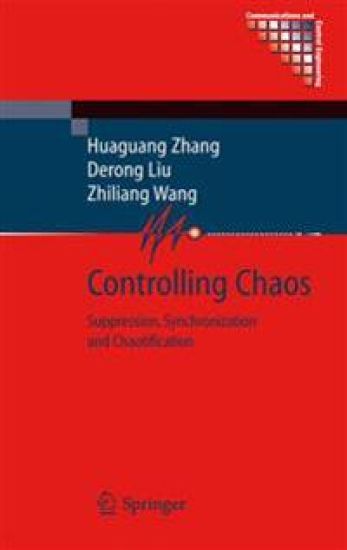
Controlling Chaos

Controlling Chaos

Huaguang Zhang; Derong Liu; Zhiliang Wang

Springer London Ltd
2011
nidottu
Controlling Chaos achieves three goals: the suppression, synchronisation and generation of chaos, each of which is the focus of a separate part of the book. The text deals with the well-known Lorenz, Rössler and Hénon attractors and the Chua circuit and with less celebrated novel systems. Modelling of chaos is accomplished using difference equations and ordinary and time-delayed differential equations. The methods directed at controlling chaos benefit from the influence of advanced nonlinear control theory: inverse optimal control is used for stabilization; exact linearization for synchronization; and impulsive control for chaotification. Notably, a fusion of chaos and fuzzy systems theories is employed. Time-delayed systems are also studied. The results presented are general for a broad class of chaotic systems. This monograph is self-contained with introductory material providing a review of the history of chaos control and the necessary mathematical preliminaries for working with dynamical systems.

Controlling Chaos

Controlling Chaos

Huaguang Zhang; Derong Liu; Zhiliang Wang

Springer London Ltd
2009
sidottu
Controlling Chaos achieves three goals: the suppression, synchronisation and generation of chaos, each of which is the focus of a separate part of the book. The text deals with the well-known Lorenz, Rössler and Hénon attractors and the Chua circuit and with less celebrated novel systems. Modelling of chaos is accomplished using difference equations and ordinary and time-delayed differential equations. The methods directed at controlling chaos benefit from the influence of advanced nonlinear control theory: inverse optimal control is used for stabilization; exact linearization for synchronization; and impulsive control for chaotification. Notably, a fusion of chaos and fuzzy systems theories is employed. Time-delayed systems are also studied. The results presented are general for a broad class of chaotic systems. This monograph is self-contained with introductory material providing a review of the history of chaos control and the necessary mathematical preliminaries for working with dynamical systems.