Kirjojen hintavertailu. Mukana 12 595 353 kirjaa ja 12 kauppaa.

Kirjailija

Zhilin Li

Kirjat ja teokset yhdessä paikassa: 8 kirjaa, julkaisuja vuosilta 2004-2021, suosituimpien joukossa Introduction To Partial Differential Equations (With Maple), An: A Concise Course. Vertaile teosten hintoja ja tarkista saatavuus suomalaisista kirjakaupoista.

8 kirjaa

Kirjojen julkaisuhaarukka 2004-2021.

Introduction To Partial Differential Equations (With Maple), An: A Concise Course

Introduction To Partial Differential Equations (With Maple), An: A Concise Course

Zhilin Li; Larry Norris

WORLD SCIENTIFIC PUBLISHING CO PTE LTD
2021
nidottu
The book is designed for undergraduate or beginning level graduate students, and students from interdisciplinary areas including engineers, and others who need to use partial differential equations, Fourier series, Fourier and Laplace transforms. The prerequisite is a basic knowledge of calculus, linear algebra, and ordinary differential equations.The textbook aims to be practical, elementary, and reasonably rigorous; the book is concise in that it describes fundamental solution techniques for first order, second order, linear partial differential equations for general solutions, fundamental solutions, solution to Cauchy (initial value) problems, and boundary value problems for different PDEs in one and two dimensions, and different coordinates systems. Analytic solutions to boundary value problems are based on Sturm-Liouville eigenvalue problems and series solutions.The book is accompanied with enough well tested Maple files and some Matlab codes that are available online. The use of Maple makes the complicated series solution simple, interactive, and visible. These features distinguish the book from other textbooks available in the related area.
Introduction To Partial Differential Equations (With Maple), An: A Concise Course

Introduction To Partial Differential Equations (With Maple), An: A Concise Course

Zhilin Li; Larry Norris

World Scientific Publishing Co Pte Ltd
2021
sidottu
The book is designed for undergraduate or beginning level graduate students, and students from interdisciplinary areas including engineers, and others who need to use partial differential equations, Fourier series, Fourier and Laplace transforms. The prerequisite is a basic knowledge of calculus, linear algebra, and ordinary differential equations.The textbook aims to be practical, elementary, and reasonably rigorous; the book is concise in that it describes fundamental solution techniques for first order, second order, linear partial differential equations for general solutions, fundamental solutions, solution to Cauchy (initial value) problems, and boundary value problems for different PDEs in one and two dimensions, and different coordinates systems. Analytic solutions to boundary value problems are based on Sturm-Liouville eigenvalue problems and series solutions.The book is accompanied with enough well tested Maple files and some Matlab codes that are available online. The use of Maple makes the complicated series solution simple, interactive, and visible. These features distinguish the book from other textbooks available in the related area.
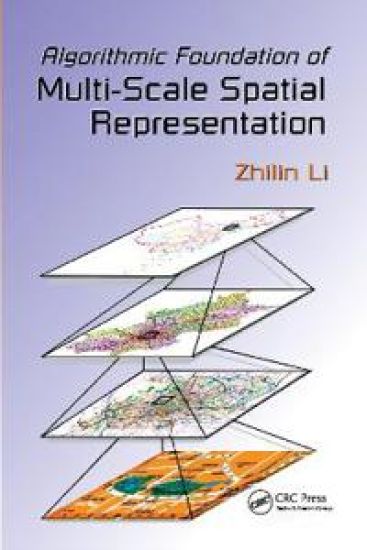
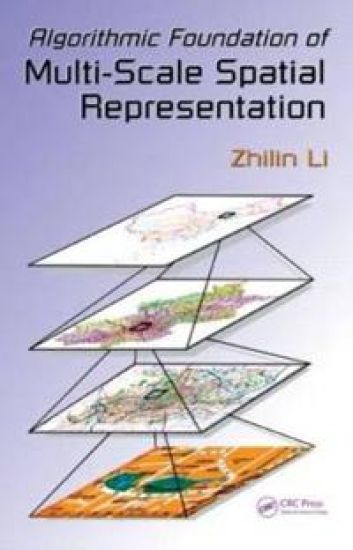
Algorithmic Foundation of Multi-Scale Spatial Representation
With the widespread use of GIS, multi-scale representation has become an important issue in the realm of spatial data handling. However, no book to date has systematically tackled the different aspects of this discipline. Emphasizing map generalization, Algorithmic Foundation of Multi-Scale Spatial Representation addresses the mathematical basis of multi-scale representation, specifically, the algorithmic foundation. Using easy-to-understand language, the author focuses on geometric transformations, with each chapter surveying a particular spatial feature. After an introduction to the essential operations required for geometric transformations as well as some mathematical and theoretical background, the book describes algorithms for a class of point features/clusters. It then examines algorithms for individual line features, such as the reduction of data points, smoothing (filtering), and scale-driven generalization, followed by a discussion of algorithms for a class of line features including contours, hydrographic (river) networks, and transportation networks. The author also addresses algorithms for individual area features, a class of area features, and various displacement operations. The final chapter briefly covers algorithms for 3-D surfaces and 3-D features. Providing a thorough treatment of low-level algorithms, Algorithmic Foundation of Multi-Scale Spatial Representation supplies the mathematical groundwork for multi-scale representations of spatial data.
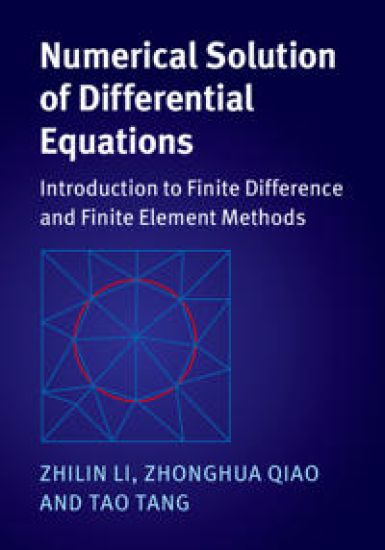
Numerical Solution of Differential Equations

Numerical Solution of Differential Equations

Zhilin Li; Zhonghua Qiao; Tao Tang

Cambridge University Press
2017
sidottu
This introduction to finite difference and finite element methods is aimed at graduate students who need to solve differential equations. The prerequisites are few (basic calculus, linear algebra, and ODEs) and so the book will be accessible and useful to readers from a range of disciplines across science and engineering. Part I begins with finite difference methods. Finite element methods are then introduced in Part II. In each part, the authors begin with a comprehensive discussion of one-dimensional problems, before proceeding to consider two or higher dimensions. An emphasis is placed on numerical algorithms, related mathematical theory, and essential details in the implementation, while some useful packages are also introduced. The authors also provide well-tested MATLAB® codes, all available online.
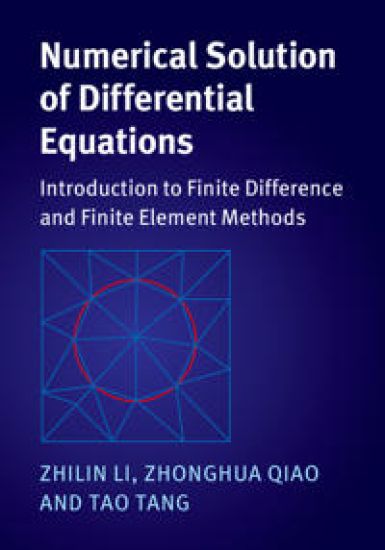
Numerical Solution of Differential Equations

Numerical Solution of Differential Equations

Zhilin Li; Zhonghua Qiao; Tao Tang

Cambridge University Press
2017
pokkari
This introduction to finite difference and finite element methods is aimed at graduate students who need to solve differential equations. The prerequisites are few (basic calculus, linear algebra, and ODEs) and so the book will be accessible and useful to readers from a range of disciplines across science and engineering. Part I begins with finite difference methods. Finite element methods are then introduced in Part II. In each part, the authors begin with a comprehensive discussion of one-dimensional problems, before proceeding to consider two or higher dimensions. An emphasis is placed on numerical algorithms, related mathematical theory, and essential details in the implementation, while some useful packages are also introduced. The authors also provide well-tested MATLAB® codes, all available online.
Algorithmic Foundation of Multi-Scale Spatial Representation
With the widespread use of GIS, multi-scale representation has become an important issue in the realm of spatial data handling. However, no book to date has systematically tackled the different aspects of this discipline. Emphasizing map generalization, Algorithmic Foundation of Multi-Scale Spatial Representation addresses the mathematical basis of multi-scale representation, specifically, the algorithmic foundation. Using easy-to-understand language, the author focuses on geometric transformations, with each chapter surveying a particular spatial feature. After an introduction to the essential operations required for geometric transformations as well as some mathematical and theoretical background, the book describes algorithms for a class of point features/clusters. It then examines algorithms for individual line features, such as the reduction of data points, smoothing (filtering), and scale-driven generalization, followed by a discussion of algorithms for a class of line features including contours, hydrographic (river) networks, and transportation networks. The author also addresses algorithms for individual area features, a class of area features, and various displacement operations. The final chapter briefly covers algorithms for 3-D surfaces and 3-D features. Providing a thorough treatment of low-level algorithms, Algorithmic Foundation of Multi-Scale Spatial Representation supplies the mathematical groundwork for multi-scale representations of spatial data.
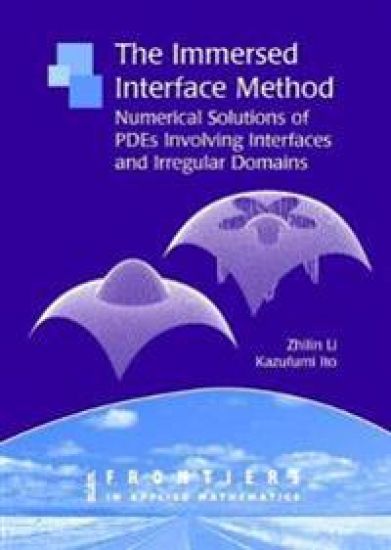
The Immersed Interface Method

The Immersed Interface Method

Zhilin Li; Kazufumi Ito

Society for Industrial Applied Mathematics,U.S.
2006
pokkari
Interface problems arise when there are two different materials, such as water and oil, or the same material at different states, such as water and ice. If partial or ordinary differential equations are used to model these applications, the parameters in the governing equations are typically discontinuous across the interface separating the two materials or states, and the source terms are often singular to re?ect source/sink distributions along codimensional interfaces. Because of these irregularities, the solutions to the differential equations are typically nonsmooth or even discontinuous. As a result, many standard numerical methods based on the assumption of smoothness of solutions do not work or work poorly for interface problems. The Immersed Interface Method provides an introduction to the immersed interface method (IIM), a powerful numerical method for solving interface problems and problems defined on irregular domains for which analytic solutions are rarely available. This book gives a complete description of the IIM, discusses recent progress in the area, and describes numerical methods for a number of classic interface problems.It also contains many numerical examples that can be used as benchmark problems for numerical methods designed for interface problems on irregular domains. The IIM is a sharp interface method that has been coupled with evolution schemes such as the level set and front tracking methods and has been used in both finite difference and finite element formulations to solve several moving interface and free boundary problems. In particular, the authors discuss the IIM's applications to Stefan problems and unstable crystal growth, incompressible Stokes and Navier-Stokes flows with moving interfaces, an inverse problem identifying unknown shapes in a region, a nonlinear interface problem of magnetorheological ?uids containing iron particles, and other problems. The book also contains several applications of free boundary and moving interface problems, including examples from physics, computational fluid mechanics, mathematical biology, material science, and other fields.The IIM, which is based on uniform or adaptive Cartesian/polar/spherical grids or triangulations, is simple enough to be implemented by researchers and graduate students with a reasonable background in differential equations and numerical analysis yet powerful enough to solve complicated problems with high-order accuracy. Since interfaces or irregular boundaries are one dimension lower than solution domains, the extra costs in dealing with interfaces or irregular boundaries are generally insigni?cant, and many software packages based on uniform Cartesian/polar/spherical grids, such as the FFT and fast Poisson solvers, can be applied easily with the IIM. The most recent IIM computer codes and packages are available online.
Digital Terrain Modeling

Digital Terrain Modeling

Zhilin Li; Christopher Zhu; Chris Gold

CRC Press
2004
sidottu
Written by experts, Digital Terrain Modeling: Principles and Methodology provides comprehensive coverage of recent developments in the field. The topics include terrain analysis, sampling strategy, acquisition methodology, surface modeling principles, triangulation algorithms, interpolation techniques, on-line and off-line quality control in data acquisition, DTM accuracy assessment and mathematical models for DTM accuracy prediction, multi-scale representation, data management, contouring, visual analysis (or visualization), the derivation of various types of terrain parameters, and future development and applications.