Kirjojen hintavertailu. Mukana 12 595 353 kirjaa ja 12 kauppaa.

Kirjailija

Zuming Feng

Kirjat ja teokset yhdessä paikassa: 5 kirjaa, julkaisuja vuosilta 2002-2006, suosituimpien joukossa USA and International Mathematical Olympiads 2005. Vertaile teosten hintoja ja tarkista saatavuus suomalaisista kirjakaupoista.

5 kirjaa

Kirjojen julkaisuhaarukka 2002-2006.

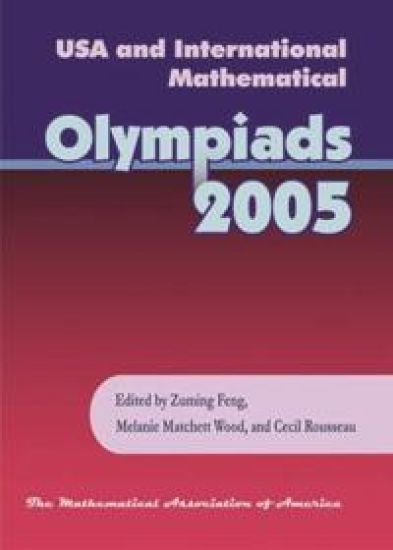
USA and International Mathematical Olympiads 2005

USA and International Mathematical Olympiads 2005

Zuming Feng; Melanie Matchett Wood; Cecil Rousseau

Mathematical Association of America
2006
nidottu
The Mathematical Olypiad books, covering the USA Mathematical Olypiad (USAMO) and the International Mathematical Olypiad (IMO), have been published annually by the MAA American Mathematics Competitions since 1976. This is the sixth volume in that series published by the MAA in its Problem Book series. The IMO is the work mathematics championship for high school students. It takes place annually in a different country each year. The aims of the IMO are (1) to discover, encourage and challenge mathematically gifted young people in all countries; (2) to foster friendships between mathematicians around the world; (3) to create an opportunity for the exchange of information on school syllabi and practice throughout the world. The USAMO and the Team Selection Test (TST) are the last two stages of the selection process for the United states of America IMO team. The preceding examinations are the AMC 10 or AMC12 and the American Invitational Mathematics Examination (AIME). Participation in the AIME, USAMO, and the TST is by invitation only, based on performance in the preceding exams of the sequence. Through the AMC contests and the IMO, young gifted mathematicians are identified and recognized while they are still in secondary school. Participation in the competitions provides them with the chance to measure themselves against other exceptional students from all over the world. This work was prepared by Zuming Feng, Melanie Matchett Wood, the Leader and Deputy Leader of the 2004 USA IMO team, and by Cecil Rousseau, the chair of the USAMO Committee. In addition to presenting their own carefully written solutions to the problems, Zuming and Melanie provide remarkable solutions developed by the examination committees, contestants, and experts, during or after the contests. They also provide a detailed report of the 2000 2004 USAMO/IMO results and a comprehensive guide to other material that emphasize advances problem-solving.This collection of excellent problems and beautiful solutions is a valuable companion for students who wish to develop their interest in mathematics outside the school curriculum and to deepen their knowledge of mathematics.
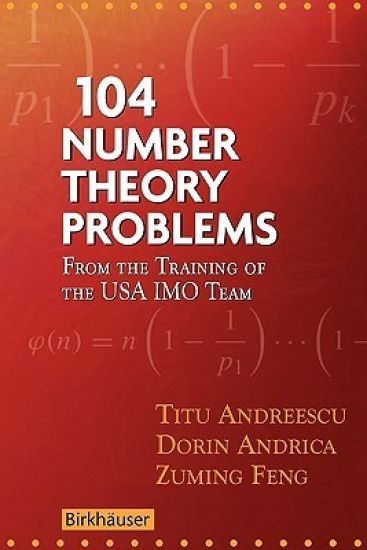
104 Number Theory Problems

104 Number Theory Problems

Titu Andreescu; Dorin Andrica; Zuming Feng

Birkhauser Boston Inc
2006
nidottu
This book contains 104 of the best problems used in the training and testing of the U. S. International Mathematical Olympiad (IMO) team. It is not a collection of very dif?cult, and impenetrable questions. Rather, the book gradually builds students’ number-theoretic skills and techniques. The ?rst chapter provides a comprehensive introduction to number theory and its mathematical structures. This chapter can serve as a textbook for a short course in number theory. This work aims to broaden students’ view of mathematics and better prepare them for possible participation in various mathematical competitions. It provides in-depth enrichment in important areas of number theory by reorganizing and enhancing students’ problem-solving tactics and strategies. The book further stimulates s- dents’ interest for the future study of mathematics. In the United States of America, the selection process leading to participation in the International Mathematical Olympiad (IMO) consists of a series ofnational contests called the American Mathematics Contest 10 (AMC 10), the American Mathematics Contest 12 (AMC 12), the American Invitational Mathematics - amination (AIME), and the United States of America Mathematical Olympiad (USAMO). Participation in the AIME and the USAMO is by invitation only, based on performance in the preceding exams of the sequence. The Mathematical Olympiad Summer Program (MOSP) is a four-week intensive training program for approximately ?fty very promising students who have risen to the top in the American Mathematics Competitions.
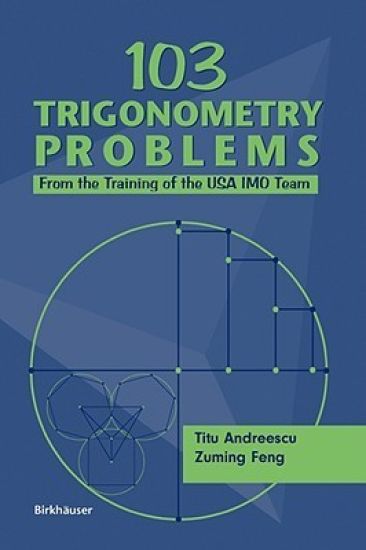
103 Trigonometry Problems

103 Trigonometry Problems

Titu Andreescu; Zuming Feng

Birkhauser Boston Inc
2004
nidottu
103 Trigonometry Problems contains highly-selected problems and solutions used in the training and testing of the USA International Mathematical Olympiad (IMO) team. Though many problems may initially appear impenetrable to the novice, most can be solved using only elementary high school mathematics techniques. Key features: - Problem-solving tactics and strategies, along with practical test-taking techniques, provide in-depth enrichment and preparation for possible participation in various mathematical competitions - Comprehensive introduction (first chapter) to trigonometric functions, their relations and functional properties, and their applications in the Euclidean plane and solid geometry expose advanced students to college level material 103 Trigonometry Problems is a cogent problem-solving resource for advanced high school students, undergraduates, and mathematics teachers engaged in competition training.
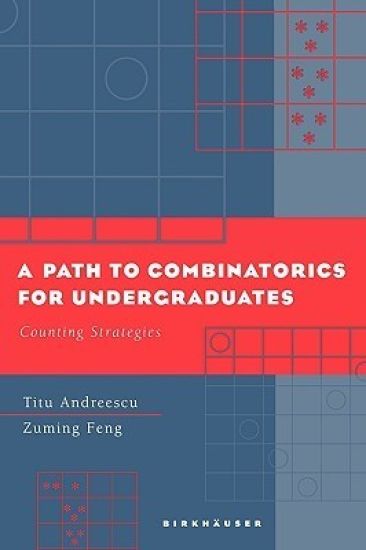
A Path to Combinatorics for Undergraduates

A Path to Combinatorics for Undergraduates

Titu Andreescu; Zuming Feng

Birkhauser Boston Inc
2003
nidottu
The main goal of the two authors is to help undergraduate students understand the concepts and ideas of combinatorics, an important realm of mathematics, and to enable them to ultimately achieve excellence in this field. This goal is accomplished by familiariz­ ing students with typical examples illustrating central mathematical facts, and by challenging students with a number of carefully selected problems. It is essential that the student works through the exercises in order to build a bridge between ordinary high school permutation and combination exercises and more sophisticated, intricate, and abstract concepts and problems in undergraduate combinatorics. The extensive discussions of the solutions are a key part of the learning process. The concepts are not stacked at the beginning of each section in a blue box, as in many undergraduate textbooks. Instead, the key mathematical ideas are carefully worked into organized, challenging, and instructive examples. The authors are proud of their strength, their collection of beautiful problems, which they have accumulated through years of work preparing students for the International Math­ ematics Olympiads and other competitions. A good foundation in combinatorics is provided in the first six chapters of this book. While most of the problems in the first six chapters are real counting problems, it is in chapters seven and eight where readers are introduced to essay-type proofs. This is the place to develop significant problem-solving experience, and to learn when and how to use available skills to complete the proofs.
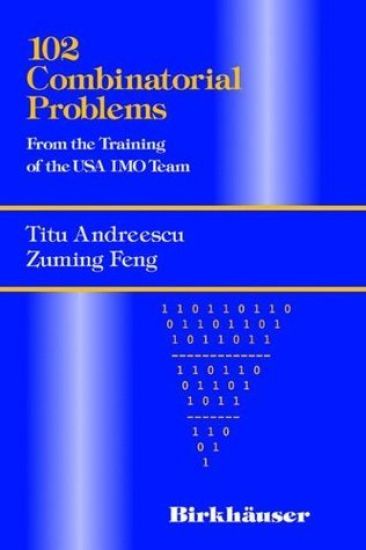
102 Combinatorial Problems

102 Combinatorial Problems

Titu Andreescu; Zuming Feng

Birkhauser Boston Inc
2002
nidottu
"102 Combinatorial Problems" consists of carefully selected problems that have been used in the training and testing of the USA International Mathematical Olympiad (IMO) team. Key features: * Provides in-depth enrichment in the important areas of combinatorics by reorganizing and enhancing problem-solving tactics and strategies * Topics include: combinatorial arguments and identities, generating functions, graph theory, recursive relations, sums and products, probability, number theory, polynomials, theory of equations, complex numbers in geometry, algorithmic proofs, combinatorial and advanced geometry, functional equations and classical inequalities The book is systematically organized, gradually building combinatorial skills and techniques and broadening the student's view of mathematics. Aside from its practical use in training teachers and students engaged in mathematical competitions, it is a source of enrichment that is bound to stimulate interest in a variety of mathematical areas that are tangential to combinatorics.