
Kirjojen hintavertailu. Mukana 12 390 323 kirjaa ja 12 kauppaa.

Kirjahaku

Etsi kirjoja tekijän nimen, kirjan nimen tai ISBN:n perusteella.

2 kirjaa tekijältä Anthony Flood

Christ, Capital and Liberty: A Polemic

Christ, Capital and Liberty: A Polemic

Anthony Flood

Independently Published
2019
nidottu
". . . Christ, Capital and Liberty: A Polemic is a spirited and detailed defence of the fundamental compatibility of Catholicism and Austro-Libertarianism. . . . T]he multiple, mostly short, chapters . . . provide so many insights, engage the perspectives of so many thinkers and attack the central topic of the compatibility of Catholicism and Austro-Libertarianism from so many angles that no reader can fail to achieve a greater insight into the matter after reading it than he had before he began."- From the Foreword by Gerard N. Casey MA, LLM, PhD, DLitt., Professor Emeritus, University College Dublin, Associated Scholar, The Mises Institute, Auburn, Alabama, Fellow, Mises UKHostility to markets can take many forms, not only that of the frankly socialist specter haunting America. Sometimes it's disguised as Christian piety. Exemplary of this is Catholic polemicist Christopher A. Ferrara's ignorant attack on the Austrian School of Economics (ASE) as incarnated in his 2010 The Church and the Libertarian. Championing Distributism and the social democracy that's vended under the label "Catholic Social Teaching," Ferrara claims that the ASE is morally and intellectually at variance with Catholicism.Anthony Flood (Herbert Aptheker: Studies in Willful Blindness) responded with anarcho-catholic, a blog on which he argued for the compatibility, even harmony, that Ferrara denied. His book is an object lesson in how a Christian ought not to conduct controversy, and Flood counts the ways. Believing that the evidence and arguments marshaled in his blog posts should have a wider platform, Flood has resurrected them as Christ, Capital and Liberty: A Polemic.Included are several of Flood's well-received essays: on Lord Acton as a libertarian Catholic; a review of The Church and the Market by Thomas Woods (Ferrara's former collaborator); and a defense of the idea of international "anarchy" against David Ray Griffin's argument that it is a "cause of war." Introducing them is Flood's uncompromising criticism of the pro-abortion stance of his late mentor and friend, the Dean of the ASE Murray N. Rothbard.In his preface Flood outlines his current views, which move beyond (without denying the insights of) Austro-Libertarianism (which is theologically neutral) while suggesting a Biblically based attitude toward the politics in the present dispensation as ultimately futile, if inevitable.
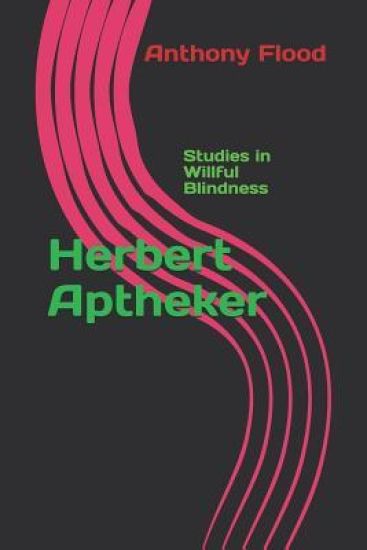
Herbert Aptheker: Studies in Willful Blindness

Herbert Aptheker: Studies in Willful Blindness

Anthony Flood

Independently Published
2019
nidottu
Herbert Aptheker (1915-2003), a pioneering researcher in African-American slave revolts, was also an American Communist theoretician. Anthony Flood, who attended Aptheker's lectures a half-century ago, became his research assistant, friend and comrade. Decades after Flood repudiated the comradeship, it dawned on him that Aptheker's politics had blocked his research in his area of specialization: he failed to recognize The Black Jacobins, the work of C. L. R. James (1901-1989) that chronicled the only successful slave revolt in modern times. The failure was ideological. In the course of investigating this silence, Flood discovered scholars who admired both writers, but never at the same time. Doing so would have forced them to address the uncomfortable truth that one of their heroes ignored the other. That is, the white radical scholar ignored the black radical scholar who was 14 years his senior. The only explanation, Flood contends, is that Aptheker, the Stalinist, could not bring himself to acknowledge the work of James, the Trotskyist. There are other problems with Aptheker's legacy, of course, such as his uncovering the truth about slavery in the Americas while covering it up in the Soviet Union and its satellites. The "dissing" of James, however, undermines his "anti-racism" reputation as well as his argument that "partisanship with the oppressed" makes objectivity in history writing possible. He was a partisan of too many oppressors. He eventually admitted his own "willful blindness" (his words), yet that didn't stop him from defending, as late as 2000, The Truth about Hungary, his book-length apologia for the Soviet Union's crushing of the 1956 Hungarian revolution.Herbert Aptheker: Studies in Willful Blindness includes not only Flood's essay on Aptheker and James, but also vignettes of his coming into Aptheker's life as a high school student and that of Sidney Hook (Aptheker's nemesis and Flood's philosophy professor). Also included are a review of the first biography of Aptheker and an inquiry into Aptheker's status as an historian. Appendices include Aptheker's first essay (in The American Hebrew) and Flood's first letter on Aptheker (in The Journal of American History).Herbert Aptheker expressed the ethos of the American Communist Party in its heyday, an atmosphere that pervades "progressive" American politics today. If you want to look at his role in that "progression," this monograph is a good place to start.