Kirjojen hintavertailu. Mukana 11 699 587 kirjaa ja 12 kauppaa.

Kirjahaku

Etsi kirjoja tekijän nimen, kirjan nimen tai ISBN:n perusteella.

1000 tulosta hakusanalla Debra Reid

Esther

Esther

Debra Reid

INTERVARSITY PRESS
2008
nidottu
The place: Persia. The time: fifth-century BC. The Jews were threatened with genocide. A decree ordered the extermination of young and old, women and children. The book of Esther describes how this crisis was averted through the bravery of Esther, the wisdom of Mordecai and the unity of the Jewish people. Debra Reid's approachable commentary helps us see even more clearly in the book of Esther the God who quietly --and sometimes unexpectedly-- works behind the scenes to order the events of our lives.This completely new volume replaces the previous editon of Esther in the Tyndale Commentary series written by Joyce Baldwin.
Esther

Esther

Debra Reid

Inter-Varsity Press
2008
nidottu
The place: Persia. The time: fifth century BC. The Jews were threatened with genocide. A decree ordered the extermination of young and old, women and children. The book of Esther describes how this crisis was averted through the bravery of Esther, the wisdom of her stepfather and the unity of the Jewish people. It also reveals the God who quietly - and sometimes unexpectedly - works behind the scenes to order the events of our lives.
Who's Who of the Bible

Who's Who of the Bible

Debra Reid; Martin H Manser

Lion Books
2012
nidottu
The Bible contains over three thousand names - all of which are included in this exhaustive Who's Who of the Bible. Every single individual whose name is listed in the Bible is listed here in order of their appearance in the Bible with their dates, a concise description of their lives and significance, and references to where they occur in the text. With sections on the Pentateuch, the History books, Poetry and Wisdom books, the Prophets, the Gospels and Acts, and the Letters and Revelation, this book also includes a user's guide, family trees of key individuals, a timeline, an alphabetical list of names, and an Appendix on the Apocrypha. Putting all the information on the Bible's rich cast of characters at your finger tips, this is an essential guide for any preacher, teacher, biblical scholar, student, or Bible reader.
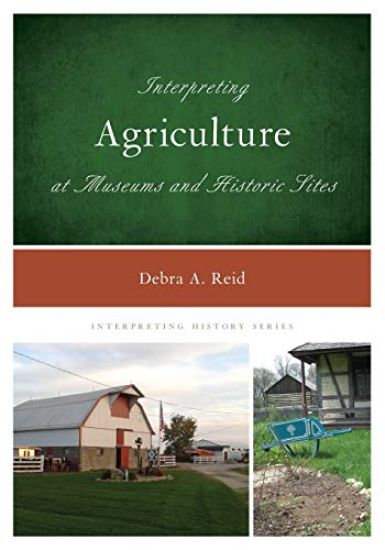
Interpreting Agriculture at Museums and Historic Sites
Interpreting Agriculture in Museums and Historic Sites orients readers to major themes in agriculture and techniques in education and interpretation that can help you develop humanities-based public programming that enhance agricultural literacy. Case studies illustrate the ways that local research can help you link your history organization to compelling local, national (even international) stories focused on the multidisciplinary topic. That ordinary plow, pitch fork, and butter paddle can provide the tangible evidence of the story worth telling, even if the farm land has disappeared into subdivisions and agriculture seems as remote as the nineteenth century. Other topics include discussion of alliances between rural tourism and community-supported agriculture, farmland conservation and stewardship, heritage breed and seed preservation efforts, and antique tractor clubs. Any of these can become indispensable partners to history organizations searching for a new interpretive theme to explore and new partners to engage.
Interpreting Agriculture at Museums and Historic Sites
Interpreting Agriculture in Museums and Historic Sites orients readers to major themes in agriculture and techniques in education and interpretation that can help you develop humanities-based public programming that enhance agricultural literacy. Case studies illustrate the ways that local research can help you link your history organization to compelling local, national (even international) stories focused on the multidisciplinary topic. That ordinary plow, pitch fork, and butter paddle can provide the tangible evidence of the story worth telling, even if the farm land has disappeared into subdivisions and agriculture seems as remote as the nineteenth century. Other topics include discussion of alliances between rural tourism and community-supported agriculture, farmland conservation and stewardship, heritage breed and seed preservation efforts, and antique tractor clubs. Any of these can become indispensable partners to history organizations searching for a new interpretive theme to explore and new partners to engage.
Interpreting the Environment at Museums and Historic Sites

Interpreting the Environment at Museums and Historic Sites

Debra A. Reid; David D. Vail

Rowman Littlefield
2019
sidottu
State and local history collections provide a foundation for telling stories of the ways that humans have interacted with their environments over time, changing them, destroying them, conserving them, sustaining them. This book re-focuses thinking about the environment to thinking from the perspective of place and time, and people within that place-time continuum. The book provides a primer on “major problems” in researching and thinking about the environment. It addresses human perspectives on land distribution (Indian compared to English, Spanish, French approaches), the range of land use from conservation to exploitation, the disconnect between garbage and reduce-reuse-recycle campaigns; the histories of environmental movements and back to the land movements and their consequences, and the different experiences that become evidence when research documents race, class, gender and ethnicity in one place over time. The book moves beyond “nature,” distinguishing between natural environments and human-manipulated environments and ecosystems. Both have relevance to "interpreting the environment at museums and historic sites." It proposes a multi-disciplinary approach that requires expertise in the Humanities as well as the sciences and social sciences to best understand space and place over time. It incorporates case studies of the theory and method in relation to human goals – creating working environments, getting water, growing food, traveling and trading, building things, and preserving remarkable natural landscapes. Interpreting the Environment at Museums and Historic Sites is for anyone who wants to better understand the environment that surrounds us and sustains us, who wants to become a better steward of that environment, and who wants to share lessons learned with others. The process starts by focusing attention on the environment – the physical space that constitutes the largest three-dimensional object in museum collections. It involves conceptualizing spaces and places of human influence; spaces that contain layer upon layer documenting human struggles to survive and thrive. This evidence exists in natural environments as well as the city center. The process continues by adopting an environment-centric view of the spaces destined to be interpreted. This mind-set forms the basis for devising research plans to document the ways humans have changed, destroyed, conserved and sustained spaces over time, and the ways that the environment reacts. Interpretation built on evidence, then becomes the basis for cross-disciplinary engagement with the environment.
Interpreting the Environment at Museums and Historic Sites

Interpreting the Environment at Museums and Historic Sites

Debra A. Reid; David D. Vail

Rowman Littlefield
2019
nidottu
State and local history collections provide a foundation for telling stories of the ways that humans have interacted with their environments over time, changing them, destroying them, conserving them, sustaining them. This book re-focuses thinking about the environment to thinking from the perspective of place and time, and people within that place-time continuum. The book provides a primer on “major problems” in researching and thinking about the environment. It addresses human perspectives on land distribution (Indian compared to English, Spanish, French approaches), the range of land use from conservation to exploitation, the disconnect between garbage and reduce-reuse-recycle campaigns; the histories of environmental movements and back to the land movements and their consequences, and the different experiences that become evidence when research documents race, class, gender and ethnicity in one place over time. The book moves beyond “nature,” distinguishing between natural environments and human-manipulated environments and ecosystems. Both have relevance to "interpreting the environment at museums and historic sites." It proposes a multi-disciplinary approach that requires expertise in the Humanities as well as the sciences and social sciences to best understand space and place over time. It incorporates case studies of the theory and method in relation to human goals – creating working environments, getting water, growing food, traveling and trading, building things, and preserving remarkable natural landscapes. Interpreting the Environment at Museums and Historic Sites is for anyone who wants to better understand the environment that surrounds us and sustains us, who wants to become a better steward of that environment, and who wants to share lessons learned with others. The process starts by focusing attention on the environment – the physical space that constitutes the largest three-dimensional object in museum collections. It involves conceptualizing spaces and places of human influence; spaces that contain layer upon layer documenting human struggles to survive and thrive. This evidence exists in natural environments as well as the city center. The process continues by adopting an environment-centric view of the spaces destined to be interpreted. This mind-set forms the basis for devising research plans to document the ways humans have changed, destroyed, conserved and sustained spaces over time, and the ways that the environment reacts. Interpretation built on evidence, then becomes the basis for cross-disciplinary engagement with the environment.
Reaping a Greater Harvest

Reaping a Greater Harvest

Debra A. Reid

Texas A M University Press
2007
sidottu
Cooperative demonstration work began in Texas in 1903 as an effort to teach farmers new methods of crop cultivation and management. However, black farmers in Texas were excluded from demonstration work until the Smith-Lever Agricultural Extension Act in 1914. By World War I, the resulting Negro Division included a complicated bureaucracy of African American agents who reported to white officials, were supervised by black administrators, and served black farmers. The measurable successes of these African American farmers exacerbated racial tensions and led to pressure on agents to maintain the racial status quo. In ""Reaping a Greater Harvest"", Reid deftly spotlights further hierarchies of class and gender within the extension service. Her analysis clearly demonstrates how the same system that enabled the agents and the farmers they served to wield some political influence also kept them dependent on a racialized state that systematically discriminated against them and maintained the white-dominated southern landscape. Historians of race, gender, and class will join agricultural historians in valuing this careful examination of an understudied development in a corner of the Jim Crow South.
The Association for Living History, Farm and Agricultural Museums: Proceedings of the 2016 Conference and Annual Meeting: The Rural Life Museum, Louis
For over 35 years, the Association for Living History, Farm and Agricultural Museums (ALHFAM) has published the presentations and workshops presented at each Annual Conference in monograph form. An index to the articles in each volume can be found on the ALHFAM website at http: //www.alhfam.org/Proceedings-Index. ALHFAM members can access the full text of any article via the ALHFAM Skills & Knowledge Base on the website. For more information on ALHFAM, go to www.alhfam.org.
A Day in the Badlands

A Day in the Badlands

Devra Hock-Reid; Judy Diamond

Zea Books
2025
pokkari
About the Badlands Fossils This story tells about the fossils of ancient animals found in the Wind River and Bighorn basins of Wyoming. Wyoming's rich fossil record tell us about amazing animals from millions of years ago. About 66 million years ago, an asteroid slammed into the Earth, causing devastating changes that led to the extinction of dinosaurs. As the planet began to recover, it was much warmer than today, allowing palm trees and other tropical plants to grow in Wyoming. Many new species of mammals and birds emerged in this warm climate. Earth's temperatures peaked about 52 million years ago. Paleontologists call this time the "Early Eocene Climatic Optimum." Paleontologists study the deep-time geological record to understand how plants and animals respond to a changing climate. In this story, three children visit a paleontological site in Wyoming and get magically transported back in time, resulting in a 52-million-year-old safari adventure they will never forget
A Day in the Badlands

A Day in the Badlands

Devra Hock-Reid; Judy Diamond

University of Nebraska-Lincoln
2025
sidottu
About the Badlands Fossils This story tells about the fossils of ancient animals found in the Wind River and Bighorn basins of Wyoming. Wyoming's rich fossil record tell us about amazing animals from millions of years ago. About 66 million years ago, an asteroid slammed into the Earth, causing devastating changes that led to the extinction of dinosaurs. As the planet began to recover, it was much warmer than today, allowing palm trees and other tropical plants to grow in Wyoming. Many new species of mammals and birds emerged in this warm climate. Earth's temperatures peaked about 52 million years ago. Paleontologists call this time the "Early Eocene Climatic Optimum." Paleontologists study the deep-time geological record to understand how plants and animals respond to a changing climate. In this story, three children visit a paleontological site in Wyoming and get magically transported back in time, resulting in a 52-million-year-old safari adventure they will never forget
I Am Debra Lee

I Am Debra Lee

Debra Lee

Hachette Books
2023
sidottu
*Well-Read Black Girl - Book Club Pick*As an incredible glass-ceiling breaker and the woman who brought timeless television shows like The Game and Being Mary Jane to cable, Debra Lee has been the visionary responsible for elevating Black images and storytelling for decades. Now she's telling her own story, in an intimate and eye-opening tale about the triumphant and tricky moments of a career in entertainment.I Am Debra Lee is a page-turner, filled with deeply personal revelations, juicy celebrity intel, and electrifying behind-the-scenes stories that reveal how she went from a girl raised in the segregated South to leading the first Black company traded on the New York Stock Exchange and how she juggled social responsibility while managing a company targeted toward the Black community. In a rousing narrative, Lee writes: "I don't just love Black culture-the magic in our hair, the swagger in our steps, the particular way we can say 'alright now' to fit our changing moods-Black culture saved me." In her exciting debut, she answers all of our questions about building an unapologetically Black enterprise as a Black woman. What to do when you're forced to attend a board meeting eight weeks after a C-section. How to manage a team of men when you're the first female CEO at the company. How she learned the hard way to say no to those in power when their vision didn't align with her purpose.I Am Debra Lee tackles lessons that women CEOs rarely dare to. She addresses her personal struggles with motherhood and "having it all," navigating reproductive choice, fertility, and #MeToo while achieving great professional success. Being Black and a woman in corporate life isn't easy for anyone. But Lee shows how she evolved from a shy girl who dreaded public speaking to becoming a force to be reckoned with as she helped build the leading entertainment company for Black audiences and consumers of Black culture globally.?I Am Debra Lee is a must-read for all strivers in any industry. Lee is a truthteller about the critical choices that Black leaders face. As she has done her whole career, in this book, she opens the door for others to come after her, by sharing the truth behind her own inspiring story of power, perseverance, and success.
I Am Debra Lee

I Am Debra Lee

Debra Lee

Hachette Books
2025
pokkari
A riveting memoir by the former CEO of Black Entertainment Television (BET), about the glamorous and ugly moments of being a high-powered Black woman executive in the entertainment industry.Debra Lee has been the visionary responsible for elevating Black images and storytelling for decades with timeless television shows like The Game and Being Mary Jane. Now she's telling her own story, in a page-turner, filled with electrifying behind-the-scenes stories that reveal how she went from a girl raised in the segregated South to leading the first Black company traded on the New York Stock Exchange and how she juggled social responsibility while managing a company targeted toward the Black community.Lee answers all of our questions about building an unapologetically Black enterprise as a Black woman. What to do when you're forced to attend a board meeting eight weeks after a C-section. How to manage a team of men when you're the first female CEO at the company. How she learned the hard way to say no to those in power when their vision didn't align with her purpose.I Am Debra Lee tackles lessons that women CEOs rarely dare to. She addresses her personal struggles with motherhood and "having it all," navigating reproductive choice, fertility, and #MeToo as she helped build the leading entertainment company for Black audiences globally. As she has done her whole career, in this book, she opens the door for others to come after her, by sharing the truth behind her own inspiring story of power, perseverance, and success."Debra Lee is a force! I love her candor and vulnerability within these pages. I Am Debra Lee is designed to make an impact." -Alicia Keys"I was glued to Debra's every word in this memoir."-Taraji P. Henson