
Kirjahaku
Etsi kirjoja tekijän nimen, kirjan nimen tai ISBN:n perusteella.
1000 tulosta hakusanalla Stuart Croft
Das Leben der Maria Stuart, einer der tragischen Gestalten der Weltgeschichte, der vom Schicksal fr h alles an irdischer Macht so m helos in die H nde gegeben wurde, ohne da sie es zu halten verstand, hat schon bald nach ihrem Tod sehr unterschiedliche Darstellungen erfahren: vom Hymnus, der sie wie eine Heilige verteidigte, bis zum genauen Gegenteil. Sie war - soviel ist gewi - eine anziehende, leidenschaftliche, kluge und stolze Frau, aber wohl weniger eine K nigin, als die sie sich dennoch f hlte. Wie war das eigentlich mit Maria Stuart? War sie wirklich am Mord ihres zweiten Gatten beteiligt, war sie es nicht? Der Fall begann Stefan Zweig zu interessieren, als er im Britischen Museum zu London einen handschriftlichen Bericht ber ihre Hinrichtung las. Ich fragte nach einem wirklich verl lichen Buch. Niemand konnte mir eines nennen, und so suchend und mich erkundigend geriet ich unwillk rlich hinein ins Vergleichen und hatte, ohne es recht zu wissen, ein Buch ber Maria Stuart begonnen ... So entstand diese bewundernswert intuitive und zugleich doch weitgehend objektive romanhafte Biographie.
Ce qui est clair et vident s'explique de soi-m me, mais le myst re exerce une action cr atrice. C'est pourquoi les figures et les v nements historiques qu'enveloppe le voile de l'incertitude demanderont toujours tre interpr t s et po tis s de multiples fois. La trag die de la vie de Marie Stuart en est l'exemple classique par excellence. Peu de femmes, dans l'histoire, ont provoqu une closion aussi abondante de drames, de romans, de biographies et fait na tre autant de discussions. Pendant plus de trois si cles, elle n'a pas cess d'attirer les po tes, d'occuper les savants, et aujourd'hui encore sa personnalit s'impose avec force notre examen. Car tout ce qui est confus d sire la clart , tout ce qui est obscur r clame la lumi re. Le myst re qui entoure la vie de Marie Stuart a t l'objet de repr sentations et d'interpr tations aussi contradictoires que fr quentes: il n'existe peut- tre pas d'autre femme qui ait t peinte sous des traits aussi diff rents, tant t comme une criminelle, tant t comme une martyre, tant t comme une folle intrigante, ou bien encore comme une sainte. Chose curieuse, cette diversit d'aspects n'est pas due au manque de mat riaux parvenus jusqu' nous, mais au contraire leur surabondance embrouill e, les proc s-verbaux, actes, lettres et rapports conserv s se comptant par milliers. Mais plus on approfondit ces documents, plus on se rend compte de la f cheuse fragilit de tout t moignage historique. Car bien qu'ancien et certifi authentique, un document n'en est pas pour cela plus s r et plus vrai au point de vue humain. Nulle part autant qu'ici on ne constate aussi nettement l' tonnante diff rence qui peut exister entre les r cits faits la m me heure d'un seul et m me v nement par plusieurs observateurs. chaque oui bas sur des pi ces s'oppose un non s'appuyant sur des preuves, chaque accusation, une justification. Le faux s'emm le tellement au vrai, le fictif au r el, qu'il est possible de prouver avec la plus grande vraisemblance chaque fa on de voir les choses: celui qui veut d montrer que Marie Stuart fut complice du meurtre de son poux peut produire des t moignages la douzaine, de m me que celui qui veut faire la preuve de son innocence. Si la partialit de la politique ou du patriotisme vient encore s'ajouter la confusion des rapports, l'alt ration du portrait n'en est que plus grande. Et lorsque, comme dans le cas pr sent, les biographes de l'h ro ne appartiennent pour la plupart deux courants, deux religions ou deux conceptions sociales en opposition, obligatoirement leur opinion est faite d'avance; en g n ral les auteurs protestants ne voient qu'une coupable en Marie Stuart, cependant que les auteurs catholiques accusent lisabeth. Chez les crivains anglais, la reine d' cosse est presque toujours d peinte comme une criminelle; chez les crivains de son pays, comme l'innocente victime d'une inf me calomnie. Les uns attestent l'authenticit des lettres de la cassette, chose la plus controvers e, aussi nergiquement que les autres en certifient la fausset ; le fait le plus insignifiant est mati re discussion. C'est pourquoi il est peut- tre possible celui qui n'est ni Anglais ni cossais, celui que n'encombrent point les pr jug s de race, d' tre plus objectif et d'aborder cette trag die avec toute la passion et l'impartialit de l'artiste.

This book is a volume in the Penn Press Anniversary Collection. To mark its 125th anniversary in 2015, the University of Pennsylvania Press rereleased more than 1,100 titles from Penn Press's distinguished backlist from 1899-1999 that had fallen out of print. Spanning an entire century, the Anniversary Collection offers peer-reviewed scholarship in a wide range of subject areas.
Some royal names are predestined to misfortune: in France, there is the name "Henry". Henry I was poisoned, Henry II was killed in a tournament, Henry III and Henry IV were assassinated. As to Henry V, for whom the past is so fatal already, God alone knows what the future has in store for him.

John Stuart Mill; His Life and Works
Herbert Spencer
Createspace Independent Publishing Platform
2015
nidottu
John Stuart Mill; His Life and Works is a classic biography of the great English philosopher by Herbert Spencer. John Stuart Mill (20 May 1806 - 8 May 1873) was a British philosopher, political economist and civil servant. One of the most influential thinkers in the history of liberalism, he contributed widely to social theory, political theory and political economy. Dubbed "the most influential English-speaking philosopher of the nineteenth century", Mill's conception of liberty justified the freedom of the individual in opposition to unlimited state and social control. Mill was a proponent of utilitarianism, an ethical theory developed by his predecessor Jeremy Bentham. He contributed to the investigation of scientific methodology, though his knowledge of the topic was based on the writings of others, notably William Whewell, John Herschel and Auguste Comte, and research carried out for Mill by Alexander Bain. Mill engaged in written debate with Whewell. A member of the Liberal Party, he was also the first Member of Parliament to call for women's suffrage. John Stuart Mill was born at 13 Rodney Street in Pentonville, Middlesex, the eldest son of the Scottish philosopher, historian and economist James Mill, and Harriet Burrow. John Stuart was educated by his father, with the advice and assistance of Jeremy Bentham and Francis Place. He was given an extremely rigorous upbringing, and was deliberately shielded from association with children his own age other than his siblings. His father, a follower of Bentham and an adherent of associationism, had as his explicit aim to create a genius intellect that would carry on the cause of utilitarianism and its implementation after he and Bentham had died. Mill was a notably precocious child. He describes his education in his autobiography. At the age of three he was taught Greek. 11] By the age of eight, he had read Aesop's Fables, Xenophon's Anabasis, 11] and the whole of Herodotus, 11] and was acquainted with Lucian, Diogenes La rtius, Isocrates and six dialogues of Plato. 11] He had also read a great deal of history in English and had been taught arithmetic, physics and astronomy. At the age of eight, Mill began studying Latin, the works of Euclid, and algebra, and was appointed schoolmaster to the younger children of the family. His main reading was still history, but he went through all the commonly taught Latin and Greek authors and by the age of ten could read Plato and Demosthenes with ease. His father also thought that it was important for Mill to study and compose poetry. One of Mill's earliest poetic compositions was a continuation of the Iliad. In his spare time he also enjoyed reading about natural sciences and popular novels, such as Don Quixote and Robinson Crusoe. His father's work, The History of British India was published in 1818; immediately thereafter, at about the age of twelve, Mill began a thorough study of the scholastic logic, at the same time reading Aristotle's logical treatises in the original language. In the following year he was introduced to political economy and studied Adam Smith and David Ricardo with his father, ultimately completing their classical economic view of factors of production. Mill's comptes rendus of his daily economy lessons helped his father in writing Elements of Political Economy in 1821, a textbook to promote the ideas of Ricardian economics; however, the book lacked popular support. 12] Ricardo, who was a close friend of his father, used to invite the young Mill to his house for a walk in order to talk about political economy.
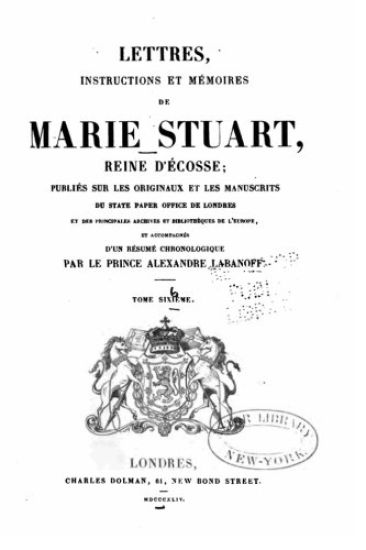
Lettres, instructions et mémoires de Marie Stuart, reine d'Écosse - Tome Sixième
Marie Stuart
Createspace Independent Publishing Platform
2015
nidottu
Lettres, instructions et m moires de Marie Stuart, reine d' cosse - Tome Sixi me by Marie Stuart. This book is a reproduction of the original book published in 1844 and may have some imperfections such as marks or hand-written notes.
The Subjection of Women (1869) by John Stuart Mill (World's Classics)
John Stuart Mill
Createspace Independent Publishing Platform
2016
nidottu

Flora Annie Steel (1847 - 1929) was an English writer who notably lived in British India for 22 years and is best remembered for her books set or related to the sub-continent. Steel's 1917 historical novel "Miss Stuart's Legacy" offers the reader a glimpse into colonial India that is typical with her fiction, weaving a delicate story to the backdrop of British imperialism in an exotic land. An entertaining and insightful read, this book is highly recommended for those with an interest in India's history and will not disappoint those who have read and enjoyed other works by this author. Also by this author: "Tales of the Punjab" (1894), "The Flower of Forgiveness" (1894), and "The Potter's Thumb" (1894). Many vintage books such as this are becoming increasingly scarce and expensive. It is with this in mind that we are republishing this volume now in an affordable, modern, high-quality edition complete with an essay from "The Garden of Fidelity" by R. R. Clark.

A song of heroes (1890) by John Stuart Blackie
John Stuart Blackie
Createspace Independent Publishing Platform
2016
nidottu
He was born in Glasgow, on Charlotte Street, the son of Aberdeen banker, Alexander Blackie (d.1846) and Helen Stodart. He was educated at the New Academy and afterwards at the Marischal College, in Aberdeen, where his father was manager of the Commercial Bank. After attending classes at Edinburgh University (1825-1826), Blackie spent three years at Aberdeen as a student of theology. In 1829 he went to Germany, and after studying at G ttingen and Berlin (where he came under the influence of Heeren, Otfried M ller, Schleiermacher, Neander and B ckh) he accompanied Bunsen to Italy and Rome. The years spent abroad extinguished his former wish to enter the Church, and at his father's desire he gave himself up to the study of law. He had already, in 1824, been placed in a lawyer's office, but only remained there six months. By the time he was admitted a member of the Faculty of Advocates (1834) he had acquired a strong love of the classics and a taste for letters in general. A translation of Goethe's Faust, which he published in 1834, met with considerable success, winning the approbation of Carlyle. After a year or two of desultory literary work he was (May 1839) appointed to the newly instituted chair of Humanity (Latin) in the Marischal College.
The Wise Men of Greece (1877) BY John Stuart Blackie
John Stuart Blackie
Createspace Independent Publishing Platform
2016
nidottu
Biography He was born in Glasgow, on Charlotte Street, the son of Aberdeen banker, Alexander Blackie (d.1846) and Helen Stodart. He was educated at the New Academy and afterwards at the Marischal College, in Aberdeen, where his father was manager of the Commercial Bank. After attending classes at Edinburgh University (1825-1826), Blackie spent three years at Aberdeen as a student of theology. In 1829 he went to Germany, and after studying at G ttingen and Berlin (where he came under the influence of Heeren, Otfried M ller, Schleiermacher, Neander and B ckh) he accompanied Bunsen to Italy and Rome. The years spent abroad extinguished his former wish to enter the Church, and at his father's desire he gave himself up to the study of law. He had already, in 1824, been placed in a lawyer's office, but only remained there six months. By the time he was admitted a member of the Faculty of Advocates (1834) he had acquired a strong love of the classics and a taste for letters in general. A translation of Goethe's Faust, which he published in 1834, met with considerable success, winning the approbation of Carlyle. After a year or two of desultory literary work he was (May 1839) appointed to the newly instituted chair of Humanity (Latin) in the Marischal College. Difficulties arose in the way of his installation, owing to the action of the Presbytery on his refusing to sign unreservedly the Confession of Faith; but these were eventually overcome, and he took up his duties as professor in November 1841. In the following year he married. From the first his professorial lectures were conspicuous for the unconventional enthusiasm with which he endeavoured to revivify the study of the classics; and his growing reputation, added to the attention excited by a translation of Aeschylus which he published in 1850, led to his appointment in 1852 to the professorship of Greek at Edinburgh University, in succession to George Dunbar, a post which he continued to hold for thirty years.
Lays and Legends of Ancient Greece (1880) By John Stuart Blackie
John Stuart Blackie
Createspace Independent Publishing Platform
2016
nidottu
Biography He was born in Glasgow, on Charlotte Street, the son of Aberdeen banker, Alexander Blackie (d.1846) and Helen Stodart. He was educated at the New Academy and afterwards at the Marischal College, in Aberdeen, where his father was manager of the Commercial Bank. After attending classes at Edinburgh University (1825-1826), Blackie spent three years at Aberdeen as a student of theology. In 1829 he went to Germany, and after studying at G ttingen and Berlin (where he came under the influence of Heeren, Otfried M ller, Schleiermacher, Neander and B ckh) he accompanied Bunsen to Italy and Rome. The years spent abroad extinguished his former wish to enter the Church, and at his father's desire he gave himself up to the study of law. He had already, in 1824, been placed in a lawyer's office, but only remained there six months. By the time he was admitted a member of the Faculty of Advocates (1834) he had acquired a strong love of the classics and a taste for letters in general. A translation of Goethe's Faust, which he published in 1834, met with considerable success, winning the approbation of Carlyle. After a year or two of desultory literary work he was (May 1839) appointed to the newly instituted chair of Humanity (Latin) in the Marischal College. Difficulties arose in the way of his installation, owing to the action of the Presbytery on his refusing to sign unreservedly the Confession of Faith; but these were eventually overcome, and he took up his duties as professor in November 1841. In the following year he married. From the first his professorial lectures were conspicuous for the unconventional enthusiasm with which he endeavoured to revivify the study of the classics; and his growing reputation, added to the attention excited by a translation of Aeschylus which he published in 1850, led to his appointment in 1852 to the professorship of Greek at Edinburgh University, in succession to George Dunbar, a post which he continued to hold for thirty years.