

Kirjahaku
Etsi kirjoja tekijän nimen, kirjan nimen tai ISBN:n perusteella.
1000 tulosta hakusanalla Pascal-J-B
Money is an evil that does good, and a good that does evil. It inspires hymns to the prosperity it enables, manifestos about the poor it leaves behind, and diatribes for its corrosion of morality. In The Wisdom of Money, one of the world’s great essayists guides us through the rich commentary that money has generated since ancient times—both the passions and the resentments—as he builds an unfashionable defense of the worldly wisdom of the bourgeoisie.Bruckner begins with the worshippers and the despisers. Sometimes they are the same people—priests, for example, who venerate the poor from within churches of opulence and splendor. This hypocrisy endures in our secular world, he says, not least in his own France, where it is de rigueur even among the rich to feign indifference to money. It is better to speak plainly about money in the old American fashion, in Bruckner’s view. A little more honesty would allow us to see through the myths of money’s omnipotence but also the dangers of the aristocratic, ideological, and religious systems of thought that try to put money in its place. This does not mean we should emulate the mega-rich with their pathologies of consumption, competition, and narcissistic philanthropy. But we could do worse than defy three hundred years of derision from novelists and poets to embrace the unromantic bourgeois virtues of work, security, and moderate comfort. It is wise to have money, Bruckner tells us, and wise to think about it critically.

Happiness today is not just a possibility or an option but a requirement and a duty. To fail to be happy is to fail utterly. Happiness has become a religion--one whose smiley-faced god looks down in rebuke upon everyone who hasn't yet attained the blessed state of perpetual euphoria. How has a liberating principle of the Enlightenment--the right to pursue happiness--become the unavoidable and burdensome responsibility to be happy? How did we become unhappy about not being happy--and what might we do to escape this predicament? In Perpetual Euphoria, Pascal Bruckner takes up these questions with all his unconventional wit, force, and brilliance, arguing that we might be happier if we simply abandoned our mad pursuit of happiness. Gripped by the twin illusions that we are responsible for being happy or unhappy and that happiness can be produced by effort, many of us are now martyring ourselves--sacrificing our time, fortunes, health, and peace of mind--in the hope of entering an earthly paradise. Much better, Bruckner argues, would be to accept that happiness is an unbidden and fragile gift that arrives only by grace and luck. A stimulating and entertaining meditation on the unhappiness at the heart of the modern cult of happiness, Perpetual Euphoria is a book for everyone who has ever bristled at the command to "be happy."
The sexual revolution is justly celebrated for the freedoms it brought--birth control, the decriminalization of abortion, the liberalization of divorce, greater equality between the sexes, women's massive entry into the workforce, and more tolerance of homosexuality. But as Pascal Bruckner, one of France's leading writers, argues in this lively and provocative reflection on the contradictions of modern love, our new freedoms have also brought new burdens and rules--without, however, wiping out the old rules, emotions, desires, and arrangements: the couple, marriage, jealousy, the demand for fidelity, the war between constancy and inconstancy. It is no wonder that love, sex, and relationships today are so confusing, so difficult, and so paradoxical. Drawing on history, politics, psychology, literature, pop culture, and current events, this book--a best seller in France--exposes and dissects these paradoxes. With his customary brilliance and wit, Bruckner traces the roots of sexual liberation back to the Enlightenment in order to explain love's supreme paradox, epitomized by the 1960s oxymoron of "free love": the tension between freedom, which separates, and love, which attaches. Ashamed that our sex lives fail to live up to such liberated ideals, we have traded neuroses of repression for neuroses of inadequacy, and we overcompensate: "Our parents lied about their morality," Bruckner writes, but "we lie about our immorality." Mixing irony and optimism, Bruckner argues that, when it comes to love, we should side neither with the revolutionaries nor the reactionaries. Rather, taking love and ourselves as we are, we should realize that love makes no progress and that its messiness, surprises, and paradoxes are not merely the sources of its pain--but also of its pleasure and glory.
Fascism, communism, genocide, slavery, racism, imperialism--the West has no shortage of reasons for guilt. And, indeed, since the Holocaust and the end of World War II, Europeans in particular have been consumed by remorse. But Pascal Bruckner argues that guilt has now gone too far. It has become a pathology, and even an obstacle to fighting today's atrocities. Bruckner, one of France's leading writers and public intellectuals, argues that obsessive guilt has obscured important realities. The West has no monopoly on evil, and has destroyed monsters as well as created them--leading in the abolition of slavery, renouncing colonialism, building peaceful and prosperous communities, and establishing rules and institutions that are models for the world. The West should be proud--and ready to defend itself and its values. In this, Europeans should learn from Americans, who still have sufficient self-esteem to act decisively in a world of chaos and violence. Lamenting the vice of anti-Americanism that grips so many European intellectuals, Bruckner urges a renewed transatlantic alliance, and advises Americans not to let recent foreign-policy misadventures sap their own confidence. This is a searing, provocative, and psychologically penetrating account of the crude thought and bad politics that arise from excessive bad conscience.

How happiness became mandatory—and why we should reject the demand to "be happy"Happiness today is not just a possibility or an option but a requirement and a duty. To fail to be happy is to fail utterly. Happiness has become a religion—one whose smiley-faced god looks down in rebuke upon everyone who hasn't yet attained the blessed state of perpetual euphoria. How has a liberating principle of the Enlightenment—the right to pursue happiness—become the unavoidable and burdensome responsibility to be happy? How did we become unhappy about not being happy—and what might we do to escape this predicament? In Perpetual Euphoria, Pascal Bruckner takes up these questions with all his unconventional wit, force, and brilliance, arguing that we might be happier if we simply abandoned our mad pursuit of happiness.Gripped by the twin illusions that we are responsible for being happy or unhappy and that happiness can be produced by effort, many of us are now martyring ourselves—sacrificing our time, fortunes, health, and peace of mind—in the hope of entering an earthly paradise. Much better, Bruckner argues, would be to accept that happiness is an unbidden and fragile gift that arrives only by grace and luck.A stimulating and entertaining meditation on the unhappiness at the heart of the modern cult of happiness, Perpetual Euphoria is a book for everyone who has ever bristled at the command to "be happy."

Fertility and Family Planning in the United States
Pascal Kidder Whelpton; Arthur A. Campbell; John E. Patterson
Princeton University Press
2015
pokkari
In 1955 the Scripps Foundation for Research in Population Problems conducted a survey to determine the number of pregnancies and births wives had had, the number of children wanted expected etc. In 1960 a similar study was made, and the results are presented here. Projections on births and population for the US to 1985 are presented. Originally published in 1966. The Princeton Legacy Library uses the latest print-on-demand technology to again make available previously out-of-print books from the distinguished backlist of Princeton University Press. These editions preserve the original texts of these important books while presenting them in durable paperback and hardcover editions. The goal of the Princeton Legacy Library is to vastly increase access to the rich scholarly heritage found in the thousands of books published by Princeton University Press since its founding in 1905.

Fertility and Family Planning in the United States
Pascal Kidder Whelpton; Arthur A. Campbell; John E. Patterson
Princeton University Press
2016
sidottu
In 1955 the Scripps Foundation for Research in Population Problems conducted a survey to determine the number of pregnancies and births wives had had, the number of children wanted expected etc. In 1960 a similar study was made, and the results are presented here. Projections on births and population for the US to 1985 are presented. Originally published in 1966. The Princeton Legacy Library uses the latest print-on-demand technology to again make available previously out-of-print books from the distinguished backlist of Princeton University Press. These editions preserve the original texts of these important books while presenting them in durable paperback and hardcover editions. The goal of the Princeton Legacy Library is to vastly increase access to the rich scholarly heritage found in the thousands of books published by Princeton University Press since its founding in 1905.

An Overture to Geofinance: Global Finance, Geopolitics, and the Wielding of Power: Theory and Praxis
Pascal Vander Straeten
Value4risk LLC
2018
nidottu
Geofinance is about a way of seeing the world. As a true introduction, this work aims at commencing a journey that very few have undertaken, namely witnessing the pioneering of a brand new theory that has an interdisciplinary aspect. Indeed, the world of today can no longer be analysed and understood solely from the perspective of finance, economics, political sciences, or geography. This silo mentality is no longer compatible with the complex world in which we are living. We need a holistic approach that builds bridges between various research fields thereby helping understanding the complex nature of a phenomenon. That phenomenon is geofinance. Intuitively, many among you already perceive how geopolitics affect the world of global finance, but also how the realm of international finance is impacting on world events, and their stakeholders, be it governments, businesses, or individuals. This articulate and incisive introductory textbook shepherds practitioners, cognoscenti, scholars, and students through their first encounter with geofinance. It offers a clear bodywork for exploring contemporary power conflicts by illustrating how the world of geopolitics and the realm of global finance are mutually shaping and interacting with each other. The overarching theme of geofinancial structures (contexts) and geofinancial agents (institutions, markets, individuals wielding financial power, etc.) is accessible and necessitates no previous understanding of theory or current financial affairs.Throughout the book, case studies including the influence of financial markets on geopolitics, the contagion effects between sovereign and banking risks, the influence of geopolitical black swans on the world of international finance, the impact of geofinance on business, etc. emphasize the multi-faceted nature of the complex relationship between global finance and geopolitics in its broadest sense. Reading this book will provide a deeper and critical understanding of current world of global finance and facilitate access to higher level course work and essays on geofinance. Both students of finance, geography, international relations, and mainstream readers alike will find this book an essential stepping-stone to a fuller understanding of contemporary financially driven conflicts.

Truth Wars: The Battle For The Human Heart
Pascal John Imperato; John Pascal
John Pascal Books
2018
nidottu
A beautiful nation crafted by men of faith is under siege by arrogant, elite humanists bent on conquest. Enter this story at Berkard University and live on the battle lines.


When a house explodes with a mother and two children inside, Stan Kobe is called to the horrific crime scene. The father, a former Air Force bomb technician, becomes the key suspect, but mysteriously disappears and is never found. Ten years will pass before another triple homicide occurs with similarities only the savvy prosecutor, Kobe, knows are common to his decade-old cold case. Stan begins an entangled journey to flush out a shaky theory both crimes are related. But while doing so he gets more than he bargains for and uncovers what he believes is an imminent plot by domestic terrorists targeted to strike his city's delicate infrastructure. More disturbing, though, is that he discovers he may be a target too.As the countdown to destruction begins, Stan Kobe embarks upon a frantic race to "render safe" the situation and save his beloved city, but maybe, most importantly, those he loves.

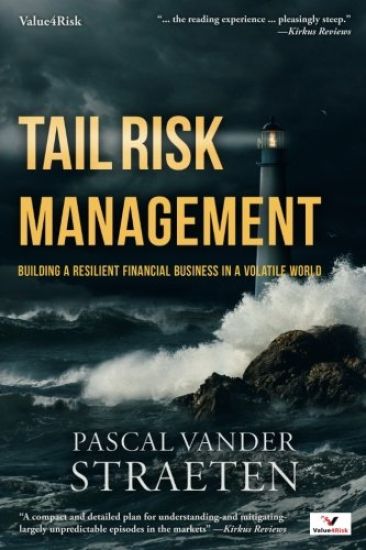
Tail Risk Management: Building a Resilient Financial Business in a Volatile World
Pascal Vander Straeten
Value4risk LLC
2017
nidottu
(This is the Black & White version of the book.)Ever since the collapse of the Bretton Woods system and the deregulation of markets in the 1970-1980s, financial markets have exploded in terms of size, volatility, complexity, and interconnectedness (through globalization and technology). Concomitantly, the frequency and severity of banking crises have equally increased over the last decades.Additionally, the banking regulations of the last decades have focussed a lot on quantitative risk models and probability theories claiming that uncertainty could be measured. However, the severity of the previous banking crisis (2007-2008) proves that disruptions are hard to quantify, and these quantitative risk tools were inadequate in achieving a better resilience of the banks.In other words, large and well-respected financial institutions have experienced failure in the face of tail risks, revealing the inadequate protection provided by current practice. More than just capital management, tail risk management takes a qualitative approach that involves business strategy.As such, although quantitative methods are used most often in risk assessment, their usefulness wanes in the realm of tail risk management. To effectively mitigate extreme risks and preserve a firm's survivability, the focus must be on building a resilient business model. Therefore, this book studies the possibility to enhance the existing risk management framework pertaining to business resilience within the banking industry. Indeed, the dynamic, complex nature of the banking environment necessitates ongoing vigilance to anticipate vulnerabilities, as well as organizational flexibility and agility when disruptions occur.The objective of this book is to borrow risk management concepts from corporate industries that equally operate in extreme environments and transpose them to the banking industry, and see whether they could make the business models of banks more resilient.In Tail Risk Management, author Pascal M. vander Straeten, a twenty-five-year financial services veteran and founder of consulting firm Value4Risk, pulls best practices from across industries to provide a new risk management framework. These principles will guide a business toward necessary changes in modern management practices, regulations, and cultures that can be applied on an enterprise-wide basis, addressing extreme risks at any stage in their development.In the face of a systemic crisis, a resilient business model will provide strong lines of defense against failure. Resilience nowadays is a crucial concern as, notwithstanding the vast array of banking regulations, market participants, as well as other stakeholders, remain wary about the stability of banking organizations. Unquantifiable uncertainties will always exist, and traditional risk management approaches are not adequate. Using this extensive guide, learn what needs to change and why-and how to implement a potentially business-saving strategy.
Tail Risk Management: Building a Resilient Financial Business in a Volatile World
Pascal Vander Straeten
Value4risk LLC
2017
nidottu
This the COLORED version of the book. Although quantitative methods are used most often in risk assessment, their usefulness wanes in the realm of tail risk management. To effectively mitigate extreme risks and preserve a firm's survivability, the focus must be on building a resilient business model.Over the last ten years, large and well-respected financial institutions have experienced failure in the face of tail risks, revealing the inadequate protection provided by current practice. More than just capital management, tail risk management takes a qualitative approach that involves business strategy.In Tail Risk Management, author Pascal M. vander Straeten, a twenty-five-year financial services veteran and founder of consulting firm Value4Risk, pulls best practices from across industries to provide a new risk management framework. These principles will guide a business toward necessary changes in modern management practices, regulations, and cultures that can be applied on an enterprise-wide basis, addressing extreme risks at any stage in their development.In the face of a systemic crisis, a resilient business model will provide strong lines of defense against failure. Unquantifiable uncertainties will always exist, and traditional risk management approaches are not adequate. Using this extensive guide, learn what needs to change and why-and how to implement a potentially business-saving strategy.

Ray thought he would sign up for an easy project at his church: just a couple of visits a week to a hospice patient. He had no idea how God would use His new recruit. Ray found himself trying to save a victim of human trafficking and street kids about to join a Manhattan gang. He considers backing out when he discovers how unhappy organized crime is about losing their source of income. Two goons rough him up, but God still wants him on the job.

If we are to distinguish mere non-being from that which is not, yet may be, from that which was not, yet could have been, or from that which will not be, yet could become, we are committed in some way to grant being to possibilities. The possible is not actual; yet it is not nothing. What then could it be? What ontological status could it possess? In Contingency, Time, and Possibility: An Essay on Aristotle and Duns Scotus, Pascal Massie opens these questions by combining two approaches: First, an original inquiry that analyses the notions of chance, fate, event, contradiction, and so forth, and suggests that the distinction between potency and act arises from a confrontation with the impossible. Second, a historical inquiry that focuses on Aristotle and Duns Scotus, two key figures contributing to a fundamental transformation in the history of Western ontology; namely, the transition from a metaphysics of nature (Aristotle) to a metaphysics of the will (Scotus). In doing so, this book departs from the prevailing interpretation of the history of modal logic according to which Scotus rejected the principle of plenitude attributed to Aristotle and replaced the ancient diachronic theory of possibilities with a synchronic one, thereby contributing to a “possible world’s semantics.” Rather, Massie argues that in its proper ontological import, the question of possibility concerns the limit between being and non-being and that this limit must be thought in terms of temporality. With Scotus, however, a radical shift occurs. Possibilities are understood in terms of will, creation, omnipotence, and transcending freedom. As such, they belong to the realm of what is supremely actual (i.e., superabundant activity). What used to be understood as a lesser degree of being (the quasi non-being of uninformed matter and mere possibilities) becomes the mark of omnipotence.

The planet is sick. Human beings are guilty of damaging it. We have to pay. Today, that is the orthodoxy throughout the Western world. Distrust of progress and science, calls for individual and collective self-sacrifice to ‘save the planet’ and cultivation of fear: behind the carbon commissars, a dangerous and counterproductive ecological catastrophism is gaining ground. Modern society’s susceptibility to this kind of thinking derives from what Bruckner calls “the seductive attraction of disaster,” as exemplified by the popular appeal of disaster movies. But ecological catastrophism is harmful in that it draws attention away from other, more solvable problems and injustices in the world in order to focus on something that is portrayed as an Apocalypse. Rather than preaching catastrophe and pessimism, we need to develop a democratic and generous ecology that addresses specific problems in a practical way.

The planet is sick. Human beings are guilty of damaging it. We have to pay. Today, that is the orthodoxy throughout the Western world. Distrust of progress and science, calls for individual and collective self-sacrifice to ‘save the planet’ and cultivation of fear: behind the carbon commissars, a dangerous and counterproductive ecological catastrophism is gaining ground. Modern society’s susceptibility to this kind of thinking derives from what Bruckner calls “the seductive attraction of disaster,” as exemplified by the popular appeal of disaster movies. But ecological catastrophism is harmful in that it draws attention away from other, more solvable problems and injustices in the world in order to focus on something that is portrayed as an Apocalypse. Rather than preaching catastrophe and pessimism, we need to develop a democratic and generous ecology that addresses specific problems in a practical way.

Today we like to think that marriage is a free choice based on love: that we freely choose whom to marry and that we do so, not so much for survival or social advantage, but for love. The invention of marriage for love inverted the old relationship between love and marriage. In the past, marriage was sacred, and love, if it existed at all, was a consequence of marriage; today, love is sacred and marriage is secondary. But now marriage appears to be becoming increasingly superfluous. For the past forty years or so, the number of weddings has been declining, the number of divorces exploding and the number of unmarried individuals and couples growing, while single-parent families are becoming more numerous. Love has triumphed over marriage but now it is destroying it from inside. So has the ideal of marriage for love failed, and has love finally been liberated from the shackles of marriage? In this brilliant and provocative book Pascal Bruckner argues that the old tension between love and marriage has not been resolved in favour of love, it has simply been displaced onto other levels. Even if it seems more straightforward, the contemporary landscape of love is far from euphoric: as in the past, infidelity, loss and betrayal are central to the plots of modern love, and the disenchantment is all the greater because marriages are voluntary and not imposed. But the collapse of the ideal of marriage for love is not necessarily a cause for remorse, because it demonstrates that love retains its subversive power. Love is not a glue to be put in the service of the institution of marriage: it is an explosive that blows up in our faces, dynamite pure and simple.