Kirjojen hintavertailu. Mukana 12 595 353 kirjaa ja 12 kauppaa.

Kirjailija

Albert Einstein

Kirjat ja teokset yhdessä paikassa: 241 kirjaa, julkaisuja vuosilta 1916-2026, suosituimpien joukossa New Evidence of the Militarization of America. Vertaile teosten hintoja ja tarkista saatavuus suomalaisista kirjakaupoista.

241 kirjaa

Kirjojen julkaisuhaarukka 1916-2026.

The World as I See it

The World as I See it

Albert Einstein

General Press
2018
nidottu
The most advanced and celebrated mind of the 20th Century, without a doubt, is attributed to Albert Einstein. This interesting book allows us to explore his beliefs, philosophical ideas, and opinions on many subjects. Subjects include politics, religion, education, the meaning of life, Jewish issues, the world economy, peace and pacifism.
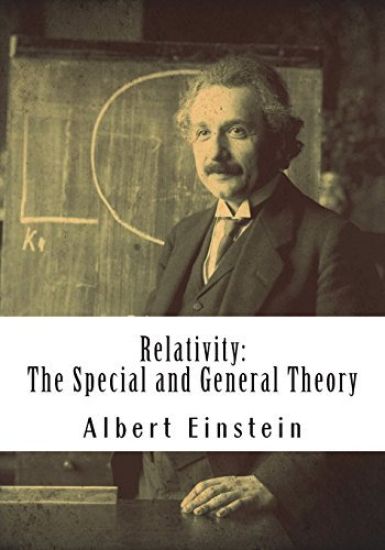
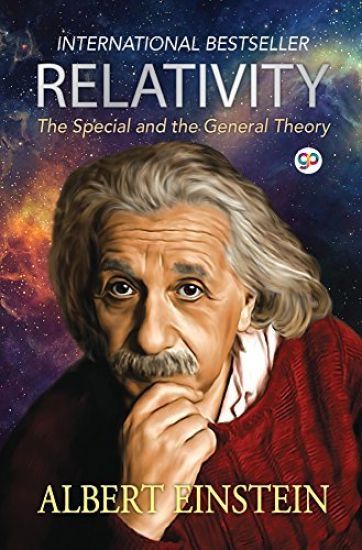
Relativity: The Special and General Theory

Relativity: The Special and General Theory

Albert Einstein

Createspace Independent Publishing Platform
2018
nidottu
The present book is intended, as far as possible, to give an exact insight into the theory of Relativity to those readers who, from a general scientific and philosophical point of view, are interested in the theory, but who are not conversant with the mathematical apparatus of theoretical physics. The work presumes a standard of education corresponding to that of a university matriculation examination, and, despite the shortness of the book, a fair amount of patience and force of will on the part of the reader. The author has spared himself no pains in his endeavour to present the main ideas in the simplest and most intelligible form, and on the whole, in the sequence and connection in which they actually originated. In the interest of clearness, it appeared to me inevitable that I should repeat myself frequently, without paying the slightest attention to the elegance of the presentation. I adhered scrupulously to the precept of that brilliant theoretical physicist L. Boltzmann, according to whom matters of elegance ought to be left to the tailor and to the cobbler. I make no pretence of having withheld from the reader difficulties which are inherent to the subject. On the other hand, I have purposely treated the empirical physical foundations of the theory in a "step-motherly" fashion, so that readers unfamiliar with physics may not feel like the wanderer who was unable to see the forest for the trees. May the book bring some one a few happy hours of suggestive thought
The Travel Diaries of Albert Einstein

The Travel Diaries of Albert Einstein

Albert Einstein

PRINCETON UNIVERSITY PRESS
2018
sidottu
Albert Einstein’s travel diary to the Far East and Middle EastIn the fall of 1922, Albert Einstein, along with his then-wife, Elsa Einstein, embarked on a five-and-a-half-month voyage to the Far East and Middle East, regions that the renowned physicist had never visited before. Einstein's lengthy itinerary consisted of stops in Hong Kong and Singapore, two brief stays in China, a six-week whirlwind lecture tour of Japan, a twelve-day tour of Palestine, and a three-week visit to Spain. This handsome edition makes available the complete journal that Einstein kept on this momentous journey.The telegraphic-style diary entries record Einstein's musings on science, philosophy, art, and politics, as well as his immediate impressions and broader thoughts on such events as his inaugural lecture at the future site of the Hebrew University in Jerusalem, a garden party hosted by the Japanese Empress, an audience with the King of Spain, and meetings with other prominent colleagues and statesmen. Entries also contain passages that reveal Einstein's stereotyping of members of various nations and raise questions about his attitudes on race. This beautiful edition features stunning facsimiles of the diary's pages, accompanied by an English translation, an extensive historical introduction, numerous illustrations, and annotations. Supplementary materials include letters, postcards, speeches, and articles, a map of the voyage, a chronology, a bibliography, and an index.Einstein would go on to keep a journal for all succeeding trips abroad, and this first volume of his travel diaries offers an initial, intimate glimpse into a brilliant mind encountering the great, wide world.
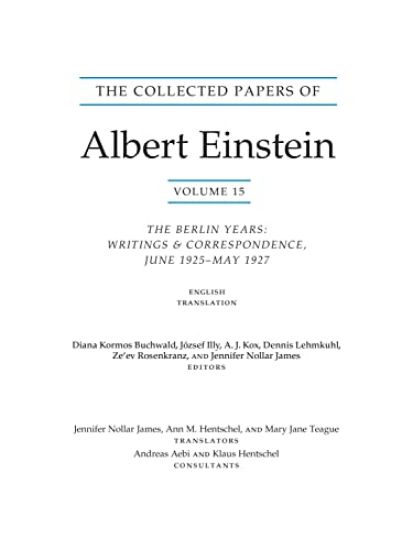
The Collected Papers of Albert Einstein, Volume 15

The Collected Papers of Albert Einstein, Volume 15

Albert Einstein

PRINCETON UNIVERSITY PRESS
2018
sidottu
This volume covers one of the most thrilling two-year periods in twentieth-century physics, as matrix mechanics—developed chiefly by W. Heisenberg, M. Born, and P. Jordan—and wave mechanics—developed by E. Schrödinger—supplanted the earlier quantum theory. The almost one hundred writings by Einstein, of which a third have never been published, and the more than thirteen hundred letters show Einstein’s immense productivity and hectic pace of life.Einstein quickly grasps the conceptual peculiarities involved in the new quantum mechanics, such as the difference between Schrödinger’s wave function and a field defined in spacetime, or the emerging statistical interpretation of both matrix and wave mechanics. Inspired by correspondence with G. Y. Rainich, he investigates with Jakob Grommer the problem of motion in general relativity, hoping for a hint at a new avenue to unified field theory.Einstein falls victim to scientific fraud when, in a collaboration with E. Rupp, he becomes convinced that the latter’s experiments, aimed at deciding whether excited atoms emit light instantaneously (in quanta) or in a finite time (in waves), confirm a wave-theoretic explanation.While it was known that the teenage Einstein had been romantically involved with Marie Winteler in 1895, newly discovered documents reveal that his love for Marie was rekindled in 1909–10 while he was still married to Mileva Maric.The 1925 Locarno Treaties renew Einstein’s optimism in European reconciliation. He backs the “International manifesto against compulsory military service” and continues his participation in the League of Nations’ International Committee on Intellectual Cooperation. He remains intensely committed to the shaping of the Hebrew University in Jerusalem, although his enthusiasm for this cause is sorely tested.
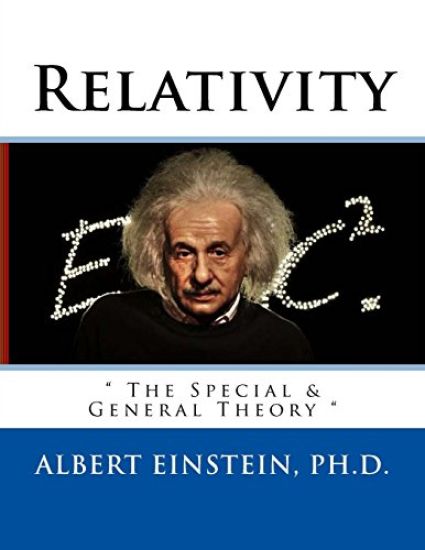
Relativity: The Special & General Theory

Relativity: The Special & General Theory

Albert Einstein

Createspace Independent Publishing Platform
2018
nidottu
The theory of relativity usually encompasses two interrelated theories by Albert Einstein: special relativity and general relativity. Special relativity applies to elementary particles and their interactions, describing all their physical phenomena except gravity. General relativity explains the law of gravitation and its relation to other forces of nature. It applies to the cosmological and astrophysical realm, including astronomy.The theory transformed theoretical physics and astronomy during the 20th century, superseding a 200-year-old theory of mechanics created primarily by Isaac Newton. It introduced concepts including spacetime as a unified entity of space and time, relativity of simultaneity, kinematic and gravitational time dilation, and length contraction. In the field of physics, relativity improved the science of elementary particles and their fundamental interactions, along with ushering in the nuclear age. With relativity, cosmology and astrophysics predicted extraordinary astronomical phenomena such as neutron stars, black holes, and gravitational waves.
The Collected Papers of Albert Einstein, Volume 15 (Translation Supplement)
A translation of selected non-English texts included in Volume 15 is available in paperback. Since this supplementary paperback includes only select portions of Volume 15, it is not recommended for purchase without the main volume.Every document in The Collected Papers of Albert Einstein appears in the language in which it was written, and this supplementary paperback volume presents the English translations of select portions of non-English materials in Volume 15. This translation does not include notes or annotation of the documentary volume and is not intended for use without the original language documentary edition which provides the extensive editorial commentary necessary for a full historical and scientific understanding of the documents.
Relativity

Relativity

Albert Einstein

General Press
2018
sidottu
Albert Einstein is the unquestioned founder of modern physics. His theory of relativity is the most important scientific idea of the modern era. In this book Einstein explains, using the minimum of mathematical terms, the basic ideas and principles of the theory which has shaped the world we live in today. Unsurpassed by any subsequent books on relativity, this remains the most popular and useful exposition of Einstein's immense contribution to human knowledge. In this work Einstein intended, as far as possible, to give an exact insight into the theory of relativity to those readers who, from a general and scientific philosophical point of view, are interested in the theory, but who are not conversant with the mathematical apparatus of theoretical physics. The theory of relativity enriched physics and astronomy during the 20th century.
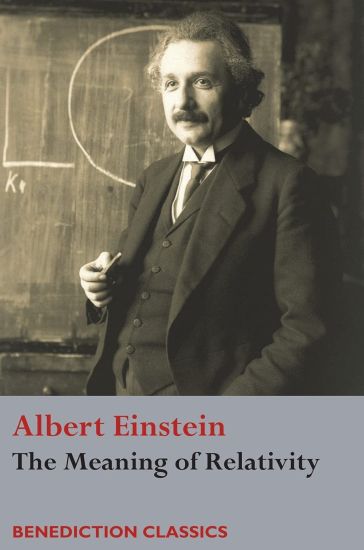
The Meaning of Relativity

The Meaning of Relativity

Albert Einstein

BENEDICTION CLASSICS
2017
sidottu
A must read for all students of physics.While many have written on relativity, this book remains one of the most lucid explanations of the special and general theories ever written. Einstein has a particular authority. He presents the facts but also exposes the thought processes that led him to them, the physical interpretation of his theory.
The Meaning of Relativity

The Meaning of Relativity

Albert Einstein

Benediction Classics
2017
pokkari
While many have written on relativity, this book remains one of the most lucid explanations of the special and general theories ever written. Einstein has a particular authority. He presents the facts but also exposes the thought processes that led him to them.
Relativity - The Special and General Theory/ Sidelights on Relativity

Relativity - The Special and General Theory/ Sidelights on Relativity

Albert Einstein

Createspace Independent Publishing Platform
2017
nidottu
Relativity - The Special and General Theory/ Sidelights on Relativity is a compilation of two classic Albert Einstein physics papers. Special relativity is a theory of the structure of spacetime. It was introduced in Einstein's 1905 paper "On the Electrodynamics of Moving Bodies" (for the contributions of many other physicists see History of special relativity). Special relativity is based on two postulates which are contradictory in classical mechanics: The laws of physics are the same for all observers in uniform motion relative to one another (principle of relativity). The speed of light in a vacuum is the same for all observers, regardless of their relative motion or of the motion of the light source. The resultant theory copes with experiment better than classical mechanics. For instance, postulate 2 explains the results of the Michelson-Morley experiment. Moreover, the theory has many surprising and counterintuitive consequences. Some of these are: Relativity of simultaneity: Two events, simultaneous for one observer, may not be simultaneous for another observer if the observers are in relative motion. Time dilation: Moving clocks are measured to tick more slowly than an observer's "stationary" clock. Length contraction: Objects are measured to be shortened in the direction that they are moving with respect to the observer. Maximum speed is finite: No physical object, message or field line can travel faster than the speed of light in a vacuum. The effect of Gravity can only travel through space at the speed of light, not faster or instantaneously. Mass-energy equivalence: E = mc2, energy and mass are equivalent and transmutable. Relativistic mass, idea used by some researchers. The defining feature of special relativity is the replacement of the Galilean transformations of classical mechanics by the Lorentz transformations. General relativity is a theory of gravitation developed by Einstein in the years 1907-1915. The development of general relativity began with the equivalence principle, under which the states of accelerated motion and being at rest in a gravitational field (for example, when standing on the surface of the Earth) are physically identical. The upshot of this is that free fall is inertial motion: an object in free fall is falling because that is how objects move when there is no force being exerted on them, instead of this being due to the force of gravity as is the case in classical mechanics. This is incompatible with classical mechanics and special relativity because in those theories inertially moving objects cannot accelerate with respect to each other, but objects in free fall do so. To resolve this difficulty Einstein first proposed that spacetime is curved. In 1915, he devised the Einstein field equations which relate the curvature of spacetime with the mass, energy, and any momentum within it. Some of the consequences of general relativity are: Clocks run slower in deeper gravitational wells. This is called gravitational time dilation. Orbits precess in a way unexpected in Newton's theory of gravity. (This has been observed in the orbit of Mercury and in binary pulsars). Rays of light bend in the presence of a gravitational field. Rotating masses "drag along" the spacetime around them; a phenomenon termed "frame-dragging". The universe is expanding, and the far parts of it are moving away from us faster than the speed of light. Technically, general relativity is a theory of gravitation whose defining feature is its use of the Einstein field equations. The solutions of the field equations are metric tensors which define the topology of the spacetime and how objects move inertially.
Relativity: The Special and the General Theory

Relativity: The Special and the General Theory

Albert Einstein

Fingerprint! Publishing
2017
nidottu
Discover Albert Einstein's groundbreaking theories with ""Relativity: The Special and the General Theory."" This influential work provides a comprehensive exploration of the principles that revolutionized our understanding of space, time, and gravity. A must-read for science enthusiasts and those intrigued by the mysteries of the universe. Albert Einstein's revolutionary work, ""Relativity: The Special and the General Theory"" Explore the profound principles that reshaped our understanding of the universe Dive into the concepts of space, time, and gravity Perfect for science enthusiasts and those interested in theoretical physics A thought-provoking addition to any book collection, unlocking the secrets of the cosmos.
RELATIVITY

RELATIVITY

Albert Einstein

Rupa Co
2017
nidottu
Along with quantum mechanics in the 1920s, Einstein's Special Theory of Relativity (1905) and General Theory of Relativity (1916) stand as the supreme achievements of twentieth-century physics. In simplest terms, the theory of Relativity is an approach to the measurement and study of space and time. The theory assumes that findings are based upon the relation of the frame of reference to the objects measured. The Special Theory of Relativity is primarily concerned with electric and magnetic phenomena. The General Theory focuses on gravity-not as a force as Newton postulated-but as a curved field in the space-time continuum, created by the presence of mass. Redesigned to present an easier reading, Relativity includes both explanatory illustrations and mathematical derivations of Einstein's theories. This book brings out the great scientist's remarkable ability to penetrate directly into the heart of the subject and yet remain lucid and accessible.
Relativity: The Special And General Theory

Relativity: The Special And General Theory

Albert Einstein

Createspace Independent Publishing Platform
2016
nidottu
Special Relativity was originally proposed in 1905 by Albert Einstein in the paper "On the Electrodynamics of Moving Bodies". The inconsistency of Newtonian mechanics with Maxwell's equations of electromagnetism and the lack of experimental con rmation for a hypothesized luminiferous aether led to the development of special relativity, which corrects mechanics to handle situations involving motions nearing the speed of light. Special relativity implies a wide range of consequences, which have been experimentally veri ed, including length contraction, time dilation, relativistic mass, mass-energy equivalence, a universal speed limit and relativity of simultaneity. It has replaced the conventional notion of an absolute universal time with the notion of a time that is dependent on reference frame and spatial position. General Relativity (GR, also known as the general theory of relativity or GTR) is the geometric theory of gravitation published by Albert Einstein in 1915 and the current description of gravitation in modern physics.Each RADLEY CLASSIC is a meticulously restored, luxurious and faithful reproduction of a classic book; produced with elegant text layout, clarity of presentation, and stylistic features that make reading a true pleasure. Special attention is given to legible fonts and adequate letter sizing, correct line length for readability, generous margins and triple lead (lavish line separation); plus we do not allow any mistakes/changes/ additions to creep into the original author's words.Visit RADLEY BOOKS at www.radleybooks.com to see more classic book titles in this series.