Kirjojen hintavertailu. Mukana 12 473 035 kirjaa ja 12 kauppaa.
Kirjailija
Amartya Sen
Kirjat ja teokset yhdessä paikassa: 71 kirjaa, julkaisuja vuosilta 1973-2023, suosituimpien joukossa Identität und Gewalt. Vertaile teosten hintoja ja tarkista saatavuus suomalaisista kirjakaupoista.
At this time when many have lost hope amidst conflicts, terrorism, environmental destruction, economic inequality and the breakdown of democracy, this beautifully written book outlines how to rethink and reform our key institutions - markets, corporations, welfare policies, democratic processes and transnational governance - to create better societies based on core principles of human dignity, sustainability, and justice. This new vision is based on the findings of over 300 social scientists involved in the collaborative, interdisciplinary International Panel on Social Progress. Relying on state-of-the-art scholarship, these social scientists reviewed the desirability and possibility of all relevant forms of long-term social change, explored current challenges, and synthesized their knowledge on the principles, possibilities, and methods for improving the main institutions of modern societies. Their common finding is that a better society is indeed possible, its contours can be broadly described, and all we need is to gather forces toward realizing this vision.
Development seen from a more holistic perspective looks beyond the expansion of material means and considers the enrichment of people's lives. The arts are an indispensable asset in taking a comprehensive approach toward the improvement of lives. Incorporating aspects of international trade, education, sustainability, gender, mental health and social inclusion, The Creative Wealth of Nations demonstrates the diverse impact of applying the arts in development to promote meaningful economic and social progress. Patrick Kabanda explores a counterintuitive and largely invisible creative economy: whilst many artists struggle to make ends meet, the arts can also be a promising engine for economic growth. If nations can fully engage their creative wealth manifested in the arts, they are likely to reap major monetary and nonmonetary benefits from their cultural sector. Drawing from his own experience of the support music provided growing up amidst political and economic turmoil in Uganda, Kabanda shows us the benefits of an arts-inclusive approach to development in Africa, and beyond.
Development seen from a more holistic perspective looks beyond the expansion of material means and considers the enrichment of people's lives. The arts are an indispensable asset in taking a comprehensive approach toward the improvement of lives. Incorporating aspects of international trade, education, sustainability, gender, mental health and social inclusion, The Creative Wealth of Nations demonstrates the diverse impact of applying the arts in development to promote meaningful economic and social progress. Patrick Kabanda explores a counterintuitive and largely invisible creative economy: whilst many artists struggle to make ends meet, the arts can also be a promising engine for economic growth. If nations can fully engage their creative wealth manifested in the arts, they are likely to reap major monetary and nonmonetary benefits from their cultural sector. Drawing from his own experience of the support music provided growing up amidst political and economic turmoil in Uganda, Kabanda shows us the benefits of an arts-inclusive approach to development in Africa, and beyond.
Originally published in 1970, this classic study has been recognized for its groundbreaking role in integrating economics and ethics, and for its influence in opening up new areas of research in social choice, including aggregative assessment. It has also had a large influence on international organizations, including the United Nations, notably in its work on human development. The book showed that the "impossibility theorems" in social choice theory--led by the pioneering work of Kenneth Arrow--do not negate the possibility of reasoned and democratic social choice. Sen's ideas about social choice, welfare economics, inequality, poverty, and human rights have continued to evolve since the book's first appearance. This expanded edition preserves the text of the original while presenting eleven new chapters of fresh arguments and results. "Expanding on the early work of Condorcet, Pareto, Arrow, and others, Sen provides rigorous mathematical argumentation on the merits of voting mechanisms...For those with graduate training, it will serve as a frequently consulted reference and a necessity on one's book shelf."--J. F. O'Connell, Choice
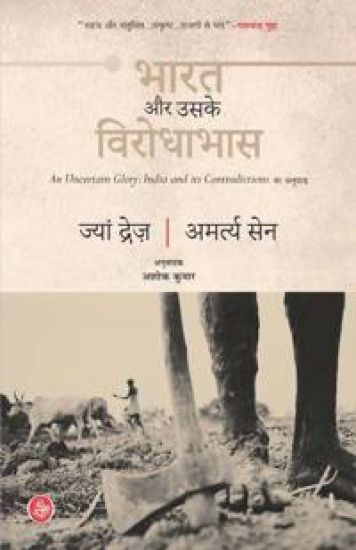
नब्बे के बाद भारतीय अर्थव्यवस्था ने सकल घरेलू उत्पाद में वृद्धि के लिहाज़ से अच्छी प्रगति की है। उपनिवेशवादी शासन तले जो देश सदियों तक एक निम्न आय अर्थव्यवस्था के रूप में गतिरोध का शिकार बना रहा और आज़ादी के बाद भी कई दशकों तक बेहद धीमी रफ्तार से आगे बढ़ा, उसके लिए यह निश्चित ही एक बड़ी उपलब्धि है।लेकिन ऊँची और टिकाऊ वृद्धि दर को हासिल करने में सफलता अन्तत इसी बात से आँकी जाएगी कि इस आर्थिक वृद्धि का लोगों के जीवन तथा उनकी स्वाधीनताओं पर क्या प्रभाव पड़ा है। भारत आर्थिक वृद्धि दर की सीढ़ियाँ तेज़ी से तो चढ़ता गया है लेकिन जीवन-स्तर के सामाजिक संकेतकों के पैमाने पर वह पिछड़ गया है-यहाँ तक कि उन देशों के मुकाबले भी जिनसे वह आर्थिक वृद्धि के मामले में आगे बढ़ा है।दुनिया में आर्थिक वृद्धि के इतिहास में ऐसे कुछ ही उदाहरण मिलते हैं कि कोई देश इतने लम्बे समय तक तेज़ आर्थिक वृद्धि करता रहा हो और मानव विकास के मामले में उसकी उपलब्धियाँ इतनी सीमित रही हों। इसे देखते हुए भारत में आर्थिक वृद्धि और सामाजिक प्रगति के बीच जो सम्बन्ध है उसका गहरा विश्लेषण लम्बे अरसे से अपेक्षित है। यह पुस्तक बताती है कि इन पारस्परिक सम्बन्धों के बारे में समझदारी का प्रभावी उपयोग किस तरह किया जा सकता है। जीवन-स्तर में सुधार तथा उनकी बेहतरी की दिशा में प्रगति और अन्तत आर्थिक वृद्धि भी इसी पर निर्भर है।- 'शिष्ट और नियंत्रित... उत्कृष्ट... नवीन।' -रामचन्द्र गुहा, फाइनेंशियल टाइम्स - 'बेहतरीन... दुनिया के दो सबसे अनुभवी और बौद्धिक प्रत्यक्षदर्शियों की कलम से।' -विलियम डेलरिम्पल, न्यू स्टेट्समैन - 'प्रोफेसर अमर्त्य सेन और ज्यां द्रेज़ अपनी किताब से आपको सोचने पर मजबूर कर देते हैं... भारत के लिए सबसे बड़ी चिन्ता की बात आज के समाज में बढ़ती हुई असमानताएँ होनी चाहिए।' -र
Reading books is a kind of enjoyment. Reading books is a good habit. We bring you a different kinds of books. You can carry this book where ever you want. It is easy to carry. It can be an ideal gift to yourself and to your loved ones. Care instruction keep away from fire.
"Can the values which individual members of society attach to different alternatives be aggregated into values for society as a whole, in a way that is both fair and theoretically sound? Is the majority principle a workable rule for making decisions? How should income inequality be measured? When and how can we compare the distribution of welfare in different societies?" So reads the 1998 Nobel citation by the Swedish Academy, acknowledging Amartya Sen's important contributions in welfare economics and particularly his work in Collective Choice and Social Welfare. Originally published in 1970, this classic study has been recognized for its groundbreaking role in integrating economics and ethics, and for its influence in opening up new areas of research in social choice, including aggregative assessment. It has also had a large influence on international organizations, including the United Nations, notably in its work on human development. The book showed that the "impossibility theorems" in social choice theory--led by the pioneering work of Kenneth Arrow--do not negate the possibility of reasoned and democratic social choice. Sen's ideas about social choice, welfare economics, inequality, poverty, and human rights have continued to evolve since the book's first appearance. This expanded edition preserves the text of the original while presenting eleven new chapters of fresh arguments and results. Both the new and original chapters alternate between nonmathematical treatments of Sen's subjects, accessible to all, and mathematical arguments and proofs. A new introduction gives a far-reaching, up-to-date overview of the subject of social choice.
Nobel Prize winner Amartya Sen's first great book, now reissued in a fully revised and expanded second edition'Can the values which individual members of society attach to different alternatives be aggregated into values for society as a whole, in a way that is both fair and theoretically sound? Is the majority principle a workable rule for making decisions? How should income inequality be measured? When and how can we compare the distribution of welfare in different societies?'These questions, from the citation by the Swedish Academy of Sciences when Amartya Sen was awarded the Nobel Memorial Prize in Economics, refer to his work in Collective Choice and Social Welfare, the most important of all his early books. Originally published in 1970, this classic work in welfare economics has been recognized for its ground-breaking role in integrating economics and ethics, and for its influence in opening up new areas of research in social choice, including aggregative assessment. It has also had a large influence on international organizations, including the United Nations, particularly in its work on human development. In its original version, the book showed that the 'impossibility theorems' in social choice theory-led by the pioneering work of Kenneth Arrow-need not be seen as destructive of the possibility of reasoned and democratic social choice. Sen's ideas about social choice, welfare economics, inequality, poverty and human rights have continued to evolve since the book's first appearance. This expanded edition, which begins by reproducing the 1970 edition in its entirety, goes on to present eleven new chapters of new arguments and results. As in the original version, the new chapters alternate between non-mathematical chapters completely accessible to all, and those which present mathematical arguments and proofs. The reader who prefers to shun mathematics can follow all the non-mathematical chapters on their own, to receive a full, informal understanding. There is also a substantial new introduction which gives a superb overview of the whole subject of social choice.
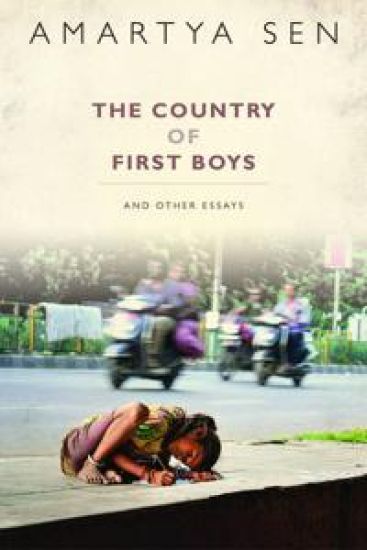
Time and again Amartya Sen, Nobel laureate and polymath, has stimulated our thoughts and world-view through his ideas. In his new collection of cultural essays Sen examines social justice and welfare, by addressing some of the fundamental issues of our time like deprivation, disparity, hunger, illiteracy, alienation, globalization, media, freedom of speech, injustice, inequality, exclusion, and exploitation. Sens deeply informed and humane writing connects history, culture, literature, economics, and politics. Several of the essays are concerned particularly with India - its historical traditions and the issues it faces today; many - such as his address to the General Assembly of the United Nations in 2004 - engage with global concerns. All are written with a passion and conviction, a gently persuasive style, and a characteristically undogmatic engagement with differing points of view. Most of these essays were first published in the Indian literary publication The Little Magazine. Others are published here for the first time. The book is introduced by Gopalkrishna Gandhi, former Indian diplomat and governor of West Bengal, who is also the grandson of Mahatma Gandhi.
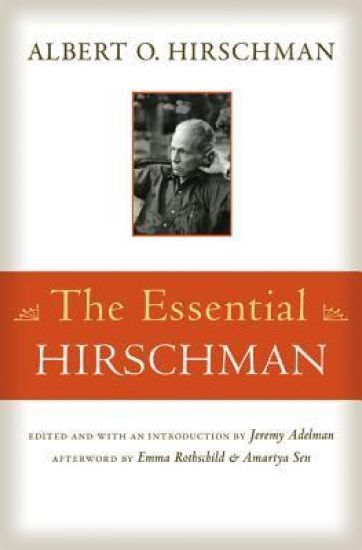
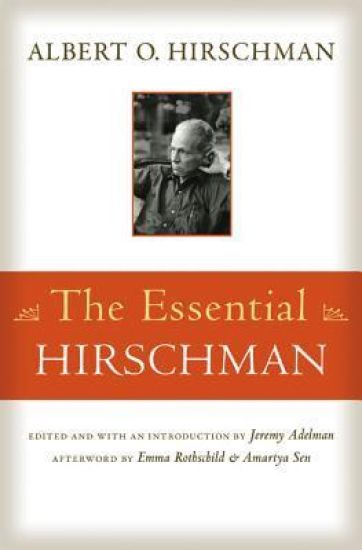
The Essential Hirschman brings together some of the finest essays in the social sciences, written by one of the twentieth century's most influential and provocative thinkers. Albert O. Hirschman was a master essayist, one who possessed the rare ability to blend the precision of economics with the elegance of literary imagination. In an age in which our academic disciplines require ever-greater specialization and narrowness, it is rare to encounter an intellectual who can transform how we think about inequality by writing about traffic, or who can slip in a quote from Flaubert to reveal something surprising about taxes. The essays gathered here span an astonishing range of topics and perspectives, including industrialization in Latin America, imagining reform as more than repair, the relationship between imagination and leadership, routine thinking and the marketplace, and the ways our arguments affect democratic life. Throughout, we find humor, unforgettable metaphors, brilliant analysis, and elegance of style that give Hirschman such a singular voice. Featuring an introduction by Jeremy Adelman that places each of these essays in context as well as an insightful afterword by Emma Rothschild and Amartya Sen, The Essential Hirschman is the ideal introduction to Hirschman for a new generation of readers and a must-have collection for anyone seeking his most important writings in one book.
Why India's problems won't be solved by rapid economic growth alone When India became independent in 1947 after two centuries of colonial rule, it immediately adopted a firmly democratic political system, with multiple parties, freedom of speech, and extensive political rights. The famines of the British era disappeared, and steady economic growth replaced the economic stagnation of the Raj. The growth of the Indian economy quickened further over the last three decades and became the second fastest among large economies. Despite a recent dip, it is still one of the highest in the world. Maintaining rapid as well as environmentally sustainable growth remains an important and achievable goal for India. In An Uncertain Glory, two of India's leading economists argue that the country's main problems lie in the lack of attention paid to the essential needs of the people, especially of the poor, and often of women. There have been major failures both to foster participatory growth and to make good use of the public resources generated by economic growth to enhance people's living conditions. There is also a continued inadequacy of social services such as schooling and medical care as well as of physical services such as safe water, electricity, drainage, transportation, and sanitation. In the long run, even the feasibility of high economic growth is threatened by the underdevelopment of social and physical infrastructure and the neglect of human capabilities, in contrast with the Asian approach of simultaneous pursuit of economic growth and human development, as pioneered by Japan, South Korea, and China. In a democratic system, which India has great reason to value, addressing these failures requires not only significant policy rethinking by the government, but also a clearer public understanding of the abysmal extent of social and economic deprivations in the country. The deep inequalities in Indian society tend to constrict public discussion, confining it largely to the lives and concerns of the relatively affluent. Dr ze and Sen present a powerful analysis of these deprivations and inequalities as well as the possibility of change through democratic practice.
Kenneth J. Arrow's pathbreaking "impossibility theorem" was a watershed innovation in the history of welfare economics, voting theory, and collective choice, demonstrating that there is no voting rule that satisfies the four desirable axioms of decisiveness, consensus, nondictatorship, and independence. In this book Eric Maskin and Amartya Sen explore the implications of Arrow's theorem. Sen considers its ongoing utility, exploring the theorem's value and limitations in relation to recent research on social reasoning, and Maskin discusses how to design a voting rule that gets us closer to the ideal-given the impossibility of achieving the ideal. The volume also contains a contextual introduction by social choice scholar Prasanta K. Pattanaik and commentaries from Joseph E. Stiglitz and Kenneth J. Arrow himself, as well as essays by Maskin, Dasgupta, and Sen outlining the mathematical proof and framework behind their assertions.
The Essential Hirschman brings together some of the finest essays in the social sciences, written by one of the twentieth century's most influential and provocative thinkers. Albert O. Hirschman was a master essayist, one who possessed the rare ability to blend the precision of economics with the elegance of literary imagination. In an age in which our academic disciplines require ever-greater specialization and narrowness, it is rare to encounter an intellectual who can transform how we think about inequality by writing about traffic, or who can slip in a quote from Flaubert to reveal something surprising about taxes. The essays gathered here span an astonishing range of topics and perspectives, including industrialization in Latin America, imagining reform as more than repair, the relationship between imagination and leadership, routine thinking and the marketplace, and the ways our arguments affect democratic life. Throughout, we find humor, unforgettable metaphors, brilliant analysis, and elegance of style that give Hirschman such a singular voice. Featuring an introduction by Jeremy Adelman that places each of these essays in context as well as an insightful afterword by Emma Rothschild and Amartya Sen, The Essential Hirschman is the ideal introduction to Hirschman for a new generation of readers and a must-have collection for anyone seeking his most important writings in one book.
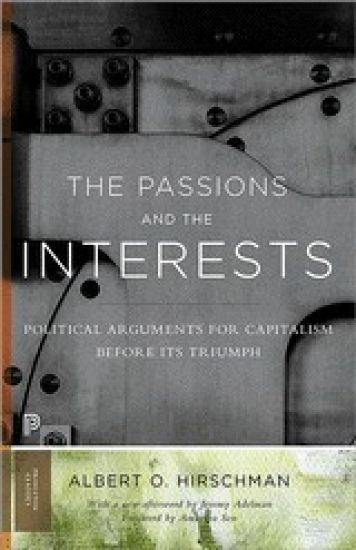
In this volume, Albert Hirschman reconstructs the intellectual climate of the seventeenth and eighteenth centuries to illuminate the intricate ideological transformation that occurred, wherein the pursuit of material interests--so long condemned as the deadly sin of avarice--was assigned the role of containing the unruly and destructive passions of man. Hirschman here offers a new interpretation for the rise of capitalism, one that emphasizes the continuities between old and new, in contrast to the assumption of a sharp break that is a common feature of both Marxian and Weberian thinking. Among the insights presented here is the ironical finding that capitalism was originally supposed to accomplish exactly what was soon denounced as its worst feature: the repression of the passions in favor of the "harmless," if one-dimensional, interests of commercial life. To portray this lengthy ideological change as an endogenous process, Hirschman draws on the writings of a large number of thinkers, including Montesquieu, Sir James Steuart, and Adam Smith. Featuring a new afterword by Jeremy Adelman and a foreword by Amartya Sen, this Princeton Classics edition of The Passions and the Interests sheds light on the intricate ideological transformation from which capitalism emerged triumphant, and reaffirms Hirschman's stature as one of our most influential and provocative thinkers.
This book is motivated by the idea that the cost of inaction can be much greater than the cost of action. Inaction can lead to serious negative consequences—for individuals, the economy, and society. The consequences of a failure to reduce extreme poverty, for example, typically include malnutrition, preventable morbidity, premature mortality, incomplete basic education, and other human and social development costs. In this volume, the authors seek to clarify exactly what is meant by “cost of inaction.” They develop a methodology to account for the consequences and estimate the costs of a failure to respond to the needs of children and their families. Their conceptual framework emphasizes the need to select appropriate actions against which inaction is evaluated. The authors present the results of applying the cost of inaction (COI) approach to six case studies from Rwanda and Angola. The case studies highlight important differences between the COI approach and benefit-cost analysis as it is traditionally implemented.
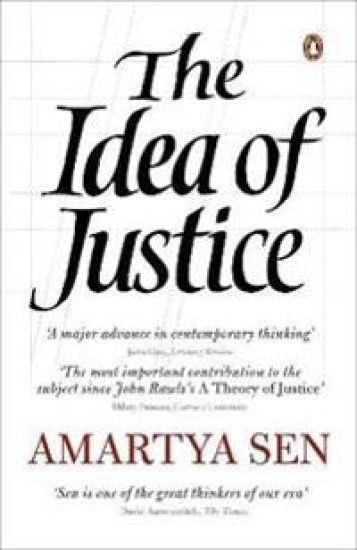
Social justice: an ideal, forever beyond our grasp; or one of many practical possibilities? More than a matter of intellectual discourse, the idea of justice plays a real role in how--and how well--people live. And in this book the distinguished scholar Amartya Sen offers a powerful critique of the theory of social justice that, in its grip on social and political thinking, has long left practical realities far behind. The transcendental theory of justice, the subject of Sen's analysis, flourished in the Enlightenment and has proponents among some of the most distinguished philosophers of our day; it is concerned with identifying perfectly just social arrangements, defining the nature of the perfectly just society. The approach Sen favors, on the other hand, focuses on the comparative judgments of what is "more" or "less" just, and on the comparative merits of the different societies that actually emerge from certain institutions and social interactions. At the heart of Sen's argument is a respect for reasoned differences in our understanding of what a "just society" really is. People of different persuasions--for example, utilitarians, economic egalitarians, labor right theorists, no--nonsense libertarians--might each reasonably see a clear and straightforward resolution to questions of justice; and yet, these clear and straightforward resolutions would be completely different. In light of this, Sen argues for a comparative perspective on justice that can guide us in the choice between alternatives that we inevitably face.
From Nobel Prize-winning economist Amartya Sen, The Idea of Justice is a refreshing alternative approach to mainstream theories of justice. Is justice an ideal, for ever beyond our grasp, or something that may actually guide our practical decisions and enhance our lives? At the heart of Sen's argument is his insistence on the role of public reason in establishing what can make societies less unjust. But there are always choices to be made between alternative assessments of what is reasonable, and competing positions can each be well defended. Rather than rejecting these pluralities, we should use them to construct a theory of justice that can accommodate divergent points of view. Sen also inspiringly shows how the principles of justice in the modern world must avoid parochialism and address vital questions of global injustice. The breadth of vision, intellectual acuity and striking humanity of one of the world's leading public intellectuals have never been more clearly shown than in this remarkable book. 'A major advance in contemporary thinking' John Gray, Literary Review 'The most important contribution to the subject since John Rawls's A Theory of Justice' Hilary Putnam, Harvard University 'Sen writes with dry wit, a feel for history and a relaxed cosmopolitanism ... a conviction that economists and philosophers are in business to improve the world burns on almost every page' Economist 'Sen's magisterial critique of the dominant mode of liberal political philosophy confirms him as the English-speaking world's pre-eminent public intellectual' New Statesman Books of the Decade Amartya Sen is Lamont University Professor at Harvard. He won the Nobel Prize in Economics in 1998 and was Master of Trinity College, Cambridge 1998-2004. His most recent books are The Argumentative Indian, Identity and Violence and Development as Freedom. His books have been translated into thirty languages.
We want to make GDP the measure of everything - performance, well-being, quality of life - when it only represents a measure of market economic activity. On the contrary, it is possible to construct reliable measures of the material determinants of well-being, income distribution, quality of life, the sustainability of current developments and many other aspects of our economy and society. This is even essential if we want society to recognize itself more in the image that the mirror of statistical data reflects back to it and, above all, if we want to make informed decisions about the future. To face the future, we must first better decipher the world around us and better perceive how it is changing. There is no other way out than to improve the Arithmetic of Nations. This is precisely what this book proposes. Joseph Stiglitz is the 2001 Nobel Prize winner in Economics. After serving as Chief Economist and Senior Vice President of the World Bank, he is a professor at Columbia University in New York. Amartya Sen is the 1998 Nobel Prize winner in Economics. He is a professor at Harvard University. Jean-Paul Fitoussi is a professor at the Institut d' tudes politiques de Paris. He is also President of the French Economic Observatory.