Kirjojen hintavertailu. Mukana 12 390 323 kirjaa ja 12 kauppaa.

Kirjailija

Barbara Raue

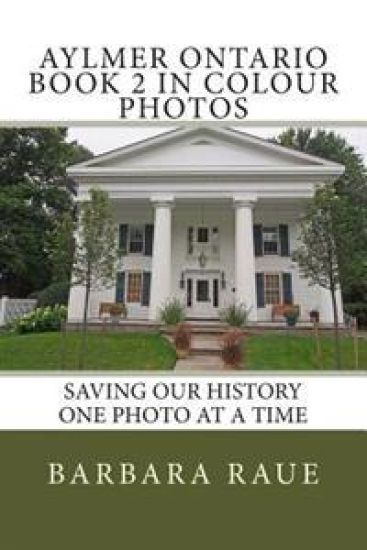
Kirjat ja teokset yhdessä paikassa: 295 kirjaa, julkaisuja vuosilta 2010-2020, suosituimpien joukossa Aylmer Ontario Book 2 in Colour Photos: Saving Our History One Photo at a Time. Vertaile teosten hintoja ja tarkista saatavuus suomalaisista kirjakaupoista.

Mukana myös kirjoitusasut: Barbara Raue'

295 kirjaa

Kirjojen julkaisuhaarukka 2010-2020.

Italianate Architecture in Ontario in Colour Photos: Saving Our History One Photo at a Time
This book is dedicated to the Italianate style of architecture in Ontario. From Acton, Ajax and Alton, through Ayr, Belfountain and Belleville, to Caledonia, Conestogo and Collingwood, from Elora to Fisherville and Goderich, through Grimsby, Guelph and Hamilton, from Ingersoll, Kingston and Kitchener, from London, Midland and Mount Pleasant, to New Hamburg, Niagara Falls, and Norwich, from Oakville, Orangeville and Ottawa, from Paris, Peterborough, and Port Colborne, from Port Elgin, Port Hope and Port Perry, from Sarnia, Seaforth and Shelburne, from Simcoe, Salford, and St. George, through Stouffville, Strathroy and Tavistock, from Uxbridge, Waterloo, Whitby and Windsor, through Zorra Township, with many other towns in between, there are more than one hundred homes to admire
Rite of Marriage

Rite of Marriage

Barbara Raue

Independently Published
2019
nidottu
Dorothy Donaldson has had only minimal contact with her Mom over the past twelve years. When she receives a long letter from her, she is surprised; included in the letter is a request that she go to Boston to visit and reconnect. She is encouraged to go and to take some of her paintings with her to try to sell in Boston.Shortly after Dorothy's letter arrives, Kathleen O'Magony, the fianc of Dorothy's son Jonathan, receives an invitation from her grandparents to visit them in Boston. Kathleen has not seen them since she was six years old so doesn't remember them at all. She has never been away from Serena, Montana, a small western town. Since it is already October, she would be away until the spring, a very daunting prospect. She would miss her parents and her fianc .Dorothy and Kathleen travel together to Boston. They are met with challenges and chances for romance. What decisions will each make?Meanwhile back in Montana, Jonathan makes a huge mistake and has to face the consequences as he moves forward with his life.
Second Empire Architecture in Ontario in Colour Photos: Saving Our History One Photo at a Time
The Second Empire architectural style is distinguished by the mansard roof, its most noteworthy feature, which shows evidence of the French origins. Projecting central towers and one or two-storey bays can also be present.This book is dedicated to the Second Empire style of architecture in Ontario. From Arthur, Aylmer and Ayr, through Belleville, Brantford and Brockville, to Cambridge, Cobourg and Cornwall, to Goderich, Guelph and Hamilton, to Jarvis, Kingston and Kitchener, from Midland, Morrisburg and Niagara-on-the-Lake, from Orangeville, Orillia and Ottawa, from Palmerston, Paris and Perth, from Port Perry, Sault Ste. Marie, and Simcoe, from Stouffville, Waterdown and Waterford, and through Woodstock, with many other towns in between, there are more than sixty homes to admire.
Kamloops British Columbia Canada Book 3 in Colour Photos: Saving Our History One Photo at a Time
Kamloops is a city in south central British Columbia in Canada, located at the confluence of the two branches of the Thompson River near Kamloops Lake.The first European explorer, David Stuart, arrived in 1811; he was sent out from Fort Astoria, a Pacific Fur Company post; he spent a winter there with the Secwepemc people. He and Alexander Ross established a post there in May 1812, "Fort Cumcloups".The rival North West Company established another post, Fort Shuswap, nearby in the same year. The two operations were merged in 1813 when the North West Company officials in the region bought out the operations of the Pacific Fur Company. After the North West Company's forced merger with the Hudson's Bay Company in 1821, the post became known commonly as Thompson's River Post, or Fort Thompson, which over time became known as Fort Kamloops.After the fur trade arrived in 1812, Kamloops became the crossroads for horse-drawn pack trains. In the years that followed, Kamloops' reputation as a bristling locality for trade and commerce was greatly broadened by the gold rush of the 1850s, among other things. Following the arrival of the first permanent ranchers was the railway which came through in 1893; Kamloops continued to be the resting stop for the weary travelers. Kamloops has continued to grow since then with cattle ranching, forestry and mining.The gold rush of the 1860s and the construction of the Canadian Pacific Railway, which reached Kamloops from the West in 1883, brought further growth.Pulp, plywood, veneer, cement, and a copper mine are industries in Kamloops. The Royal Inland Hospital is the city's largest employer. Thompson River University serves a student body of 10,000.This book covers such streets as Nicola Street, Royal Avenue, Tranquille Road and Fortune Drive.
Kamloops British Columbia Canada Book 2 in Colour Photos: Saving Our History One Photo at a Time
Kamloops is a city in south central British Columbia in Canada, located at the confluence of the two branches of the Thompson River near Kamloops Lake.The first European explorer, David Stuart, arrived in 1811; he was sent out from Fort Astoria, a Pacific Fur Company post; he spent a winter there with the Secwepemc people. He and Alexander Ross established a post there in May 1812, "Fort Cumcloups".The rival North West Company established another post, Fort Shuswap, nearby in the same year. The two operations were merged in 1813 when the North West Company officials in the region bought out the operations of the Pacific Fur Company. After the North West Company's forced merger with the Hudson's Bay Company in 1821, the post became known commonly as Thompson's River Post, or Fort Thompson, which over time became known as Fort Kamloops.After the fur trade arrived in 1812, Kamloops became the crossroads for horse-drawn pack trains. In the years that followed, Kamloops' reputation as a bristling locality for trade and commerce was greatly broadened by the gold rush of the 1850s, among other things. Following the arrival of the first permanent ranchers was the railway which came through in 1893; Kamloops continued to be the resting stop for the weary travelers. Kamloops has continued to grow since then with cattle ranching, forestry and mining.The gold rush of the 1860s and the construction of the Canadian Pacific Railway, which reached Kamloops from the West in 1883, brought further growth.Pulp, plywood, veneer, cement, and a copper mine are industries in Kamloops. The Royal Inland Hospital is the city's largest employer. Thompson River University serves a student body of 10,000.This book covers the two streets St. Paul and Battle.
Rite of Passage

Rite of Passage

Barbara Raue

Independently Published
2019
nidottu
Jonathan Donaldson was finished school. What was he going to do now? When he arrived home, there was a letter from his grandfather asking him to come out to the family ranch to work during the summer. He hadn't seen his grandparents for six years since his father died. Did he want to go? His step-father, Paul Maryvale, pushed him to go and feed him information on the working of the ranch. Paul didn't figure Jonathan would survive a month with the hard work. Jonathan set out to prove that he could last. His Grandpa wanted him to come to love the ranch. Could he do that?He made mistake after mistake and got himself into some dangerous situations, but slowly he learned how to do things correctly. His love for the ranch was growing, as was his interest in Kathleen O'Magony. Was it just a passing interest or could there be more to it?
Queen Anne Architecture in Ontario in Colour Photos: Saving Our History One Photo at a Time
The Queen Anne architectural style is distinguished by an irregular outline featuring a combination of an offset tower, broad gables, projecting two-storey bays, verandahs, multi-sloped roofs, and tall, decorative chimneys. A mixture of brick and wood is common. Windows often have one large single-paned bottom sash and small panes in the upper sash.This book is dedicated to the Queen Anne style of architecture in Ontario. From Acton and Amherstburg, through Belleville, Brockville and Burford, to Cambridge, Colborne and Dundas, to Hamilton, Kingston and Kingsville, to Kitchener, Midland and Niagara Falls, from Ottawa, Orangeville and Owen Sound, from Paris, Peterborough and Port Colborne, from Port Hope to Sarnia and Smiths Falls, from St. Marys, St. Thomas and Stratford, through Woodstock and Windsor, with many other towns in between, there are more than one hundred homes to admire.
Kamloops British Columbia Canada Book 1 in Colour Photos: Saving Our History One Photo at a Time
Kamloops is a city in south central British Columbia in Canada, located at the confluence of the two branches of the Thompson River near Kamloops Lake.The first European explorer, David Stuart, arrived in 1811; he was sent out from Fort Astoria, a Pacific Fur Company post; he spent a winter there with the Secwepemc people. He and Alexander Ross established a post there in May 1812, "Fort Cumcloups".The rival North West Company established another post, Fort Shuswap, nearby in the same year. The two operations were merged in 1813 when the North West Company officials in the region bought out the operations of the Pacific Fur Company. After the North West Company's forced merger with the Hudson's Bay Company in 1821, the post became known commonly as Thompson's River Post, or Fort Thompson, which over time became known as Fort Kamloops.After the fur trade arrived in 1812, Kamloops became the crossroads for horse-drawn pack trains. In the years that followed, Kamloops' reputation as a bristling locality for trade and commerce was greatly broadened by the gold rush of the 1850s, among other things. Following the arrival of the first permanent ranchers was the railway which came through in 1893; Kamloops continued to be the resting stop for the weary travelers. Kamloops has continued to grow since then with cattle ranching, forestry and mining.The gold rush of the 1860s and the construction of the Canadian Pacific Railway, which reached Kamloops from the West in 1883, brought further growth.Pulp, plywood, veneer, cement, and a copper mine are industries in Kamloops. The Royal Inland Hospital is the city's largest employer. Thompson River University serves a student body of 10,000.
Norwich Ontario in Colour Photos: Saving Our History One Photo at a Time
The Township of Norwich is a located in Oxford County in southwestern Ontario. Oxford County Road 59 is the major north-south highway through much of the township. The local economy is largely agricultural, based on corn, soybean, and wheat production with dairy farming in the north part of the township and tobacco, vegetable, and ginseng farming to the south. Slowly, ginseng and traditional cash crops are replacing the former cash crop - tobacco, as demand shrinks.In 1799, the Township of Norwich was laid out by surveyor William Hambly into lines and concessions and 200-acre lots.The Bostwicks, Ingersolls and Canfields were New England families who had made their start in the New World in the 1600s, and frontier living had been second nature to them for generations. Settlement in the former Norwich Township came more than fifteen years after Oxford Township. The Norwich settlement was founded by two men: Peter Lossing and Peter De Long. Peter Lossing's house was the first one in Norwich.In 1809, Peter Lossing, a member of the Society of Friends from Dutchess County New York, visited Norwich Township. In June 1910, with his brother-in-law Peter de Long, purchased 15,000 acres of land in this area. That fall Lossing brought his family to Upper Canada. The de Long family and nine others soon joined them. By 1820 an additional group of about fifty had settled here. These resourceful pioneers founded one of the most successful Quaker communities in Upper Canada.The township was divided into North and South Norwich Townships in 1855.In 1975, Oxford County underwent countywide municipal restructuring. The Village of Norwich and the Townships of East Oxford, North Norwich and South Norwich were amalgamated to create the Township of Norwich.Norwich includes the communities of Beaconsfield, Bond's Corners, Brown's Corners, Burgessville, Cornell, Creditville, Curries, Eastwood, Hawtrey, Hink's Corners, Holbrook, Milldale, Muir, Newark, New Durham, Norwich, Oriel, Otterville, Oxford Centre, Rock's Mills, Rosanna, Springford, Summerville, Blows, and Vandecar.On August 7, 1979, Norwich was struck by a large tornado. The storm cut a path of destruction across Norwich Township from Blows to New Durham, leaving the community of Oxford Centre in a state of total destruction.On June 2, 1998, a tornado touched down in Holbrook and then Norwich, damaging trees, farm equipment, barns, and houses.
Strathroy Ontario in Colour Photos: Saving Our History One Photo at a Time
Strathroy-Caradoc is located west of the City of London.After the War of 1812, the British government encouraged thousands of people from Britain to come to Southwestern Ontario. There were three main reasons for this:1. The British were afraid that Americans would invade through the Sydenham River area again as they had at Baldoon. If there were settlements in the area, the settlers could warn the British and fight against the Americans.2. In England, the end of the war meant that many soldiers were out of work. They were starving and homeless. In Ireland, landlords had mismanaged the lands, which led to the Potato Famine. Since potatoes were the main source of income and food, thousands of Irish were starving. In Scotland, landlords chose to graze sheep in the Highlands, and they forced the Scottish Highlanders to leave. In an effort to help these people, the British government began to give away land in Upper Canada.3. Soldiers of the War of 1812 and the war with France expected land rewards from the King of England; there was no land left in Britain to give them. Land in Upper Canada was given away instead.Land along the Sydenham River was sparsely settled, the land was fertile and flat which made it easier to clear. The river gave settlers fresh water, and power for their water mills. It could also be used as a highway to move goods to Detroit, where they could be sold. A new road had been built between London and Goderich, which made it easier to get to the Sydenham River by land.When the government gave away land, there were often conditions the new owner had to live up to, including building roads, mills, and armies, but often, it meant inviting immigrants from Britain to live on their land. For example, a settler might receive 20 000 acres of land, but would be forced to give away 5,000 to other settlers. They would be expected to organize how the immigrants would get to the new settlement, what they would do when they arrived (such as raise sheep, beef or cotton), and help them settle in by building churches and schools. This is how settlements and villages were created along the Sydenham river.In 1830 James Buchanan, the British Consul at New York City, acquired a tract of 1,200 acres of unsettled land in Adelaide Township. His son, John Stewart, settled there and built a sawmill and gristmill on the Sydenham River. These pioneer industries formed the nucleus of a settlement which was named Strathroy means "Red Valley" in Gaelic, and is named after James Buchanan's birthplace in County Tyrone, Ireland. The construction of a branch line of the Great Western Railway through Strathroy in 1856 stimulated the growth of the community. The line was eventually connected to Michigan at Windsor, providing the farmers of Strathroy with an extra market for their produce.
Sampler Book 13, Ontario in Colour Photos: Saving Our History One Photo at a Time
Each photo I take that precedes a demolition, or a natural disaster such as a tornado or a fire, is meeting this aim of mine of Saving Our History One Photo at a Time. There are more than 100 towns already photographed which you can visit without moving from your comfortable chair in your living room. Think about what it was like in those by-gone days. Imagine what it was like to live in a mansion like one of these.Sampler Book 13 includes pictures from the following places: Beaver Valley, Chatsworth, West Flamborough, and Niagara Falls.
Sampler Book 12, Ontario in Colour Photos: Saving Our History One Photo at a Time
Each photo I take that precedes a demolition, or a natural disaster such as a tornado or a fire, is meeting this aim of mine of Saving Our History One Photo at a Time. There are more than 100 towns already photographed which you can visit without moving from your comfortable chair in your living room. Think about what it was like in those by-gone days. Imagine what it was like to live in a mansion like one of these.Sampler Book 12 includes pictures from the following places in Haldimand County: Jarvis, Hagersville, Caledonia, Cayuga, Fisherville, and Dunnville.
Woodstock Ontario Book 4 in Colour Photos: Saving Our History One Photo at a Time
Woodstock is located in the heart of South Western Ontario, at the junction of highways 401 and 403, 50 kilometers east of London and 60 kilometers west of Kitchener. Woodstock is the largest municipality in Oxford County.Light Street memorializes A. W. Light, the first of the military officers to arrive in the area. He was a retired colonel, had published several books, and had many ideas and much enthusiasm for the settlement at the west end.In the 1830s, British naval and army officers placed on half-pay were encouraged to settle in Oxford to ensure this community's loyalty to the British crown. The first to arrive was Alexander Whalley Light, a retired colonel who came to Oxford County in 1831. He was joined by Philip Graham in 1832, a retired captain of the Royal Navy, and Captain Andrew Drew, on half-pay from the Royal Navy, arrived in Woodstock to make preparations for his superior, Rear-Admiral Henry Vansittart, also on half-pay. Half-pay officers went to considerable lengths to clear their chosen parcels of land.
Zorra Township Ontario in Colour Photos: Saving Our History One Photo at a Time
Zorra is a township in Oxford County in south-western Ontario. A predominantly rural municipality, Zorra was formed in 1975 through the amalgamation of East Nissouri, West Zorra and North Oxford townships. It is best known for the Highland Games weekend held each summer in Embro, celebrating the heritage of the Scottish pioneer families. The township comprises the communities of Banner, Bennington, Brooksdale, Brown's Corners, Cody's Corners, Dicksons Corners, Dunn's Corner, Embro, Golspie, Granthurst, Harrington, Harrington West, Holiday, Kintore, Lakeside, Maplewood, McConkey, Medina, Rayside, Thamesford, Uniondale, Youngsville, and Zorra Station.Among the earliest settlers of Zorra Township, were United Empire Loyalists from the New England States. Zorra was first surveyed in 1820 and Embro became a separate municipality in 1858. Embro is located on a branch of the Thames River. The first buildings were two distilleries owned by McDonald and Crittenden.Flour, grist and oatmeal mills were built. John McDonald built a carding and cloth factory. Businesses started up: watchmaker and jeweler, boots and shoes, eight blacksmith shops, wagon and carriage makers, tinsmith, carpenters, potash manufacturer, four general stores, two cabinet makers, undertaker, three doctors, and a pump manufacturer. In 1875, Embro had two newspapers, "The Planet" and "The Review", with a third added in 1880, "The Embro Courier". The Embro Public Library started as a Mechanics Institute in 1882; it became a public library in 1895.
Sampler Book 14, Ontario in Colour Photos: Saving Our History One Photo at a Time
Each photo I take that precedes a demolition, or a natural disaster such as a tornado or a fire, is meeting this aim of mine of Saving Our History One Photo at a Time. There are more than 100 towns already photographed which you can visit without moving from your comfortable chair in your living room. Think about what it was like in those by-gone days. Imagine what it was like to live in a mansion like one of these.Sampler Book 14 includes pictures from the following places in Northern Ontario: Thunder Bay, Sault Ste. Marie, Smiths Falls, Lake Superior, Sudbury, North Bay and Parry Sound.
Otterville and Burgessville Ontario in Colour Photos: Saving Our History One Photo at a Time
The Township of Norwich is located in Oxford County in southwestern Ontario. Pioneering families emigrated from Norwich in upper New York State in the early 19th century. Oxford County Road 59 is the major north-south highway through much of the township, including the community of Norwich proper. The local economy is largely agricultural, based on corn, soybean, and wheat production with dairy farming in the north part of the township and tobacco, vegetable, and ginseng farming to the south. Slowly, ginseng and traditional cash crops are replacing the former cash crop - tobacco, as demand shrinks.In 1799, the Township of Norwich was laid out by surveyor William Hambly into lines and concessions and 200-acre lots. The township was divided into North and South Norwich Townships in 1855.In 1975, Oxford County underwent countywide municipal restructuring. The Village of Norwich and the Townships of East Oxford, North Norwich and South Norwich were amalgamated to create the Township of Norwich.Norwich includes the communities of Beaconsfield, Bond's Corners, Brown's Corners, Burgessville, Cornell, Creditville, Curries, Eastwood, Hawtrey, Hink's Corners, Holbrook, Milldale, Muir, Newark, New Durham, Norwich, Oriel, Otterville, Oxford Centre, Rock's Mills, Rosanna, Springford, Summerville, Blows, and Vandecar.Otterville is a village in Norwich Township in Oxford County. It is located on the Otter Creek. Otterville was settled in 1807. Encouraged by local Quakers, free blacks and escaped slaves fled persecution in the United States and found homes in the Otterville area beginning in 1829. Otterville African Methodist Episcopal Church and Cemetery served the local black community until the late 1880s.