Kirjojen hintavertailu. Mukana 12 309 213 kirjaa ja 12 kauppaa.

Kirjailija

Benjamin Constant

Kirjat ja teokset yhdessä paikassa: 177 kirjaa, julkaisuja vuosilta 1824-2026, suosituimpien joukossa Adolphe. Vertaile teosten hintoja ja tarkista saatavuus suomalaisista kirjakaupoista.

177 kirjaa

Kirjojen julkaisuhaarukka 1824-2026.

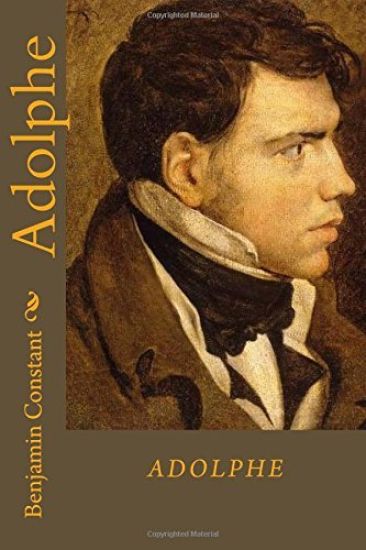
Adolphe

Adolphe

Benjamin Constant

Createspace Independent Publishing Platform
2018
nidottu
Adolphe, anecdote trouv e dans les papiers d'un inconnu, puis publi e est un roman de Benjamin Constant publi en 1816. Adolphe raconte l'inexorable d composition d'une relation amoureuse. Apr s avoir s duit Ell nore par vanit plus que par amour, Adolphe ne parvient ni rompre ni aimer. Son ind cision, entre sinc rit et mauvaise foi, ainsi qu'une sorte de sadisme m l de compassion, pr cipiteront la course l'ab me de ce couple fatal.
On Religion

On Religion

Benjamin Constant

Liberty Fund Inc
2017
sidottu
This is the first full-length English translation of Benjamin Constants massive study of humanitys religious forms and development, published in five volumes between 1824 and 1831. Constant (17671830) regarded On Religion, worked on over the course of many years, as perhaps his most important philosophical work. He called it the only interest, the only consolation of my life, and the book that I was destined by nature to write. While the recent revival of interest in Constants thought has been welcome and fruitful, it has been incomplete, tending to leave out of account his writings on religion. In this connection, On Religion is essential reading and of interest for many reasons. As an analysis of humanitys religious experience, the work is notable for its methodology. Unlike previous writers with dogmatic commitments, whether theological or philosophical, Constant aimed to work with well-established facts and to relate religious forms to their historical contexts and civilizational developments. In this way, he was a precursor of the scientific study of religion. This objectivity, however, was not tantamount to moral-political neutrality. In the aftermath of the French Revolution, he wanted partisans of the new order to recognize that the religious impulse was natural to the human heart: to extirpate religion was therefore a fools errand and worse. Likewise, he instructed religious reactionaries that history had left them behind: now the natural state of the religious sentiment was an unfettered spirituality left free to find new forms of expression. His counsel to contemporaries has proven prescient concerning subsequent religious developments in democratic and totalitarian societies. In his day, Constant was a consistent liberal, a life-long advocate of representative government, as well as of the central liberal arrangement concerning religion: separation of church and state. But On Religion demonstrates that principled liberalism can turn a sympathetic as well as analytic eye toward religion, and in an unbegrudging way find an important place for it in free society. There are signs that this is a lesson that contemporary liberalism would do well to relearn.
On Religion

On Religion

Benjamin Constant

Liberty Fund Inc
2017
nidottu
This is the first full-length English translation of Benjamin Constants massive study of humanitys religious forms and development, published in five volumes between 1824 and 1831. Constant (17671830) regarded On Religion, worked on over the course of many years, as perhaps his most important philosophical work. He called it the only interest, the only consolation of my life, and the book that I was destined by nature to write. While the recent revival of interest in Constants thought has been welcome and fruitful, it has been incomplete, tending to leave out of account his writings on religion. In this connection, On Religion is essential reading and of interest for many reasons. As an analysis of humanitys religious experience, the work is notable for its methodology. Unlike previous writers with dogmatic commitments, whether theological or philosophical, Constant aimed to work with well-established facts and to relate religious forms to their historical contexts and civilizational developments. In this way, he was a precursor of the scientific study of religion. This objectivity, however, was not tantamount to moral-political neutrality. In the aftermath of the French Revolution, he wanted partisans of the new order to recognize that the religious impulse was natural to the human heart: to extirpate religion was therefore a fools errand and worse. Likewise, he instructed religious reactionaries that history had left them behind: now the natural state of the religious sentiment was an unfettered spirituality left free to find new forms of expression. His counsel to contemporaries has proven prescient concerning subsequent religious developments in democratic and totalitarian societies. In his day, Constant was a consistent liberal, a life-long advocate of representative government, as well as of the central liberal arrangement concerning religion: separation of church and state. But On Religion demonstrates that principled liberalism can turn a sympathetic as well as analytic eye toward religion, and in an unbegrudging way find an important place for it in free society. There are signs that this is a lesson that contemporary liberalism would do well to relearn.
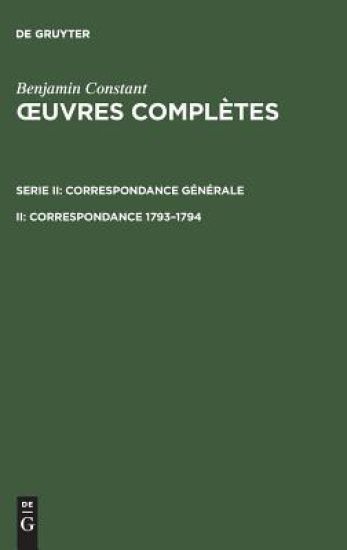
OEuvres complètes, II, Correspondance 1793-1794
This second volume of the "Correspondance generale," which covers the years 1793 and 1794, is composed mainly of the continuation of the brilliant series of letters which Benjamin Constant (1767-1830), now a courtier at Brunswick, had begun to exchange with Isabelle de Charriere in Switzerland in 1787. These letters, along with those addressed by Constant to other correspondents, particularly to several members of his family and friends in Brunswick, enable us to follow the events of his intellectual and emotional life at this time, including his friendship with the publicist Jakob Mauvillon, his role in the court-martial affair of his father, his divorce from his first wife Minna von Cramm, his friendship with Charlotte von Hardenberg (later his second wife), his break with the Court of Brunswick, his return to Switzerland and the beginning of his long liaison with Germaine de Stael.
OEuvres complètes, III, Correspondance 1795-1799
The third volume of Correspondance generale contains the text of 279 letters written by or addressed to Benjamin Constant from the period preceding the beginning of his career as journalist and publicist in Paris in May - June 1795 until his nomination to the Tribunat in December 1799. This volume is a valuable document on the intellectual and political life of the period; at the same time it allows the reader to see at close range Constant's relations his family and friends, including Isabelle de Charriere and Germaine de Stael; the reader will also find here the earliest letters of his correspondence with Julie Talma.
OEuvres complètes, V, Correspondance 1803-1805
The 285 letters contained in this volume of the "Correspondance generale" date from the years following Constant's exclusion from the Tribunal. They reflect his work on religious issues, his dreams of literary success, and his travels in France, Germany, and Switzerland. In addition, they provide an impression of political life at the beginning of the Napoleonic empire and the emotional vicissitudes undergone by their author: his unsuccessful attempts to break with Germaine de Stael, his desire to marry (but whom?), his presence at the deaths of Julie Talma and Isabelle de Charriere, and his initial lack of enthusiasm after renewing his acquaintance with Charlotte von Hardenberg.
OEuvres complètes, IV, Correspondance 1800-1802
This fourth volume of the Correspondance generale contains 368 letters written during the period of the Consulat when, as a member of the Tribunat until January 1802, Constant acquired a reputation as a brilliant orator and outspoken opponent of Bonaparte. It was also a period when he produced a number of manuscripts on politics and religion on which he would base works published between 1814 and 1830. The correspondence also contains letters of compelling human interest to and from Julie Talma and an extraordinary epistolary exchange with Anna Lindsay, with whom Constant fell in love in 1800.
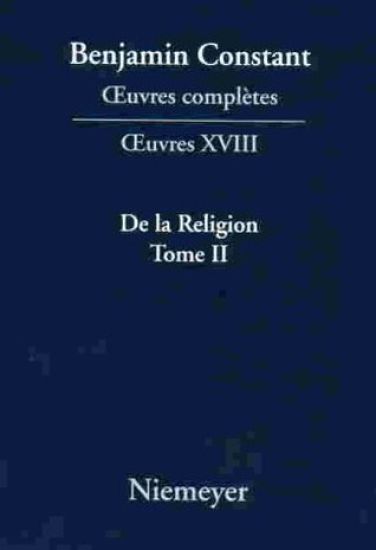
OEuvres complètes, XVIII, De la Religion, considérée dans sa source, ses formes ses développements, Tome II
This volume contains the definitive version of the second of the five volumes of Benjamin Constant's major study entitled "De la Religion, consideree dans sa source ...." Its unusually extensive annexes assemble a selection of manuscripts illustrating the working methods and strategies employed by the author. Further, the volume contains a general introduction, a chronology and a detailed critical apparatus comprising explanatory notes, biographical details of the persons referred to, a bibliography, and an index of proper names. As such it gives a graphic idea of the astounding originality displayed by Constant in his approach to research on religion.