Kirjojen hintavertailu. Mukana 12 390 323 kirjaa ja 12 kauppaa.

Kirjailija

Birendra Nath Mandal

Kirjat ja teokset yhdessä paikassa: 6 kirjaa, julkaisuja vuosilta 2015-2024, suosituimpien joukossa Wavelet Based Approximation Schemes for Singular Integral Equations. Vertaile teosten hintoja ja tarkista saatavuus suomalaisista kirjakaupoista.

6 kirjaa

Kirjojen julkaisuhaarukka 2015-2024.

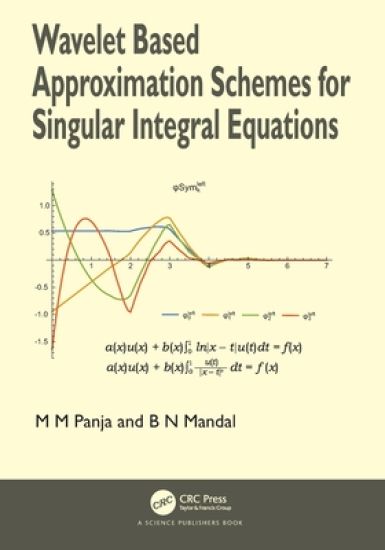
Wavelet Based Approximation Schemes for Singular Integral Equations

Wavelet Based Approximation Schemes for Singular Integral Equations

Madan Mohan Panja; Birendra Nath Mandal

CRC Press
2022
nidottu
Many mathematical problems in science and engineering are defined by ordinary or partial differential equations with appropriate initial-boundary conditions. Among the various methods, boundary integral equation method (BIEM) is probably the most effective. It’s main advantage is that it changes a problem from its formulation in terms of unbounded differential operator to one for an integral/integro-differential operator, which makes the problem tractable from the analytical or numerical point of view. Basically, the review/study of the problem is shifted to a boundary (a relatively smaller domain), where it gives rise to integral equations defined over a suitable function space. Integral equations with singular kernels areamong the most important classes in the fields of elasticity, fluid mechanics, electromagnetics and other domains in applied science and engineering. With the advancesin computer technology, numerical simulations have become important tools in science and engineering. Several methods have been developed in numerical analysis for equations in mathematical models of applied sciences. Widely used methods include: Finite Difference Method (FDM), Finite Element Method (FEM), Finite Volume Method (FVM) and Galerkin Method (GM). Unfortunately, none of these are versatile. Each has merits and limitations. For example, the widely used FDM and FEM suffers from difficulties in problem solving when rapid changes appear in singularities. Even with the modern computing machines, analysis of shock-wave or crack propagations in three dimensional solids by the existing classical numerical schemes is challenging (computational time/memory requirements). Therefore, with the availability of faster computing machines, research into the development of new efficient schemes for approximate solutions/numerical simulations is an ongoing parallel activity. Numerical methods based on wavelet basis (multiresolution analysis) may be regarded as a confluence of widely used numerical schemes based on Finite Difference Method, Finite Element Method, Galerkin Method, etc. The objective of this monograph is to deal with numerical techniques to obtain (multiscale) approximate solutions in wavelet basis of different types of integral equations with kernels involving varieties of singularities appearing in the field of elasticity, fluid mechanics, electromagnetics and many other domains in applied science and engineering.
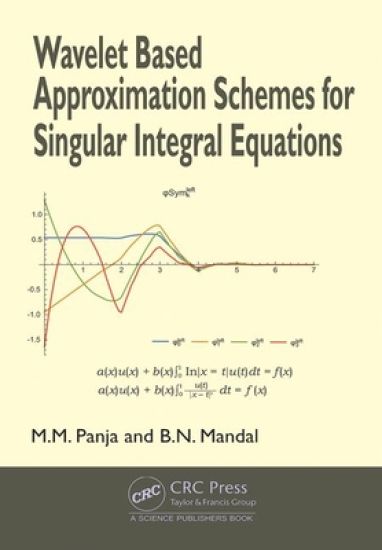
Wavelet Based Approximation Schemes for Singular Integral Equations

Wavelet Based Approximation Schemes for Singular Integral Equations

Madan Mohan Panja; Birendra Nath Mandal

CRC Press
2020
sidottu
Many mathematical problems in science and engineering are defined by ordinary or partial differential equations with appropriate initial-boundary conditions. Among the various methods, boundary integral equation method (BIEM) is probably the most effective. It’s main advantage is that it changes a problem from its formulation in terms of unbounded differential operator to one for an integral/integro-differential operator, which makes the problem tractable from the analytical or numerical point of view. Basically, the review/study of the problem is shifted to a boundary (a relatively smaller domain), where it gives rise to integral equations defined over a suitable function space. Integral equations with singular kernels areamong the most important classes in the fields of elasticity, fluid mechanics, electromagnetics and other domains in applied science and engineering. With the advancesin computer technology, numerical simulations have become important tools in science and engineering. Several methods have been developed in numerical analysis for equations in mathematical models of applied sciences. Widely used methods include: Finite Difference Method (FDM), Finite Element Method (FEM), Finite Volume Method (FVM) and Galerkin Method (GM). Unfortunately, none of these are versatile. Each has merits and limitations. For example, the widely used FDM and FEM suffers from difficulties in problem solving when rapid changes appear in singularities. Even with the modern computing machines, analysis of shock-wave or crack propagations in three dimensional solids by the existing classical numerical schemes is challenging (computational time/memory requirements). Therefore, with the availability of faster computing machines, research into the development of new efficient schemes for approximate solutions/numerical simulations is an ongoing parallel activity. Numerical methods based on wavelet basis (multiresolution analysis) may be regarded as a confluence of widely used numerical schemes based on Finite Difference Method, Finite Element Method, Galerkin Method, etc. The objective of this monograph is to deal with numerical techniques to obtain (multiscale) approximate solutions in wavelet basis of different types of integral equations with kernels involving varieties of singularities appearing in the field of elasticity, fluid mechanics, electromagnetics and many other domains in applied science and engineering.
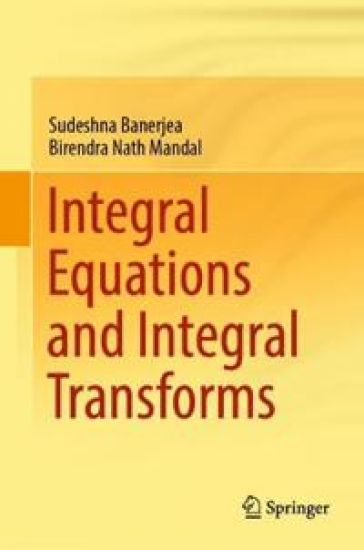
Integral Equations and Integral Transforms

Integral Equations and Integral Transforms

Sudeshna Banerjea; Birendra Nath Mandal

SPRINGER VERLAG, SINGAPORE
2023
sidottu
This comprehensive textbook on linear integral equations and integral transforms is aimed at senior undergraduate and graduate students of mathematics and physics. The book covers a range of topics including Volterra and Fredholm integral equations, the second kind of integral equations with symmetric kernels, eigenvalues and eigen functions, the Hilbert–Schmidt theorem, and the solution of Abel integral equations by using an elementary method. In addition, the book covers various integral transforms including Fourier, Laplace, Mellin, Hankel, and Z-transforms. One of the unique features of the book is a general method for the construction of various integral transforms and their inverses, which is based on the properties of delta function representation in terms of Green’s function of a Sturm–Liouville type ordinary differential equation and its applications to physical problems. The book is divided into two parts: integral equations and integral transforms.Each chapter is supplemented with numerous illustrative examples to aid in understanding. The clear and concise presentation of the topics covered makes this book an ideal resource for students, researchers, and professionals interested in the theory and application of linear integral equations and integral transforms.
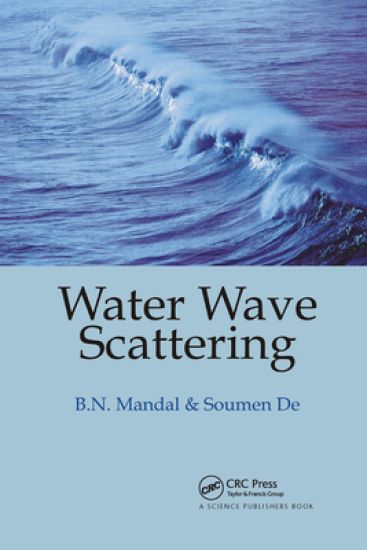
Water Wave Scattering

Water Wave Scattering

Birendra Nath Mandal; Soumen De

CRC Press
2020
nidottu
The theory of water waves is most varied and is a fascinating topic. It includes a wide range of natural phenomena in oceans, rivers, and lakes. It is mostly concerned with elucidation of some general aspects of wave motion including the prediction of behaviour of waves in the presence of obstacles of some special configurations that are of interest to ocean engineers. Unfortunately, even the apparently simple problems appear to be difficult to tackle mathematically unless some simplified assumptions are made. Fortunately, one can assume water to be an incompressible, in viscid and homogeneous fluid. The linearised theory of water waves is based on the assumption that the amplitude of the motion is small compared to the wave length. If rotational motion is assumed, then the linearised theory of water waves is essentially concerned with solving the Laplace equation in the water region together with linearised boundary condition. There are varied classes of problems that have been/are being studied mathematically in the literature within the framework of linearised theory of water waves for last many years. Scattering by obstacles of various geometrical configurations is one such class of water wave problems. This book is devoted to advanced mathematical work related to water wave scattering. Emphasis is laid on the mathematical and computational techniques required to study these problems mathematically.The book contains nine chapters. The first chapter is introductory in nature. It includes the basic equations of linearised theory for a single layer fluid, a two-layer fluid, solution of dispersion equations, and a general idea on scattering problems and the energy identity in water with a free surface. Chapter 2 is concerned with wave scattering involving thin rigid plates of various geometrical configurations, namely, plane vertical barriers or curved barriers, inclined barriers, horizontal barrier, and also thin elastic vertical plate. For the horizontal case, the barrier is submerged below an ice-cover modelled as a thin elastic plate floating on water. Chapter 3 discusses wave scattering by a rectangular trench by using Galerkin technique. Chapter 4 involves wave scattering by a dock by using Carleman singular integral equation followed by reduction to Riemann-Hilbert problems. Chapter 5 involves several wave scattering problems involving discontinuities at the upper surface of water by using the Wiener-Hopf technique, by reduction to Carleman singular integral equations. Chapter 6 considers scattering by a long horizontal circular cylinder either half immersed or completely submerged. In chapter 7, some important energy identities are derived for scattering problems in a single-layer and also in a two-layer fluid. Chapter 8 is concerned with wave scattering in a two-layer fluid by a thin vertical plate and by a long horizontal circular cylinder submerged in either of the two layers. Chapter 9 is the final chapter which considers a number of wave scattering problems in a single-layer or a two-layer fluid with variable bottom topography by using a simplified perturbation analysisIt is hoped that this book will be useful to researchers on water waves. The several wave scattering problems presented in the book are mostly based on the research work carried out by the authors and their associates.
Water Wave Scattering

Water Wave Scattering

Birendra Nath Mandal; Soumen De

Productivity Press
2015
sidottu
The theory of water waves is most varied and is a fascinating topic. It includes a wide range of natural phenomena in oceans, rivers, and lakes. It is mostly concerned with elucidation of some general aspects of wave motion including the prediction of behaviour of waves in the presence of obstacles of some special configurations that are of interest to ocean engineers. Unfortunately, even the apparently simple problems appear to be difficult to tackle mathematically unless some simplified assumptions are made. Fortunately, one can assume water to be an incompressible, in viscid and homogeneous fluid. The linearised theory of water waves is based on the assumption that the amplitude of the motion is small compared to the wave length. If rotational motion is assumed, then the linearised theory of water waves is essentially concerned with solving the Laplace equation in the water region together with linearised boundary condition. There are varied classes of problems that have been/are being studied mathematically in the literature within the framework of linearised theory of water waves for last many years. Scattering by obstacles of various geometrical configurations is one such class of water wave problems. This book is devoted to advanced mathematical work related to water wave scattering. Emphasis is laid on the mathematical and computational techniques required to study these problems mathematically.The book contains nine chapters. The first chapter is introductory in nature. It includes the basic equations of linearised theory for a single layer fluid, a two-layer fluid, solution of dispersion equations, and a general idea on scattering problems and the energy identity in water with a free surface. Chapter 2 is concerned with wave scattering involving thin rigid plates of various geometrical configurations, namely, plane vertical barriers or curved barriers, inclined barriers, horizontal barrier, and also thin elastic vertical plate. For the horizontal case, the barrier is submerged below an ice-cover modelled as a thin elastic plate floating on water. Chapter 3 discusses wave scattering by a rectangular trench by using Galerkin technique. Chapter 4 involves wave scattering by a dock by using Carleman singular integral equation followed by reduction to Riemann-Hilbert problems. Chapter 5 involves several wave scattering problems involving discontinuities at the upper surface of water by using the Wiener-Hopf technique, by reduction to Carleman singular integral equations. Chapter 6 considers scattering by a long horizontal circular cylinder either half immersed or completely submerged. In chapter 7, some important energy identities are derived for scattering problems in a single-layer and also in a two-layer fluid. Chapter 8 is concerned with wave scattering in a two-layer fluid by a thin vertical plate and by a long horizontal circular cylinder submerged in either of the two layers. Chapter 9 is the final chapter which considers a number of wave scattering problems in a single-layer or a two-layer fluid with variable bottom topography by using a simplified perturbation analysisIt is hoped that this book will be useful to researchers on water waves. The several wave scattering problems presented in the book are mostly based on the research work carried out by the authors and their associates.