Kirjojen hintavertailu. Mukana 12 363 183 kirjaa ja 12 kauppaa.

Kirjailija

Bruno Latour

Kirjat ja teokset yhdessä paikassa: 62 kirjaa, julkaisuja vuosilta 1986-2026, suosituimpien joukossa Prospecting Ocean. Vertaile teosten hintoja ja tarkista saatavuus suomalaisista kirjakaupoista.

62 kirjaa

Kirjojen julkaisuhaarukka 1986-2026.

Artefaktens återkomst : ett möte mellan organisationsteori och tingens socio
Bruno Latour är mannen som gav substans åt uttrycket "tvärdisciplinär forskning" och hans tankar är av värde för alla som försöker förstå det samtida samhället.I detta urval presenterar han åsikter i frågor som är centrala i såväl samhällsvetenskapen som i samhället. Bland annat hävdar han i en av bokens essäer att pre-moderniteten fortfarande lever i vår "moderna" tid; att artefakterna har blivit en diskriminerad minoritet trots att vi står i stor tacksamhetsskuld till dem. Han anser att det är artefakterna som stabiliserar vårt samhälle.Latours verk provocerar och manar till reflektion. Hans tankar är alltid originella och relevanta. Filosofi, semiologi, sociologi, historia och socialantropologi vävs ihop i ett försök att förstå vårt organiserade, teknologiska samhälle.

Prince and the Wolf: Latour and Harman at the LSE, The

Prince and the Wolf: Latour and Harman at the LSE, The

Bruno Latour; Graham Harman

John Hunt Publishing
2011
nidottu
The Prince and the Wolf contains the transcript of a debate which took place on 5th February 2008 at the London School of Economics (LSE) between the prominent French sociologist, anthropologist, and philosopher Bruno Latour and the Cairo-based American philosopher Graham Harman. The occasion for the debate was the impending publication of Harman's book, Prince of Networks: Bruno Latour and Metaphysics. During the discussion, Latour (the 'Prince') compared the professional philosophers who have pursued him over the years to a pack of wolves. The Prince and the Wolf is the story of what happens when the wolf catches up with the prince. Latour and Harman engage in brisk and witty conversation about questions that go to the heart of both metaphysics and research methodology: What are objects? How do they interact? And best how to study them?
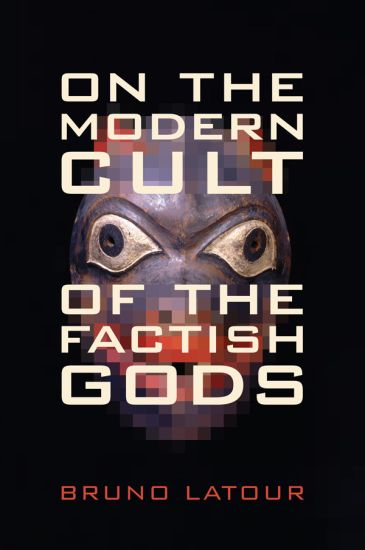
On the Modern Cult of the Factish Gods

On the Modern Cult of the Factish Gods

Bruno Latour

Duke University Press
2010
pokkari
On the Modern Cult of the Factish Gods continues the project that the influential anthropologist, philosopher, and science studies theorist Bruno Latour advanced in his book We Have Never Been Modern. There he redescribed the Enlightenment idea of universal scientific truth, arguing that there are no facts separable from their fabrication. In this concise work, Latour delves into the “belief in naive belief,” the suggestion that fetishes-objects invested with mythical powers-are fabricated and that facts are not. Mobilizing his work in the anthropology of science, he uses the notion of “factishes” to explore a way of respecting the objectivity of facts and the power of fetishes without forgetting that both are fabricated. While the fetish-worshipper knows perfectly well that fetishes are man-made, the Modern icon-breaker inevitably erects new icons. Yet Moderns sense no contradiction at the core of their work. Latour pursues his critique of critique, or the possibility of mediating between subject and object, or the fabricated and the real, through the notion of “iconoclash,” making productive comparisons between scientific practice and the worship of visual images and religious icons.
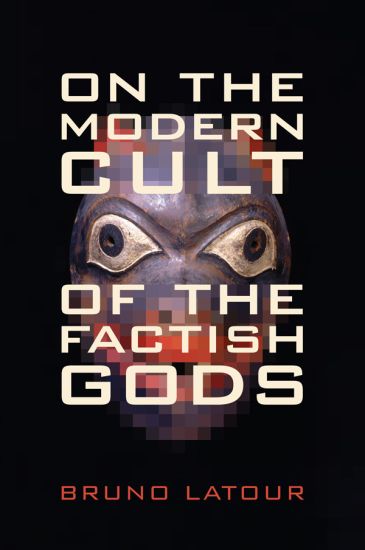
On the Modern Cult of the Factish Gods

On the Modern Cult of the Factish Gods

Bruno Latour

Duke University Press
2010
sidottu
On the Modern Cult of the Factish Gods continues the project that the influential anthropologist, philosopher, and science studies theorist Bruno Latour advanced in his book We Have Never Been Modern. There he redescribed the Enlightenment idea of universal scientific truth, arguing that there are no facts separable from their fabrication. In this concise work, Latour delves into the “belief in naive belief,” the suggestion that fetishes-objects invested with mythical powers-are fabricated and that facts are not. Mobilizing his work in the anthropology of science, he uses the notion of “factishes” to explore a way of respecting the objectivity of facts and the power of fetishes without forgetting that both are fabricated. While the fetish-worshipper knows perfectly well that fetishes are man-made, the Modern icon-breaker inevitably erects new icons. Yet Moderns sense no contradiction at the core of their work. Latour pursues his critique of critique, or the possibility of mediating between subject and object, or the fabricated and the real, through the notion of “iconoclash,” making productive comparisons between scientific practice and the worship of visual images and religious icons.
The Making of Law

The Making of Law

Bruno Latour

Polity Press
2009
sidottu
In this book, Bruno Latour pursues his ethnographic inquiries into the different value systems of modern societies. After science, technology, religion, art, it is now law that is being studied by using the same comparative ethnographic methods. The case study is the daily practice of the French supreme courts, the Conseil d’Etat, specialized in administrative law (the equivalent of the Law Lords in Great Britain). Even though the French legal system is vastly different from the Anglo-American tradition and was created by Napoleon Bonaparte at the same time as the Code-based system, this branch of French law is the result of a home-grown tradition constructed on precedents. Thus, even though highly technical, the cases that form the matter of this book, are not so exotic for an English-speaking audience. What makes this study an important contribution to the social studies of law is that, because of an unprecedented access to the collective discussions of judges, Latour has been able to reconstruct in detail the weaving of legal reasoning: it is clearly not the social that explains the law, but the legal ties that alter what it is to be associated together. It is thus a major contribution to Latour’s social theory since it is now possible to compare the ways legal ties build up associations with the other types of connection that he has studied in other fields of activity. His project of an alternative interpretation of the very notion of society has never been made clearer than in this work. To reuse the title of his first book, this book is in effect the 'Laboratory Life of Law'.
The Making of Law

The Making of Law

Bruno Latour

Polity Press
2009
nidottu
In this book, Bruno Latour pursues his ethnographic inquiries into the different value systems of modern societies. After science, technology, religion, art, it is now law that is being studied by using the same comparative ethnographic methods. The case study is the daily practice of the French supreme courts, the Conseil d’Etat, specialized in administrative law (the equivalent of the Law Lords in Great Britain). Even though the French legal system is vastly different from the Anglo-American tradition and was created by Napoleon Bonaparte at the same time as the Code-based system, this branch of French law is the result of a home-grown tradition constructed on precedents. Thus, even though highly technical, the cases that form the matter of this book, are not so exotic for an English-speaking audience. What makes this study an important contribution to the social studies of law is that, because of an unprecedented access to the collective discussions of judges, Latour has been able to reconstruct in detail the weaving of legal reasoning: it is clearly not the social that explains the law, but the legal ties that alter what it is to be associated together. It is thus a major contribution to Latour’s social theory since it is now possible to compare the ways legal ties build up associations with the other types of connection that he has studied in other fields of activity. His project of an alternative interpretation of the very notion of society has never been made clearer than in this work. To reuse the title of his first book, this book is in effect the 'Laboratory Life of Law'.
The Science of Passionate Interests

The Science of Passionate Interests

Bruno Latour; Vincent Antonin Lepinay

Prickly Paradigm Press, LLC
2009
nidottu
How can economics become genuinely quantitative? This is the question that French sociologist Gabriel Tarde tackled at the end of his career, and in this pamphlet, Bruno Latour and Vincent Antonin Lepinay offer a lively introduction to the work of that forgotten genius of nineteenth-century social thought. Tarde's solution was in total contradiction to the dominant views of his time: to quantify the connections between people and goods, you need to grasp 'passionate interests'. In Tarde's view, capitalism is not a system of cold calculations - rather it is a constant amplification in the intensity and reach of passions. In a stunning anticipation of contemporary economic anthropology, Tarde's work defines an alternative path beyond the two illusions responsible for so much modern misery: the adepts of the Invisible Hand and the devotees of the Visible Hand will learn how to escape the sterility of their fight and recognize the originality of a thinker for whom everything is intersubjective, hence quantifiable. At a time when the regulation of financial markets is the subject of heated debate, Latour and Lepinay provide a valuable historical perspective on the fundamental nature of capitalism.
Aufklärungen

Aufklärungen

Michel Serres; Bruno Latour

Merve Verlag GmbH
2008
nidottu
Bruno Latour unterhält sich in fünf Gesprächen mit Michel Serres über dessen Zugang zur Wissenschaft, die Geschichte der exakten Wissenschaften, die Literatur, die Philosophie, das Ende der Kritik und die Weisheit. Sie behandeln die maßgeblichen Themen der Arbeiten Serres, der sich zu seinem Leitbild die Figur des Hermes ausgewählt hat und sein Denken an den Begriffen Kommunikation, Interferenz, Übersetzung und Distribution entlang entwickelt hat. "Es gibt ein Geheimnis Michel Serres: Sie sind zugleich sehr bekannt und sehr verkannt. Und das obwohl Ihre Bücher technisch gesehen zur Philosophie gehören. Darüber möchte ich gerne Aufklärungen. Sie beschreiten einen Weg, Sie gehen überall hin, in die Wissenschaften, die Mythen, die Literatur und gleichzeitig verwischen Sie oft die Spuren, die Sie zu Ihren Resultaten gebracht haben."
En ny sociologi for et nyt samfund

En ny sociologi for et nyt samfund

Bruno Latour

Lindhardt og Ringhof
2008
nidottu
En ny sociologi for et nyt samfund er en grundlæggende udfordring af eksisterende sociologiske teorier i traditionen fra Durkheim til Bourdieu – og den første samlede fremstilling af Bruno Latours ideer og det, der er blevet kendt som Aktør-Netværk-Teori. Christian Borch og Mikael Rask Madsen skriver i deres forord: "Vi kan ikke glæde os nok over nu at have dette vigtige værk i dansk oversættelse. Det er ikke Latours første bog på dansk, men det er den, som mest prægnant fremlægger hans sociologiske bidrag og forklarer, hvorfor vi behøver en ny sociologi for et nyt samfund." Latour skelner mellem to forskellige sociologier. Der er på den ene side 'det sociales sociologi' – der følger Durkheims grundlæggende idé om samfundet som et særligt domæne. På den anden side er der Latours egen 'associationssociologi', som dyrker den minutiøse forklaring og undersøgelse af, hvordan det sociale konstant skabes som nye forbindelser eller sammenføjninger. Latour hævder, at en tidssvarende sociologi, bl.a. for at kunne forstå miljøproblemer, er nødt til at betragte ikke-menneskelige 'aktører' som fx objekter og teknologier på linje med mennesker og deres handlinger, kommunikation og symboler. Og hans store fortjeneste er at argumentere konsistent for, hvordan vi kan følge disse aktører og kortlægge deres ageren – og herigennem vise, hvordan det sociale skabes.
Wir sind nie modern gewesen

Wir sind nie modern gewesen

Bruno Latour

SUHRKAMP VERLAG
2008
pokkari
Am Beginn der modernen Naturwissenschaft steht die strikte Trennung von Natur und Gesellschaft, von "natürlichen" und "gesellschaftlichen" Instanzen. Bruno Latour optiert in seinem Klassiker der modernen Soziologie dafür, sich diese Trennung etwas genauer anzusehen. Seine These lautet: Je strikter und gründlicher diese Trennung in der Moderne vollzogen wurde, um so besser konnten sich zwischen den getrennten Bereichen "Quasiobjekte" ausbreiten, die sowohl natürlich als auch gesellschaftlich determiniert sind. Diese hybriden "Quasiobjekte", welche die Moderne ausgeblendet hat, gilt es anzuerkennen. Nur dann nämlich kann das zweifelhaft gewordene Credo der Moderne, daß ökonomische Rationalität, wissenschaftliche Wahrheit und Technik bereits Garanten eines sinnvollen Fortschritts sind, verabschiedet werden, ohne gleich in den Katzenjammer der Postmoderne zu verfallen.
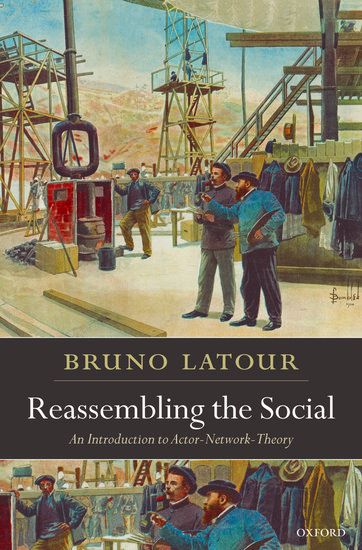
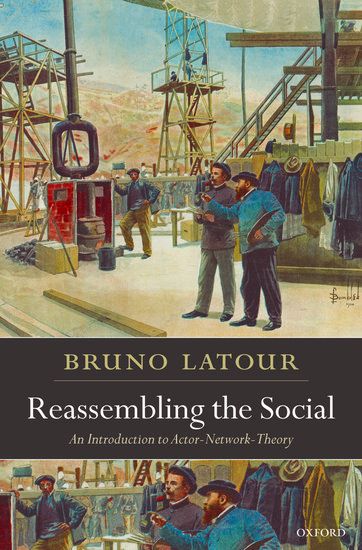
Reassembling the Social

Reassembling the Social

Bruno Latour

Oxford University Press
2007
nidottu
Reassembling the Social is a fundamental challenge from one of the world's leading social theorists to how we understand society and the 'social'. Bruno Latour's contention is that the word 'social', as used by Social Scientists, has become laden with assumptions to the point where it has become misnomer. When the adjective is applied to a phenomenon, it is used to indicate a stablilized state of affairs, a bundle of ties that in due course may be used to account for another phenomenon. But Latour also finds the word used as if it described a type of material, in a comparable way to an adjective such as 'wooden' or 'steely'. Rather than simply indicating what is already assembled together, it is now used in a way that makes assumptions about the nature of what is assembled. It has become a word that designates two distinct things: a process of assembling; and a type of material, distinct from others. Latour shows why 'the social' cannot be thought of as a kind of material or domain, and disputes attempts to provide a 'social explanations' of other states of affairs. While these attempts have been productive (and probably necessary) in the past, the very success of the social sciences mean that they are largely no longer so. At the present stage it is no longer possible to inspect the precise constituents entering the social domain. Latour returns to the original meaning of 'the social' to redefine the notion, and allow it to trace connections again. It will then be possible to resume the traditional goal of the social sciences, but using more refined tools. Drawing on his extensive work examining the 'assemblages' of nature, Latour finds it necessary to scrutinize thoroughly the exact content of what is assembled under the umbrella of Society. This approach, a 'sociology of associations', has become known as Actor-Network-Theory, and this book is an essential introduction both for those seeking to understand Actor-Network Theory, or the ideas of one of its most influential proponents.
Vi har aldrig været moderne

Vi har aldrig været moderne

Bruno Latour

Gyldendal
2006
nidottu
At være moderne er at kunne skelne mellem tro og viden, natur og kultur, ting og menneske. Men hvor skal vi placere fænomener som huller i ozonlaget, genmodificerede planter, reagensglasbørn, skovdød og global opvarmning? Er de naturlige eller menneskeskabte? Lokale eller globale? Begge dele? Moderne videnskab har produceret så mange komplekse teknologier og netværk, hvor kultur og natur er vævet ind i hinanden, at det bliver stadig vanskeligere i praksis at opretholde skellene mellem politik, videnskab, teknologi og natur. Vi har aldrig været moderne er en blændende analyse af paradokserne i det moderne, oplyste projekts distinktioner mellem naturvidenskab, humaniora og samfundsvidenskab, og et forsvar for en tænkning, der er hybrid og kompleks som verden selv. Latours ambitiøse og provokerende bog udkom første gang på fransk i 1991 og regnes i dag for en videnssociologisk klassisker.
Reassembling the Social

Reassembling the Social

Bruno Latour

Oxford University Press
2005
sidottu
Reassembling the Social is a fundamental challenge from one of the world's leading social theorists to how we understand society and the 'social'. Bruno Latour's contention is that the word 'social', as used by Social Scientists, has become laden with assumptions to the point where it has become misnomer. When the adjective is applied to a phenomenon, it is used to indicate a stablilized state of affairs, a bundle of ties that in due course may be used to account for another phenomenon. But Latour also finds the word used as if it described a type of material, in a comparable way to an adjective such as 'wooden' or 'steely'. Rather than simply indicating what is already assembled together, it is now used in a way that makes assumptions about the nature of what is assembled. It has become a word that designates two distinct things: a process of assembling; and a type of material, distinct from others. Latour shows why 'the social' cannot be thought of as a kind of material or domain, and disputes attempts to provide a 'social explanations' of other states of affairs. While these attempts have been productive (and probably necessary) in the past, the very success of the social sciences mean that they are largely no longer so. At the present stage it is no longer possible to inspect the precise constituents entering the social domain. Latour returns to the original meaning of 'the social' to redefine the notion, and allow it to trace connections again. It will then be possible to resume the traditional goal of the social sciences, but using more refined tools. Drawing on his extensive work examining the 'assemblages' of nature, Latour finds it necessary to scrutinize thoroughly the exact content of what is assembled under the umbrella of Society. This approach, a 'sociology of associations', has become known as Actor-Network-Theory, and this book is an essential introduction both for those seeking to understand Actor-Network Theory, or the ideas of one of its most influential proponents.
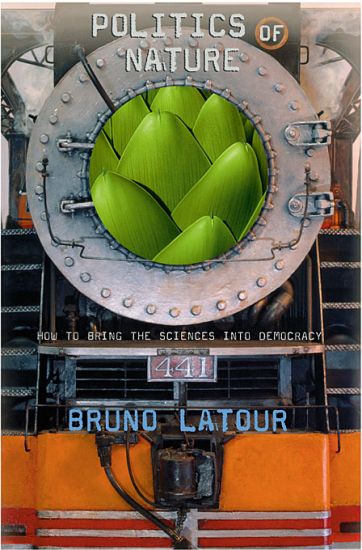
Politics of Nature

Politics of Nature

Bruno Latour

Harvard University Press
2004
nidottu
A major work by one of the more innovative thinkers of our time, Politics of Nature does nothing less than establish the conceptual context for political ecology—transplanting the terms of ecology into more fertile philosophical soil than its proponents have thus far envisioned. Bruno Latour announces his project dramatically: “Political ecology has nothing whatsoever to do with nature, this jumble of Greek philosophy, French Cartesianism and American parks.” Nature, he asserts, far from being an obvious domain of reality, is a way of assembling political order without due process. Thus, his book proposes an end to the old dichotomy between nature and society—and the constitution, in its place, of a collective, a community incorporating humans and nonhumans and building on the experiences of the sciences as they are actually practiced.In a critique of the distinction between fact and value, Latour suggests a redescription of the type of political philosophy implicated in such a “commonsense” division—which here reveals itself as distinctly uncommonsensical and in fact fatal to democracy and to a healthy development of the sciences. Moving beyond the modernist institutions of “mononaturalism” and “multiculturalism,” Latour develops the idea of “multinaturalism,” a complex collectivity determined not by outside experts claiming absolute reason but by “diplomats” who are flexible and open to experimentation.
Pandora’s Hope

Pandora’s Hope

Bruno Latour

Harvard University Press
1999
nidottu
A scientist friend asked Bruno Latour point-blank: “Do you believe in reality?” Taken aback by this strange query, Latour offers his meticulous response in Pandora’s Hope. It is a remarkable argument for understanding the reality of science in practical terms.In this book, Latour, identified by Richard Rorty as the new “bête noire of the science worshipers,” gives us his most philosophically informed book since Science in Action. Through case studies of scientists in the Amazon analyzing soil and in Pasteur’s lab studying the fermentation of lactic acid, he shows us the myriad steps by which events in the material world are transformed into items of scientific knowledge. Through many examples in the world of technology, we see how the material and human worlds come together and are reciprocally transformed in this process.Why, Latour asks, did the idea of an independent reality, free of human interaction, emerge in the first place? His answer to this question, harking back to the debates between Might and Right narrated by Plato, points to the real stakes in the so-called science wars: the perplexed submission of ordinary people before the warring forces of claimants to the ultimate truth.
Aramis, or The Love of Technology

Aramis, or The Love of Technology

Bruno Latour

Harvard University Press
1996
nidottu
Bruno Latour has written a unique and wonderful tale of a technological dream gone wrong. The story of the birth and death of Aramis—the guided-transportation system intended for Paris—is told in this thought-provoking and fictional account by several different parties: an engineer and his professor; company executives and elected officials; a sociologist; and finally Aramis itself, who delivers a passionate plea on behalf of technological innovations that risk being abandoned by their makers. As the young engineer and professor follow Aramis’s trail—conducting interviews, analyzing documents, assessing the evidence—perspectives keep shifting: the truth is revealed as multilayered, unascertainable, comprising an array of possibilities worthy of Rashomon. This charming and profound book, part novel and part sociological study, is Latour at his thought-provoking best.
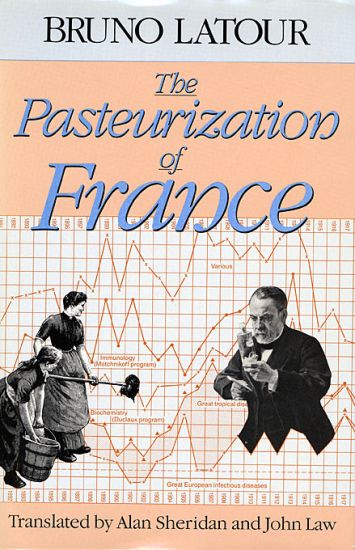
The Pasteurization of France

The Pasteurization of France

Bruno Latour

Harvard University Press
1993
nidottu
What can one man accomplish, even a great man and brilliant scientist? Although every town in France has a street named for Louis Pasteur, was he alone able to stop people from spitting, persuade them to dig drains, influence them to undergo vaccination? Pasteur’s success depended upon a whole network of forces, including the public hygiene movement, the medical profession (both military physicians and private practitioners), and colonial interests. It is the operation of these forces, in combination with the talent of Pasteur, that Bruno Latour sets before us as a prime example of science in action.Latour argues that the triumph of the biologist and his methodology must be understood within the particular historical convergence of competing social forces and conflicting interests. Yet Pasteur was not the only scientist working on the relationships of microbes and disease. How was he able to galvanize the other forces to support his own research? Latour shows Pasteur’s efforts to win over the French public—the farmers, industrialists, politicians, and much of the scientific establishment.Instead of reducing science to a given social environment, Latour tries to show the simultaneous building of a society and its scientific facts. The first section of the book, which retells the story of Pasteur, is a vivid description of an approach to science whose theoretical implications go far beyond a particular case study. In the second part of the book, “Irreductions,” Latour sets out his notion of the dynamics of conflict and interaction, of the “relation of forces.” Latour’s method of analysis cuts across and through the boundaries of the established disciplines of sociology, history, and the philosophy of science, to reveal how it is possible not to make the distinction between reason and force. Instead of leading to sociological reductionism, this method leads to an unexpected irreductionism.
We Have Never Been Modern

We Have Never Been Modern

Bruno Latour

Harvard University Press
1993
nidottu
With the rise of science, we moderns believe, the world changed irrevocably, separating us forever from our primitive, premodern ancestors. But if we were to let go of this fond conviction, Bruno Latour asks, what would the world look like? His book, an anthropology of science, shows us how much of modernity is actually a matter of faith.What does it mean to be modern? What difference does the scientific method make? The difference, Latour explains, is in our careful distinctions between nature and society, between human and thing, distinctions that our benighted ancestors, in their world of alchemy, astrology, and phrenology, never made. But alongside this purifying practice that defines modernity, there exists another seemingly contrary one: the construction of systems that mix politics, science, technology, and nature. The ozone debate is such a hybrid, in Latour’s analysis, as are global warming, deforestation, even the idea of black holes. As these hybrids proliferate, the prospect of keeping nature and culture in their separate mental chambers becomes overwhelming—and rather than try, Latour suggests, we should rethink our distinctions, rethink the definition and constitution of modernity itself. His book offers a new explanation of science that finally recognizes the connections between nature and culture—and so, between our culture and others, past and present.Nothing short of a reworking of our mental landscape, We Have Never Been Modern blurs the boundaries among science, the humanities, and the social sciences to enhance understanding on all sides. A summation of the work of one of the most influential and provocative interpreters of science, it aims at saving what is good and valuable in modernity and replacing the rest with a broader, fairer, and finer sense of possibility.