Kirjojen hintavertailu. Mukana 12 152 606 kirjaa ja 12 kauppaa.

Kirjailija

Bryan Frederick

Kirjat ja teokset yhdessä paikassa: 30 kirjaa, julkaisuja vuosilta 2015-2024, suosituimpien joukossa Improving Conflict-Phase Access. Vertaile teosten hintoja ja tarkista saatavuus suomalaisista kirjakaupoista.

30 kirjaa

Kirjojen julkaisuhaarukka 2015-2024.

Improving Conflict-Phase Access

Improving Conflict-Phase Access

Bryan Frederick; Kristen Gunness; Gabrielle Tarini; Andrew Stravers; Michael J Mazarr; Emily Ellinger; Jonah Blank; Shawn Cochran; Jeffrey W Hornung; Lyle J Morris; Jordan Ernstsen; Lydia Grek; Howard Wang; Lev Navarre Chao

RAND Corporation
2024
pokkari
Ensuring military access to the territory of allies and partners in the Indo-Pacific in the event of a future conflict with China is a critical concern for U.S. policymakers. By looking at five specific allies and partners, the authors explore how states are likely to approach access requests, what factors influence such decisions, and what peacetime policy levers the United States might have to increase the likelihood of access in conflict.
Managing Escalation While Competing Effectively in the Indo-Pacific

Managing Escalation While Competing Effectively in the Indo-Pacific

Bryan Frederick; Kristen Gunness; Bonny Lin; Cortez A Cooper; Bryan Rooney; James Benkowski; Nathan Chandler; Cristina L Garafola; Jeffrey W Hornung; Karl P Mueller; Paul Orner; Timothy R Heath; Christian Curriden; Emily Ellinger

RAND Corporation
2023
pokkari
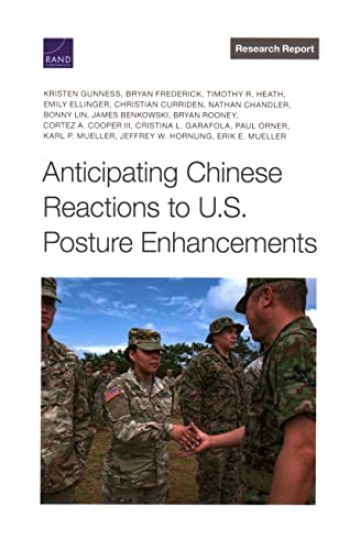
This report assesses how China may react to expanded or varied U.S. military activities in the Indo-Pacific. It provides a framework of key factors likely to determine Chinese responses and identifies the characteristics of U.S. military activities that may either enhance deterrence of Chinese aggression or increase the risks of an escalatory Chinese reaction.
Anticipating Chinese Reactions to U.S. Posture Enhancements

Anticipating Chinese Reactions to U.S. Posture Enhancements

Kristen Gunness; Bryan Frederick; Timothy R. Heath

RAND Corporation
2022
nidottu
The dramatic increase in Chinese power and military capabilities over the past two decades has prompted calls for U.S. policymakers, and the U.S. Department of Defense in particular, to reevaluate their approach to the Indo-Pacific region, including changes to U.S. military posture. This report provides a framework of key factors that U.S. policymakers should consider in assessing how China may react to shifting U.S. posture in the region.
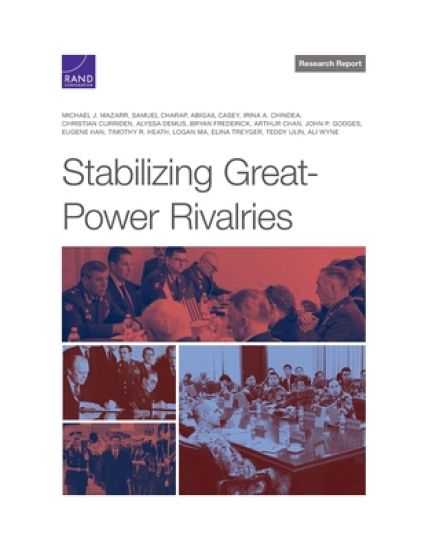
Stabilizing Great-Power Rivalries

Stabilizing Great-Power Rivalries

Michael J Mazarr; Samuel Charap; Abigail Casey; Irina a Chindea; Christian Curriden; Alyssa Demus; Bryan Frederick; Arthur Chan; John P Godges; Eugene Han; Timothy R Heath; Logan Ma; Elina Treyger; Teddy Ulin; Ali Wyne

RAND
2021
nidottu
The international system appears headed for a renewed era of intense competition among major powers. The authors sought to identify the factors that keep such rivalries stable and those that lead to conflictual outcomes. Leveraging theory and historical case studies, the authors created a framework for assessing the stability of a strategic rivalry, then applied it to the current U.S.-Russia and U.S.-China competitions.
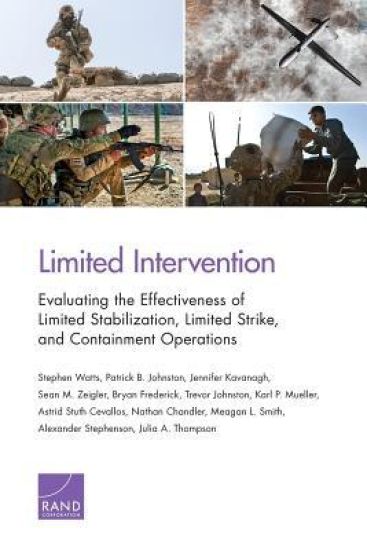
Limited Intervention

Limited Intervention

Stephen Watts; Patrick B Johnston; Jennifer Kavanagh; Sean M Zeigler; Bryan Frederick; Trevor Johnston; Karl P Mueller; Astrid Stuth Cevallos; Nathan Chandler; Meagan L Smith; Alexander Stephenson; Julia A Thompson

RAND
2018
nidottu
The foreign policy and defense communities have intensively debated the efficacy of low-cost and small-footprint military options for crises such as those in Afghanistan, Iraq, Libya, Somalia, Syria, and Yemen. This report provides a statistical analysis of hundreds of cases, supplemented by case studies, to evaluate the strategic effects of each option across a range of irregular warfare operations and in a range of operational environments.
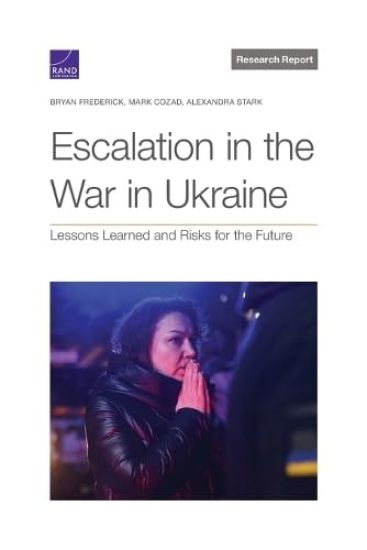
Escalation in the War in Ukraine

Escalation in the War in Ukraine

Bryan Frederick; Mark Cozad; Alexandra Stark

RAND Corporation
2023
pokkari
This report evaluates the potential for further escalation in the conflict in Ukraine, including the prospects for escalation to Russian nuclear use. The report is intended to inform U.S. and NATO policymakers as they consider how to avoid further escalation of the conflict while assisting Ukraine in its efforts to defeat the Russian invasion and to better inform the public debate around these issues.
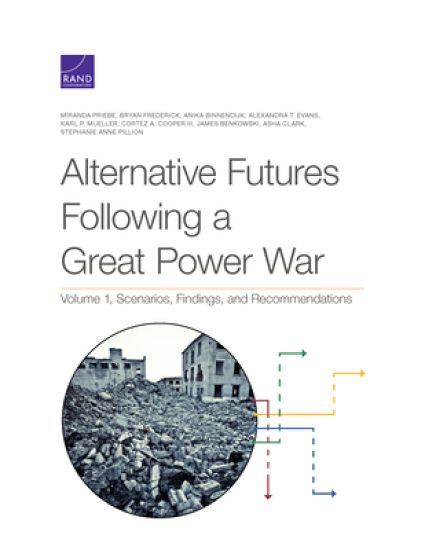
Alternative Futures Following a Great Power War

Alternative Futures Following a Great Power War

Miranda Priebe; Bryan Frederick; Anika Binnendijk; Alexandra T Evans; Karl P Mueller; Cortez A Cooper; James Benkowski; Asha Clark; Stephanie Anne Pillion

RAND Corporation
2023
pokkari
The Department of Defense has become increasingly focused on competition with China and Russia and the possibility of great power war. RAND researchers generated four plausible near-term war scenarios and assessed how they could shape the postwar strategic environment. These scenarios show the complex relationship between wartime and postwar goals, highlighting the importance of considering postwar outcomes in prewar planning.
Future U.S. Peacetime Policy Toward Russia

Future U.S. Peacetime Policy Toward Russia

Miranda Priebe; Bryan Frederick; Alexandra T Evans; Samuel Charap; Gabrielle Tarini; Bryan Rooney

RAND Corporation
2023
pokkari
After the Ukraine war ends, U.S.-Russian relations will remain hostile. But future U.S. policymakers will also need to balance competing demands and might therefore consider a peacetime limited less-hardline approach toward Russia. Using four historical case studies, the authors found that such approaches can lead to durable but narrow gains without emboldening the rival. But such policies may not prevent later deterioration of the relationship.
Restraint and the Future of Warfare

Restraint and the Future of Warfare

Bryan Frederick; Nathan Chandler

RAND
2022
nidottu
This volume of the Future of Warfare series examines the most significant trends in factors affecting the use of restraint in warfare that could affect U.S. national security: the spread of lawfare, the widespread distribution of imagery of U.S. military operations, the increasing effectiveness of false accusations, and the increasing public concern for civilian casualties.
Assessing Trade-Offs in U.S. Military Intervention Decisions

Assessing Trade-Offs in U.S. Military Intervention Decisions

Bryan Frederick; Jennifer Kavanagh; Stephanie Pezard

RAND
2022
nidottu
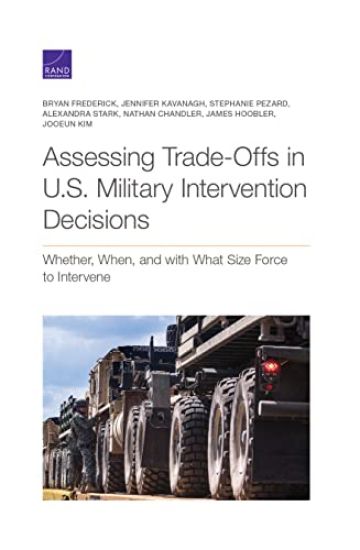
In this report, the authors create a framework that can be used to rigorously consider the trade-offs involved in U.S. military intervention decisions following the outbreak of a war or crisis. This framework can provide a better understanding of the relationships between intervention timing, intervention size, and intervention outcomes to inform future debates about whether, when, and with what size force to undertake a military intervention.
Anticipating Adversary Military Interventions

Anticipating Adversary Military Interventions

Jennifer Kavanagh; Bryan Frederick; Nathan Chandler

RAND
2021
nidottu
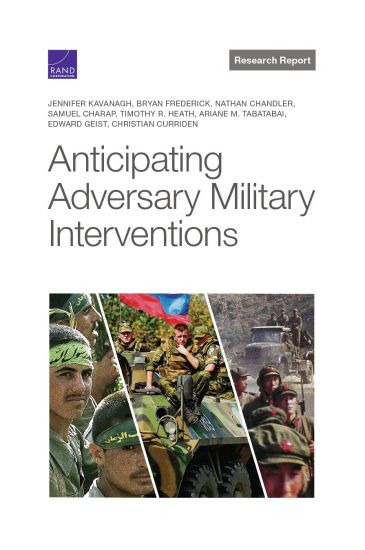
The authors explore where, how, and how often U.S. adversaries have intervened militarily since 1946 and identify why these adversaries initiated military interventions and why they might do so in the future. Three companion reports consider Chinese, Russian, and Iranian military intervention behavior in detail. The insights and signposts identified in these reports can inform U.S. decisions about military posture, partnerships, and investments.
Iran's Military Interventions

Iran's Military Interventions

Ariane M Tabatabai; Nathan Chandler; Bryan Frederick

RAND
2021
nidottu
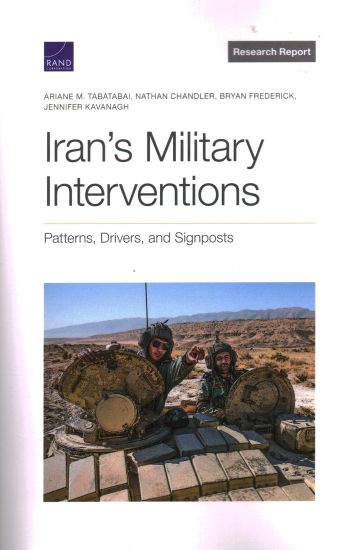
In recent years, Iran has risen as one of the most significant regional challenges faced by the United States. In this report, the authors assess when, where, why, and how Iran conducts military interventions and identify key signposts of Iranian military interventions that can be used as early warning indicators for U.S. military planners and can guide decisions about the use of forces in the Middle East region.
Russia's Military Interventions

Russia's Military Interventions

Samuel Charap; Edward Geist; Bryan Frederick; John J Drennan; Nathan Chandler; Jennifer Kavanagh

RAND
2021
nidottu
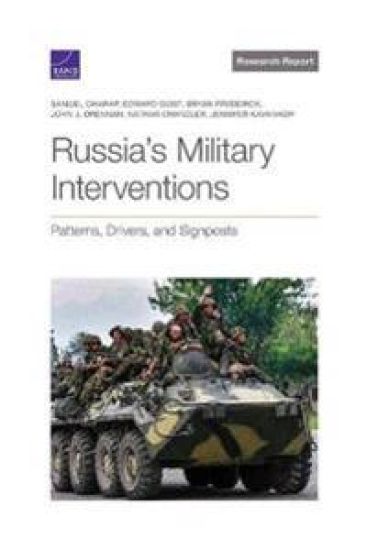
Despite Russia's relatively small global economic footprint, it has engaged in more interventions than any other U.S. competitor since the end of the Cold War. In this report, the authors assess when, where, and why Russia conducts military interventions by analyzing the 25 interventions that Russia has undertaken since 1991, including detailed case studies of the 2008 Russia-Georgia War and Moscow's involvement in the ongoing Syrian civil war.
China's Military Interventions

China's Military Interventions

Timothy R Heath; Christian Curriden; Bryan Frederick

RAND
2021
nidottu
Great powers have frequently employed large, expeditionary military forces engaged in various operations abroad. As China has ascended in power, observers have debated whether the country might follow a similar path. China has undertaken two types of military interventions in its post-1949 history. The report's authors assess which one of two patterns is likely to predominate in China's future and how this pattern might change.
Understanding the Deterrent Impact of U.S. Overseas Forces

Understanding the Deterrent Impact of U.S. Overseas Forces

Bryan Frederick; Stephen Watts; Matthew Lane; Abby Doll; Ashley L Rhoades; Meagan L Smith

RAND
2020
nidottu
This report provides empirical evidence on the deterrent effects of U.S. overseas military forces. It investigates how these effects might vary by the type, size, and location of these forces, as well as the effects of U.S. forces deployed in the midst of crises. The analyses provide the clearest evidence in support of the deterrent effect of heavy ground forces, particularly when deployed near but not directly bordering potential adversaries.