
Kirjailija
C. G. Jung
Kirjat ja teokset yhdessä paikassa: 355 kirjaa, julkaisuja vuosilta 1954-2026, suosituimpien joukossa Kalojen aika. Vertaile teosten hintoja ja tarkista saatavuus suomalaisista kirjakaupoista.
Mukana myös kirjoitusasut: C.G. Jung, C G Jung, C.G Jung, C. G Jung
355 kirjaa
Kirjojen julkaisuhaarukka 1954-2026.
The Collected Works of C. G. Jung is a multi-volume work containing the writings of psychiatrist Carl Jung. Contains revised versions of works previously published, works not previously translated, and new translations of virtually all of Jung's writings. Prior to his death he supervised the textual revision. Several of the volumes are extensively illustrated; each contains an index and most a bibliography.
THE COLLECTED WORKS OF C. G. JUNG: Symbols of Transformation (Volume 5)
C.G. Jung
TAYLOR FRANCIS LTD
2023
sidottu
In 1911 Jung published a book of which he says: '...it laid down a programme to be followed for the next few decades of my life.' It was vastly erudite and covered innumerable fields of study: psychiatry, psychoanalysis, ethnology and comparitive religion amongst others. In due course it became a standard work and was translated into French, Dutch and Italian as well as English, in which language it was given the well-known but somewhat misleading title of The Psychology of the Unconscious.In the Foreword to the present revised edition which first appeared in 1956, Jung says: '...it was the explosion of all those psychic contents which could find no room, no breathing space, in the constricting atmosphere of Freudian psychology... It was an attempt, only partially successful, to create a wider setting for medical psychology and to bring the whole of the psychic phenomena within its purview.'For this edition, appearing ten years after the first, bibliographical citations and entries have been revised in the light of subsequent publications in the Collected Works and in the standard edition of Freud's works, some translations have been substituted in quotations, and other essential corrections have been made, but there have been no changes of substance in the text.
THE COLLECTED WORKS OF C. G. JUNG: Mysterium Coniunctionis (Volume 14)
C.G. Jung
TAYLOR FRANCIS LTD
2023
sidottu
Mysterium Coniunctionis was first published in the Collected Works of C.G. Jung in 1963. For this second edition of the work, numerous corrections and revisions have been made in cross-references to other volumes of the Collected Works now available and likewise in the Bibliography.Mysterium Coniunctionis was Jung's last work of book length and gives a final account of his lengthy researches in alchemy. It was Jung's empirical discovery that certain key problems of modern man were prefigures in what t he alchemists called their 'art' or 'process'. Jung maintained that 'the world of alchemical symbols does not belong to the rubbish heap of the past, but stands in a very real and living relationship to our most recent discoveries concerning the psychology of the unconscious'. The volume includes ten plates, a Bibliography, an Index, and an Appendix of original Latin and Greek texts quoted in the work.
This bibliography records the initial publication of each original work by C.G. Jung, each translation, and significant revisions and expansions of both, up to 1975. In nearly every case, the compilers have examined the publications in German, French and English. Translations are recorded in Danish, Dutch, English, Finnish, French, Greek Hebrew, Hungarian, Italian, Japanese, Norwegian, Portuguese, Russian, Serbo-Croatian, Slovenian, Spanish, Swedish and Turkish. It is arranged according to language, with German and English first, publications being listed chronologically in each language.The General Bibliography lists the contents of the respective volumes of the Collected Works (of which this is Volume 19) and the Gesammelte Werke, published in Switzerland, and shows the interrelation of the two editions. It also lists Jung's seminars and provides, where possible, information about the origin of works that were first conceived as lectures. An index is provided of all the titles in English and German, and all original works in the other languages. Three specialist indexes, of personal names, organizations and societies and periodicals, complete the work.The publication of the General Bibliography, together with the General Index (Volume 20 of the Collected Works), complete the publication of the Collected Works of C.G. Jung in English.
Collected Works of C.G. Jung: Alchemical Studies (Volume 13)
C.G. Jung
TAYLOR FRANCIS LTD
2023
sidottu
The psychological and religious implications of alchemy were Jung's major preoccupation during the last thirty years of his life. The essays composing the present volume complete the publication of his alchemial researches, to which three entire volumes have been devoted ^DDL the monumental Mysterium Coniunctionis, Psychology and Alchemy, and Aion ^DDL besides shorter papers in other volumes.This collection of shorter Alchemial Studies has special value as an introduction to Jung's work on alchemy. The first study, on Chinese alchemy, marked the beginning of his interest in the subject, and was originally published in a volume written jointly with Richard Wilhelm. The other four are now published for the first time completely in English.

C.g. Jung Set - Answer to Job/Dreams/four Archetypes/Synchronicity/the Undiscovered Self
C. G. Jung; R. F. C. (TRN) Hull; Sonu (FRW) Shamdasani
Princeton University Press
2010
pokkari
The best of C. G. Jung in one set! These five volumes -- the all-time bestselling editions of Jung's work -- contain popular selections from The Collected Works of C. G. Jung. Each classic volume is newly introduced by Sonu Shamdasani editor of the bestselling The Red Book: Liber Novus and Philemon Professor of Jung History at University College London.
Beginning with Jung's earliest correspondence to associates of the psychoanalytic period and ending shortly before his death, the 935 letters selected for these two volumes offer a running commentary on his creativity. The recipients of the letters include Mircea Eliade, Sigmund Freud, Esther Harding, James Joyce, Karl Kernyi, Erich Neumann, Maud Oakes, Herbert Read, Upton Sinclair, and Father Victor White.
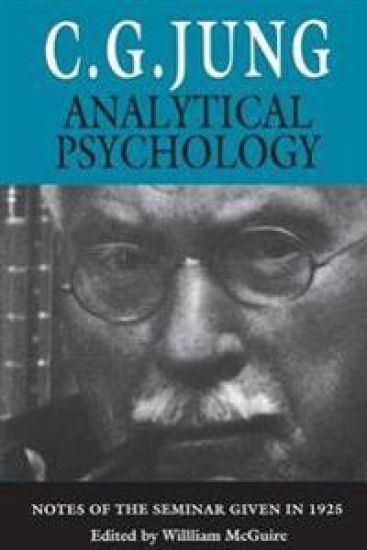
For C. G. Jung, 1925 was a watershed year. He turned fifty, visited the Pueblo Indians of New Mexico and the tribesmen of East Africa, published his first book on the principles of analytical psychology meant for the lay public, and gave the first of his formal seminars in English. The seminar, conducted in weekly meetings during the spring and summer, began with a notably personal account of the development of his thinking from 1896 up to his break with Freud in 1912. It moved on to discussions of the basic tenets of analytical psychology--the collective unconscious, typology, the archetypes, and the anima/animus theory. In the elucidation of that theory, Jung analyzed in detail the symbolism in Rider Haggard's She and other novels. Besides these literary paradigms, he made use of case material, examples in the fine arts, and diagrams.
This bibliography records the initial publication of each original work by C.G. Jung, each translation, and significant revisions and expansions of both, up to 1975. In nearly every case, the compilers have examined the publications in German, French and English. Translations are recorded in Danish, Dutch, English, Finnish, French, Greek Hebrew, Hungarian, Italian, Japanese, Norwegian, Portuguese, Russian, Serbo-Croatian, Slovenian, Spanish, Swedish and Turkish. It is arranged according to language, with German and English first, publications being listed chronologically in each language.The General Bibliography lists the contents of the respective volumes of the Collected Works (of which this is Volume 19) and the Gesammelte Werke, published in Switzerland, and shows the interrelation of the two editions. It also lists Jung's seminars and provides, where possible, information about the origin of works that were first conceived as lectures. An index is provided of all the titles in English and German, and all original works in the other languages. Three specialist indexes, of personal names, organizations and societies and periodicals, complete the work.The publication of the General Bibliography, together with the General Index (Volume 20 of the Collected Works), complete the publication of the Collected Works of C.G. Jung in English.
In May 1956, in his eighty-second year, Jung first discussed with Gerhard Adler the question of the publication of his letters. Over many years, Jung had often used the medium of letters to communicate his ideas to others and to clarify the interpretation of his work, quite apart from answering people who approached him with genuine problems of their own and simply corresponding with friends and colleagues. Many of his letters thus contain new creative ideas and provide a running commentary on his work.From some 1,600 letters written by Jung between the years 1906-1961, the editors have selected over 1,000. Volume 2 contains 460 letters written between 1951 and 1961, during the last years of Jung's life, when he was in contact with many people whose names are familiar to the English reader. These include Mircea Eliade, R.F.C. Hull, Ernest Jones, Herbert Read, J.B. Rhine, Upton Sinclair and Fr. Victor White.Volume 2 also contains an addenda with sixteen letters from the period 1915-1946 and a subject index to both volumes. The annotation throughout is detailed and authoritative.
Beginning with Jung's earliest correspondence to associates of the psychoanalytic period and ending shortly before his death, the 935 letters selected for these two volumes offer a running commentary on his creativity. The recipients of the letters include Mircea Eliade, Sigmund Freud, Esther Harding, James Joyce, Karl Kernyi, Erich Neumann, Maud Oakes, Herbert Read, Upton Sinclair, and Father Victor White.
The Freud/Jung Letters
Sigmund Freud; C. G. Jung; William (EDT) McGuire
Princeton University Press
1974
sidottu
In April 1906, Sigmund Freud wrote a brief note to C. G. Jung, initiating a correspondence that was to record the rise and fall of the close relationship between the founder of psychoanalysis and his chosen heir. This correspondence is now available for the first time, complete except for a few missing letters apparently lost long ago. The letters, some 360 in number, span seven years and range in length from a postcard to a virtual essay of 1,500 words. In accordance with an agreement between the writers' sons, Ernst Freud and Franz Jung, the letters are published as documents, without interpretation, but with a detailed annotation that identifies more than 400 persons, 500 publications, and many literary and topical allusions. Anna Freud comments, "[The annotation] has turned the correspondence truly into a history of the beginnings of psychoanalysis, something that was very much needed and is not given anywhere else with the same attention to detail and inclusion of all the people in public life who cither came to psychoanalysis for a while or turned violently against it from the beginning...Every detail is necessary and enhances the value of the book."There are appendixes, facsimiles, and contemporary photographs. The index, with bibliographical details, is exhaustive. As historical documents, the letters reflect the early struggles of Freud and Jung in gaining acceptance for psychoanalysis. Freud, Jung's senior by twenty years, patiently assesses the opposition, cautioning the fiery Jung to concentrate more on his research than on answering the critics. The two exchange candid opinions on their colleagues, plan strategies for the advancement of their cause, and most important, share their experiences with patients and with the reading that led them to new scientific realizations. The correspondence provides an account of the composition of many papers, lectures, and books of Freud, Jung, and their colleagues, and describes the genesis of the journals, conferences, and international and local societies of the movement. The decline of the correspondence documents Jung's increasing reluctance to accept the entire Freudian code, and the growing bitterness that led to the mutual decision to end the correspondence and the relationship.
The Collected Works of C. G. Jung is a multi-volume work containing the writings of psychiatrist Carl Jung.Contains revised versions of works previously published, works not previously translated, and new translations of virtually all of Jung's writings. Prior to his death he supervised the textual revision.Several of the volumes are extensively illustrated; each contains an index and most a bibliography.
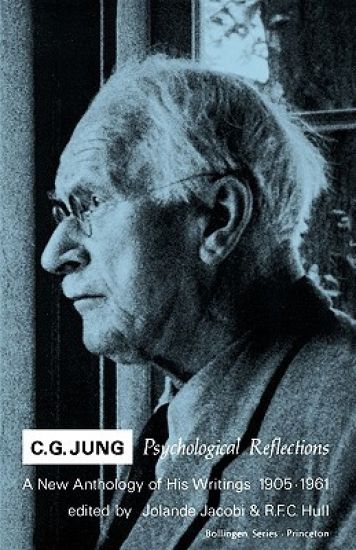
C.G. Jung
C. G. Jung; R. F. C. (TRN) Hull; Jolande (EDT) Jacobi
Princeton University Press
1973
pokkari
Carl Gustav Jung, the great Swiss psychologist, who died in 1961 in his eighty-sixth year, was a profound thinker of extraordinary creativity. In the course of his medical practice he reflected deeply on human nature and human problems, and his prolific writings bear witness to his great wisdom and insight. For this completely revised edition, selections from publications of the years 1945-1961, the last fruitful years of Jung's life, have been added, and the book has been reset in a new compact format. The selections are arranged thematically under four main headings: The Nature and Activity of the Psyche, Man in His Relation to Others, The World of Values, and On Ultimate Things.Jung's reflections frequently have a penetrating relevance to today's (and tomorrow's) problems. On prejudice: "Our unwillingness to see our own faults and the projection of them is the beginning of most quarrels, and is the strongest guarantee that injustice, animosity, and persecution are not ready to die out." On sex: "We are not yet far enough advanced to distinguish between moral and immoral behavior in the realm of free sexual activity." On religion: "No one can know what the ultimate things are. We must therefore take them as we experience them. And if such experience helps to make life healthier, more beautiful, more complete, and more satisfactory to yourself and to those you love, you may safely say: 'This was the grace of God.'"
The psychological and religious implications of alchemy were Jung's major preoccupation during the last thirty years of his life. The essays composing the present volume complete the publication of his alchemial researches, to which three entire volumes have been devoted ^DDL the monumental Mysterium Coniunctionis, Psychology and Alchemy, and Aion ^DDL besides shorter papers in other volumes.This collection of shorter Alchemial Studies has special value as an introduction to Jung's work on alchemy. The first study, on Chinese alchemy, marked the beginning of his interest in the subject, and was originally published in a volume written jointly with Richard Wilhelm. The other four are now published for the first time completely in English.

The Critical Edition of the Works of C. G. Jung, Volume 1
C. G. Jung
PRINCETON UNIVERSITY PRESS
2026
sidottu
An authoritative new translation of Jung’s writings from his student years Featuring extensive original commentary as well as diary excerpts and other rare materials published here for the first time As a medical student at the University of Basel, C. G. Jung was a member of the Zofingia Society, a student fraternity, becoming president of the Basel section in the winter semester 1897–1898. Between 1896 and 1899, he delivered four lectures there, addressing empirical psychology, natural science, philosophy, spiritualism, metaphysics, and religion—topics that anticipate and illuminate his later work. In these early writings, Jung wrestles with the tension between scientific materialism and his religious-metaphysical interests, criticizing reductionist views in the sciences while still insisting on scientific method. He argues for a life principle irreducible to matter that would enable the possibility of the postmortem existence of the soul. This volume presents Jung’s lectures together with the discussions that followed. It also includes transcripts of several of his sittings with his cousin Helene Preiswerk, material he later used for his medical dissertation. Beginning in 1898, Jung kept a personal diary; the volume offers excerpts in which he continues to reflect on philosophical, literary, and religious issues—including the aesthetics of music—together with an unpublished piece on Tolstoy’s Resurrection. Also included are philosophical notes he began compiling around 1897, portions of which continued in his diary, as well as a reading list with comments prepared for his Zofingia lectures. Two papers he wrote for his medical curriculum—on wound infection and pellagra—are likewise reproduced. The Critical Edition of the Works of C. G. Jung is a monumental, multiyear publishing initiative that introduces Jung’s writings to a new generation of readers in a vibrant new English translation. Each volume features an in-depth historical introduction, informative annotations that draw on Jung’s unpublished correspondence, a detailed chronology, and variorum presentations of works that went through multiple editions.
A penetrating account of Jung’s insights into children’s dreams and the psychology of childhood In the 1930s, C. G. Jung embarked on a bold investigation into childhood dreams as remembered by adults to better understand their significance to the lives of the dreamers. Jung presented his findings in a four-year seminar series at the Swiss Federal Institute of Technology in Zurich. Presented here in an inspired English translation, these seminars reveal Jung as an impassioned educator in dialogue with his students, providing an invaluable picture of how he taught others to interpret dreams. Here we witness Jung the clinician more vividly than ever before—he is witty, impatient, sometimes authoritarian, always wise and intellectually daring, but also a teacher who, though brilliant, could be humbled by life’s great mysteries. This splendid volume is the fullest representation of Jung’s views on the interpretation of children’s dreams.
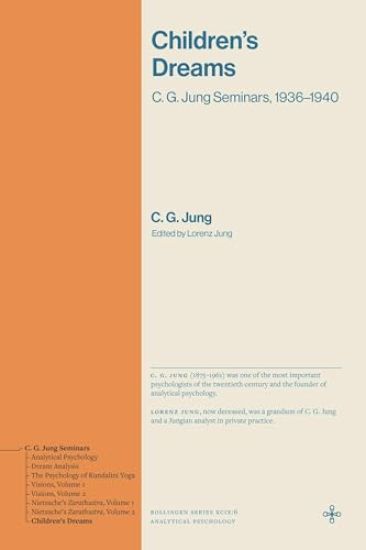
A penetrating account of Jung’s insights into children’s dreams and the psychology of childhood In the 1930s, C. G. Jung embarked on a bold investigation into childhood dreams as remembered by adults to better understand their significance to the lives of the dreamers. Jung presented his findings in a four-year seminar series at the Swiss Federal Institute of Technology in Zurich. Presented here in an inspired English translation, these seminars reveal Jung as an impassioned educator in dialogue with his students, providing an invaluable picture of how he taught others to interpret dreams. Here we witness Jung the clinician more vividly than ever before—he is witty, impatient, sometimes authoritarian, always wise and intellectually daring, but also a teacher who, though brilliant, could be humbled by life’s great mysteries. This splendid volume is the fullest representation of Jung’s views on the interpretation of children’s dreams.
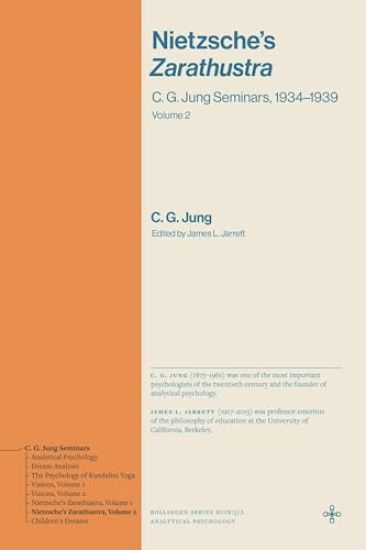
Volume two of Jung’s seminar on the book that moved him profoundly and had a lifelong influence on his thought Nietzsche’s infamous work Thus Spake Zarathustra is filled with a strange sense of religiosity that seems to run counter to the philosopher’s usual polemics against religious faith. For some scholars, this book marks little but a mental decline in the great philosopher. For C. G. Jung, however, Zarathustra was an invaluable demonstration of the unconscious at work, one that illuminated both Nietzsche’s psychology and spirituality and that of the modern world in general. This is the second of two volumes of Jung’s lively seminar on Nietzsche’s Zarathustra, which remains an important source for specialists in depth psychology. In these historic sessions, the mature Jung speaks informally to members of his inner circle about a thinker whose work not only overwhelmed him with the depth of their understanding of human nature but also provided the philosophical sources of many of his own ideas.