Kirjojen hintavertailu. Mukana 12 390 323 kirjaa ja 12 kauppaa.

Kirjailija

Christian Smith

Kirjat ja teokset yhdessä paikassa: 39 kirjaa, julkaisuja vuosilta 1991-2026, suosituimpien joukossa The Sacred Project of American Sociology. Vertaile teosten hintoja ja tarkista saatavuus suomalaisista kirjakaupoista.

39 kirjaa

Kirjojen julkaisuhaarukka 1991-2026.

Divided by Faith

Divided by Faith

Michael O. Emerson; Christian Smith

OXFORD UNIVERSITY PRESS INC
2026
sidottu
First published in 2000, Divided by Faith has become a landmark book for understanding race and religion in the United States. Drawing on a nationwide telephone survey of two thousand people and an additional two hundred face-to-face interviews, it probes the grassroots of white evangelical America. A quarter of a century on from the first edition, Michael O. Emerson and Christian Smith find that despite efforts by the movement's leaders to address the problem of racial discrimination, evangelicals themselves are still preserving America's racial chasm. In fact, most white evangelicals see no systematic discrimination against Black Americans or other racial groups. The authors contend that it is not overt racism that prevents evangelicals from recognizing ongoing problems in American society. Instead, it is the evangelical movement's emphasis on individualism, free will, and personal relationships that makes invisible the pervasive injustice that perpetuates racial inequality. This second edition has been thoroughly overhauled with updated statistics and an additional chapter covering developments over the last twenty-five years. The authors assess the growth of the rise of Christian nationalism, whiteness studies, critical race theory, the racialization of religion, and the religionization of race. Through a large body of evidence combined with sophisticated analysis and interpretation, they throw a bright light on the oldest American dilemma. In the end, they conclude that despite the best intentions of evangelical leaders and some positive trends, real racial reconciliation remains far over the horizon.
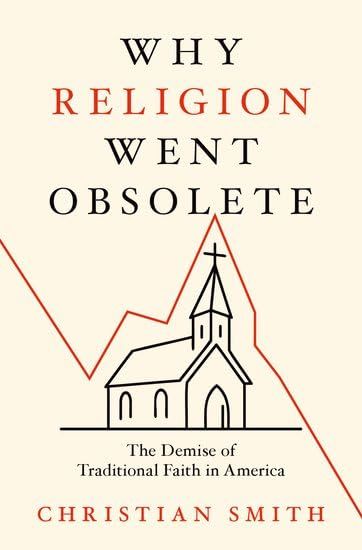
Why Religion Went Obsolete

Why Religion Went Obsolete

Christian Smith

OXFORD UNIVERSITY PRESS INC
2025
sidottu
Is traditional American religion doomed? Traditional religion in the United States has suffered huge losses in recent decades. The number of Americans identifying as "not religious" has increased remarkably. Religious affiliation, service attendance, and belief in God have declined. More and more people claim to be "spiritual but not religious." Religious organizations have been reeling from revelations of sexual and financial scandals and cover-ups. Public trust in "organized religion" has declined significantly. Crucially, these religious losses are concentrated among younger generations. This means that, barring unlikely religious revivals among youth, the losses will continue and accelerate in time, as less-religious younger Americans replace older more-religious ones and increasingly fewer American children are raised by religious parents. All this is clear. But what is less clear is exactly why this is happening. We know a lot more about the fact that traditional American religion has declined than we do about why this is so. Why Religion Went Obsolete aims to change that. Drawing on survey data and hundreds of interviews, Christian Smith offers a sweeping, multifaceted account of why many Americans have lost faith in traditional religion. An array of large-scale social forces-everything from the end of the Cold War to the rise of the internet to shifting ideas about gender and sexuality-came together to render traditional religion culturally obsolete. For growing numbers of Americans, traditional religion no longer seems useful or relevant. Using quantitative empirical measures of big-picture changes over time as well as exploring the larger cultural environment--the cultural "zeitgeist"--Smith explains why this is the case and what it means for the future. Crucially, he argues, it does not mean a strictly secular future. Rather, Americans' spiritual impulses are being channelled in new and interesting directions. Why Religion Went Obsolete is a tour de force from one of our leading chroniclers of religion in America.
Religious Parenting

Religious Parenting

Christian Smith; Bridget Ritz; Michael Rotolo

Princeton University Press
2021
pokkari
How parents approach the task of passing on religious faith and practice to their childrenHow do American parents pass their religion on to their children? At a time of overall decline of traditional religion and an increased interest in personal “spirituality,” Religious Parenting investigates the ways that parents transmit religious beliefs, values, and practices to their kids. We know that parents are the most important influence on their children’s religious lives, yet parents have been virtually ignored in previous work on religious socialization. Renowned religion scholar Christian Smith and his collaborators Bridget Ritz and Michael Rotolo explore American parents’ strategies, experiences, beliefs, and anxieties regarding religious transmission through hundreds of in-depth interviews that span religious traditions, social classes, and family types all around the country.Throughout we hear the voices of evangelical, Catholic, Mormon, mainline and black Protestant, Jewish, Muslim, Hindu, and Buddhist parents and discover that, despite massive diversity, American parents share a nearly identical approach to socializing their children religiously. For almost all, religion is important for the foundation it provides for becoming one’s best self on life’s difficult journey. Religion is primarily a resource for navigating the challenges of this life, not preparing for an afterlife. Parents view it as their job, not religious professionals’, to ground their children in life-enhancing religious values that provide resilience, morality, and a sense of purpose. Challenging longstanding sociological and anthropological assumptions about culture, the authors demonstrate that parents of highly dissimilar backgrounds share the same “cultural models” when passing on religion to their children.Taking an extensive look into questions of religious practice and childrearing, Religious Parenting uncovers parents’ real-life challenges while breaking innovative theoretical ground.
Handing Down the Faith

Handing Down the Faith

Christian Smith; Amy Adamczyk

Oxford University Press Inc
2021
sidottu
The most important influence shaping the religious and spiritual lives of children, youth, and teenagers is their parents. A myriad of studies show that the parents of American youth play the leading role in shaping the character of their religious and spiritual lives, even well after they leave home and often for the rest of their lives. We know a lot about the importance of parents in faith transmission. However we know much less about the actual beliefs, feelings, and activities of the parents themselves, what Christian Smith and Amy Adamczyk call the "intergenerational transmission of religious faith and practice." To address that gap, this book reports the findings of a new national study of religious parents in the United States. The findings and conclusions in Handing Down the Faith are based on 215 in-depth, personal interviews with religious parents from many traditions and different parts of the country, and sophisticated analyses of two nationally representative surveys of American parents about their religious parenting. Handing Down the Faith explores the background beliefs informing how and why religious parents seek to pass on religion to their children; examines how parenting styles interact with parent religiousness to shape effective religious transmission; shows how parents have been influenced by their experiences as children influenced by their own parents; reveals how religious parents view their congregations and what they most seek out in a local church, synagogue, temple, or mosque; explores the experiences and outlooks of immigrant parents including Latino Catholics, East Asian Buddhists, South Asian Muslims, and Indian Hindus. Smith and Adamczyk step back to consider how American religion has transformed over the last 100 years and to explain why parents today shoulder such a huge responsibility in transmitting religious faith and practice to their children. The book is rich in empirical evidence and unique in many of the topics it explores and explains, providing a variety of sometimes counterintuitive findings that will interest scholars of religion, social scientists interested in the family, parenting, and socialization; clergy and religious educators and leaders; and religious parents themselves.
To Flourish or Destruct

To Flourish or Destruct

Christian Smith

University of Chicago Press
2021
nidottu
In his 2010 book What Is a Person?, Christian Smith argued that sociology had for too long neglected this fundamental question. Prevailing social theories, he wrote, do not adequately “capture our deep subjective experience as persons, crucial dimensions of the richness of our own lived lives, what thinkers in previous ages might have called our ‘souls’ or ‘hearts.’” Building on Smith’s previous work, To Flourish or Destruct examines the motivations intrinsic to this subjective experience: Why do people do what they do? How can we explain the activity that gives rise to all human social life and social structures? Smith argues that our actions stem from a motivation to realize what he calls natural human goods: ends that are, by nature, constitutionally good for all human beings. He goes on to explore the ways we can and do fail to realize these ends—a failure that can result in varying gradations of evil. Rooted in critical realism and informed by work in philosophy, psychology, and other fields, Smith’s ambitious book situates the idea of personhood at the center of our attempts to understand how we might shape good human lives and societies.
Back-Pocket God

Back-Pocket God

Melinda Lundquist Denton; Richard Flory; Christian Smith

Oxford University Press Inc
2020
sidottu
More than a decade ago, a group of researchers began to study the religious and spiritual lives of American teenagers. They tracked these young people over the course of a decade, revisiting them periodically to check in on the state -and future- of religion in America, and reporting on their findings in a series of books, beginning with Soul Searching (2005). Now, with Back-Pocket God, this mammoth research project comes to its conclusion. What have we learned about the changing shape of religion in America? Back-Pocket God explores continuity and change among young people from their teenage years through the latter stages of "emerging adulthood." Melinda Lundquist Denton and Richard Flory find that the story of young adult religion is one of an overall decline in commitment and affiliation, and in general, a moving away from organized religion. Yet, there is also a parallel trend in which a small, religiously committed group of emerging adults claim faith as an important fixture in their lives. Emerging adults don't seem so much opposed to religion or to religious organizations, at least in the abstract, as they are uninterested in religion, at least as they have experienced it. Religion is like an app on the ubiquitous smartphones in our back pockets: readily accessible, easy to control, and usefulbut only for limited purposes. Denton and Flory show that some of the popular assumptions about young people and religion are not as clear as what many people seem to believe. The authors challenge the characterizations of religiously unaffiliated emerging adults -sometimes called "religious nones"- as undercover atheists. At the other end of the spectrum, they question the assumption that those who are not religious will return to religion once they marry and have children.
Religious Parenting

Religious Parenting

Christian Smith; Bridget Ritz; Michael Rotolo

PRINCETON UNIVERSITY PRESS
2019
sidottu
How parents approach the task of passing on religious faith and practice to their childrenHow do American parents pass their religion on to their children? At a time of overall decline of traditional religion and an increased interest in personal “spirituality,” Religious Parenting investigates the ways that parents transmit religious beliefs, values, and practices to their kids. We know that parents are the most important influence on their children’s religious lives, yet parents have been virtually ignored in previous work on religious socialization. Renowned religion scholar Christian Smith and his collaborators Bridget Ritz and Michael Rotolo explore American parents’ strategies, experiences, beliefs, and anxieties regarding religious transmission through hundreds of in-depth interviews that span religious traditions, social classes, and family types all around the country.Throughout we hear the voices of evangelical, Catholic, Mormon, mainline and black Protestant, Jewish, Muslim, Hindu, and Buddhist parents and discover that, despite massive diversity, American parents share a nearly identical approach to socializing their children religiously. For almost all, religion is important for the foundation it provides for becoming one’s best self on life’s difficult journey. Religion is primarily a resource for navigating the challenges of this life, not preparing for an afterlife. Parents view it as their job, not religious professionals’, to ground their children in life-enhancing religious values that provide resilience, morality, and a sense of purpose. Challenging longstanding sociological and anthropological assumptions about culture, the authors demonstrate that parents of highly dissimilar backgrounds share the same “cultural models” when passing on religion to their children.Taking an extensive look into questions of religious practice and childrearing, Religious Parenting uncovers parents’ real-life challenges while breaking innovative theoretical ground.
The Happiness Effect

The Happiness Effect

Donna Freitas; Christian Smith

Oxford University Press Inc
2019
nidottu
Sexting. Cyberbullying. Narcissism. Social media has become the dominant force in young people's lives, and each day seems to bring another shocking tale of private pictures getting into the wrong hands, or a lament that young people feel compelled to share their each and every thought with the entire world. Have smartphones and social media created a generation of self-obsessed egomaniacs? Absolutely not, Donna Freitas argues in this provocative book. And, she says, these alarmist fears are drawing attention away from the real issues that young adults are facing. Drawing on a large-scale survey and interviews with students on thirteen college campuses, Freitas finds that what young people are overwhelmingly concerned with--what they really want to talk about--is happiness. They face enormous pressure to look perfect online--not just happy, but blissful, ecstatic, and fabulously successful. Unable to achieve this impossible standard, they are anxious about letting the less-than-perfect parts of themselves become public. Far from wanting to share everything, they are brutally selective when it comes to curating their personal profiles, and worry obsessively that they might unwittingly post something that could come back to haunt them later in life. Through candid conversations with young people from diverse backgrounds, Freitas reveals how even the most well-adjusted individuals can be stricken by self-doubt when they compare their experiences with the vast collective utopia that they see online. And sometimes, as on anonymous platforms like Yik Yak, what they see instead is a depressing cesspool of racism and misogyny. Yet young people are also extremely attached to their smartphones and apps, which sometimes bring them great pleasure. It is very much a love-hate relationship. While much of the public's attention has been focused on headline-grabbing stories, the everyday struggles and joys of young people have remained under the radar. Freitas brings their feelings to the fore, in the words of young people themselves. The Happiness Effect is an eye-opening window into their first-hand experiences of social media and its impact on them.
Religion

Religion

Christian Smith

Princeton University Press
2019
pokkari
A groundbreaking new theory of religionReligion remains an important influence in the world today, yet the social sciences are still not adequately equipped to understand and explain it. This book advances an innovative theory of religion that goes beyond the problematic theoretical paradigms of the past. Drawing on the philosophy of critical realism and personalist social theory, Christian Smith explores why humans are religious in the first place—uniquely so as a species—and offers an account of secularization and religious innovation and persistence that breaks the logjam in which religious scholarship has been stuck for so long. Certain to stimulate debate and inspire promising new avenues of scholarship, Religion features a wealth of illustrations and examples that help to make its concepts accessible to readers. This superbly written book brings sound theoretical thinking to a perennially thorny subject, and a new vitality and focus to its study.
Atheist Overreach

Atheist Overreach

Christian Smith

Oxford University Press Inc
2019
sidottu
In recent years atheism has become ever more visible, acceptable, and influential. Atheist apologists have become increasingly vociferous and confident in their claims: that a morality requiring benevolence towards all and universal human rights need not be grounded in religion; that modern science disproves the existence of God; and that there is nothing innately religious about human beings. In Atheist Overreach, Christian Smith takes a look at the evidence and arguments, and explains why we ought to be skeptical of these atheists' claims about morality, science, and human nature. He does not argue that atheism is necessarily wrong, but rather that its advocates are advancing crucial claims that are neither rationally defensible nor realistic. Their committed worldview feeds unhelpful arguments and contributes to the increasing polarization of today's political landscape. Everyone involved in the theism-atheism debates, in shared moral reflection, and in the public consumption of the findings of science should be committed to careful reasoning and rigorous criticism. This book provides readers with the information they need to participate more knowledgably in debates about atheism and what it means for our society.
Calling All Americans: A Solution to Fight Back Corruption

Calling All Americans: A Solution to Fight Back Corruption

Christian Smith

Independently Published
2018
nidottu
Are you tired of the poor management of power in our American government? Do you feel like their is nothing that can be done to fight against the corruption and greed that plagues our government? Well, their is In this short simplified book I show you how You and I can change the government without actually being apart of the government. Be part of a movement that will sweep the nation as Americans unite and take back power for the people and drive out those that seek to abuse the power of being elected to benefit themselves and their agenda's for power.
The Happiness Effect

The Happiness Effect

Donna Freitas; Christian Smith

Oxford University Press Inc
2017
sidottu
Sexting. Cyberbullying. Narcissism. People-and especially the media-are consumed by fears about the effect of social media on young people. We hear constantly about the dangers that lurk online, and about young people's seemingly pathological desire to share anything and everything about themselves with the entire world. Donna Freitas has traveled the country, talking to college students about what's really happening on social media. What she finds is that, while we focus on the problems that make headlines, we are ignoring the seemingly mundane, but much more widespread, problems that occur every day. Young people, she shows, feel enormous pressure to look happy all the time-and not just basically content, but blissful, ecstatic, inspiring and successful in their personal, professional, and academic lives-regardless of how they actually feel. Of course, these young adults are not that happy, at least not all of the time, and the constant exposure to the seemingly perfect lives of other people on social media only makes them feel worse. What's more, far from wanting to share everything about themselves, they are terrified of sharing something that will come back to haunt them later in life. The rise of social media has brought about a dramatic cultural shift: the need to curate a perfect identity online that often has little to do with reality. The consequences, Freitas shows, can be very real. Drawing on an online survey and in-person interviews with students from thirteen campuses around the U.S, Freitas offers a window into the social media generation and how they use Facebook, Snapchat, and Twitter, and other online platforms. She presents fascinating insights about how these people are consciously creating alternate identities for themselves, while also suffering from the belief that the other people they encounter online really are as perfect as their profiles appear. This is an eye-opening look at the real world of social media today.
To Flourish or Destruct

To Flourish or Destruct

Christian Smith

University of Chicago Press
2015
sidottu
In his 2010 book What Is a Person?, Christian Smith argued that sociology had for too long neglected this fundamental question. Prevailing social theories, he wrote, do not adequately "capture our deep subjective experience as persons, crucial dimensions of the richness of our own lived lives, what thinkers in previous ages might have called our 'souls' or 'hearts.'" Building on Smith's previous work, To Flourish or Destruct examines the motivations intrinsic to this subjective experience: Why do people do what they do? How can we explain the activity that gives rise to all human social life and social structures? Smith argues that our actions stem from a motivation to realize what he calls natural human goods: ends that are, by nature, constitutionally good for all human beings. He goes on to explore the ways we can and do fail to realize these ends-a failure that can result in varying gradations of evil. Rooted in critical realism and informed by work in philosophy, psychology, and other fields, Smith's ambitious book situates the idea of personhood at the center of our attempts to understand how we might shape good human lives and societies.
The Paradox of Generosity

The Paradox of Generosity

Christian Smith; Hilary Davidson

Oxford University Press Inc
2014
sidottu
Determining why, when, and to whom people feel compelled to be generous affords invaluable insight into positive and problematic ways of life. Organ donation, volunteering, and the funding of charities can all be illuminated by sociological and psychological perspectives on how American adults conceive of and demonstrate generosity. Focusing not only on financial giving but on the many diverse forms generosity can take, Christian Smith and Hilary Davidson show the deep impactusually good, sometimes destructivethat giving has on individuals. The Paradox of Generosity is the first study to make use of the cutting-edge empirical data collected in Smith's groundbreaking, multidisciplinary, five-year Science of Generosity Initiative. It draws on an extensive survey of 2,000 Americans, more than sixty in-depth interviews with individuals across twelve states, and analysis of over 1,000 photographs and other visual materials. This wealth of evidence reveals a consistent link between demonstrating generosity and leading a better life: more generous people are happier, suffer fewer illnesses and injuries, live with a greater sense of purpose, and experience less depression. Smith and Davidson also show, however, that to achieve a better life a person must practice generosity regularly-random acts of kindness are not enough. Offering a wide range of vividly illustrative case studies, this volume will be a crucial resource for anyone seeking to understand the true impact and meaning of generosity.
The Sacred Project of American Sociology

The Sacred Project of American Sociology

Christian Smith

Oxford University Press Inc
2014
sidottu
Counter to popular perceptions, contemporary American sociology is and promotes a profoundly sacred project at heart, Sociology today is in fact animated by sacred impulses, driven by sacred commitments, and serves a sacred project. Sociology appears on the surface to be a secular, scientific enterprise-its founding fathers were mostly atheists. Its basic operating premises are secular and naturalistic. Sociologists today are disproportionately not religious, compared to all Americans, and often irreligious. The Sacred Project of American Sociology shows, counter-intuitively, that the secular enterprise that everyday sociology appears to be pursuing is actually not what is really going on at sociology's deepest level. Christian Smith conducts a self-reflexive, tables-turning, cultural and institutional sociology of the profession of American sociology itself, showing that this allegedly secular discipline ironically expresses Emile Durkheim's inescapable sacred, exemplifies its own versions of Marxist false consciousness, and generates a spirited reaction against Max Weber's melancholically observed disenchantment of the world. American sociology does not escape the analytical net that it casts over the rest of the ordinary world. Sociology itself is a part of that very human, very social, often very sacred and spiritual world. And sociology's ironic mis-recognition of its own sacred project leads to a variety of arguably self-destructive and distorting tendencies. This book re-asserts a vision for what sociology is most important for, in contrast with its current commitments, and calls sociologists back to a more honest, fair, and healthy vision of its purpose.