Kirjojen hintavertailu. Mukana 12 156 237 kirjaa ja 12 kauppaa.

Kirjailija

D. Stephen Long

Kirjat ja teokset yhdessä paikassa: 28 kirjaa, julkaisuja vuosilta 2000-2024, suosituimpien joukossa Saving Karl Barth. Vertaile teosten hintoja ja tarkista saatavuus suomalaisista kirjakaupoista.

Mukana myös kirjoitusasut: D Stephen Long

28 kirjaa

Kirjojen julkaisuhaarukka 2000-2024.

Saving Karl Barth

Saving Karl Barth

D. Stephen Long

Fortress Press,U.S.
2014
pokkari
Challenging recent rejections of Hans Urs von Balthasar's groundbreaking study of Karl Barth's theology, Stephen Long argues that these interpreters are myopically impatient with the nuances of Balthasar's reading of Barth and fail to appreciate the longstanding theological friendship that perdured. Even more, current readings threaten to repristinate the embattled divide hallmarking Protestant-Catholic relations prior to Vatican II. Long contends against these contemporary trajectories in a substantial defense of Balthasar's theological preoccupation with Barth's thought. This book offers one of the first full contextualizations of the friendship that developed between Balthasar and Barth, which lasted from the 1930s until Balthasar's death in the 1980s. Re-evaluating Balthasar's theological work on Barth, the present volume provides a critical new reading of not only Balthasar's original volume but a wider account of the systematic engagement Balthasar carried on throughout his career. Within this, a paradigm for fruitful, generous ecumenical dialogue emerges.
Tragedy, Tradition, Transformism

Tragedy, Tradition, Transformism

D. Stephen Long

Routledge
2020
nidottu
In this original interpretation and critique of Paul Ramsey’s ethical thought, D. Stephen Long traces the development of one of the mid-twentieth century’s most important and controversial religious social thinkers. Long examines Ramsey’s early liberal idealism as well as later influences on his work, including the just war doctrine, Reinhold Niebu
The Perfectly Simple Triune God

The Perfectly Simple Triune God

D. Stephen Long

Fortress Press,U.S.
2016
pokkari
Although God as simple and Triune was widely accepted for over a millennium, simplicity has been widely critiqued and rejected by modern theology. The purported error is in conceiving God's unity prior to the Triune persons, an error begun by Augustine and crystallized in Aquinas. The Perfectly Simple Triune God challenges this critique and reading of Aquinas as a misunderstanding of his doctrine of God. By refusing to begin theology with God's oneness, who God is collapses into who God is for us, a loss of the biblical and dramatic character of God for us. D. Stephen Long posits that the two treatises were never independent, but inextricably related and entailing one another. Long provides a constructive rereading of Thomas Aquinas, tracing antecedents to Aquinas in the patristic tradition, and readings of him through to the Reformers, taking into account challenges to the classical tradition posed by modern and contemporary theology and philosophy to offer a robust articulation of divine Trinitarian agency for a contemporary age that adheres to broadly considered orthodox and ecumenical parameters.
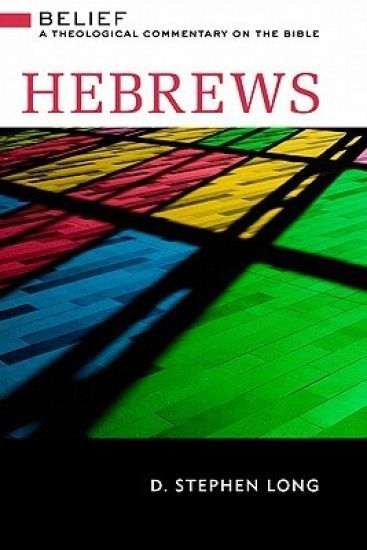
Hebrews

Hebrews

D. Stephen Long

Westminster/John Knox Press,U.S.
2011
sidottu
The book of Hebrews is a fascinating extended sermon which has nurtured and challenged the church for centuries. It stands in tension with our sensibilities but provides guidance for the church's life and for individual Christians. In this theological commentary, D. Stephen Long explores this captivating book. He finds Hebrews extremely relevant for today since it integrates doctrine, ethics, and politics while helping faithful Christians find their ways through troubled times. It invites us into a robust world beyond the assumptions of today's scientific worldviews. Hebrews also helps us understand how to read Scripture after the triumph of Jesus Christ. Long's expert theological guidance helps us understand Hebrews and hear its message for our contemporary world.The volumes in Belief: A Theological Commentary on the Bible from Westminster John Knox Press offer a fresh and invigorating approach to all the books of the Bible. Building on a wide range of sources from biblical studies, the history of theology, the church's liturgical and musical traditions, contemporary culture, and the Christian tradition, noted scholars focus less on traditional historical and literary angles in favor of a theologically focused commentary that considers the contemporary relevance of the texts. This series is an invaluable resource for those who want to probe beyond the backgrounds and words of biblical texts to their deep theological and ethical meanings for the church today.
Christian Ethics

Christian Ethics

D. Stephen Long

Oxford University Press
2010
nidottu
This Very Short Introduction to Christian ethics introduces the topic by examining its sources and historical basis. D. Stephen Long presents a discussion of the relationship between Christian ethics, modern, and postmodern ethics, and explores practical issues including sex, money, and power. Long recognises the inherent difficulties in bringing together 'Christian' and 'ethics' but argues that this is an important task for both the Christian faith and for ethics. Arguing that Christian ethics are not a precise science, but the cultivation of practical wisdom from a range of sources, Long also discusses some of the failures of the Christian tradition, including the crusades, the conquest, slavery, inquistions, and the Galileo affair. Placing them in the context of the theory and practice of ethics and their historical persepctive, he notes the challenges they raise for Christian ethics. He concludes with a discussion of their implications in the modern era, considering how this affects our lives in the present age. ABOUT THE SERIES: The Very Short Introductions series from Oxford University Press contains hundreds of titles in almost every subject area. These pocket-sized books are the perfect way to get ahead in a new subject quickly. Our expert authors combine facts, analysis, perspective, new ideas, and enthusiasm to make interesting and challenging topics highly readable.
Calculated Futures

Calculated Futures

D. Stephen Long; Nancy Ruth Fox

Baylor University Press
2007
nidottu
Calculated Futures examines the ethical and theological underpinnings of the free-market economy, investigating not only the morality of corporations and exchange rates, but also how the politics of economics shape people as moral agents. It does this less by insisting on the unfavorable effects of capitalism, and more by drawing on theological virtues, Christian doctrines, and liturgical practices to discover what they might show us about economic exchanges. Calculated Futures seeks a way forward by engaging economics as a social scientific discipline without subordinating theology to it.
Tragedy, Tradition, Transformism

Tragedy, Tradition, Transformism

D Stephen Long

Wipf Stock Publishers
2007
pokkari
In his original interpretation and critique of Paul Ramsey's ethical thought, D. Stephen Long traces the development of one of the mid-twentieth century's most important and controversial religious social thinkers. Long examines Ramsey's early liberal idealism as well as later influences on his work, including the just war doctrine, Reinhold Niebuhr's realism, H. Richard Niebuhr's historical relativism, Karl Barth's neo-orthodoxy, and Jacques Maritain's integralism. Long overcomes obstacles confronting any Ramsey scholar--such as a theology that cannot be systematized and the complexities of Ramsey's own writing--and lends sharp insight to the philosophical, theological, and moral issues we face today. Scholars of religious ethics and intellectual thought will find this work to be essential reading. ""Paul Ramsey's contribution to twentieth-century Christian ethics in this country was immense, and it deserves attention and careful study. Stephen Long provides just that--offering a thorough account of the development of Ramsey's thought, some little-known information (from the Ramsey papers at Duke) about Ramsey's early years, and the kind of probing theological analysis that Ramsey himself always attempted. This book will help make possible a continued reappropriation of the riches of Ramsey's writings."" --Gilbert Meilaender, Oberlin College D. Stephen Long is Professor of Theology at Marquette University. He has published a number of works including The Goodness of God, The Divine Economy, John Wesley's Moral Theology, and Theology and Culture (Cascade Books, 2007).
On Teaching and Learning Christian Ethics

On Teaching and Learning Christian Ethics

D. Stephen Long

GEORGETOWN UNIVERSITY PRESS
2024
pokkari
An expansion of the discipline of ethics demonstrates that Aquinas’s “infusing of virtue” makes better sense of the moral life than finding a method to guide action While teaching ethics is universally applauded, how one goes about it is much more difficult and contested than is often recognized. On Teaching and Learning Christian Ethics addresses what it means to teach and learn ethics through a thorough comparison of two ethicists, Henry Sidgwick and F. D. Maurice. Where Sidgwick understood ethics as developing a method for guiding voluntary action to what is right, Maurice maintained that ethics concerns life as a whole, and that requires placing it within a metaphysical and theological realm in which the good is much more definitive than right. This comparative history argues that Maurice’s use of Thomas Aquinas’s “infusing of virtue” makes better sense of the moral life of ordinary persons than the specialized, academic discipline Sidgwick bequeathed. Long expands the discipline of ethics through the central theme of his work: that moral life is a gift rather than an achievement. He provides a clear argument in favor of a more holistic approach to teaching ethics.
On Teaching and Learning Christian Ethics

On Teaching and Learning Christian Ethics

D. Stephen Long

GEORGETOWN UNIVERSITY PRESS
2024
sidottu
An expansion of the discipline of ethics demonstrates that Aquinas’s “infusing of virtue” makes better sense of the moral life than finding a method to guide action While teaching ethics is universally applauded, how one goes about it is much more difficult and contested than is often recognized. On Teaching and Learning Christian Ethics addresses what it means to teach and learn ethics through a thorough comparison of two ethicists, Henry Sidgwick and F. D. Maurice. Where Sidgwick understood ethics as developing a method for guiding voluntary action to what is right, Maurice maintained that ethics concerns life as a whole, and that requires placing it within a metaphysical and theological realm in which the good is much more definitive than right. This comparative history argues that Maurice’s use of Thomas Aquinas’s “infusing of virtue” makes better sense of the moral life of ordinary persons than the specialized, academic discipline Sidgwick bequeathed. Long expands the discipline of ethics through the central theme of his work: that moral life is a gift rather than an achievement. He provides a clear argument in favor of a more holistic approach to teaching ethics.
The Art of Cycling, Living, and Dying

The Art of Cycling, Living, and Dying

D Stephen Long

Cascade Books
2021
sidottu
Forty years of avid bicycling came to a conclusion for D. Stephen Long in early October, 2020. Fearing his own imminent death required Long to reflect on life, on its beginnings, middle, and endings. This work uses the lessons learned from cycling, and the experience of the rapid onset of illness, to discuss God, friendship, racism, sexuality, justice, virtues, vices, and much more. It offers a moral theology but one more in keeping with how we take it up--not through theories but in the practices that make up everyday life. Attention to everyday life can help us live well and in so doing prepare us to die well.
The Art of Cycling, Living, and Dying

The Art of Cycling, Living, and Dying

D Stephen Long

Cascade Books
2021
pokkari
Forty years of avid bicycling came to a conclusion for D. Stephen Long in early October, 2020. Fearing his own imminent death required Long to reflect on life, on its beginnings, middle, and endings. This work uses the lessons learned from cycling, and the experience of the rapid onset of illness, to discuss God, friendship, racism, sexuality, justice, virtues, vices, and much more. It offers a moral theology but one more in keeping with how we take it up--not through theories but in the practices that make up everyday life. Attention to everyday life can help us live well and in so doing prepare us to die well.
Tragedy, Tradition, Transformism

Tragedy, Tradition, Transformism

D. Stephen Long

Routledge
2019
sidottu
In this original interpretation and critique of Paul Ramsey’s ethical thought, D. Stephen Long traces the development of one of the mid-twentieth century’s most important and controversial religious social thinkers. Long examines Ramsey’s early liberal idealism as well as later influences on his work, including the just war doctrine, Reinhold Niebu
Augustinian and Ecclesial Christian Ethics

Augustinian and Ecclesial Christian Ethics

D. Stephen Long

Lexington Books/Fortress Academic
2018
sidottu
What is the relationship between the command to love one’s enemies and the use of violence and/or other coercive political means? This work examines this question by comparing and contrasting two important contemporary approaches to Christian ethics, neoAugustinian and the ecclesial or neoAnabaptist. It traces the complicated conversation that has taken place since John Howard Yoder took on Reinhold Niebuhr’s interpretation of the Anabaptists in the 1940’s. It consists of three parts. The first part traces the development of the Augustinian-Niebuhrian approach to ethics from Niebuhr through those who have advanced his work including Paul Ramsey, Timothy Jackson, Charles Mathewes, Eric Gregory, and Jennifer Herdt. It also examines the Augustinian ethics of Oliver O’Donovan, John Milbank and Nicholas Wolterstorff. Along with tracing the Augustinian approach and its trajectories through agapism, theology and the interpretation of Augustine, it identifies fifteen criticisms that this approach brings against the neoAnabaptists. The second part traces the origin of the ecclesial or neoAnabaptist approach, and then examines its relationship to, and criticism of, agapism, what theological doctrines are central and its interpretation of Augustine. Its purpose is primarily constructive by explaining the role that ecclesiology, Christology and eschatology have among the neoAnabaptists. The third part addresses the criticisms levied by Augustinians against the neoAnabaptists by drawing on the constructive theology in the second part. It intends to show where the Augustinian critics are correct, where they have missed key theological teachings, and where they misrepresent. It also assesses the summons to the nationalist project the Augustinians put to the neoAnabaptists. If this work is successful, this third part will not be defensive. It will instead illumine the reasons for the criticisms and suggest means by which the conversation that began between Yoder and Niebuhr can continue and possibly bear fruit for theological ethics in both its ecclesial and nationalist projects for generations to come.