Kirjojen hintavertailu. Mukana 12 595 353 kirjaa ja 12 kauppaa.
Kirjailija
Didier Fassin
Kirjat ja teokset yhdessä paikassa: 25 kirjaa, julkaisuja vuosilta 2007-2025, suosituimpien joukossa Four Lectures on Ethics – Anthropological Perspectives. Vertaile teosten hintoja ja tarkista saatavuus suomalaisista kirjakaupoista.
Anthropology has recently seen a lively interest in the subject of ethics and comparative notions of morality and freedom. This masterclass brings together four of the most eminent anthropologists working in this field-Michael Lambek, Veena Das, Didier Fassin, and Webb Keane-to discuss, via lectures and responses, important topics facing anthropological ethics and the theoretical debates that surround it. The authors explore the ways we understand morality across many different cultural settings, asking questions such as: How do we recognize the ethical in different ethnographic worlds? What constitutes agency and awareness in everyday life? What might an anthropology of ordinary ethics look like? And what happens when ethics approaches the political in both Western and non-Western societies. Contrasting perspectives and methods-and yet in complimentary ways-this masterclass will serve as an essential guide for how an anthropology of ethics can be formulated in the twenty-first century.

»Samtykket til tilintetgørelsen af Gaza har skabt en stor sprække i verdens moralske orden. Sandsynligvis vil betydningen af det, der udspillede sig i Palæstina efter Hamas’ morderiske angreb den 7. oktober 2023 – og reaktionen på det i mange af verdens politiske og intellektuelle magtcentre – med tiden stå i et brutalt lys.«På baggrund af de første seks måneder af den krig som Israel indledte i Gaza efter angrebene den 7. oktober 2023 undersøger bogen, hvad forfatteren betegner som et moralsk og intellektuelt kollaps i Vesten. De fleste vestlige regeringer har ikke bare stiltiende samtykket, men også bidraget til den israelske hærs ødelæggelse af Gaza og krigsforbrydelser mod befolkningen. Bogen dokumenterer hvordan de sammen med medierne i overdreven grad har taget udgangspunkt i den israelske regerings standpunkt, der både udelader og mistænkeliggør den palæstinensiske historie og erfaring samt kriminaliserer dem, der opfordrer til våbenhvile.Didier Fassin (f. 1955) er fransk antropolog, læge og sociolog. Han er professor ved både Princeton University og Collège de France samt en del af ledelsen ved École des hautes études en sciences sociale i Paris. Han har skrevet mere end tyve bøger, der kredser om politiske, moralske og sociale spørgsmål.
In recent decades, the forced displacement of populations has fueled nationalism and xenophobia across the world, arousing fear and hostility. Policies have been implemented to deter migrants, crack down on humanitarian workers and externalize border monitoring in remote territories. Men, women and children who flee political violence, religious persecution or poverty in their country and set off on journeys often lasting years may find themselves on dangerous routes where they face police brutality, gang rackets, confinement camps, barbed-wire fences, the rigors of the desert and the perils of the sea. Many lose their lives. But what do we really know about the experience of these people, the hazards they encounter, repression they endure, and the assistance they receive? This is what Didier Fassin and Anne-Claire Defossez set out to uncover through the research they conducted at the border between Italy and France, in a region of the Alps that has become, since the mid-2010s, a privileged site of passage for people arriving in Europe from Afghanistan, Iran, the Maghreb and sub-Saharan Africa. Over a period of five years, they collected their poignant stories, participated in the activities of a shelter, took part in mountain rescue operations, interviewed politicians, policy makers and law enforcement officers. Their investigation reveals the ineffectiveness of the militarization of the border and the dismay of the police who are aware of the futility of their mission; it attests to the solidarity and commitment of the volunteers; and it explores the form of life of exiles, which has become a defining feature of our time. This timely and well-researched book will be of great value to students and scholars in sociology, anthropology, politics and geography, and to anyone interested in migration and refugees today.
»Samtycket till skövlingen av Gaza har öppnat en jättelik lucka i världsmoralen. Det är nämligen troligt att innebörden av skeendet i Palestina efter Hamas mordlystna överfall den 7 oktober 2023, och gensvaret som dessa händelser till stor del har fått i maktens politiska och intellektuella högborgar världen över, med tiden kommer att framträda i ett krasst ljus: den internationella realpolitiken har i dessa dagar gett ett flertal prov på att en del människor lämnas åt sitt öde, men det som historien kommer att minnas är stödet för att krossa vissa av dem.« Så inleder Didier Fassin sin svidande vidräkning med det internationella samfundets svar på Israels skövling av Gaza. Realpolitiken har trumfat människo-värdet. Denna bok erbjuder både en analys av och är ett arkiv för ett fullständigt moraliskt sammanbrott.Didier Fassin är en fransk antropolog och sociolog. Han är utbildad läkare, expert på folkhälsa och verksam vid Collège de France där han innehar en professur i »Moralfrågor och politiska frågor i samtidens samhällen«. Därtill är han professor vid Institute for Advanced Study vid Princeton University i USA och forskningsledare på École des hautes études en sciences sociales i Paris. Han har mottagit flera priser för sin forskning och är författare till en lång rad böcker. Detta är den första översättningen till på svenska. Boken har översatts av Thomas Andersson
Consent to the obliteration of Gaza has created an enormous gulf in the global moral order. History will record how Western governments and large sections of their elites have supported the war waged by Israel against Palestinians after Hamas's attack on 7 October 2023 and silenced voices calling for a ceasefire, a just peace and a respect of international law. Not only buildings have been devastated and civilians massacred, but also language and thought have been damaged. Providing an archive of the first six months of the war nourished by multiple sources, the book examines how the past of occupation and oppression of Palestine has been negated, how a vocabulary and a grammar of facts have been imposed, how accusations of antisemitism have produced censorship and self-censorship, how mainstream media have been restrained and biased. It addresses the acceptance of the unequal worth of lives and the differential treatment of deaths. It questions the invocation of the existential threat for Israel and the debt contracted because of the Holocaust. It analyses how the geopolitical and economic stakes in the Middle East and the growing rejection of Muslims and Arabs have contributed to the abdication of values and principles claimed as foundational.
Public health erupted into the world’s consciousness in early 2020 with the Covid pandemic and its multiple social and economic consequences. What had been until then, for most people, a remote and specialized field of expertise suddenly became the very basis for the government of lives. The Worlds of Public Health analyzes the moral and political issues at stake in the practice of public health today, including the influence of positivism, the boundaries of disease, conspiracy theories, morality tests, and the challenges posed by the health of migrants and prisoners. This exploration transports readers from South Africa, the country most impacted by the AIDS epidemic, to Ecuador, with the supposedly highest maternal mortality rate in Latin America; from the scientific controversies concerning the so-called worm wars in Kenya to conflicts between doctors and patients around Gulf War syndrome in the United States; from lead poisoning and public housing in France to the Covid-19 pandemic worldwide. Through these case studies, Didier Fassin argues that, ultimately, public health is a politics of life, revealing the different and unequal ways in which life is valued – and either protected or not – in contemporary societies.
For people and governments around the world, the onset of the COVID-19 pandemic seemed to place the preservation of human life at odds with the pursuit of economic and social life. Yet this simple alternative belies the complexity of the entanglements the crisis has created and revealed, not just between health and wealth but also around morality, knowledge, governance, culture, and everyday subsistence. Didier Fassin and Marion Fourcade have assembled an eminent team of scholars from across the social sciences, conducting research on six continents, to reflect on the multiple ways the coronavirus has entered, reshaped, or exacerbated existing trends and structures in every part of the globe. The contributors show how the disruptions caused by the pandemic have both hastened the rise of new social divisions and hardened old inequalities and dilemmas. An indispensable volume, Pandemic Exposures provides an illuminating analysis of this watershed moment and its possible aftermath.
Adapted from the landmark essay Enforcing Order, this striking graphic novel offers an accessible inside look at policing and how it leads to discrimination and violence. What we know about the forces of law and order often comes from dramatic episodes that make the headlines, or from sensationalized versions for film and television. These gripping accounts can obscure a crucial aspect of police work: the tedium of everyday patrols and paperwork, under a constant pressure to meet numbers. Around the time of the 2005 French riots, anthropologist and sociologist Didier Fassin spent fifteen months observing up close the daily life of an anti-crime squad in one of the largest precincts in the Paris region. His unprecedented study, which sparked intense discussion about policing in the largely working-class, immigrant suburbs, remains acutely relevant in light of all-too-common incidents of police brutality against minorities. This new, powerfully illustrated adaptation clearly presents the insights of Fassin's investigation, and draws connections to the challenges we face today.
It is a simple story. A 37-year-old man belonging to the Traveller community is shot dead by a special unit of the French police on the family farm where he was hiding since he failed to return to prison after temporary release. The officers claim self-defense. The relatives, present at the scene, contest that claim. A case is opened, and it concludes with a dismissal that is upheld on appeal. Dismayed by these decisions, the family continues the struggle for truth and justice. Giving each account of the event the same credit, Didier Fassin conducts a counter-investigation, based on the re-examination of all the available details and on the interviews of its protagonists. A critical reflection on the work of police forces, the functioning of the justice system, and the conditions that make such tragedies possible and seldom punished, Death of a Traveller is also an attempt to restore to these marginalized communities what they are usually denied: respectability.
Over the last few decades, most societies have become more repressive, their laws more relentless, their magistrates more inflexible, independently of the evolution of crime. In The Will to Punish, using an approach both genealogical and ethnographic, distinguished anthropologist Didier Fassin addresses the major issues raised by this punitive moment through an inquiry into the very foundations of punishment. What is punishment? Why punish? Who is punished? Through these three questions, he initiates a critical dialogue with moral philosophy and legal theory on the definition, the justification and the distribution of punishment. Discussing various historical and national contexts, mobilizing a ten-year research program on police, justice and prison, and taking up the legacy of Friedrich Nietzsche and Michel Foucault, he shows that the link between crime and punishment is an historical artifact, that the response to crime has not always been the infliction of pain, that punishment does not only proceed from rational logics used to legitimize it, that more severity in sentencing often means increasing social inequality before the law, and that the question, "What should be punished?" always comes down to the questions "Whom do we deem punishable?" and "Whom do we want to be spared?" Going against a triumphant penal populism, this investigation proposes a salutary revision of the presuppositions that nourish the passion for punishing and invites to rethink the place of punishment in the contemporary world. The theses developed in the volume are discussed by criminologist David Garland, historian Rebecca McLennan, and sociologist Bruce Western, to whom Didier Fassin responds in a short essay.
How can we think of life in its dual expression, matter and experience, the living and the lived? Philosophers and, more recently, social scientists have offered multiple answers to this question, often privileging one expression or the other – the biological or the biographical. But is it possible to conceive of them together and thus reconcile naturalist and humanist approaches? Using research conducted on three continents and engaging in critical dialogue with Wittgenstein, Benjamin, and Foucault, Didier Fassin attempts to do so by developing three concepts: forms of life, ethics of life, and politics of life. In the conditions of refugees and asylum seekers, in the light of mortality statistics and death benefits, and via a genealogical and ethnographical inquiry, the moral economy of life reveals troubling tensions in the way contemporary societies treat human beings. Once the pieces of this anthropological composition are assembled, like in Georges Perec’s jigsaw puzzle, an image appears: that of unequal lives.
The prison is a recent invention, hardly more than two centuries old, yet it has become the universal system of punishment. How can we understand the place that the correctional system occupies in contemporary societies? What are the experiences of those who are incarcerated as well as those who work there? To answer these questions, Didier Fassin conducted a four-year-long study in a French short-stay prison, following inmates from their trial to their release. He shows how the widespread use of imprisonment has reinforced social and racial inequalities and how advances in civil rights clash with the rationales and practices used to maintain security and order. He also analyzes the concerns and compromises of the correctional staff, the hardships and resistance of the inmates, and the ways in which life on the inside intersects with life on the outside. In the end, the carceral condition appears to be irreducible to other forms of penalty both because of the chain of privations it entails and because of the experience of meaninglessness it comprises. Examined through ethnographic lenses, prison worlds are thus both a reflection of society and its mirror. At a time when many countries have begun to realize the impasse of mass incarceration and question the consequences of the punitive turn, this book will provide empirical and theoretical tools to reflect on the meaning of punishment in contemporary societies.
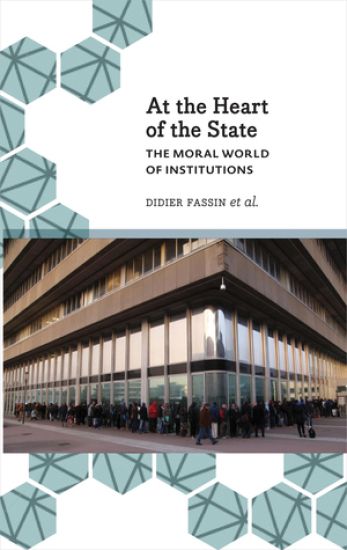
The state is often regarded as an abstract and neutral bureaucratic entity. Against this common sense idea, At the Heart of the State argues that it is also a concrete reality with a morality, embodied in the work of its agents and inscribed in the issues of its time. A political and moral anthropology, this book is the result of a five-year investigation conducted by ten scholars, based in France. It analyses, amongst other topics, the police, the court system, the prison apparatus, the social services and mental health facilities. Combining genealogy and ethnography, its authors show that these state institutions do not simply implement laws, rules and procedures: they mobilise values and affects, judgements and emotions. In other words, they reflect the morality of the state.