Kirjojen hintavertailu. Mukana 12 390 323 kirjaa ja 12 kauppaa.

Kirjailija

Duncan Pritchard

Kirjat ja teokset yhdessä paikassa: 22 kirjaa, julkaisuja vuosilta 2005-2026, suosituimpien joukossa Skepticism. Vertaile teosten hintoja ja tarkista saatavuus suomalaisista kirjakaupoista.

22 kirjaa

Kirjojen julkaisuhaarukka 2005-2026.

Skepticism

Skepticism

Annalisa Coliva; Duncan Pritchard

TAYLOR FRANCIS LTD
2023
sidottu
Skepticism is one of the perennial problems of philosophy: from antiquity, to the early modern period of Descartes and Hume, and right through to the present day. It remains a fundamental and widely studied topic and, as Annalisa Coliva and Duncan Pritchard show in Skepticism, it presents us with a paradox with important ramifications not only for epistemology but also for many other core areas of philosophy.This book provides a thorough grounding in contemporary debates about skepticism, exploring the following key topics: the core skeptical arguments, with a particular focus on Cartesian and Humean radical skepticism the epistemic principles that are held to underlie skeptical arguments, such as the Closure and Underdetermination principlesthe content externalism of Putnam, Davidson, and Chalmers, and how it might help us respond to radical skepticism the epistemic externalism/internalism distinction and how it relates to the skeptical problematic contextualism in epistemology and its anti-skeptical import the various interpretations of a Wittgensteinian hinge epistemology the viability of epistemological disjunctivism, including whether it can be combined with hinge epistemology as part of a dual response to radical skepticism liberal and conservative responses to the Humean skeptical paradox. Both authors are prominent figures who work on skepticism, and so one novelty of the book is that it provides an insight into their own contrasting responses to this philosophical difficulty. With the addition of annotated further reading and a glossary, this is an ideal starting point for anyone studying the philosophy of skepticism, along with students of epistemology, metaphysics, and contemporary analytic philosophy.
Skepticism

Skepticism

Annalisa Coliva; Duncan Pritchard

TAYLOR FRANCIS LTD
2021
nidottu
Skepticism is one of the perennial problems of philosophy: from antiquity, to the early modern period of Descartes and Hume, and right through to the present day. It remains a fundamental and widely studied topic and, as Annalisa Coliva and Duncan Pritchard show in Skepticism, it presents us with a paradox with important ramifications not only for epistemology but also for many other core areas of philosophy.This book provides a thorough grounding in contemporary debates about skepticism, exploring the following key topics: the core skeptical arguments, with a particular focus on Cartesian and Humean radical skepticism the epistemic principles that are held to underlie skeptical arguments, such as the Closure and Underdetermination principlesthe content externalism of Putnam, Davidson, and Chalmers, and how it might help us respond to radical skepticism the epistemic externalism/internalism distinction and how it relates to the skeptical problematic contextualism in epistemology and its anti-skeptical import the various interpretations of a Wittgensteinian hinge epistemology the viability of epistemological disjunctivism, including whether it can be combined with hinge epistemology as part of a dual response to radical skepticism liberal and conservative responses to the Humean skeptical paradox. Both authors are prominent figures who work on skepticism, and so one novelty of the book is that it provides an insight into their own contrasting responses to this philosophical difficulty. With the addition of annotated further reading and a glossary, this is an ideal starting point for anyone studying the philosophy of skepticism, along with students of epistemology, metaphysics, and contemporary analytic philosophy.
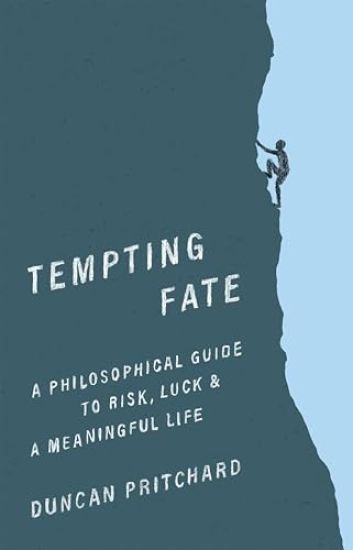
Tempting Fate

Tempting Fate

Duncan Pritchard

PRINCETON UNIVERSITY PRESS
2026
sidottu
A leading philosopher explains how risk-taking can help us live authentic and flourishing lives We take risks every day—perhaps not the extreme, dangling-off-the-side-of-a-mountain kind of risks, but risks nonetheless, in decisions about careers, marriage, children, moving house, and other matters. Tempting fate is simply what we have to do from time to time in life. But how we should go about tempting fate in a reasonable way? In this illuminating book, philosopher Duncan Pritchard explains why risk-taking, even extreme risk-taking, can sometimes be both reasonable and admirable, and how it can play a crucial role in living an authentic life. Using Alex Honnold’s famous free solo climb of El Capitan as a paradigm example of admirable risk-taking, Pritchard offers a completely new theory of risk, one that explains it in terms of fragility rather than probability. He shows how fragility can explain why skill and preparation are crucial to sensible risk-taking, even when the activity is unavoidably high risk. Fragility also makes clear that taking risks means riding one’s luck and why both risk and luck are vital to living an authentic and meaningful existence. Pritchard shows that his fragility theory of risk has practical implications for making sense of risk in law, arts, sports, and other domains. Tempting fate, in other words, is not merely thrill-seeking but essential for human flourishing.
Wittgenstein on Knowledge and Certainty

Wittgenstein on Knowledge and Certainty

Danièle Moyal-Sharrock; Duncan Pritchard

Cambridge University Press
2025
sidottu
An overview is offered of Wittgenstein's groundbreaking discussion of knowledge and certainty, especially in his final notebooks, published as On Certainty. The main interpretative readings of On Certainty are discussed, especially a non-propositional/non-epistemic interpretation and a variety of propositional and/or epistemic interpretations. Surveys are offered of the readings of On Certainty presented by such figures as Annalisa Coliva, John Greco, Danièle Moyal-Sharrock, Duncan Pritchard, Genia Schönbaumsfeld, P. F. Strawson, MichaelWilliams, and CrispinWright. This Element demonstrates how On Certainty has been especially groundbreaking for epistemology with regard to its treatment of the problem of radical scepticism.
Wittgenstein on Knowledge and Certainty

Wittgenstein on Knowledge and Certainty

Danièle Moyal-Sharrock; Duncan Pritchard

Cambridge University Press
2025
pokkari
An overview is offered of Wittgenstein's groundbreaking discussion of knowledge and certainty, especially in his final notebooks, published as On Certainty. The main interpretative readings of On Certainty are discussed, especially a non-propositional/non-epistemic interpretation and a variety of propositional and/or epistemic interpretations. Surveys are offered of the readings of On Certainty presented by such figures as Annalisa Coliva, John Greco, Danièle Moyal-Sharrock, Duncan Pritchard, Genia Schönbaumsfeld, P. F. Strawson, MichaelWilliams, and CrispinWright. This Element demonstrates how On Certainty has been especially groundbreaking for epistemology with regard to its treatment of the problem of radical scepticism.
What is this thing called Knowledge?

What is this thing called Knowledge?

Duncan Pritchard

TAYLOR FRANCIS LTD
2023
nidottu
What is knowledge? Where does it come from? What kinds of knowledge are there? Can we know anything at all? What is the practical relevance of learning about epistemology?This lucid and engaging introduction grapples with these central questions in the theory of knowledge, offering a clear, non-partisan view of the main themes of epistemology. Both traditional issues and contemporary ideas are discussed in 22 easily digestible chapters, each of which concludes with a useful summary of the main ideas discussed, study questions, annotated further reading, and a guide to internet resources.Each chapter also features text boxes providing bite-sized summaries of key concepts and major philosophers, and clear and interesting examples are used throughout. The book concludes with an annotated guide to general introductions to epistemology, a glossary of key terms, and a summary of the main examples used in epistemology. This is an ideal first textbook in the theory of knowledge for undergraduates coming to philosophy for the first time.This fifth edition has been revised throughout and features a new part devoted to social epistemology. In addition, the text as a whole has been refreshed to keep it up-to-date with current developments.
What is this thing called Knowledge?

What is this thing called Knowledge?

Duncan Pritchard

TAYLOR FRANCIS LTD
2023
sidottu
What is knowledge? Where does it come from? What kinds of knowledge are there? Can we know anything at all? What is the practical relevance of learning about epistemology?This lucid and engaging introduction grapples with these central questions in the theory of knowledge, offering a clear, non-partisan view of the main themes of epistemology. Both traditional issues and contemporary ideas are discussed in 22 easily digestible chapters, each of which concludes with a useful summary of the main ideas discussed, study questions, annotated further reading, and a guide to internet resources.Each chapter also features text boxes providing bite-sized summaries of key concepts and major philosophers, and clear and interesting examples are used throughout. The book concludes with an annotated guide to general introductions to epistemology, a glossary of key terms, and a summary of the main examples used in epistemology. This is an ideal first textbook in the theory of knowledge for undergraduates coming to philosophy for the first time.This fifth edition has been revised throughout and features a new part devoted to social epistemology. In addition, the text as a whole has been refreshed to keep it up-to-date with current developments.
Scepticism

Scepticism

Duncan Pritchard

Oxford University Press
2019
nidottu
Throughout history scepticism and the urge to question accepted truths has been a powerful force for change and growth. Today, as we are bombarded by adverts, scientific studies praising the latest superfoods, and political rhetoric, a healthy amount of scepticism is widely encouraged. But when is such scepticism legitimate - for example, as a driver of new ideas - and when is it problematic? And what role might adopting a sceptical outlook play in leading an intellectually virtuous life? In this Very Short Introduction Duncan Pritchard explores both the advantages of scepticism, in challenging outdated notions, and also how it can have unhelpful social consequences, in generating distrust. He considers the role of scepticism at the source of contemporary social and political movements such as climate change denial, post-truth politics, and fake news. Pritchard also examines the philosophical arguments for a radical form of scepticism which maintains that knowledge is impossible, and explores some of the main responses to these arguments. Finally, he considers the part scepticism might play in applying better thinking and learning to achieve a more meaningful life. ABOUT THE SERIES: The Very Short Introductions series from Oxford University Press contains hundreds of titles in almost every subject area. These pocket-sized books are the perfect way to get ahead in a new subject quickly. Our expert authors combine facts, analysis, perspective, new ideas, and enthusiasm to make interesting and challenging topics highly readable.
Epistemic Angst

Epistemic Angst

Duncan Pritchard

Princeton University Press
2019
pokkari
Epistemic Angst offers a completely new solution to the ancient philosophical problem of radical skepticism—the challenge of explaining how it is possible to have knowledge of a world external to us.Duncan Pritchard argues that the key to resolving this puzzle is to realize that it is composed of two logically distinct problems, each requiring its own solution. He then puts forward solutions to both problems. To that end, he offers a new reading of Wittgenstein's account of the structure of rational evaluation and demonstrates how this provides an elegant solution to one aspect of the skeptical problem. Pritchard also revisits the epistemological disjunctivist proposal that he developed in previous work and shows how it can effectively handle the other aspect of the problem. Finally, he argues that these two antiskeptical positions, while superficially in tension with each other, are not only compatible but also mutually supporting.The result is a comprehensive and distinctive resolution to the problem of radical skepticism, one that challenges many assumptions in contemporary epistemology.
Philosophy, Science and Religion for Everyone

Philosophy, Science and Religion for Everyone

Duncan Pritchard; Mark Harris

Routledge
2017
nidottu
Philosophy, Science and Religion for Everyone brings together these great truth-seeking disciplines, and seeks to understand the ways in which they challenge and inform each other.Key topics and their areas of focus include:• Foundational Issues – why should anyone care about the science-and-religion debate? How do scientific claims relate to the truth? Is evolution compatible with design?• Faith and Rationality – can faith ever be rational? Are theism and atheism totally opposed? Is God hidden or does God simply not exist?• Faith and Science - what provides a better explanation for the origin of the universe—science or religion? Faith and physics: can they be reconciled? Does contemporary neuroscience debunk religious belief? Creationism and evolutionary biology - what constitutes science and what constitutes pseudo-science?• Practical Implications – is fundamentalism just a problem for religious people? What are the ethical implications of the science-and-religion debate? Do logic and religion mix?This book is designed to be used in conjunction with the free ‘Philosophy, Science and Religion’ MOOC (massive open online course) created by the University of Edinburgh, and hosted by the Coursera platform (www.coursera.org). This book is also highly recommended for anyone looking for a concise overview of this fascinating discipline.
Philosophy, Science and Religion for Everyone

Philosophy, Science and Religion for Everyone

Duncan Pritchard; Mark Harris

Routledge
2017
sidottu
Philosophy, Science and Religion for Everyone brings together these great truth-seeking disciplines, and seeks to understand the ways in which they challenge and inform each other.Key topics and their areas of focus include:• Foundational Issues – why should anyone care about the science-and-religion debate? How do scientific claims relate to the truth? Is evolution compatible with design?• Faith and Rationality – can faith ever be rational? Are theism and atheism totally opposed? Is God hidden or does God simply not exist?• Faith and Science - what provides a better explanation for the origin of the universe—science or religion? Faith and physics: can they be reconciled? Does contemporary neuroscience debunk religious belief? Creationism and evolutionary biology - what constitutes science and what constitutes pseudo-science?• Practical Implications – is fundamentalism just a problem for religious people? What are the ethical implications of the science-and-religion debate? Do logic and religion mix?This book is designed to be used in conjunction with the free ‘Philosophy, Science and Religion’ MOOC (massive open online course) created by the University of Edinburgh, and hosted by the Coursera platform (www.coursera.org). This book is also highly recommended for anyone looking for a concise overview of this fascinating discipline.
Philosophy for Everyone

Philosophy for Everyone

Matthew Chrisman; Duncan Pritchard; Guy Fletcher; Elinor Mason; Jane Suilin Lavelle; Michela Massimi; Alasdair Richmond; Dave Ward

Routledge
2016
nidottu
Philosophy for Everyone begins by explaining what philosophy is before exploring the questions and issues at the foundation of this important subject.Key topics in this new edition and their areas of focus include:Moral philosophy – the nature of our moral judgments and reactions, whether they aim at some objective moral truth, or are mere personal or cultural preferences; and the possibility of moral responsibility given the sorts of things that cause behavior;Political philosophy – fundamental questions about the nature of states and their relationship to the citizens within those statesEpistemology – what our knowledge of the world and ourselves consists in, and how we come to have it; and whether we should form beliefs by trusting what other people tell us;Philosophy of mind – what it means for something to have a mind, and how minds should be understood and explained; Philosophy of science – foundational conceptual issues in scientific research and practice, such as whether scientific theories are true; andMetaphysics - fundamental questions about the nature of reality, such as whether we have free will, or whether time travel is possible.This book is designed to be used in conjunction with the free ‘Introduction to Philosophy’ MOOC (massive open online course) created by the University of Edinburgh’s Eidyn research centre, and hosted by the Coursera platform (www.coursera.org/course/introphil).This book is also highly recommended for anyone looking for a short overview of this fascinating discipline.
Philosophy for Everyone

Philosophy for Everyone

Matthew Chrisman; Duncan Pritchard; Guy Fletcher; Elinor Mason; Jane Suilin Lavelle; Michela Massimi; Alasdair Richmond; Dave Ward

Routledge
2016
sidottu
Philosophy for Everyone begins by explaining what philosophy is before exploring the questions and issues at the foundation of this important subject.Key topics in this new edition and their areas of focus include:Moral philosophy – the nature of our moral judgments and reactions, whether they aim at some objective moral truth, or are mere personal or cultural preferences; and the possibility of moral responsibility given the sorts of things that cause behavior;Political philosophy – fundamental questions about the nature of states and their relationship to the citizens within those statesEpistemology – what our knowledge of the world and ourselves consists in, and how we come to have it; and whether we should form beliefs by trusting what other people tell us;Philosophy of mind – what it means for something to have a mind, and how minds should be understood and explained; Philosophy of science – foundational conceptual issues in scientific research and practice, such as whether scientific theories are true; andMetaphysics - fundamental questions about the nature of reality, such as whether we have free will, or whether time travel is possible.This book is designed to be used in conjunction with the free ‘Introduction to Philosophy’ MOOC (massive open online course) created by the University of Edinburgh’s Eidyn research centre, and hosted by the Coursera platform (www.coursera.org/course/introphil).This book is also highly recommended for anyone looking for a short overview of this fascinating discipline.
Epistemic Angst

Epistemic Angst

Duncan Pritchard

PRINCETON UNIVERSITY PRESS
2015
sidottu
Epistemic Angst offers a completely new solution to the ancient philosophical problem of radical skepticism--the challenge of explaining how it is possible to have knowledge of a world external to us. Duncan Pritchard argues that the key to resolving this puzzle is to realize that it is composed of two logically distinct problems, each requiring its own solution. He then puts forward solutions to both problems. To that end, he offers a new reading of Wittgenstein's account of the structure of rational evaluation and demonstrates how this provides an elegant solution to one aspect of the skeptical problem. Pritchard also revisits the epistemological disjunctivist proposal that he developed in previous work and shows how it can effectively handle the other aspect of the problem. Finally, he argues that these two antiskeptical positions, while superficially in tension with each other, are not only compatible but also mutually supporting. The result is a comprehensive and distinctive resolution to the problem of radical skepticism, one that challenges many assumptions in contemporary epistemology.
Epistemological Disjunctivism

Epistemological Disjunctivism

Duncan Pritchard

Oxford University Press
2014
nidottu
Duncan Pritchard offers an original defence of epistemological disjunctivism. This is an account of perceptual knowledge which contends that such knowledge is paradigmatically constituted by a true belief that enjoys rational support which is both factive and reflectively accessible to the agent. In particular, in a case of paradigmatic perceptual knowledge that p, the subject's rational support for believing that p is that she sees that p, where this rational support is both reflectively accessible and factive (i.e., it entails p). Such an account of perceptual knowledge poses a radical challenge to contemporary epistemology, since by the lights of standard views in epistemology this proposal is simply incoherent. Pritchard's aim in Epistemological Disjunctivism is to show that this proposal is theoretically viable (i.e., that it does not succumb to the problems that it appears to face), and also to demonstrate that this is an account of perceptual knowledge which we would want to endorse if it were available on account of its tremendous theoretical potential. In particular, he argues that epistemological disjunctivism offers a way through the impasse between epistemic externalism and internalism, and also provides the foundation for a distinctive response to the problem of radical scepticism.
Epistemological Disjunctivism

Epistemological Disjunctivism

Duncan Pritchard

Oxford University Press
2012
sidottu
Duncan Pritchard offers an original defence of epistemological disjunctivism. This is an account of perceptual knowledge which contends that such knowledge is paradigmatically constituted by a true belief that enjoys rational support which is both factive and reflectively accessible to the agent. In particular, in a case of paradigmatic perceptual knowledge that p, the subject's rational support for believing that p is that she sees that p, where this rational support is both reflectively accessible and factive (i.e., it entails p). Such an account of perceptual knowledge poses a radical challenge to contemporary epistemology, since by the lights of standard views in epistemology this proposal is simply incoherent. Pritchard's aim in Epistemological Disjunctivism is to show that this proposal is theoretically viable (i.e., that it does not succumb to the problems that it appears to face), and also to demonstrate that this is an account of perceptual knowledge which we would want to endorse if it were available on account of its tremendous theoretical potential. In particular, he argues that epistemological disjunctivism offers a way through the impasse between epistemic externalism and internalism, and also provides the foundation for a distinctive response to the problem of radical scepticism.
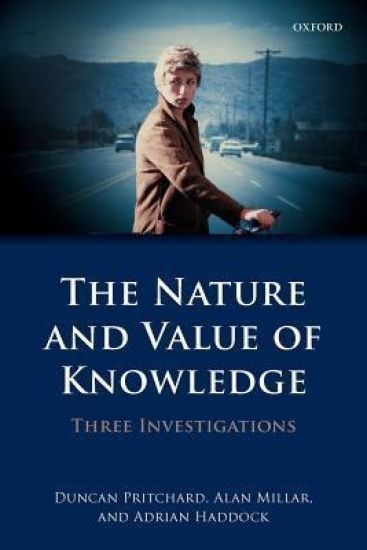
The Nature and Value of Knowledge

The Nature and Value of Knowledge

Duncan Pritchard; Alan Millar; Adrian Haddock

Oxford University Press
2012
nidottu
This volume comprises three distinct investigations into the relationship between the nature and the value of knowledge. Each is written by one of the authors in consultation with the other two. 'Knowledge and Understanding' (by Duncan Pritchard) critically examines virtue-theoretic responses to the problem of the value of knowledge, and argues that the finally valuable cognitive state is not knowledge but understanding. 'Knowledge and Recognition' (by Alan Millar) develops an account of knowledge in which the idea of a recognitional ability plays a prominent role, and argues that this account enables us better to understand knowledge and its value. 'Knowledge and Action' (by Adrian Haddock) argues for an account of knowledge and justification which explains why knowledge is valuable, and enables us to make sense of the knowledge we have of our intentional actions.
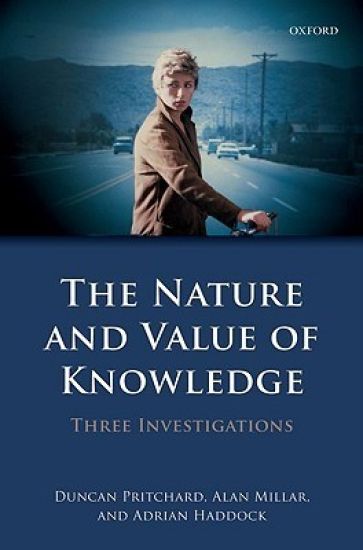
The Nature and Value of Knowledge

The Nature and Value of Knowledge

Duncan Pritchard; Alan Millar; Adrian Haddock

Oxford University Press
2010
sidottu
This volume comprises three distinct investigations into the relationship between the nature and the value of knowledge. Each is written by one of the authors in consultation with the other two. 'Knowledge and Understanding' (by Duncan Pritchard) critically examines virtue-theoretic responses to the problem of the value of knowledge, and argues that the finally valuable cognitive state is not knowledge but understanding. 'Knowledge and Recognition' (by Alan Millar) develops an account of knowledge in which the idea of a recognitional ability plays a prominent role, and argues that this account enables us better to understand knowledge and its value. 'Knowledge and Action' (by Adrian Haddock) argues for an account of knowledge and justification which explains why knowledge is valuable, and enables us to make sense of the knowledge we have of our intentional actions.
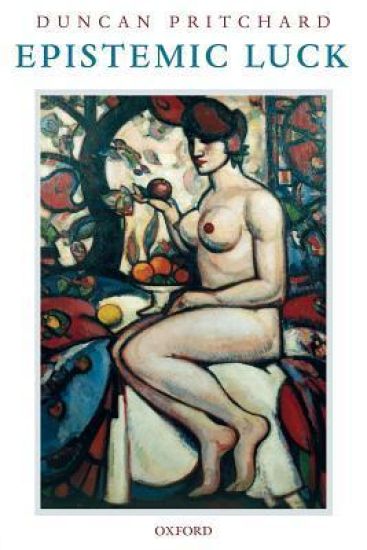
Epistemic Luck

Epistemic Luck

Duncan Pritchard

Clarendon Press
2007
nidottu
One of the key supposed 'platitudes' of contemporary epistemology is the claim that knowledge excludes luck. One can see the attraction of such a claim, in that knowledge is something that one can take credit for - it is an achievement of sorts - and yet luck undermines genuine achievement. The problem, however, is that luck seems to be an all-pervasive feature of our epistemic enterprises, which tempts us to think that either scepticism is true and that we don't know very much, or else that luck is compatible with knowledge after all. In this book, Duncan Pritchard argues that we do not need to choose between these two austere alternatives, since a closer examination of what is involved in the notion of epistemic luck reveals varieties of luck that are compatible with knowledge possession and varieties that aren't. Moreover, Pritchard shows that a more nuanced understanding of the relationship between luck and knowledge can cast light on many of the most central topics in contemporary epistemology. These topics include: the externalism/internalism distinction; virtue epistemology; the problem of scepticism; metaepistemological scepticism; modal epistemology; and the problem of moral luck. All epistemologists will need to come to terms with Pritchard's original and incisive contribution.
Epistemology AZ

Epistemology AZ

Martijn Blaauw; Duncan Pritchard

Edinburgh University Press
2005
sidottu
An alphabetically arranged guide to all the major epistemological debates and positions. Epistemology A-Z introduces undergraduate and post-graduate students in philosophy (and epistemology in particular) to the main problems and positions in epistemology. It shows where these problems and positions connect and where they part thereby providing a valuable resource both for following connections between ideas and for appreciating the place of key figures and concepts in the subject. The book includes entries on some of the most important historical and contemporary contributors to the field. And all the entries are cross-referenced so that each item is placed within the context of the wider debate, resulting in a multi-layered treatment of all of the main epistemological positions and figures. Key features * Coverage of all major positions and figures; * Clear and concise entries; * All entries are cross-referenced.