Kirjailija
Eliot Weinberger
Kirjat ja teokset yhdessä paikassa: 33 kirjaa, julkaisuja vuosilta 1987-2025, suosituimpien joukossa Muhammad. Vertaile teosten hintoja ja tarkista saatavuus suomalaisista kirjakaupoista.
33 kirjaa
Kirjojen julkaisuhaarukka 1987-2025.
Muhammad is a shimmering, lyrical biography of the Prophet, composed from the words of Muslims throughout the centuries. Drawing on a variety of Islamic sources, from the hadith, or sayings of Muhammad and his companions, to Abbasid and Persian texts, Weinberger weaves a subtle, mystical prose poem, spanning Muhammad's birth and childhood; his adolescence, miracles and marriages; to the isra and miraj, his journey from Mecca to Jerusalem and ascent into heaven, with the angel Jibril (Gabriel) as his guide. The result is a vivid triptych that presents the final prophet of Islam with extraordinary clarity. At a time when the Muslim world is being demonized in much of the media Muhammad provides a sense of the awe surrounding this historical and sacred figure.
Nineteen Ways of Looking at Wang Wei
Eliot Weinberger; Octavio Paz
New Directions Publishing Corporation
2016
nidottu
The difficulty (and necessity) of translation is concisely described in Nineteen Ways of Looking at Wang Wei, a close reading of different translations of a single poem from the Tang Dynasty—from a transliteration to Kenneth Rexroth’s loose interpretation. As Octavio Paz writes in the afterword, “Eliot Weinberger’s commentary on the successive translations of Wang Wei’s little poem illustrates, with succinct clarity, not only the evolution of the art of translation in the modern period but at the same time the changes in poetic sensibility.”
I over halvtreds år har Eliot Weinberger været kendt for sine innovative litterære og politiske essays, der er oversat til mere end tredive sprog, for sine bane- brydende oversættelser fra spansk, og sit enestående virke som litterær redaktør. I sin nye bog Tu Fus liv har Eliot Weinberger skabt en montage af 58 digte, der skildrer en af Tangdynastiets helt store digtere, nemlig Tu Fu (712–770 e.Kr.), hans liv og samtid. Med linjer, der er lige så gennemtrængende som en klassisk tanka og lige så flydende som en bjergstrøm, udfoldes de temaer om længsel og nærvær, endeløs krig og vedvarende pandemi, der omgav det liv, den gamle kinesiske mester levede: Du spørger hvordan jeg har det: / Lyt til vildgæssenes ekko / og krigshestene der galoperer forbi.
”Weinbergers syrliga, orakelmässiga Tu Fu beskriver en värld som känns smärtsamt bekant. Det skulle kunna vara Etiopien, Myanmar eller en rad andra konfliktzoner. – The Paris Review ”Han är som en uråldrig kinesisk cittraspelare som stämmer upp ensam uppe i bergen och blickar ut över världen.” – Bei Dao _______ ”Kriget fortgår: jag lever bland rådjur.” I över femtio år har Eliot Weinberger prisats för sina nyskapande litterära och politiska essäer, som har översatts till över trettio språk. I sin enastående nya bok Tu Fus liv har Weinberger skapat ett montage med femtioåtta dikter som fångar Tangdynasti-poeten Tu Fus (712–770) liv och tiden han levde i. I hans egna ord: ”Detta är inte en översättning av enskilda dikter utan en fiktiv självbiografi över Tu Fu med utgångspunkt i tankarna, bildspråket och allusionerna i hans poesi.” Genom verser lika genomträngande som en klassisk tanka och lika klara som en bergsbäck skildras de oändliga krig och pågående pandemier som utgör fonden till den gamle kinesiske mästarens kringflackande liv. ”Genom lärd auktoritet och en moralisk trohet mot det svårbegripliga skapar Weinberger genreöverskridande essäer och prosadikter som hjälper oss att se världen med nya ögon.” – The New York Times
Drawing inspirations from a vast oeuvre of more than a thousand poems, Eliot Weinberger has deftly composed a montage of fifty-eight poems derived and adapted from the lines, images, and feelings in Tu Fu’s poetry. These poems weave a tapestry of Tu Fu’s turbulent life and times of war and disaster. In the post-pandemic era, we may appreciate the profound solitude and desolation in Tu Fu’s poetry that still resonates across the span of a millennium. More than an homage to the life of Tu Fu, this work is a meditation on the self, suffering, and our transient beings.
»Digtet dør når det ikke har nogen steder at gå hen.«Eliot Weinbergers kondenserede oversættelsespoetik AT OVERSÆTTE er en perlerække af erfaringer fra et helt liv i oversættelse. Med umiskendelig præcision og poesi står Weinbergers tekst som en introduktion til hvad det vil sige at oversætte.Eliot Weinberger er amerikansk digter, essayist og oversætter af bl.a. Octavio Paz, Cecilia Vicuña, Jorge Luis Borges og Bei Dao.Teksten er oversat fra engelsk af Andreas Vermehren Holm.AT OVERSÆTTE indgår i Tredje septembers udgivelsesrække LEDSAGER, en serie om oversættelse, om alt det der opstår og går tabt på vejen mellem sprog.
For over fifty years Eliot Weinberger has been celebrated for his innovative literary and political essays—translated into over thirty languages—as well as his trailblazing translations from the Spanish. In his exquisite new book The Life of Tu Fu, Weinberger has composed a montage of fifty-eight poems that capture the life and times of the great Tang Dynasty poet Tu Fu (712–770 AD). As he writes in a note to the edition, “This is not a translation of individual poems, but a fictional autobiography of Tu Fu derived and adapted from the thoughts, images, and allusions in the poetry.” Through lines as penetrating as a classical tanka and as fluid as a mountain stream, themes of endless war and ongoing pandemic surround the wandering life of the ancient Chinese master.
Poetry Pamphlets 1-4
Lydia Davis; Eliot Weinberger; Susan Howe; Bernadette Mayer; Sylvia Legris
New Directions Publishing Corporation
2023
nidottu
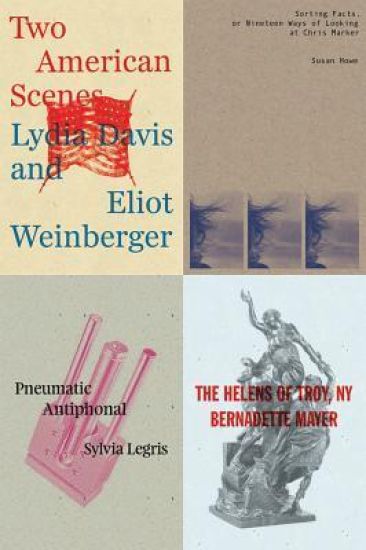
The first four collections in our revitalized Poetry Pamphlet series, established to highlight original work from writers around the world as well as forgotten treasures lost in the cracks of literary history. Included are: Two American Scenes: Our Village & A Journey on the Colorado River, by Lydia Davis and Eliot Weinberger; Sorting Facts, or Nineteen Ways of Looking at Chris Marker, by Susan Howe; The Helens of Troy, New York, by Bernadette Mayer; and Pneumatic Antiphonal, by Sylvia Legris.
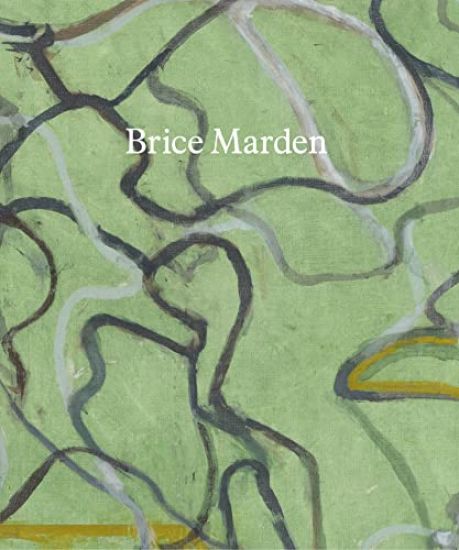
This lavishly illustrated volume features new paintings and works on paper by Brice Marden, with an essay by Eliot Weinberger.
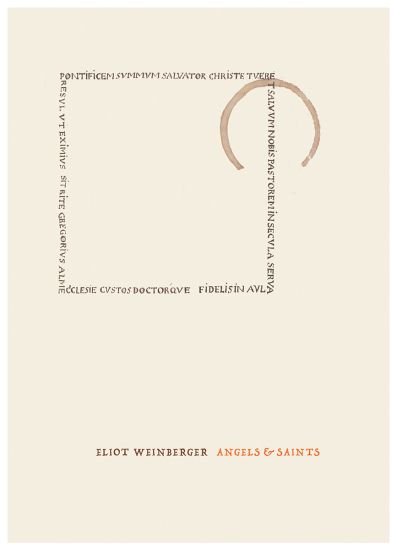
Angels have soared through Western culture and consciousness from Biblical to contemporary times. But what do we really know about these celestial beings? Where do they come from, what are they made of, how do they communicate and perceive? The celebrated essayist Eliot Weinberger has mined and deconstructed, resurrected and distilled centuries of theology into an awe-inspiring exploration of the heavenly host. From a litany of angelic voices, Weinberger’s lyrical meditation then turns to the earthly counterparts, the saints, their lives retold in a series of vibrant and playful capsule biographies, followed by a glimpse of the afterlife. Threaded throughout Angels & Saints are the glorious illuminated grid poems by the eighteenth-century Benedictine monk Hrabanus Maurus. These astonishingly complex, proto-“concrete” poems are untangled in a lucid afterword by the medieval scholar and historian Mary Wellesley.
Still Points
Robert Gardner; Eliot Weinberger
Peabody Museum of Archaeology Ethnology,U.S.
2018
sidottu
Still Points is a collection of remarkable and evocative still photographs taken by award-winning nonfiction filmmaker and author Robert Gardner during his anthropological and filming expeditions around the world. Thousands of his original photographic transparencies and negatives from the Kalahari Desert, New Guinea, Colombia, India, Ethiopia, Niger, and other remote locations are now housed in the Photographic Archives of Harvard's Peabody Museum of Archaeology and Ethnology. This elegantly produced volume presents a curated selection of more than 70 color and black-and-white images made by Gardner between the 1950s and the 1980s. Edited by Adele Pressman, Gardner's wife and literary executor, and with a foreword by Eliot Weinberger, Still Points both honors an important and influential artist and reveals new dimensions in his work."There at the end of the endless cycles of time and the loops of film is stillness, and these still photos."--From the foreword by Eliot Weinberger
This exquisitely composed photo-novel by French artist-writer Anouck Durand (born 1975)—collaged from photographic archives, personal letters and propaganda magazines—tells a true story that begins in Albania during World War II, stops in China during the Cold War, and ends in Israel after Communism crumbles. When the Nazis invaded Albania, teenage partisan Refik Veseli’s Muslim family hid Jewish photographer Mosha Mandil, his wife and two small children. Despite the dire circumstances, Mosha instilled in Refik a great passion for photography, and a friendship was forged in the crucible of war. After liberation, the Mandils left for Israel, inviting Refik to join them, but he stayed behind to contribute to his new nation, not knowing he’d never see his dear friend again. In a nuanced, wholly imagined story, Durand inhabits Refik’s voice as he narrates his journey to China where—free of Albanian state censors—he attempts to mail a letter to Mosha. She also reveals how photography, used at the behest of merciless state powers, becomes a tool for liberation and human connection. Says Richard McGuire, author of Here: "A timely book about dictatorships, propaganda and friendship. Imagine Art Spiegelman meets Chris Marker, told in gorgeous tricolor photography, a knock out!"
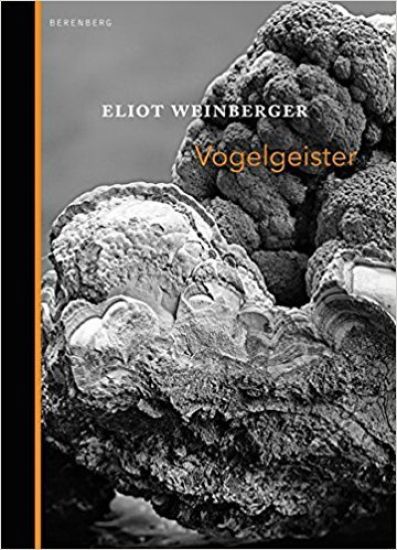
The Ghosts of Birds offers thirty-five essays by Eliot Weinberger: the first section of the book continues his linked serial-essay, An Elemental Thing, which pulls the reader into “a vortex for the entire universe” (Boston Review). Here, Weinberger chronicles a nineteenth-century journey down the Colorado River, records the dreams of people named Chang, and shares other factually verifiable discoveries that seem too fabulous to possibly be true. The second section collects Weinberger’s essays on a wide range of subjects—some of which have been published in Harper’s, New York Review of Books, and London Review of Books—including his notorious review of George W. Bush’s memoir Decision Points and writings about Mongolian art and poetry, different versions of the Buddha, American Indophilia (“There is a line, however jagged, from pseudo-Hinduism to Malcolm X”), Béla Balázs, Herbert Read, and Charles Reznikoff. This collection proves once again that Weinberger is “one of the bravest and sharpest minds in the United States” (Javier Marías).
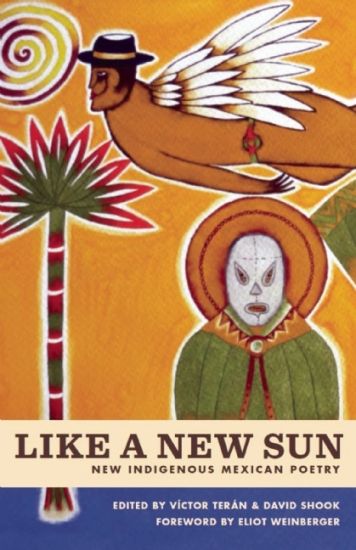
Like A New Sun features poetry from Huastecan Nahuatl, Isthmus Zapotec, Mazatec, Tsotsil, Yucatec Maya, and Zoque languages. Co-edited by Isthmus Zapotec poet Victor Teran and translator David Shook, this groundbreaking anthology introduces six indigenous Mexican poets--three women and three men--each writing in a different language. Well-established names like Juan Gregorio Regino (Mazatec) appear alongside exciting new voices like Mikeas Sanchez (Zoque). Each poet's work is contextualized and introduced by its translator. Foreword by Eliot Weinberger. Poets include Victor Teran (Isthmus Zapotec), Mikeas Sanchez (Zoque), Juan Gregorio Regino (Mazatec), Briceida Cuevas Cob (Yucatec Maya), Juan Hernandez (Huastecan Nahuatl), and Enriqueta Lunez (Tsotsil).
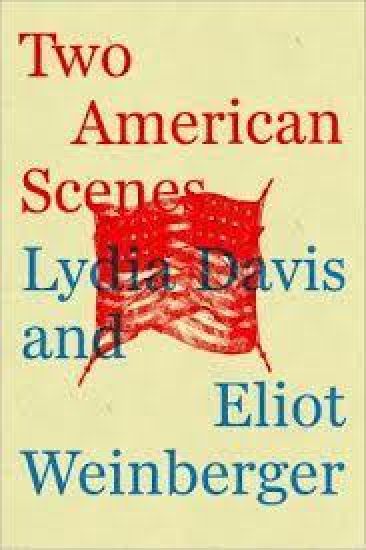
Two American Scenes
Lydia Davis; Eliot Weinberger
New Directions Publishing Corporation
2013
nidottu
Part of our revived "Poetry Pamphlet" series, Two American Scenes features two masters of the essay discussing "found material." Excerpts: It was given to me, in the nineteenth century, to spend a lifetime on this earth. Along with a few of the sorrows that are appointed unto men, I have had innumerable enjoyments; and the world has been to me, even from childhood,a great museum. — Lydia Davis Bad rapids. Bradley is knocked over the side; his foot catches under the seat and he is dragged, head under water. Camped on a sand beach, the wind blows a hurricane. Sand piles over us like a snow-drift. — Eliot Weinberge
Many of the twenty-eight essays in Oranges & Peanuts for Sale have appeared in translation in seventeen countries; some have never been published in English before. They include introductions for books of avant-garde poets; collaborations with visual artists, and articles for publications such as The New York Review of Books, The London Review of Books, and October. One section focuses on writers and literary works: strange tales from classical and modern China; the Psalms in translation: a skeptical look at E. B. White’s New York. Another section is a continuation of Weinberger’s celebrated political articles collected in What Happened Here: Bush Chronicles (a finalist for the National Books Critics Circle Award), including a sequel to “What I Heard About Iraq,” which the Guardian called the only antiwar “classic” of the Iraq War. A new installment of his magnificent linked “serial essay,” An Elemental Thing, takes us on a journey down the Yangtze River during the Sung Dynasty. The reader will also find the unlikely convergences between Samuel Beckett and Octavio Paz, photography and anthropology, and, of course, oranges and peanuts, as well as an encomium for Obama, a manifesto on translation, a brief appearance by Shiva, and reflections on the color blue, death, exoticism, Susan Sontag, and the arts and war.