Kirjojen hintavertailu. Mukana 12 657 676 kirjaa ja 12 kauppaa.
Kirjailija
Epictetus
Kirjat ja teokset yhdessä paikassa: 144 kirjaa, julkaisuja vuosilta 1890-2026, suosituimpien joukossa Meditations Of Marcus Aurelius Antoninus. Vertaile teosten hintoja ja tarkista saatavuus suomalaisista kirjakaupoista.
A Selection from the Discourses of Epictetus with the Encheiridion translated by George Long. Epictetus was a Greek Stoic philosopher. He was born a slave at Hierapolis, Phrygia and lived in Rome until his banishment, when he went to Nicopolis in northwestern Greece for the rest of his life. His teachings were written down and published by his pupil Arrian in his Discourses and Enchiridion. Very little is known of the life of Epictetus. It is said that he was a native of Hierapolis in Phrygia, a town between the Maeander and a branch of the Maeander named the Lycus. Hierapolis is mentioned in the epistle of Paul to the people of Colossae (Coloss. iv., 13); from which it has been concluded that there was a Christian church in Hierapolis in the time of the apostle. The date of the birth of Epictetus is unknown. The only recorded fact of his early life is that he was a slave in Rome, and his master was Epaphroditus, a profligate freedman of the Emperor Nero. There is a story that the master broke his slave's leg by torturing him; but it is better to trust to the evidence of Simplicius, the commentator on the Encheiridion, or Manual, who says that Epictetus was weak in body and lame from an early age. It is not said how he became a slave; but it has been asserted in modern times that the parents sold the child. I have not, however, found any authority for this statement.
On Benefits contains series of moral essays and dialogues composed by the Roman Stoic philosopher Seneca. The work explores such philosophical themes as providence, steadfastness, the happy life, anger, leisure, tranquility, the brevity of life, gift-giving, forgiveness, and treatises on natural phenomena.Lucius Annaeus Seneca was a Roman Stoic philosopher, statesman, dramatist, and in one work humorist, of the Silver Age of Latin literature. He was a tutor and later advisor to emperor Nero. While he was forced to commit suicide for alleged complicity in the Pisonian conspiracy to assassinate Nero, some sources state that he may have been innocent.
The Enchiridion: The Handbook of Epictetus by Epictetus and translated by Thomas W. Higginson with an Introduction by Albert Salomon . The Enchiridion or Handbook of Epictetus is a short manual of Stoic ethical advice compiled by Arrian, a 2nd-century disciple of the Greek philosopher Epictetus. There are things which are within our power, and there are things which are beyond our power. Within our power are opinion, aim, desire, aversion, and, in one word, whatever affairs are our own. Beyond our power are body, property, reputation, office, and, in one word, whatever are not properly our own affairs. The little book by Epictetus called Enchiridion or "manual" has played a disproportionately large role in the rise of modern attitudes and modern philosophy. As soon as it had been translated into the vernacular languages, it became a bestseller among independent intellectuals, among anti-Christian thinkers, and among philosophers of a subjective cast. Montaigne had a copy of the Enchiridion among his books. Pascal violently rejected the megalomaniac pride of the Stoic philosopher. Frederick the Great carried the book with him on all campaigns. It was a source of inspiration and encouragement to Anthony, Earl of Shaftesbury, in the serious illness which ended only in his death; many pages of his diaries contain passages copied from the Enchiridion. It has been studied and widely quoted by Scottish philosophers like Francis Hutcheson, Adam Smith, and Adam Ferguson who valued Stoic moral philosophy for its reconciliation of social dependency and personal independence.
The Discourses of Epictetus translated by George Long. The Discourses of Epictetus are a series of extracts of the teachings of the Stoic philosopher Epictetus written down by Arrian c. 108 AD. There were originally eight books, but only four now remain in their entirety, along with a few fragments of the others. In a preface attached to the Discourses, Arrian explains how he came to write them: 'I neither wrote these Discourses of Epictetus in the way in which a man might write such things; nor did I make them public myself, inasmuch as I declare that I did not even write them. But whatever I heard him say, the same I attempted to write down in his own words as nearly as possible, for the purpose of preserving them as memorials to myself afterwards of the thoughts and the freedom of speech of Epictetus.' The earliest manuscript of the Discourses is a twelfth-century manuscript kept at the Bodleian Library, Oxford. In the Bodleian manuscript, a blot or stain has fallen onto one of the pages, and has made a series of words illegible; in all the other known manuscripts these words (or sometimes the entire passage) are omitted, thus all the other manuscripts are derived from this one archetype. The Discourses were first printed (in Greek) by Vettore Trincavelli, at Venice in 1535.
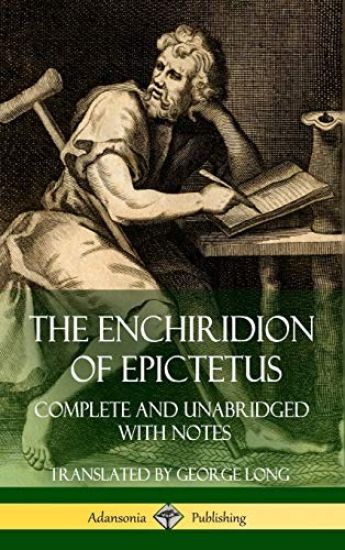
The Latin term 'enchiridion' connotes a small, essential handbook that sums up a particular matter or subject. So it was with the well-regarded enchiridion of Epictetus, who successfully tranposed the most important principles of Stoicism into this text. Important for students and enthusiasts of ancient philosophy, or for those interested in undertaking a Stoical life, this book exemplifies the tenets of an ethical and Stoic philosophy. For its unstinting commitment to such, this text remained influential and much read among Greek, Roman and later Christian scholars through the centuries following antiquity. The ethical outlook of Epictetus would notably gain favour and quotation from Marcus Aurelius, the 'philosopher king' of the Roman Empire. This hardcover edition includes the translation by George Long, and is complete with the translator's annotations.
The 18th century was a wealth of knowledge, exploration and rapidly growing technology and expanding record-keeping made possible by advances in the printing press. In its determination to preserve the century of revolution, Gale initiated a revolution of its own: digitization of epic proportions to preserve these invaluable works in the largest archive of its kind. Now for the first time these high-quality digital copies of original 18th century manuscripts are available in print, making them highly accessible to libraries, undergraduate students, and independent scholars.Western literary study flows out of eighteenth-century works by Alexander Pope, Daniel Defoe, Henry Fielding, Frances Burney, Denis Diderot, Johann Gottfried Herder, Johann Wolfgang von Goethe, and others. Experience the birth of the modern novel, or compare the development of language using dictionaries and grammar discourses. ++++The below data was compiled from various identification fields in the bibliographic record of this title. This data is provided as an additional tool in helping to insure edition identification: ++++Bodleian Library (Oxford)T179830London: printed for the author, in the year, 1734. xxix, 3],106p.; 12
The 18th century was a wealth of knowledge, exploration and rapidly growing technology and expanding record-keeping made possible by advances in the printing press. In its determination to preserve the century of revolution, Gale initiated a revolution of its own: digitization of epic proportions to preserve these invaluable works in the largest archive of its kind. Now for the first time these high-quality digital copies of original 18th century manuscripts are available in print, making them highly accessible to libraries, undergraduate students, and independent scholars.The Age of Enlightenment profoundly enriched religious and philosophical understanding and continues to influence present-day thinking. Works collected here include masterpieces by David Hume, Immanuel Kant, and Jean-Jacques Rousseau, as well as religious sermons and moral debates on the issues of the day, such as the slave trade. The Age of Reason saw conflict between Protestantism and Catholicism transformed into one between faith and logic -- a debate that continues in the twenty-first century.++++The below data was compiled from various identification fields in the bibliographic record of this title. This data is provided as an additional tool in helping to insure edition identification: ++++British LibraryT138718London: printed for J. and F. Rivington, 1768. 2v.; 12
The 18th century was a wealth of knowledge, exploration and rapidly growing technology and expanding record-keeping made possible by advances in the printing press. In its determination to preserve the century of revolution, Gale initiated a revolution of its own: digitization of epic proportions to preserve these invaluable works in the largest archive of its kind. Now for the first time these high-quality digital copies of original 18th century manuscripts are available in print, making them highly accessible to libraries, undergraduate students, and independent scholars.The Age of Enlightenment profoundly enriched religious and philosophical understanding and continues to influence present-day thinking. Works collected here include masterpieces by David Hume, Immanuel Kant, and Jean-Jacques Rousseau, as well as religious sermons and moral debates on the issues of the day, such as the slave trade. The Age of Reason saw conflict between Protestantism and Catholicism transformed into one between faith and logic -- a debate that continues in the twenty-first century.++++The below data was compiled from various identification fields in the bibliographic record of this title. This data is provided as an additional tool in helping to insure edition identification: ++++British LibraryT138718London: printed for J. and F. Rivington, 1768. 2v.; 12
The 18th century was a wealth of knowledge, exploration and rapidly growing technology and expanding record-keeping made possible by advances in the printing press. In its determination to preserve the century of revolution, Gale initiated a revolution of its own: digitization of epic proportions to preserve these invaluable works in the largest archive of its kind. Now for the first time these high-quality digital copies of original 18th century manuscripts are available in print, making them highly accessible to libraries, undergraduate students, and independent scholars.The Age of Enlightenment profoundly enriched religious and philosophical understanding and continues to influence present-day thinking. Works collected here include masterpieces by David Hume, Immanuel Kant, and Jean-Jacques Rousseau, as well as religious sermons and moral debates on the issues of the day, such as the slave trade. The Age of Reason saw conflict between Protestantism and Catholicism transformed into one between faith and logic -- a debate that continues in the twenty-first century.++++The below data was compiled from various identification fields in the bibliographic record of this title. This data is provided as an additional tool in helping to insure edition identification: ++++British LibraryN011398With a half-title and a final advertisement leaf.Glasgow: printed and sold by R. and A. Foulis, 1750. 2],92, 2]p.; 8
The 18th century was a wealth of knowledge, exploration and rapidly growing technology and expanding record-keeping made possible by advances in the printing press. In its determination to preserve the century of revolution, Gale initiated a revolution of its own: digitization of epic proportions to preserve these invaluable works in the largest archive of its kind. Now for the first time these high-quality digital copies of original 18th century manuscripts are available in print, making them highly accessible to libraries, undergraduate students, and independent scholars.Western literary study flows out of eighteenth-century works by Alexander Pope, Daniel Defoe, Henry Fielding, Frances Burney, Denis Diderot, Johann Gottfried Herder, Johann Wolfgang von Goethe, and others. Experience the birth of the modern novel, or compare the development of language using dictionaries and grammar discourses. ++++The below data was compiled from various identification fields in the bibliographic record of this title. This data is provided as an additional tool in helping to insure edition identification: ++++British LibraryT138748The ornaments are those used by William Bowyer.London: printed for A. Ward, J. and P. Knapton, S. Birt, Ja. Hodges, B. Dod, and T. Harris, 1741. 12], xxxiv, 4],337, 5]p.; 8
The 18th century was a wealth of knowledge, exploration and rapidly growing technology and expanding record-keeping made possible by advances in the printing press. In its determination to preserve the century of revolution, Gale initiated a revolution of its own: digitization of epic proportions to preserve these invaluable works in the largest archive of its kind. Now for the first time these high-quality digital copies of original 18th century manuscripts are available in print, making them highly accessible to libraries, undergraduate students, and independent scholars.The Age of Enlightenment profoundly enriched religious and philosophical understanding and continues to influence present-day thinking. Works collected here include masterpieces by David Hume, Immanuel Kant, and Jean-Jacques Rousseau, as well as religious sermons and moral debates on the issues of the day, such as the slave trade. The Age of Reason saw conflict between Protestantism and Catholicism transformed into one between faith and logic -- a debate that continues in the twenty-first century.++++The below data was compiled from various identification fields in the bibliographic record of this title. This data is provided as an additional tool in helping to insure edition identification: ++++British LibraryT131696With three final contents leaves.London: printed for Rich. Sare, 1704. 10], xxxiv, 4],426, 6]p.; 8
The 18th century was a wealth of knowledge, exploration and rapidly growing technology and expanding record-keeping made possible by advances in the printing press. In its determination to preserve the century of revolution, Gale initiated a revolution of its own: digitization of epic proportions to preserve these invaluable works in the largest archive of its kind. Now for the first time these high-quality digital copies of original 18th century manuscripts are available in print, making them highly accessible to libraries, undergraduate students, and independent scholars.The Age of Enlightenment profoundly enriched religious and philosophical understanding and continues to influence present-day thinking. Works collected here include masterpieces by David Hume, Immanuel Kant, and Jean-Jacques Rousseau, as well as religious sermons and moral debates on the issues of the day, such as the slave trade. The Age of Reason saw conflict between Protestantism and Catholicism transformed into one between faith and logic -- a debate that continues in the twenty-first century.++++The below data was compiled from various identification fields in the bibliographic record of this title. This data is provided as an additional tool in helping to insure edition identification: ++++British LibraryT138739Translated by Elizabeth Carter. London?]: Printed in the year, 1766. xviii,379, 5]p.; 12
The 18th century was a wealth of knowledge, exploration and rapidly growing technology and expanding record-keeping made possible by advances in the printing press. In its determination to preserve the century of revolution, Gale initiated a revolution of its own: digitization of epic proportions to preserve these invaluable works in the largest archive of its kind. Now for the first time these high-quality digital copies of original 18th century manuscripts are available in print, making them highly accessible to libraries, undergraduate students, and independent scholars.Western literary study flows out of eighteenth-century works by Alexander Pope, Daniel Defoe, Henry Fielding, Frances Burney, Denis Diderot, Johann Gottfried Herder, Johann Wolfgang von Goethe, and others. Experience the birth of the modern novel, or compare the development of language using dictionaries and grammar discourses. ++++The below data was compiled from various identification fields in the bibliographic record of this title. This data is provided as an additional tool in helping to insure edition identification: ++++British LibraryT138738The 'Tabula' (i.e. 'Pinax') is not in fact by Cebes.London: printed for J. Goudge, 1707. 32],147, 1]p.; 8
The 18th century was a wealth of knowledge, exploration and rapidly growing technology and expanding record-keeping made possible by advances in the printing press. In its determination to preserve the century of revolution, Gale initiated a revolution of its own: digitization of epic proportions to preserve these invaluable works in the largest archive of its kind. Now for the first time these high-quality digital copies of original 18th century manuscripts are available in print, making them highly accessible to libraries, undergraduate students, and independent scholars.The Age of Enlightenment profoundly enriched religious and philosophical understanding and continues to influence present-day thinking. Works collected here include masterpieces by David Hume, Immanuel Kant, and Jean-Jacques Rousseau, as well as religious sermons and moral debates on the issues of the day, such as the slave trade. The Age of Reason saw conflict between Protestantism and Catholicism transformed into one between faith and logic -- a debate that continues in the twenty-first century.++++The below data was compiled from various identification fields in the bibliographic record of this title. This data is provided as an additional tool in helping to insure edition identification: ++++British LibraryT138736With an index.London: printed, for Sam. Keble, 1701. 32],98, 2]p.: ill.; 12
The 18th century was a wealth of knowledge, exploration and rapidly growing technology and expanding record-keeping made possible by advances in the printing press. In its determination to preserve the century of revolution, Gale initiated a revolution of its own: digitization of epic proportions to preserve these invaluable works in the largest archive of its kind. Now for the first time these high-quality digital copies of original 18th century manuscripts are available in print, making them highly accessible to libraries, undergraduate students, and independent scholars.The Age of Enlightenment profoundly enriched religious and philosophical understanding and continues to influence present-day thinking. Works collected here include masterpieces by David Hume, Immanuel Kant, and Jean-Jacques Rousseau, as well as religious sermons and moral debates on the issues of the day, such as the slave trade. The Age of Reason saw conflict between Protestantism and Catholicism transformed into one between faith and logic -- a debate that continues in the twenty-first century.++++The below data was compiled from various identification fields in the bibliographic record of this title. This data is provided as an additional tool in helping to insure edition identification: ++++British LibraryT138744Horizontal chain lines.Glasgow: printed for Robert Urie, 1766. 128p.; 8