Kirjojen hintavertailu. Mukana 12 595 353 kirjaa ja 12 kauppaa.

Kirjailija

Harold Bloom

Kirjat ja teokset yhdessä paikassa: 57 kirjaa, julkaisuja vuosilta 1971-2026, suosituimpien joukossa Native Son - Richard Wright. Vertaile teosten hintoja ja tarkista saatavuus suomalaisista kirjakaupoista.

57 kirjaa

Kirjojen julkaisuhaarukka 1971-2026.

Native Son - Richard Wright

Native Son - Richard Wright

Harold Bloom

Chelsea House Publishers
2009
sidottu
Richard Wright's works are universally acknowledged as a starting point for black literature in contemporary America. Critics speak of the author as a pioneer, a man of rare courage. This volume of essays anzlyses Wright's ""Native Son"".
Iago: The Strategies of Evil

Iago: The Strategies of Evil

Harold Bloom

Scribner Book Company
2019
nidottu
From one of the greatest Shakespeare scholars of our time, Harold Bloom presents Othello's Iago, perhaps the Bard's most compelling villain--the fourth in a series of five short books about the great playwright's most significant personalities.Few antagonists in all of literature have displayed the ruthless cunning and deceit of Iago. Denied the promotion he believes he deserves, Iago takes vengeance on Othello and destroys him. One of William Shakespeare's most provocative and culturally relevant plays, Othello is widely studied for its complex and enduring themes of race and racism, love, trust, betrayal, and repentance. It remains widely performed across professional and community theatre alike and has been the source for many film and literary adaptations. Now award-winning writer and beloved professor Harold Bloom investigates Iago's motives and unthinkable actions with razor-sharp insight, agility, and compassion. Why and how does Iago use lies and deception--the fake news of the 15th century--to destroy Othello and several other characters in his path? What can Othello tell us about racism? Bloom is mesmerizing in the classroom, treating Shakespeare's characters like people he has known all his life. He delivers exhilarating intimacy and clarity in these pages, writing about his shifting understanding--over the course of his own lifetime--of this endlessly compelling figure, so that Iago also becomes an extraordinarily moving argument for literature as a path to and a measure of our humanity. "There are few readers more astute than Bloom" (Publishers Weekly), and his Iago is a provocative study for our time.
Iago

Iago

Harold Bloom

Scribner
2018
sidottu
From one of the greatest Shakespeare scholars of our time, Harold Bloom presents Othello’s Iago, perhaps the Bard’s most compelling villain—the fourth in a series of five short books about the great playwright’s most significant personalities.In all of literature, few antagonists have displayed the ruthless cunning and unscrupulous deceit of Iago, the antagonist to Othello. Often described as Machiavellian, Iago is a fascinating psychological specimen: at once a shrewd expert of the human mind and yet, himself a deeply troubled man. One of Shakespeare’s most provocative and culturally relevant plays, Othello is widely studied for its complex and enduring themes of race and racism, love, trust, betrayal, and repentance. It remains widely performed across professional and community theatre alike and has been the source for many film and literary adaptations. Now award-winning writer and beloved professor Harold Bloom investigates Iago’s motives and unthinkable actions with razor-sharp insight, agility, and compassion. Why and how does Iago uses fake news to destroy Othello and several other characters in his path? What can Othello tell us about racism? Bloom is mesmerizing in the classroom, treating Shakespeare’s characters like people he has known all his life. He delivers that kind of exhilarating intimacy and clarity in these pages, writing about his shifting understanding—over the course of his own lifetime—of this endlessly compelling figure, so that Iago also becomes an extraordinarily moving argument for literature as a path to and a measure of our humanity. This is a provocative study for our time.
The Classical Tradition

The Classical Tradition

Gilbert Highet; Harold Bloom

Oxford University Press Inc
2015
nidottu
Originally published in 1949, Gilbert Highet's seminal The Classical Tradition is a herculean feat of comparative literature and a landmark publication in the history of classical reception. As Highet states in the opening lines of his Preface, this book outlines "the chief ways in which Greek and Latin influence has moulded the literatures of western Europe and America. " With that simple statement, Highet takes his reader on a sweeping exploration of the history of western literature. To summarize what he covers is a near-impossible task. Discussions of Ovid and French literature of the Middle Ages and Chaucer's engagement with Virgil and Cicero lead, swiftly, into arguments of Christian versus "pagan " works in the Renaissance, Baroque imitations of Seneca, and the (re)birth of satire. Building momentum through Byron, Tennyson, and the rise of "art of art's sake, " Highet, at last, arrives at his conclusion: the birth and establishment of modernism. Though his humanist style may appear out-of-date in today's postmodernist world, there is a value to ensuring this influential work reaches a new generation, and Highet's light touch and persuasive, engaging voice guarantee the book's usefulness for a contemporary audience. Indeed, the book is free of the jargon-filled style of literary criticism that plagues much of current scholarship. Accompanied by a new foreword by renown critic Harold Bloom, this reissue will enable new readers to appreciate the enormous legacy of classical literature in the canonical works of medieval, Renaissance, and modern Europe and America.
Wallace Stevens

Wallace Stevens

Harold Bloom

Cornell University Press
1980
pokkari
This dazzling book is at once an indispensable guide to Stevens's poetic canon and a significant addition to the literature on the American Romantic movement. It gives authoritative readings of the major long poems and sequences of Stevens and deals at length with the important shorter works as well, showing their complex relations both to one another and to the work of Stevens's precursors, Wordsworth, Shelley, Keats, Emerson, and Whitman. No other book on Stevens is as ambitious or comprehensive as this one: everyone who writes on Stevens will have to take it into account. The product of twenty years of meditating, thinking, and writing about Stevens, this truly remarkable book is a brilliant extension of Bloom's theories of literary interpretation.
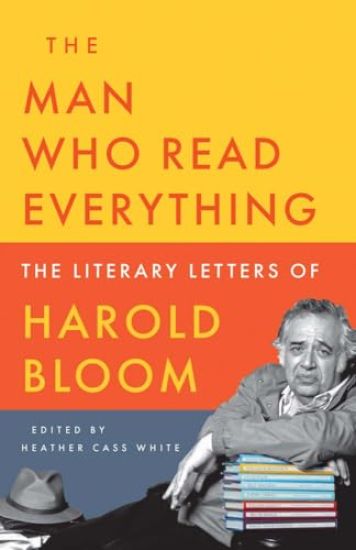
The Man Who Read Everything

The Man Who Read Everything

Harold Bloom

YALE UNIVERSITY PRESS
2026
sidottu
A selection of the lively letters between one of the world’s greatest literary critics and the poets, novelists, and scholars he most admired Bringing together a collection of Harold Bloom’s letters to and from eight of his favorite contemporary writers, Heather Cass White provides an intimate view of one of the most famous literary critics of the last century. In correspondence with Alvin Feinman, Northrop Frye, A. R. Ammons, John Hollander, James Merrill, John Ashbery, Henri Cole, and Ursula K. Le Guin, we see Bloom developing his groundbreaking theory of poetic influence, transforming himself into a public intellectual, and reckoning with the meaning of his own legacy. While Bloom’s public persona was oracular, sure, and often combative, his letters are inquiring and provisional, revealing his overarching obsession with good writing. The presence of love, as the letters show, was always vital to how Bloom worked as a reader. The writers and characters he loved were distant gods as well as his best friends, and what happened in books happened to him. Filled with delightful anecdotes and poignant observations, these letters—many of them published here for the first time—offer a new window onto twentieth-century letters and Bloom’s long and illustrious career.
The Western Canon

The Western Canon

Harold Bloom

HARPERCOLLINS PUBLISHERS INC
2025
nidottu
The literary critic defends the importance of Western literature from Chaucer and Shakespeare to Kafka and Beckett in this acclaimed national bestseller.“An impressive work…deeply, rightly passionate about the great books of the past.”—Michael Dirda, The Washington Post Book World Harold Bloom's The Western Canon is more than a required reading list—it is a “heroically brave, formidably learned” defense of the great works of literature that comprise the traditional Western Canon. Infused with a love of learning, compelling in its arguments for a unifying written culture, it argues brilliantly against the politicization of literature and presents a guide to the essential writers of the western literary tradition (The New York Times Book Review).Placing William Shakespeare at the “center of the canon,” Bloom examines the literary contributions of Dante Alighieri, John Milton, Jane Austen, Emily Dickenson, Leo Tolstoy, Sigmund Freud, James Joyce, Pablo Neruda, and many others. Bloom's book, much-discussed and praised in publications as diverse as The Economist and Entertainment Weekly, offers a dazzling display of erudition and passion.
The Bright Book of Life

The Bright Book of Life

Harold Bloom

RANDOM HOUSE USA INC
2021
nidottu
In Harold Bloom's final book, his first devoted exclusively to narrative fiction, America's most original and controversial literary critic and legendary Yale professor writes trenchantly about forty-eight masterworks spanning the Western tradition. In this valedictory volume, Yale professor Harold Bloom--who for more than half a century was regarded as America's most daringly original and controversial literary critic--gives us his only book devoted entirely to the art of the novel. With his hallmark percipience, uncanny erudition, and extraordinary devotion to sublimity, Bloom offers meditations on forty-eight essential works spanning the Western canon, from Don Quixote to The Book of Numbers; from Wuthering Heights to Absalom, Absalom ; from Les Mis rables to Blood Meridian; from Vanity Fair to Invisible Man. Here are trenchant appreciations of fiction by, among many others, Austen, Balzac, Dickens, Tolstoy, James, Conrad, Lawrence, Le Guin, and Sebald. Whether you have already read these books, are planning to, or simply care about the importance and power of fiction, Harold Bloom is your unparalleled guide to understanding them with new intimacy.
Take Arms Against a Sea of Troubles

Take Arms Against a Sea of Troubles

Harold Bloom

Yale University Press
2021
pokkari
“The great poems, plays, novels, stories teach us how to go on living. . . . Your own mistakes, accidents, failures at otherness beat you down. Rise up at dawn and read something that matters as soon as you can.”So Harold Bloom, the most famous literary critic of his generation, exhorts readers of his last book: one that praises the sustaining power of poetry."Passionate. . . . Perhaps Bloom’s most personal work, this is a fitting last testament to one of America’s leading twentieth-century literary minds."—Publishers Weekly“An extraordinary testimony to a long life spent in the company of poetry and an affecting last declaration of [Bloom's] passionate and deeply unfashionable faith in the capacity of the imagination to make the world feel habitable”—Seamus Perry, Literary Review"Reading, this stirring collection testifies, ‘helps in staying alive.’“—Kirkus Reviews, starred review This dazzling celebration of the power of poetry to sublimate death—completed weeks before Harold Bloom died—shows how literature renews life amid what Milton called “a universe of death.” Bloom reads as a way of taking arms against the sea of life’s troubles, taking readers on a grand tour of the poetic voices that have haunted him through a lifetime of reading. “High literature,” he writes, “is a saving lie against time, loss of individuality, premature death.” In passages of breathtaking intimacy, we see him awake late at night, reciting lines from Dante, Shakespeare, Milton, Montaigne, Blake, Wordsworth, Hart Crane, Jay Wright, and many others. He feels himself “edged by nothingness,” uncomprehending, but still sustained by reading. Generous and clear-eyed, this is among Harold Bloom’s most ambitious and most moving books.
Yago, las estrategias del mal

Yago, las estrategias del mal

Harold Bloom

Vaso Roto Ediciones S.L
2021
pokkari
Fake News. A pesar de estar tan en boga en nuestros d as, Shakespeare ya era consciente de la utilidad de este recurso a la hora de destruir destinos y por ello lo emple como una de las estrategias del mal con las que Yago se vengar a de Otelo, y que lo convertir an en el antagonista m s despiadado. No en vano rivaliza en importancia con Ricardo III.Harold Bloom analiza la figura de un Yago resentido y envidioso, dolido por no obtener el ascenso del que se cre a merecedor. Lo define como un pir mano que quiere prender fuego a todo y a todos. Sus deseos de venganza no conocen l mites y su perseverancia y astucia lo llevar n a desarrollar una serie de estratagemas que en nuestros d as se han convertido en mandamientos del maligno arte de la manipulaci n.Gracias a la traducci n impecable de ngel-Luis Pujante, el lector de habla hispana podr conocer la infernal interioridad de Yago de la mano de Bloom, el m s vido lector shakesperiano y el mayor revolucionario en el an lisis literario que nos ha dado el siglo XX.
Lear, la gran imagen de la autoridad

Lear, la gran imagen de la autoridad

Harold Bloom

Vaso Roto Ediciones S.L
2021
pokkari
Bloom escribe un retrato ntimo y profundamente compasivo de uno de los personajes m s conmovedores de la literatura universal. Es desde la senectud compartida -Bloom ya hab a alcanzado, como Lear, los ochenta a os al escribir esta obra- como el profesor de Yale encara la dolorosa lectura de quien se convertir a en el arquetipo de la ca da de la autoridad y el paradigma de la deposici n del amor filial en pro del poder. Lear. La gran imagen de la autoridad es el tercero de una serie de cinco libros que Bloom inici dos a os antes de su muerte. Estas obras son la conclusi n de una vida dedicada al estudio y la ense anza por parte de una de las mentes literarias m s destacadas del siglo XX y XXI y, por ello, ofrecen una perspectiva nica y actual de c mo un genio nos recomienda leer e interpretar a otro genio.Lear es un libro breve y excelente que tiene una profundidad de observaci n adquirida a lo largo de toda una vida de estudio.Publishers Weekly
Cleopatra, soy fuego y aire

Cleopatra, soy fuego y aire

Harold Bloom

Vaso Roto Ediciones S.L
2021
pokkari
Cleopatra, una de las mujeres por s misma m s fascinantes de la historia, se convirti tambi n, gracias a Shakespeare, en uno de los personajes literarios m s interesantes. La fusi n de la historia y la literatura dieron lugar al mito. Cleopatra se nos presenta como un personaje altamente complejo, tr gico y en ocasiones profundamente irritante. En Cleopatra, soy fuego y aire, Harold Bloom analiza su relaci n con el personaje y, as como nuestra comprensi n del Quijote o la Regenta var an seg n la etapa vital en la que nos encontremos, Bloom explica c mo su percepci n de Cleopatra ha llegado a su cenit en la madurez.
The Bright Book of Life

The Bright Book of Life

Harold Bloom

Alfred A. Knopf
2020
sidottu
In his first book devoted exclusively to narrative fiction, America's most original and controversial literary critic and legendary Yale professor writes trenchantly about fifty-two masterworks spanning the Western tradition. Perhaps no other literary critic but Harold Bloom could--or would--undertake a project of this immensity. And certainly no other critic could bring to it the extraordinary knowledge, understanding, and insight that are the hallmark of Bloom's every book. Ranging across centuries and continents, this final book of his career, gives us the inimitable critic on Don Quixote and Book of Numbers; Wuthering Heights and Absalom, Absalom; Les Miserables and Blood Meridian; Vanity Fair and Invisible Man; The Captain's Daughter and The Reef. He writes about works by Austen, Balzac, Dickens, Tolstoy, James, Conrad, Lawrence, Wolff, Le Guin, Sebald, and many more. Whether you have already read these books, or intend to, or simply care about the importance and power of fiction, Harold Bloom serves as an unparalleled guide through the pages of these 52 masterpieces of the genre.
Falstaff, lo mío es la vida

Falstaff, lo mío es la vida

Harold Bloom

Vaso Roto Ediciones S.L
2020
pokkari
Harold Bloom realiza un acercamiento literario, cr tico y ante todo humanista a los personajes que considera m s relevantes de Shakespeare. El primero: Falstaff.Dos a os antes de su muerte, Harold Bloom inici una serie de cinco libros en los que realizaba un an lisis literario, cr tico y, ante todo humanista, de los personajes de Shakespeare. El primero se lo dedic a Falstaff con quien Bloom se sent a especialmente identificado en su forma de amar la vida. Si Hamlet es embajador de la muerte, Falstaff lo es de la vida, Bloom, quien interpret al Caballero Gordo en los escenarios del British Art Center de Yale y, anteriormente, en Cambridge, Massachusetts, ve a a Falstaff, y a s mismo como uno de esos profesores sin colegas y con numerosos estudiantes. Influido por el personaje Shakesperiano, am la vida, la goz , y la ense . No quer a disc pulos acad micos sino seres humanos capaces de leerse y cuestionarse.Harold Bloom makes a literary, critical and above all humanistic approach to the characters he considers most relevant in Shakespeare. The first: Falstaff. Two years before his death, Harold Bloom began a series of five books in which he carried out a literary, critical and, above all, humanistic analysis of Shakespeare's characters. The first was dedicated to Falstaff with whom Bloom felt especially identified in his way of loving life. "If Hamlet is the ambassador of death, Falstaff is the ambassador of life," Bloom, who played the Fat Knight on the stages of the British Art Center at Yale and previously in Cambridge, Massachusetts, saw Falstaff, and himself as one of those professors without colleagues and with numerous students. Influenced by the Shakespearean character, he loved life, enjoyed it, and taught it. He did not want academic disciples but human beings capable of reading and questioning themselves.
Macbeth: A Dagger of the Mind

Macbeth: A Dagger of the Mind

Harold Bloom

Scribner Book Company
2020
nidottu
From Harold Bloom, the greatest Shakespeare scholar of our time, comes a portrait of Macbeth, one of William Shakespeare's most complex and compelling anti-heroes--the final volume in a series of five short books about the great playwright's most significant personalities: Falstaff, Cleopatra, Lear, Iago, and Macbeth.From the ambitious and mad titular character to his devilish wife Lady Macbeth to the mysterious Three Witches, Macbeth is one of William Shakespeare's more brilliantly populated plays and remains among the most widely read. Macbeth is a distinguished warrior hero, who over the course of the play, transforms into a brutal, murderous villain and pays an extraordinary price for committing an evil act. A man consumed with ambition and self-doubt, Macbeth is one of Shakespeare's most vital meditations on the dangerous corners of the human imagination. Award-winning writer and beloved professor Harold Bloom investigates Macbeth's unthinkable actions with razor-sharp insight, agility, and compassion. He also writes about his shifting understanding--over the course of his own lifetime--of this endlessly compelling figure. "Acclaimed critic Bloom once again plumbs the depths of a Shakespeare play to reveal new insights that]...will shift the reader's perceptions of a literary classic" (Publishers Weekly). "A lingering and deeply curious, even troubled, look at the titular character in the legendary play...this clear, concise, empathetic" (Kirkus Reviews) volume delivers that kind of exhilarating intimacy and clarity in Macbeth, the final book in an essential series.
Possessed by Memory

Possessed by Memory

Harold Bloom

Vintage Books
2020
nidottu
In arguably his most personal and lasting book, America's most daringly original and controversial critic gives us brief, luminous readings of more than eighty texts by canonical authors-- texts he has had by heart since childhood. Gone are the polemics. Here, instead, in a memoir of sorts--an inward journey from childhood to ninety--Bloom argues elegiacally with nobody but Bloom, interested only in the influence of the mind upon itself when it absorbs the highest and most enduring imaginative literature. He offers more than eighty meditations on poems and prose that have haunted him since childhood and which he has possessed by memory: from the Psalms and Ecclesiastes to Shakespeare and Dr. Johnson; Spenser and Milton to Wordsworth and Keats; Whitman and Browning to Joyce and Proust; Tolstoy and Yeats to Delmore Schwartz and Amy Clampitt; Blake to Wallace Stevens--and so much more. And though he has written before about some of these authors, these exegeses, written in the winter of his life, are movingly informed by "the freshness of last things." As Bloom writes movingly: "One of my concerns throughout Possessed by Memory is with the beloved dead. Most of my good friends in my generation have departed. Their voices are still in my ears. I find that they are woven into what I read. I listen not only for their voices but also for the voice I heard before the world was made. My other concern is religious, in the widest sense. For me poetry and spirituality fuse as a single entity. All my long life I have sought to isolate poetic knowledge. This also involves a knowledge of God and gods. I see imaginative literature as a kind of theurgy in which the divine is summoned, maintained, and augmented."
The American Canon: Literary Genius from Emerson to Pynchon
Our foremost literary critic on our most essential writers, from Emerson and Whitman to Hurston and Ellison, from Faulkner and O'Connor to Ursula K. LeGuin and Philip Roth. No critic has better understood the ways writers influence one another--how literary traditions are made--and no writer has helped readers understand this better, than Harold Bloom. Over the course of a remarkable sixty-year career, in such bestselling books as The Western Canon, Shakespeare: The Invention of the Human, and How to Read and Why, Bloom brought enormous insight and infectious enthusiasm to the great writers of the Western tradition, from Shakespeare and Cervantes to the British Romantics and the Russian masters. Now, for the first time, comes a collection of his brilliant writings about the American tradition, the ultimate guide to our nation's literature. Assembled with David Mikics (Slow Reading in a Hurried Age), this unprecedented collection gathers five decades' worth of Bloom's writings-- much of it hard to find and long unavailable--including essays, occasional pieces, and introductions as well as excerpts from his books. It offers deep readings of 47 essential American writers, reflecting on the surprising ways they have influenced each other across more than two centuries. The story it tells, of American literature as a recurring artistic struggle for selfhood, speaks to the passion and power of the American spirit. All of the visionary American writers who have long preoccupied Bloom―Emerson and Whitman, Hawthorne and Melville, and Dickinson, Faulkner, Crane, Frost, Stevens, and Bishop―make their appearance in The American Canon, along with Hemingway, James, O'Connor, Ellison, Hurston, Le Guin, Ashbery and many others. Bloom's passion for these classic writers is contagious, and he reminds readers how they have shaped our sense of who we are, and how they can summon us to be better versions of ourselves. Bloom, Mikics writes, "is still our most inspirational critic, still the man who can enlighten us by telling us to read as if our lives depended on it: Because, he insists, they do." For readers who want to deepen their appreciation of American literature, there's no better place to start than The American Canon.
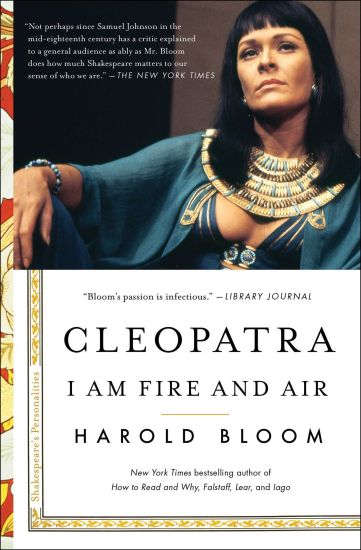
Cleopatra: I Am Fire and Air

Cleopatra: I Am Fire and Air

Harold Bloom

Scribner Book Company
2018
nidottu
From Harold Bloom, one of the greatest Shakespeare scholars of our time, comes an intimate, wise, deeply compelling portrait of Cleopatra--one of the Bard's most riveting and memorable female characters--in "a masterfully perceptive reading of this seductive play's endless wonders" (Kirkus Reviews).Cleopatra is one of the most famous women in history--and thanks to Shakespeare, one of the most intriguing personalities in literature. She is lover of Marc Antony, defender of Egypt, and, perhaps most enduringly, a champion of life. Cleopatra is supremely vexing, tragic, and complex. She has fascinated readers and audiences for centuries and has been played by the greatest actresses of their time, from Elizabeth Taylor to Vivien Leigh to Janet Suzman to Judi Dench. Award-winning writer and beloved professor Harold Bloom writes about Cleopatra with wisdom, joy, exuberance, and compassion. He also explores his own personal relationship to the character: Just as we encounter one Anna Karenina or Jay Gatsby when we are in high school and college and another when we are adults, Bloom explains his shifting understanding of Cleopatra over the course of his own lifetime. The book becomes an extraordinarily moving argument for literature as a path to and a measure of our own humanity. Bloom is mesmerizing in the classroom, wrestling with the often tragic choices Shakespeare's characters make. With Cleopatra, "Bloom brings considerable expertise and his own unique voice to this book" (Publishers Weekly), delivering exhilarating clarity and inviting us to look at this character as a flawed human who might be living in our world. The result is an invaluable resource from our greatest literary critic.