Kirjojen hintavertailu. Mukana 12 152 606 kirjaa ja 12 kauppaa.

Kirjailija

Henri Lefebvre

Kirjat ja teokset yhdessä paikassa: 30 kirjaa, julkaisuja vuosilta 1968-2023, suosituimpien joukossa The Missing Pieces. Vertaile teosten hintoja ja tarkista saatavuus suomalaisista kirjakaupoista.

30 kirjaa

Kirjojen julkaisuhaarukka 1968-2023.

Everyday Life in the Modern World

Everyday Life in the Modern World

Henri Lefebvre

TAYLOR FRANCIS LTD
2023
nidottu
Philosopher, sociologist and urban theorist, Henri Lefebvre (1901–1991) was one of the great social theorists of the twentieth century and pioneered the theorization of everyday life and space.In this fascinating book, which became a manifesto for urban activism upon its first publication in the 1960s, Lefebvre poses a major question: what gives a society undergoing constant change the illusion of stability? For Lefebvre, the answer is that our everyday lives are the product of decisions from which we are alienated, resulting in what he memorably describes as 'terror-enforced passivity'. Modern capitalism produces and controls the space around us: the buildings we work in, the roads we drive on and even the parks surrounding us are artificial and controlled, isolating the individual in a life of repetition. Lefebvre rejects such a world of control and monotony, urging instead a spontaneous, utopian creativity, in which human beings can engage in meaningful work and leisure. Profound and prophetic for its insights into the impact of capitalism and urbanization, Everyday Life in the Modern World remains a classic work by a towering thinker and essential reading today.This Routledge Classics edition includes a new Foreword by Claire Revol and Rob Shields.

Everyday Life in the Modern World

Everyday Life in the Modern World

Henri Lefebvre

TAYLOR FRANCIS LTD
2023
sidottu
Philosopher, sociologist and urban theorist, Henri Lefebvre (1901–1991) was one of the great social theorists of the twentieth century and pioneered the theorization of everyday life and space.In this fascinating book, which became a manifesto for urban activism upon its first publication in the 1960s, Lefebvre poses a major question: what gives a society undergoing constant change the illusion of stability? For Lefebvre, the answer is that our everyday lives are the product of decisions from which we are alienated, resulting in what he memorably describes as 'terror-enforced passivity'. Modern capitalism produces and controls the space around us: the buildings we work in, the roads we drive on and even the parks surrounding us are artificial and controlled, isolating the individual in a life of repetition. Lefebvre rejects such a world of control and monotony, urging instead a spontaneous, utopian creativity, in which human beings can engage in meaningful work and leisure. Profound and prophetic for its insights into the impact of capitalism and urbanization, Everyday Life in the Modern World remains a classic work by a towering thinker and essential reading today.This Routledge Classics edition includes a new Foreword by Claire Revol and Rob Shields.
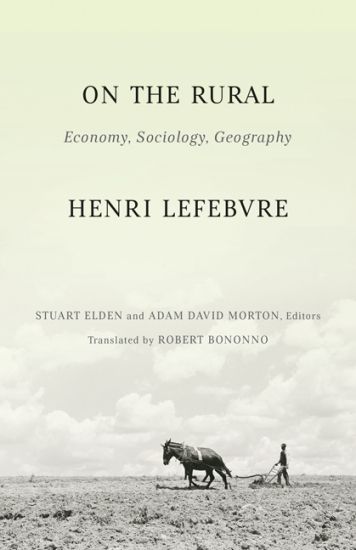
On the Rural

On the Rural

Henri Lefebvre

UNIVERSITY OF MINNESOTA PRESS
2022
nidottu
A collection of previously untranslated writings by Henri Lefebvre on rural sociology, situating his research in relation to wider Marxist workOn the Rural is the first English collection to translate Lefebvre’s crucial but lesser-known writings on rural sociology and political economy, presenting a wide-ranging approach to understanding the historical and rural sociology of precapitalist social forms, their endurance today, and conditions of dispossession and uneven development. In On the Rural, Stuart Elden and Adam David Morton present Lefebvre’s key works on rural questions, including the first half of his book Du rural À l’urbain and supplementary texts, two of which are largely unknown conference presentations published outside France. On the Rural offers methodological orientations for addressing questions of economy, sociology, and geography by deploying insights from spatial political economy to decipher the rural as a terrain and stake of capitalist transformation. By doing so, it reveals the production of the rural as a key site of capitalist development and as a space of struggle. This volume delivers a careful translation-supplemented with extensive notes and a substantive introduction-to cement Lefebvre’s central contribution to the political economy of rural sociology and geography.
On the Rural

On the Rural

Henri Lefebvre

UNIVERSITY OF MINNESOTA PRESS
2022
sidottu
A collection of previously untranslated writings by Henri Lefebvre on rural sociology, situating his research in relation to wider Marxist workOn the Rural is the first English collection to translate Lefebvre’s crucial but lesser-known writings on rural sociology and political economy, presenting a wide-ranging approach to understanding the historical and rural sociology of precapitalist social forms, their endurance today, and conditions of dispossession and uneven development. In On the Rural, Stuart Elden and Adam David Morton present Lefebvre’s key works on rural questions, including the first half of his book Du rural À l’urbain and supplementary texts, two of which are largely unknown conference presentations published outside France. On the Rural offers methodological orientations for addressing questions of economy, sociology, and geography by deploying insights from spatial political economy to decipher the rural as a terrain and stake of capitalist transformation. By doing so, it reveals the production of the rural as a key site of capitalist development and as a space of struggle. This volume delivers a careful translation-supplemented with extensive notes and a substantive introduction-to cement Lefebvre’s central contribution to the political economy of rural sociology and geography.
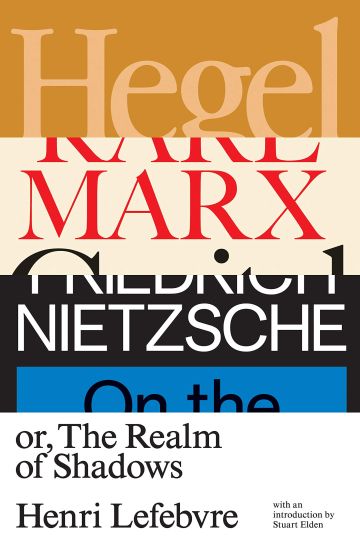
Hegel, Marx, Nietzsche

Hegel, Marx, Nietzsche

Henri Lefebvre

Verso Books
2020
nidottu
Henri Lefebvre saw Marx as an 'unavoidable, necessary, but insufficient starting point', and always insisted on the importance of Hegel to understanding Marx. Metaphilosophy also suggested the significance he ascribed to Nietzsche, in the 'realm of shadows' through which philosophy seeks to think the world. Hegel, Marx, Nietzsche: or the Realm of the Shadows proposes that the modern world is, at the same time, Hegelian in terms of the state, Marxist in terms of the social and society and Nietzschean in terms of civilisation and its values. As early as 1939, Lefebvre had pioneered a French reading of Nietzsche that rejected the philosopher's appropriation by fascists, bringing out the tragic implications of Nietzsche's proclamation that 'God is dead' long before this approach was followed by such later writers as Foucault, Derrida and Deleuze. Forty years later, in the last of his philosophical writings, Lefebvre juxtaposed the contributions of the three great thinkers, in a text that's themes remain surprisingly relevant today.
Key Writings

Key Writings

Henri Lefebvre

Bloomsbury Academic
2017
nidottu
Henri Lefebvre is widely recognized as one of the most influential social theorists of the Twentieth Century. His writings on cities, everyday life, and the production of space have become hugely influential across Cultural Studies, Sociology, Geography and Architecture. Key Writings presents the full range of Lefebvre's thought in a single volume. The selection of essays spanning 1933 to 1990, reinforce the relevance of Lefebvre's work to current debates in social theory, politics and philosophy. The book is divided into five sections: ‘Philosophy and Marxism’, ‘The Critique of Everyday Life’, ‘The Country and the City’ ‘History, Time and Space’ and ‘Politics’ and includes a general introduction by the editors as well as separate introductions to each section.
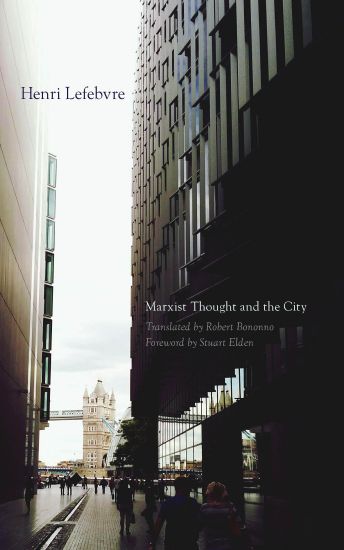
Marxist Thought and the City

Marxist Thought and the City

Henri Lefebvre; Robert Bononno

University of Minnesota Press
2016
nidottu
One of the most influential Marxist theorists of the twentieth century, Henri Lefebvre first published Marxist Thought and the City in French in 1972, marking a pivotal point in his evolution as a thinker and an important precursor to his groundbreaking work of urban sociology, The Production of Space. Marxist Thought and the City-inwhich he reviews the work of Karl Marx and Friedrich Engels for commentary and analysis on the life and growth of the city-now appears in English for the first time. Rooted in orthodox Marxisms analyses of capitalism and the capitalist mode of production, with extensive quotations from the works of Marx and Engels, this book describes the citys transition from life under feudalism to modern industrial capitalism. In doing so it highlights the various forces that sought to maintain power in the struggles between the medieval aristocracy and the urban guilds, amid the growth of banking and capital. Providing vital background and supplementary material to Lefebvres other books, including The Urban Revolution and Right to the City, Marxist Thought and the City is indispensable for students and scholars of urbanism, Marxism, social geography, early modern history, and the history of economic thought.
Metaphilosophy

Metaphilosophy

Henri Lefebvre

Verso Books
2016
nidottu
In Metaphilosophy, Henri Lefebvre works through the implications of Marx's revolutionary thought to consider philosophy's engagement with the world. Lefebvre takes Marx's notion of the "world becoming philosophical and philosophy becoming worldly" as a leitmotif, examining the relation between Hegelian-Marxist supersession and Nietzschean overcoming. Metaphilosophy is conceived of as a transformation of philosophy, developing it into a programme of radical worldwide change. The book demonstrates Lefebvre's threefold debt to Hegel, Marx and Nietzsche, but it also brings a number of other figures into the conversation, including Sartre, Heidegger and Axelos. A key text in Lefebvre's oeuvre,Metaphilosophy is also a milestone in contemporary thinking about philosophy's relation to the world.
Everyday Life in the Modern World

Everyday Life in the Modern World

Henri Lefebvre

Bloomsbury Academic
2016
nidottu
Henri Lefebvre was one of the most significant and influential social theorists of the 20th century. His impressive body of work crosses multiple disciplines including sociology, philosophy, economics, politics and cultural studies. In Everyday Life in the Modern World Lefebvre reveals the decisions and events which, day to day, we know very little about and do not actively participate in and yet have a profound effect on our lives. He considers the impact of consumerism, language and mass media on everyday life using a variety of critical approaches including Marxism and Structuralism. The Revelations edition includes an introduction by Philip Wander in which he discusses the context and importance of the book, particularly in the fields of communications, work, science and technology. This is Lefebvre's manifesto for a new cultural revolution of the everyday which is as relevant today as it ever was.
The Missing Pieces

The Missing Pieces

Henri Lefebvre

Semiotext (E)
2014
pokkari
An incantatory catalog of cultural artifacts either lost to time or never realized.* A boarder for two years following a national funeral, Mirabeau is removed from the Pantheon and transferred to the cemetery of Clamart when his pornographic novels are discovered * A photograph taken by Hessling on Christmas night, 1943, of a young woman nailed alive to the village gate of Novimgorod; Hessling asks his friend Wolfgang Borchert to develop the film, look at the photograph, and destroy it * The Beautiful Gardener, a picture by Max Ernst, burned by the Nazis-from The Missing PiecesThe Missing Pieces is an incantatory text, a catalog of what has been lost over time and what in some cases never existed. Through a lengthy chain of brief, laconic citations, Henri Lefebvre evokes the history of what is no more and what never was: the artworks, films, screenplays, negatives, poems, symphonies, buildings, letters, concepts, and lives that cannot be seen, heard, read, inhabited, or known about. It is a literary vanitas of sorts, but one that confers an almost mythical quality on the enigmatic creations it recounts-rather than reminding us of the death that inhabits everything humans create. Lefebvre's list includes Marcel Duchamp's (accdidentally destroyed) film of Man Ray shaving off the Baroness Elsa von Freytag-Loringhoven's pubic hair; the page written by Balzac on his deathbed (lost); Spinoza's Treatise on the Rainbow (thrown into a fire); the final seven meters of Kerouac's original typescript for On the Road (eaten by a dog); the chalk drawings of Francis Picabia (erased before an audience); and the one moment in Andre Malraux's life in which he exclaimed "I believe, for a minute, I was thinking nothing." The Missing Pieces offers a treasure trove of cultural and artistic detail and will entertain even those readers not enamored of the void.
Toward an Architecture of Enjoyment

Toward an Architecture of Enjoyment

Henri Lefebvre

University of Minnesota Press
2014
nidottu
Toward an Architecture of Enjoyment is the first publication in any language of the only book devoted to architecture by Henri Lefebvre. Written in 1973 but only recently discovered in a private archive, this work extends Lefebvre’s influential theory of urban space to the question of architecture. Taking the practices and perspective of habitation as his starting place, Lefebvre redefines architecture as a mode of imagination rather than a specialized process or a collection of monuments. He calls for an architecture of jouissance-of pleasure or enjoyment-centered on the body and its rhythms and based on the possibilities of the senses.Examining architectural examples from the Renaissance to the postwar period, Lefebvre investigates the bodily pleasures of moving in and around buildings and monuments, urban spaces, and gardens and landscapes. He argues that areas dedicated to enjoyment, sensuality, and desire are important sites for a society passing beyond industrial modernization. Lefebvre’s theories on space and urbanization fundamentally reshaped the way we understand cities. Toward an Architecture of Enjoyment promises a similar impact on how we think about, and live within, architecture.
Critique of Everyday Life

Critique of Everyday Life

Henri Lefebvre

Verso Books
2014
nidottu
The three-volume text by Henri Lefebvre is perhaps the richest, most prescient work about modern capitalism to emerge from one of the twentieth century's greatest philosophers and is now available for the first time in one complete volume. Written at the birth of post-war consumerism, Critique was an inspiration for the 1968 student revolution in France. It is a founding text of cultural studies and a major influence on the fields of contemporary philosophy, geography, sociology, architecture, political theory and urbanism. Lefebvre takes as his starting point and guide the "trivial" details of quotidian experience: an experience colonized by the commodity, shadowed by inauthenticity, yet remaining the only source of resistance and change. This is an enduringly radical text, untimely today only in its intransigence and optimism.
Rhythmanalysis

Rhythmanalysis

Henri Lefebvre

Bloomsbury Academic
2013
nidottu
Rhythmanalysis displays all the characteristics which made Lefebvre one of the most important Marxist thinkers of the twentieth century. In the analysis of rhythms -- both biological and social -- Lefebvre shows the interrelation of space and time in the understanding of everyday life.With dazzling skills, Lefebvre moves between discussions of music, the commodity, measurement, the media and the city. In doing so he shows how a non-linear conception of time and history balanced his famous rethinking of the question of space. This volume also includes his earlier essays on "The Rhythmanalysis Project" and "Attempt at the Rhythmanalysis of Mediterranean Towns."
Introduction to Modernity

Introduction to Modernity

Henri Lefebvre

Verso Books
2012
nidottu
Originally published in 1962, when Lefebvre was beginning his career as a lecturer in sociology at the University of Strasbourg, it established his position in the vanguard of a movement which was to culminate in the events of May 1968. A classic analysis of the modern world using Marxist dialectic, it is a book which supersedes the conventional divisions between academic disciplines. With dazzling skill, Lefebvre moves from philosophy to sociology, from literature to history, to present a profound analysis of the social, political and cultural forces at work in France and the world in the aftermath of Stalin's death-an analysis in which the contours of our own "postmodernity" appear with startling clarity.
Dialectical Materialism

Dialectical Materialism

Henri Lefebvre; Stefan Kipfer

University of Minnesota Press
2009
nidottu
With the aim of widening the scope of Marxist theory, Henri Lefebvre finished Dialectical Materialism just before the beginning of World War II and the Resistance movement against the Vichy regime. As the culmination of Lefebvre’s interwar activities, the book highlights the tension-fraught relationship between Lefebvre and the French Communist Party (PCF). For Lefebvre, unlike for the PCF, Marxism was above all a dynamic movement of theory and practice. Dialectical Materialism is an implicit response to Joseph Stalin’s Dialectical and Historical Materialism and an attempt to show that the Stalinist understanding of the concept was dogmatic and oversimplified. This edition contains a new introduction by Stefan Kipfer, explaining the book’s contemporary ramifications in the ever-expanding reach of the urban in the twentieth-century Western world.