Kirjojen hintavertailu. Mukana 12 125 995 kirjaa ja 12 kauppaa.

Kirjailija

Jack Goody

Kirjat ja teokset yhdessä paikassa: 40 kirjaa, julkaisuja vuosilta 1973-2021, suosituimpien joukossa Food and Love. Vertaile teosten hintoja ja tarkista saatavuus suomalaisista kirjakaupoista.

40 kirjaa

Kirjojen julkaisuhaarukka 1973-2021.

Creative Lives and Works

Creative Lives and Works

Alan Macfarlane; Jack Goody

Routledge
2021
sidottu
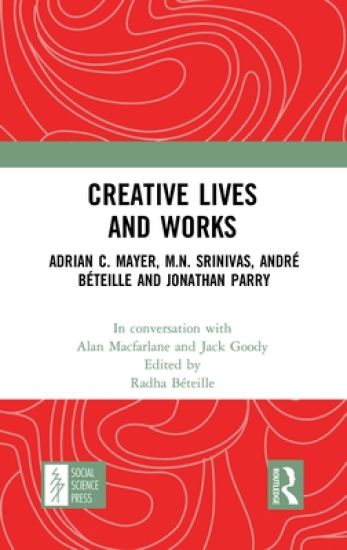
Creative Lives and Works: Adrian C. Mayer, M.N. Srinivas, André Béteille and Johnathan Parry is a collection of interviews conducted by one of England’s leading social anthropologists and historians, Professor Alan Macfarlane. Filmed over a period of 40 years, the four conversations in this volume, are part of a larger set of interviews that cut across various disciplines, from the social sciences, the sciences to the performing and visual arts. The current volume, on four of the world’s foremost social anthropologists and sociologists, who have been closely associated with the British anthropological tradition, is the third in the series of several such books. These conversations focus primarily on fieldwork experience in India and how new dimensions and interpretations were added to the discipline of sociology and social anthropology as more and more primitive cultures and ancient civilizations were studied. This book brings out the diversity of the Indian subcontinent and its people through its engaging conversations and occasional anecdotes. Immensely riveting as conversations, this collection gives one a flavour of the many different cultures that coexist in a vast country like India, often with no knowledge of each other’s existence while de-jargonizing complex sociological concepts. The book will be of enormous value not just to those interested in the subject of Sociology, Social Anthropology and Ethnography, but also those with an avid interest in History, Culture Studies as well as those with an interest in learning about other societies. Please note: This title is co-published with Social Science Press, New Delhi. Taylor & Francis does not sell or distribute the Hardback in India, Pakistan, Nepal, Bhutan, Bangladesh and Sri Lanka.
Creative Lives and Works

Creative Lives and Works

Alan Macfarlane; Jack Goody; Jean La Fontaine; Frank Kermode

Routledge
2021
sidottu
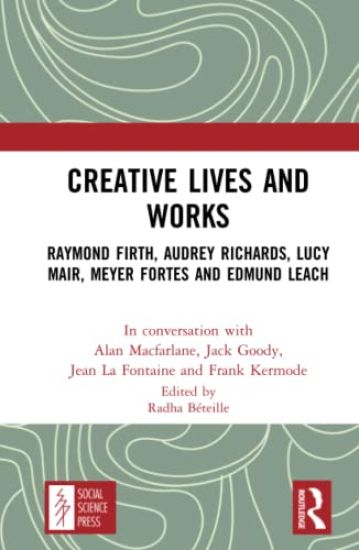
Creative Lives and Works: Raymond Firth, Audrey Richards, Lucy Mair, Meyer Fortes and Edmund Leach is a collection of interviews conducted by one of England’s leading social anthropologists and historians, Professor Alan Macfarlane. Filmed over a period of 40 years, the five conversations in this volume, are part of a larger set of interviews that cut across various disciplines, from the social sciences, the sciences to the performing and visual arts. The current volume on five of England’s foremost social anthropologists is the second in the series of several such books. These conversations and talks are interlaced with rich ethnography and interpretations of distant civilizations and the very real practices that enable these tribal societies and cultures to thrive. There are several teaching moments in these engaging conversations which are further enriched by detailed personal experiences that each of the five shares. Sir Raymond Firth gives us an insight into his Polynesian experience, while Audrey Richards and Lucy Mair recall their days in the African hinterland. Meyer Fortes’s account of his tribal study, yet again in the African subcontinent, is mesmeric, while Sir Edmund Leach’s Southeast Asian encounters are just as enthralling. Immensely riveting as conversations, this collection gives one a flavour of how tribal societies live and work. The book will be of enormous value not just to those interested in learning about tribal societies and cultures, and those interested in History, Culture Studies, but also to those curious to gather knowledge about other cultures.Please note: This title is co-published with Social Science Press, New Delhi. Taylor & Francis does not sell or distribute the Hardback in India, Pakistan, Nepal, Bhutan, Bangladesh and Sri Lanka.
Technology, Tradition and the State in Africa
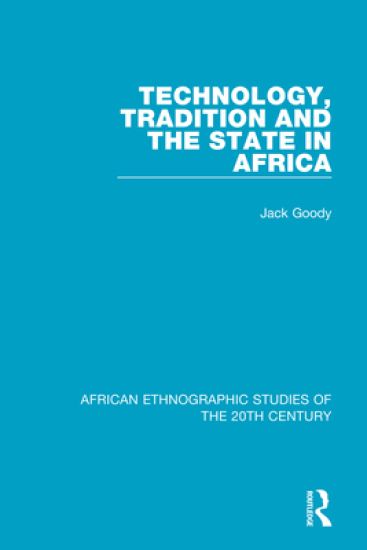
Originally published in 1971 this book argues that certain aspects of traditional African social systems have been misunderstood because of a failure to appreciate what is implied by important differences between the technologies of the major traditional African states and those of Europe and Asia. Differences in the modes of agricultural production were connected with differences in other aspects of the social system such as the relations between subjects and chiefs. This means that comparisons with the feudal systems of Western Europe or the monarchies of Asiatic states have definite limitations. Differences in technology not only affected not only the means of production but also of destruction. The importance of differential access to the means of domination is stressed as a critical factor in African political systems. This is an aspect which has been obscured in many studies that have relied largely on material gathered after the establishment of colonial rule.
The Social Organisation of the Lo Wiili
Originally published in 1967 (second edition) presents an account of the life and social organisation of the Lo Wiili of the Haute Volta and Ghana. Chapters on the geographic and ethnographic background and economic system are followed by a detailed analysis of Lo Wiili social organisation which in its broad outlines is typical of the general area. Of particular theoretical interest, however, is the co-existence in the one society of both patriclans and matriclans and the way in which the Lo Wiili see themselves not as a boundary-maintaining group ('tribe') but define themselves by cultural criteria which are relative to the group with which they are being compared. The study is also concerned with the traditional role of the Earth Shrine in maintaining social control, a widespread feature of West African societies.
Changing Social Structure in Ghana
Originally published in 1975, this book presents the results of research into social change in Ghana. The book looks in detail at the problems of particular sub-groups and sectors in one single nation and they show that the field-worker with a wide comparative background in the range of pre-industrial societies has a positive role to play in contemporary social science.
Changing Social Structure in Ghana
Originally published in 1975, this book presents the results of research into social change in Ghana. The book looks in detail at the problems of particular sub-groups and sectors in one single nation and they show that the field-worker with a wide comparative background in the range of pre-industrial societies has a positive role to play in contemporary social science.
The Social Organisation of the Lo Wiili
Originally published in 1967 (second edition) presents an account of the life and social organisation of the Lo Wiili of the Haute Volta and Ghana. Chapters on the geographic and ethnographic background and economic system are followed by a detailed analysis of Lo Wiili social organisation which in its broad outlines is typical of the general area. Of particular theoretical interest, however, is the co-existence in the one society of both patriclans and matriclans and the way in which the Lo Wiili see themselves not as a boundary-maintaining group ('tribe') but define themselves by cultural criteria which are relative to the group with which they are being compared. The study is also concerned with the traditional role of the Earth Shrine in maintaining social control, a widespread feature of West African societies.
Technology, Tradition and the State in Africa
Originally published in 1971 this book argues that certain aspects of traditional African social systems have been misunderstood because of a failure to appreciate what is implied by important differences between the technologies of the major traditional African states and those of Europe and Asia. Differences in the modes of agricultural production were connected with differences in other aspects of the social system such as the relations between subjects and chiefs. This means that comparisons with the feudal systems of Western Europe or the monarchies of Asiatic states have definite limitations. Differences in technology not only affected not only the means of production but also of destruction. The importance of differential access to the means of domination is stressed as a critical factor in African political systems. This is an aspect which has been obscured in many studies that have relied largely on material gathered after the establishment of colonial rule.
Death and the Ancestors

Death and the Ancestors

Jack Goody

Routledge
2015
nidottu
Deliberately considering relevant theories put forward by earlier writers and examining them in the light of the research for this particular book, the author spent over 100 days attending funeral ceremonies and he attended 25 burial services. First published in 1962.
Comparative Studies in Kinship
Against the background of the problems involved in the comparative study of human society, the essays in this book show the comparative ideal in practice, which combines elements from both sociology and anthropology. In each essay, specific problems are treated in a way which tests theory against evidence, to replace assertion by demonstration. Topics covered include: · Incest and Adultery · Double descent systems · Inheritance, social change and the boundary problem · Marriage policy · The circulation of women and children in northern Ghana · Indo-European kinship. First published in 1969.
Metals, Culture and Capitalism

Metals, Culture and Capitalism

Jack Goody

Cambridge University Press
2012
pokkari
Metals, Culture and Capitalism is an ambitious, broad-ranging account of the search for metals in Europe and the Near East from the Bronze Age to the Industrial Revolution and the relationship between this and economic activity, socio-political structures and the development of capitalism. Continuing his criticism of Eurocentric traditions, a theme explored in The Theft of History (2007) and Renaissances (2009), Jack Goody takes the Bronze Age as a starting point for a balanced account of the East and the West, seeking commonalities that recent histories overlook. Considering the role of metals in relation to early cultures, the European Renaissance and 'modernity' in general, Goody explores how the search for metals entailed other forms of knowledge, as well as the arts, leading to changes that have defined Europe and the contemporary world. This landmark text, spanning centuries, cultures and continents, promises to inspire scholars and students across the social sciences.
Metals, Culture and Capitalism

Metals, Culture and Capitalism

Jack Goody

Cambridge University Press
2012
sidottu
Metals, Culture and Capitalism is an ambitious, broad-ranging account of the search for metals in Europe and the Near East from the Bronze Age to the Industrial Revolution and the relationship between this and economic activity, socio-political structures and the development of capitalism. Continuing his criticism of Eurocentric traditions, a theme explored in The Theft of History (2007) and Renaissances (2009), Jack Goody takes the Bronze Age as a starting point for a balanced account of the East and the West, seeking commonalities that recent histories overlook. Considering the role of metals in relation to early cultures, the European Renaissance and 'modernity' in general, Goody explores how the search for metals entailed other forms of knowledge, as well as the arts, leading to changes that have defined Europe and the contemporary world. This landmark text, spanning centuries, cultures and continents, promises to inspire scholars and students across the social sciences.
The Theft of History

The Theft of History

Jack Goody

Cambridge University Press
2012
pokkari
In The Theft of History Jack Goody builds on his own previous work to extend further his highly influential critique of what he sees as the pervasive Eurocentric or occidentalist biases of so much western historical writing and the consequent 'theft' by the West of the achievements of other cultures in the invention of (notably) democracy, capitalism, individualism and love. Goody, one of the world's most distinguished anthropologists, raises questions about theorists, historians and methodology and proposes a new comparative approach to cross-cultural analysis which allows for more scope in examining history than an East versus West style.
Myth, Ritual and the Oral

Myth, Ritual and the Oral

Jack Goody

Cambridge University Press
2010
pokkari
In Myth, Ritual and the Oral Jack Goody, one of the world's most distinguished anthropologists, returns to the related themes of myth, orality and literacy, subjects that have long been a touchstone in anthropological thinking. Combining classic papers with recent unpublished work, this volume brings together some of the most important essays written on these themes in the past half century, representative of a lifetime of critical engagement and research. In characteristically clear and accessible style, Jack Goody addresses fundamental conceptual schemes underpinning modern anthropology, providing potent critiques of current theoretical trends. Drawing upon his highly influential work on the LoDagaa myth of the Bagre, Goody challenges structuralist and functionalist interpretations of oral 'literature', stressing the issues of variation, imagination and creativity, and the problems of methodology and analysis. These insightful, and at times provocative, essays will stimulate fresh debate and prove invaluable to students and teachers of social anthropology.
Myth, Ritual and the Oral

Myth, Ritual and the Oral

Jack Goody

Cambridge University Press
2010
sidottu
In Myth, Ritual and the Oral Jack Goody, one of the world's most distinguished anthropologists, returns to the related themes of myth, orality and literacy, subjects that have long been a touchstone in anthropological thinking. Combining classic papers with recent unpublished work, this volume brings together some of the most important essays written on these themes in the past half century, representative of a lifetime of critical engagement and research. In characteristically clear and accessible style, Jack Goody addresses fundamental conceptual schemes underpinning modern anthropology, providing potent critiques of current theoretical trends. Drawing upon his highly influential work on the LoDagaa myth of the Bagre, Goody challenges structuralist and functionalist interpretations of oral 'literature', stressing the issues of variation, imagination and creativity, and the problems of methodology and analysis. These insightful, and at times provocative, essays will stimulate fresh debate and prove invaluable to students and teachers of social anthropology.
Food and Love

Food and Love

Jack Goody

Verso Books
2010
nidottu
The development of romantic love, the evolution of national and regional cuisines, the globalization of Chinese food, the histories of various taboos on certain types of food and drink, the uniqueness of the European family-such are the fascinating and diverse themes Goody addresses in Food and Love. Starting with a sustained discussion of the debates on social development in the thought of classic theorists as well as contemporary historical and sociological notions of modernization, Goody goes on to tease out the general historical processes embedded in the most intimate recesses of our lives. In a final bracing section challenging dominant relativist conceptions, Goody considers the difficulties and complexities of cross cultural and comparative analysis, and he picks apart the doubts involved in the very process of representation and symbolic communication.Throughout this collection, Goody demonstrates that the ethnocentricity of much of Western scholarship has distorted not only the comprehension of the East but also developments in the European past and present.
Renaissances

Renaissances

Jack Goody

Cambridge University Press
2009
sidottu
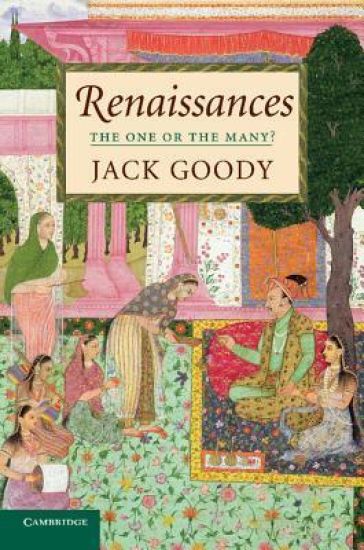
One of the most distinguished social scientists in the world addresses one of the central historical questions of the past millennium: does the European Renaissance deserve its unique status at the very heart of our notions of modernity? Jack Goody scrutinises the European model in relation to parallel renaissances that have taken place in other cultural areas, primarily Islam and China, and emphasises what Europe owed to non-European influences. Renaissances continues that strand of historical analysis critical of Eurocentrism that Goody has developed in recent works like The East and the West (1996) or The Theft of History (2006). This book is wide-ranging, powerful, deftly argued, and draws upon the author's long experience of working in Africa and elsewhere. Not since Toynbee in The Study of History has anybody attempted quite what Jack Goody is undertaking in Renaissances, and the result is as accessible as it is ambitious.
Renaissances

Renaissances

Jack Goody

Cambridge University Press
2009
pokkari
One of the most distinguished social scientists in the world addresses one of the central historical questions of the past millennium: does the European Renaissance deserve its unique status at the very heart of our notions of modernity? Jack Goody scrutinises the European model in relation to parallel renaissances that have taken place in other cultural areas, primarily Islam and China, and emphasises what Europe owed to non-European influences. Renaissances continues that strand of historical analysis critical of Eurocentrism that Goody has developed in recent works like The East and the West (1996) or The Theft of History (2006). This book is wide-ranging, powerful, deftly argued, and draws upon the author's long experience of working in Africa and elsewhere. Not since Toynbee in The Study of History has anybody attempted quite what Jack Goody is undertaking in Renaissances, and the result is as accessible as it is ambitious.
The Eurasian Miracle

The Eurasian Miracle

Jack Goody

Polity Press
2009
nidottu
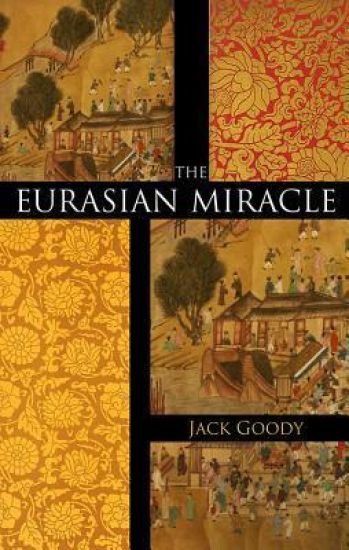
The idea of long-term European dominance is characteristic of most evolutionary theories of human culture and society in the nineteenth century. It was commonly believed that there was a natural progression from Antiquity through Feudalism to Capitalism which could not have taken place elsewhere. Today there are many who still believe that this progression was part of a European miracle that underlay the rise to global supremacy of the West. In this short book Jack Goody systematically dismantles this Eurocentric view of the world. He argues that we need to look, not for a European miracle, but rather for a Eurasian miracle that went back to the Urban Revolution of the Bronze Age, that affected the Near East, India and China well before Europe and that was much advanced by the adoption of writing. Under these conditions we find a long-term exchange of information between East and West, and the dominance of one followed by the dominance of the other - in other words, alternation rather than dominance. There were measures during the Renaissance in Europe that made for continuous growth, especially the secularization of learning, but it appears that the period of Western supremacy is now coming to an end and that we are about to experience a further alternation in favour of the East.
The Eurasian Miracle

The Eurasian Miracle

Jack Goody

Polity Press
2009
sidottu
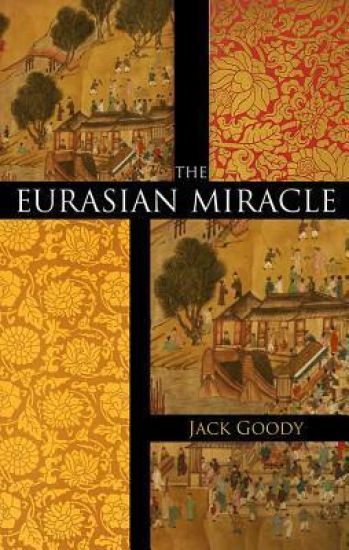
The idea of long-term European dominance is characteristic of most evolutionary theories of human culture and society in the nineteenth century. It was commonly believed that there was a natural progression from Antiquity through Feudalism to Capitalism which could not have taken place elsewhere. Today there are many who still believe that this progression was part of a European miracle that underlay the rise to global supremacy of the West. In this short book Jack Goody systematically dismantles this Eurocentric view of the world. He argues that we need to look, not for a European miracle, but rather for a Eurasian miracle that went back to the Urban Revolution of the Bronze Age, that affected the Near East, India and China well before Europe and that was much advanced by the adoption of writing. Under these conditions we find a long-term exchange of information between East and West, and the dominance of one followed by the dominance of the other - in other words, alternation rather than dominance. There were measures during the Renaissance in Europe that made for continuous growth, especially the secularization of learning, but it appears that the period of Western supremacy is now coming to an end and that we are about to experience a further alternation in favour of the East.