

Kirjailija
James Simpson
Kirjat ja teokset yhdessä paikassa: 52 kirjaa, julkaisuja vuosilta 1995-2026, suosituimpien joukossa Transactions of the Cumberland & Westmorland Antiquarian & Archaeological Society. Vertaile teosten hintoja ja tarkista saatavuus suomalaisista kirjakaupoista.
52 kirjaa
Kirjojen julkaisuhaarukka 1995-2026.

Reprint of the original. The publishing house Anatiposi publishes historical books as reprints. Due to their age, these books may have missing pages or inferior quality. Our aim is to preserve these books and make them available to the public so that they do not get lost.

Reprint of the original. The publishing house Anatiposi publishes historical books as reprints. Due to their age, these books may have missing pages or inferior quality. Our aim is to preserve these books and make them available to the public so that they do not get lost.
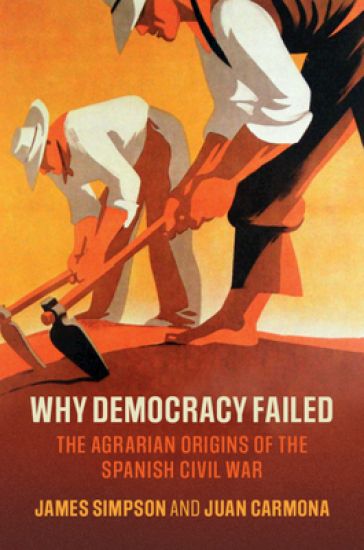
In this distinctive new history of the origins of the Spanish Civil War, James Simpson and Juan Carmona tackle the highly-debated issue of why it was that Spain's democratic Second Republic failed. They explore the interconnections between economic growth, state capacity, rural social mobility and the creation of mass competitive political parties, and how these limited the effectiveness of the new republican governments, and especially their attempts to tackle economic and social problems within the agricultural sector. They show how political change during the Republic had a major economic impact on the different groups in village society, leading to social conflicts that turned to polarization and finally, with the civil war, to violence and brutality. The democratic Republic failed not so much because of the opposition from the landed elites, but rather because small farmers had been unable to exploit more effectively their newly found political voice.
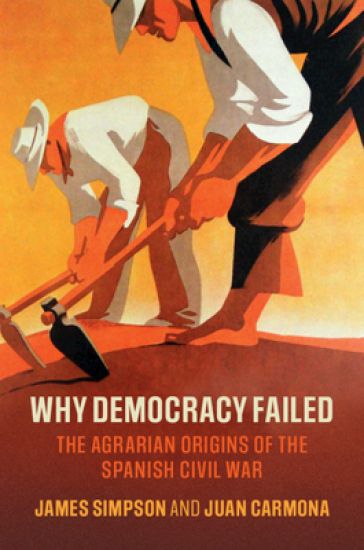
In this distinctive new history of the origins of the Spanish Civil War, James Simpson and Juan Carmona tackle the highly-debated issue of why it was that Spain's democratic Second Republic failed. They explore the interconnections between economic growth, state capacity, rural social mobility and the creation of mass competitive political parties, and how these limited the effectiveness of the new republican governments, and especially their attempts to tackle economic and social problems within the agricultural sector. They show how political change during the Republic had a major economic impact on the different groups in village society, leading to social conflicts that turned to polarization and finally, with the civil war, to violence and brutality. The democratic Republic failed not so much because of the opposition from the landed elites, but rather because small farmers had been unable to exploit more effectively their newly found political voice.

Great Britain, the 1980s. VHS is rapidly becoming popular, and the more gory and violent the movies, the better. One company has latched on to this trend quickly - selling and renting controversial films to the public. It is called the Video Instant Picture Company, a.k.a. VIPCO.Founded and run by Michael Lee - Mike to his friends - this small independent video distributor would swiftly grow into a money-making machine and become synonymous with the so-called 'Video Nasties' scandal. Indeed, as VIPCO grew, Mike would become a millionaire, find his company raided by the police, nearly go broke, then resurface to trade in on the memory of the Nasties during the nineties and beyond.VIPCO would give the iconic Zombie Flesh Eaters its first-ever UK home video release, create the headline-grabbing artwork for The Driller Killer, and produce the outlandish Spookies, amongst other notable achievements. Later, the company would gain notoriety for re-releasing some of the Nasties on sub-par DVDs and offering titles with shoddy video sleeves.VIPCO would disappear from retailer shelves in 2007. It has now been over a decade since the firm's closure, and many of VIPCO's former titles have found welcome homes with other horror genre distributors, but VIPCO is still shrouded in mystery...James Simpson, a former writer for horror movie magazines and websites, reveals the real reason why the controversial VIPCO closed, as well as detailing its long and complex history. With insights from those who worked with Mike Lee, and those who worked for rival firms, Video Nasty Mayhem opens the vault on VIPCO and finds there are plenty of surprises. The book also reviews more than 60 of VIPCO's films, offers a standalone chapter on cult director Lucio Fulci, highlights Mike Lee's turn at producing movies, and more. For anyone interested in the history of British film and distribution, Video Nasties, plus horror, cannibal and zombie movies, Video Nasty Mayhem is a must-read About the author.Growing up in the aftermath of the Video Nasties, during the late eighties and early nineties, James Simpson is from a small town in the North East of England where talking about grisly horror flicks was the norm in his school playground. For the last few years, he has written about cult cinema for several magazines and websites as well as running his own-now-defunct site: Infernal Cinema. He has interviewed horror stars Emily Booth, Barbie Wilde, and the legendary Lloyd Kaufman, amongst others, during this time. He appears in the Jason Impey documentary: VIPCO: The Untold Story. This is his first book. His favourite VIPCO movie is Spookies.

The Red-Green Axis 2.0: An Existential Threat to America and the World
James Simpson
Independently Published
2019
nidottu
The Red-Green Axis is a collusion between the Democratic Party, American Communists, Socialists and other brands of "progressives", i.e., the Red, and the forces of the Islamic jihad, the Green-so named because the color green carries much symbolism in Islam, and most Muslim nations feature green in flags, emblems, and other identifiers. Its collective goal is to alter and undermine our national character, traditions, and laws so much that it can overthrow our Constitutional republican form of government without firing a shot. The alliance allows each to take advantage of the tactics, strategies, and cultural features of the other, and mobilizes a vastly larger number of people. For example, the Council on American-Islamic Relations (CAIR) now supports Black Lives Matter (BLM) and participates in its protests. The American Civil Liberties Union (ACLU) and the Southern Poverty Law Center (SPLC) also work with BLM, CAIR, and open borders groups.Immigration is one of the Red-Green Axis's most effective tools. Under the banner of "compassion," it advocates for open borders and endless waves of refugees, asylum seekers, and other third-world immigrants to stress government budgets at all levels, overburden communities with medical, language, crime, welfare, and other burdens, while rhetorically and sometimes physically attacking those who object, calling opponents "racists," "bigots," "xenophobes," and the latest innovation, "Islamophobes."This second edition of the Red-Green Axis delves deeply into the immigration/refugee resettlement issue to catalog not only the breadth and depth of the program and its supporters, but to expose the massive problems and cultural changes that have been created, I believe deliberately, as the key element in the Axis agenda to erase America as we know it.
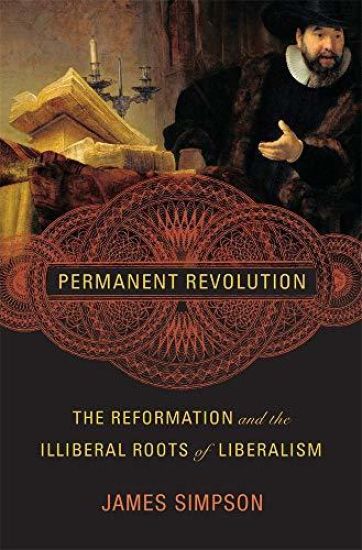
How did the Reformation, which initially promoted decidedly illiberal positions, end up laying the groundwork for Western liberalism?The English Reformation began as an evangelical movement driven by an unyielding belief in predestination, intolerance, stringent literalism, political quietism, and destructive iconoclasm. Yet by 1688, this illiberal early modern upheaval would deliver the foundations of liberalism: free will, liberty of conscience, religious toleration, readerly freedom, constitutionalism, and aesthetic liberty. How did a movement with such illiberal beginnings lay the groundwork for the Enlightenment? James Simpson provocatively rewrites the history of liberalism and uncovers its unexpected debt to evangelical religion.Sixteenth-century Protestantism ushered in a culture of permanent revolution, ceaselessly repudiating its own prior forms. Its rejection of tradition was divisive, violent, and unsustainable. The proto-liberalism of the later seventeenth century emerged as a cultural package designed to stabilize the social chaos brought about by this evangelical revolution. A brilliant assault on many of our deepest assumptions, Permanent Revolution argues that far from being driven by a new strain of secular philosophy, the British Enlightenment is a story of transformation and reversal of the Protestant tradition from within. The gains of liberalism were the unintended results of the violent early Reformation.Today those gains are increasingly under threat, in part because liberals do not understand their own history. They fail to grasp that liberalism is less the secular opponent of religious fundamentalism than its dissident younger sibling, uncertain how to confront its older evangelical competitor.

The Rhyme of the Reddleman's Daughter originated from a story the poet's four-year-old daughter told him in her bath... "I'll tell a story from my mouth ..." her term for an oral story rather than one read from a book

This work has been selected by scholars as being culturally important, and is part of the knowledge base of civilization as we know it. This work was reproduced from the original artifact, and remains as true to the original work as possible. Therefore, you will see the original copyright references, library stamps (as most of these works have been housed in our most important libraries around the world), and other notations in the work.This work is in the public domain in the United States of America, and possibly other nations. Within the United States, you may freely copy and distribute this work, as no entity (individual or corporate) has a copyright on the body of the work.As a reproduction of a historical artifact, this work may contain missing or blurred pages, poor pictures, errant marks, etc. Scholars believe, and we concur, that this work is important enough to be preserved, reproduced, and made generally available to the public. We appreciate your support of the preservation process, and thank you for being an important part of keeping this knowledge alive and relevant.


What would the great founders of modern sociology have to say about happiness, modern capitalism, generation rent or pop music? What were their ideas about? Back For the Future introduces the concept of sociological investigation and describes the theoretical approaches of Emile Durkheim, Karl Marx and Max Weber in the context of their times and through the big challenges in society today. The book discusses world happiness research, the internet and 'glocalisation', sexual freedom and gender, 'collective effervescence', modern capitalism, the ever-present bureaucratic model of management in society, social behaviour and cognitive bias amongst many other topics in today's world. You even get fine art samples, a fun puzzle and a great You Tube link to illustrate the ideas! In reader testing Back for the Future was highly rated as an introductory reader, a teaching and learning aid and as a student text that cuts across disciplinary boundaries.

The Red-Green Axis: Refugees, Immigration and the Agenda to Erase America
James Simpson
Createspace Independent Publishing Platform
2015
nidottu

A Visit to Flanders, in July, 1815: Being Chiefly an Account of the Field of Waterloo
James Simpson
Createspace Independent Publishing Platform
2015
nidottu

Today's wine industry is characterized by regional differences not only in the wines themselves but also in the business models by which these wines are produced, marketed, and distributed. In Old World countries such as France, Spain, and Italy, small family vineyards and cooperative wineries abound. In New World regions like the United States and Australia, the industry is dominated by a handful of very large producers. This is the first book to trace the economic and historical forces that gave rise to very distinctive regional approaches to creating wine. James Simpson shows how the wine industry was transformed in the decades leading up to the First World War. Population growth, rising wages, and the railways all contributed to soaring European consumption even as many vineyards were decimated by the vine disease phylloxera. At the same time, new technologies led to a major shift in production away from Europe's traditional winemaking regions. Small family producers in Europe developed institutions such as regional appellations and cooperatives to protect their commercial interests as large integrated companies built new markets in America and elsewhere. Simpson examines how Old and New World producers employed diverging strategies to adapt to the changing global wine industry. Creating Wine includes chapters on Europe's cheap commodity wine industry; the markets for sherry, port, claret, and champagne; and the new wine industries in California, Australia, and Argentina.

When we think of breaking images, we assume that it happens somewhere else. We also tend to think of iconoclasts as barbaric. Iconoclasts are people like the Taliban, who blew up Buddhist statues in 2001. We tend, that is, to look with horror on iconoclasm. This book argues instead that iconoclasm is a central strand of Anglo-American modernity. Our horror at the destruction of art derives in part from the fact that we too did, and still do, that. This is most obviously true of England's iconoclastic century between 1538 and 1643. That century of legislated early modern image breaking, exceptional in Europe for its jurisdictional extension and duration, stands at the core of this book. That's when written texts, especially poems, rather than visual images became our living monuments. Surely, though, the story of image breaking stops in the eighteenth century, with its enlightened cultivation of the visual arts and the art market. Not so, argues Under the Hammer: once started, iconoclasm is difficult to stop. It ripples through cultures, into the psyche, and it ripples through history. Museums may have protected images from the iconoclast's hammer, but also subject images to metaphorical iconoclasm. Aesthetics may have drawn a protective circle around the image, but as it did so, it also neutralised the image. The ripple effect also continues across the Atlantic, into puritan culture, into twentieth-century American Abstract Expressionism, and into the puritan temple of modern art. That, in fact, is where this book starts, with mid-twentieth-century abstract painting: the image has survived, just, but it bears the scars of a 500 year history.


The evidence is everywhere: fundamentalist reading can stir passions and provoke violence that changes the world. Amid such present-day conflagrations, this illuminating book reminds us of the sources, and profound consequences, of Christian fundamentalism in the sixteenth century. James Simpson focuses on a critical moment in early modern England, specifically the cultural transformation that allowed common folk to read the Bible for the first time. Widely understood and accepted as the grounding moment of liberalism, this was actually, Simpson tells us, the source of fundamentalism, and of different kinds of persecutory violence. His argument overturns a widely held interpretation of sixteenth-century Protestant reading--and a crucial tenet of the liberal tradition. After exploring the heroism and achievements of sixteenth-century English Lutherans, particularly William Tyndale, Burning to Read turns to the bad news of the Lutheran Bible. Simpson outlines the dark, dynamic, yet demeaning paradoxes of Lutheran reading: its demands that readers hate the biblical text before they can love it; that they be constantly on the lookout for unreadable signs of their own salvation; that evangelical readers be prepared to repudiate friends and all tradition on the basis of their personal reading of Scripture. Such reading practice provoked violence not only against Lutheranism's stated enemies, as Simpson demonstrates; it also prompted psychological violence and permanent schism within its own adherents.The last wave of fundamentalist reading in the West provoked 150 years of violent upheaval; as we approach a second wave, this powerful book alerts us to our peril.


Letters To Walter Scott, On The Moral And Political Character
James Simpson
KESSINGER PUBLISHING, LLC
2009
nidottu