Kirjojen hintavertailu. Mukana 12 224 892 kirjaa ja 12 kauppaa.
Kirjailija
Jaroslav Pelikan
Kirjat ja teokset yhdessä paikassa: 30 kirjaa, julkaisuja vuosilta 1950-2021, suosituimpien joukossa Bach Among the Theologians. Vertaile teosten hintoja ja tarkista saatavuus suomalaisista kirjakaupoista.
The Encyclopedia of Christianity is the first of a five-volume English translation of the third revised edition of Evangelisches Kirchenlexikon. Its German articles have been tailored to suit an English readership, and articles of special interest to English readers have been added. The encyclopedi
The Encyclopedia of Christianity is the first of a five-volume English translation of the third revised edition of Evangelisches Kirchenlexikon. Its German articles have been tailored to suit an English readership, and articles of special interest to English readers have been added. The encyclopedi
Volume 5 of the EC contains 295 articles constituting the alphabetical entries Si-Z -- articles on significant topics ranging from sin, spiritual direction, Sufism, and terrorism to Vatican I and II, Vineyard Christian Fellowship, World Alliance of Reformed Churches, and Zionism. Like each volume in the complete EC, this book incorporates many enhancements of and additions to the third revised edition of the German Evangelisches Kirchenlexikon: Internationale theologische Enzyklop die, on which the EC is based. Among the features of this English work are the following: articles on all but the smallest countries of the world, including former communist states that have gained their independence since 1989;the latest, best statistical information, compiled by David B. Barrett, on the religious affiliation and ecclesiastical breakdown of each country and continent;the addition of over seventy biographical articles on prominent figures throughout church history;many expanded or entirely new articles that address topics of particular interest to English-speaking readers.Unparalleled in scholarship and breadth of content, theEncyclopedia of Christianity will long serve as the standard reference work for the study of Christianity in the past and the present -- and its trajectory into the future.
Foreword by Jaroslav PelikanThe multiple award-winning "Encyclopedia of Christianity (EC), copublished by Eerdmans and Brill, is a monumental five-volumework presenting the history and current state of theChristian faith in its rich spiritual and theological diversityaround the world. The much-anticipated third volume of the"EC contains more than 350 articles for alphabetical entries J-O.Written by leading scholars from around the world, the articlesin volume 3 range from discussions of Jesus, the kingdom ofGod, and Martin Luther to marriage and divorce, NorthAmerican theology, and the Orthodox Church.
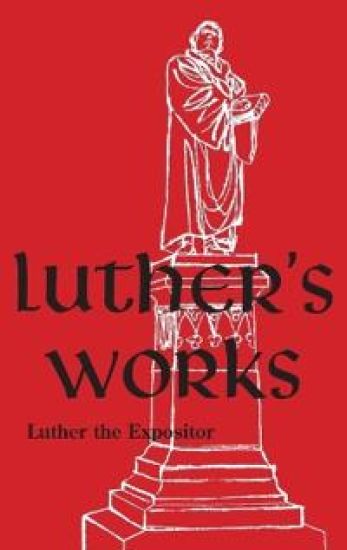
Luther the Expositor is an introduction to Luther's writings dealing with his exegetical principles and practices, illustrated by a case study of texts on the Lord's Supper. It is an overview of Luther's theology underlining the importance of exegesis in the life and thought of the church.
In this volume, an internationally renowned historian of Christian doctrine offers a theological reading of Acts. Now in paper."[A] significant commentary. . . . Pelikan asks big questions: what is sin? what were the earliest creeds? what is the nature of apostleship? He is sensitive to nuances of Greek but not obsessed by them. As such, this book will be helpful to preachers and, to a lesser extent, general readers who are sometimes flummoxed by more specialized and technical biblical commentaries."--Publishers WeeklyNew series volumes will continue to release in cloth, but as older volumes reprint, they will release in paper.
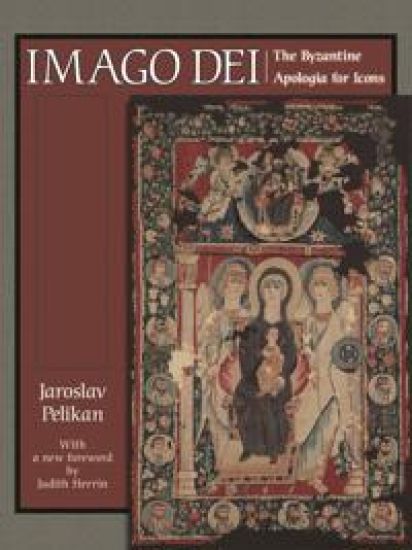
In 726 the Byzantine emperor, Leo III, issued an edict that all religious images in the empire were to be destroyed, a directive that was later endorsed by a synod of the Church in 753 under his son, Constantine V. If the policy of Iconoclasm had succeeded, the entire history of Christian art--and of the Christian church, at least in the East--would have been altered. Iconoclasm was defeated--by Byzantine politics, by popular revolts, by monastic piety, and, most fundamentally of all, by theology, just as it had been theology that the opponents of images had used to justify their actions. Analyzing an intriguing chapter in the history of ideas, the renowned scholar Jaroslav Pelikan shows how a faith that began by attacking the worship of images ended first in permitting and then in commanding it. Pelikan charts the theological defense of icons during the Iconoclastic controversies of the eighth and ninth centuries, whose high point came in A.D. 787, when the Second Council of Nicaea restored the cult of images in the church. He demonstrates how the dogmas of the Trinity and the Incarnation eventually provided the basic rationale for images: because the invisible God had become human and therefore personally visible in Jesus Christ, it became permissible to make images of that Image. And because not only the human nature of Christ, but that of his Mother had been transformed by the Incarnation, she, too, could be "iconized," together with all the other saints and angels. The iconographic "text" of the book is provided by one of the very few surviving icons from the period before Iconoclasm, the Egyptian tapestry Icon of the Virgin now in the Cleveland Museum of Art. Other icons serve to illustrate the theological argument, just as the theological argument serves to explain the icons. In a new foreword, Judith Herrin discusses the enduring importance of the book, provides a brief biography of Pelikan, and discusses how later scholars have built on his work.
The Bible is among the world's most influential and important books - and the most controversial. It affects not just religious beliefs but every aspect of our culture, including the very language we speak. But how did it become the book we know it to be? In this superbly written history, Jaroslav Pelikan charts its evolution from oral tales via Hebrew texts, Greek, and Latin translations, to its many different forms today, offering a new insight into the history of the last three thousand years. This is an enduring work of scholarship and a fascinating read.
A history of the Bible traces its evolution from an oral testament to its numerous modern iterations and translations, discussing such topics as the canonization of different versions, the adoption of certain books by religions and sects, and the varying schools of critical scholarship that exist today. Reprint.
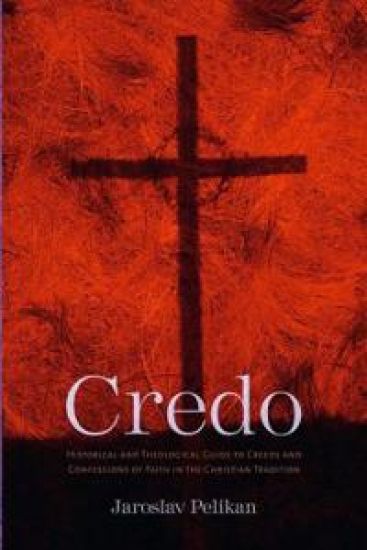
One of the world’s leading scholars offers unique insights into the history and significance of Christian creeds Eminent theologian Jaroslav Pelikan has been translating, editing, and studying the Christian creeds and confessions of faith for sixty years. This book is the historical and theological distillation of that work. In Credo, Pelikan addresses essential questions about the Christian tradition: the origins of creeds; their function; their political role; how they relate to Christian institutions, worship, and service; and how they help to explain the major divisions of the Christian church and of Christian history.Credo standsas an independent reference work devoted to the subject of what creeds and confessions are and what their role in history has been. It is also the first of the four volumes of Creeds and Confessions of Faith in the Christian Tradition, edited by Pelikan and Valerie Hotchkiss.
Both the Bible and the Constitution have the status of “Great Code,” but each of these important texts is controversial as well as enigmatic. They are asked to speak to situations that their authors could not have anticipated on their own. In this book, one of our greatest religious historians brings his vast knowledge of the history of biblical interpretation to bear on the question of constitutional interpretation. Jaroslav Pelikan compares the methods by which the official interpreters of the Bible and the Constitution—the Christian Church and the Supreme Court, respectively—have approached the necessity of interpreting, and reinterpreting, their important texts. In spite of obvious differences, both texts require close, word-by-word exegesis, an awareness of opinions that have gone before, and a willingness to ask new questions of old codes, Pelikan observes. He probes for answers to the question of what makes something authentically “constitutional” or “biblical,” and he demonstrates how an understanding of either biblical interpretation or constitutional interpretation can illuminate the other in important ways.
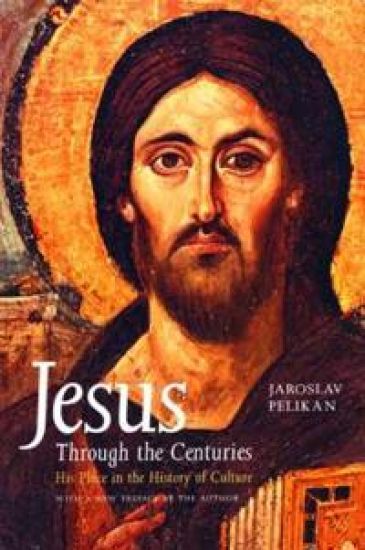
An eminent theologian’s original and compelling study of how images of Jesus through history reveal each era’s temper and values “A rich and expansive description of Jesus’ impact on the general history of culture. . . . Believers and skeptics alike will find it a sweeping visual and conceptual panorama.”—John Koenig, front page, New York Times Book Review Called “a book of uncommon brilliance” by Commonweal, Jesus Through the Centuries is an original and compelling study of the impact of Jesus on cultural, political, social, and economic history. Noted historian and theologian Jaroslav Pelikan reveals how the image of Jesus created by each successive epoch—from rabbi in the first century to liberator in the nineteenth and twentieth centuries—is a key to understanding the temper and values of that age. "An enlightening and often dramatic story . . . as stimulating as it is informative.”—John Gross, New York Times “A gracious little masterpiece.”—Thomas D’Evelyn, Christian Science Monitor
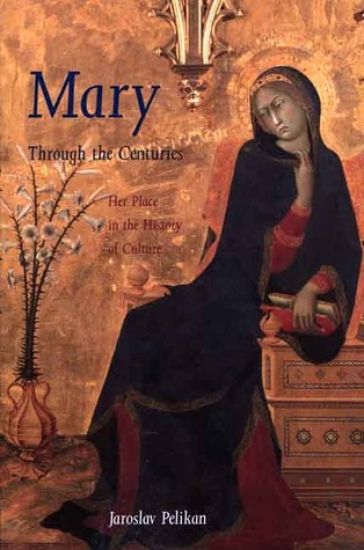
The Virgin Mary has been an inspiration to more people than any other woman who ever lived. For Catholics, Protestants, Jews, and Muslims, for artists, musicians, and writers, and for women and men everywhere she has shown many faces and personified a variety of virtues. In this important book, a world-renowned scholar who is the author of numerous books—including the best-selling Jesus Through the Centuries—tells how Mary has been depicted and venerated through the ages.Jaroslav Pelikan examines the biblical portrait of Mary, analyzing both the New and Old Testaments to see how the bits of information provided about her were expanded into a full-blown doctrine. He explores the view of Mary in late antiquity, where the differences between Mary, the mother of Christ, and Eve, the "mother of all living," provided positive and negative symbols of women. He discusses how the Eastern church commemorated Mary and how she was portrayed in the Holy Qur'an of Islam. He explains how the paradox of Mary as Virgin Mother shaped the paradoxical Catholic view of sexuality and how Reformation rejection of the worship of Mary allowed her to be a model of faith for Protestants. He considers also her role in political and social history. He analyzes the place of Mary in literature—from Dante, Spenser, and Milton to Wordsworth, George Eliot, and Goethe—as well as in music and art, and he describes the miraculous apparitions of Mary that have been experienced by the common people.Was Mary human or divine? Should she be revered for her humility or her strength? What is her place in heaven? Whatever our answers to these questions, Mary remains a symbol of hope and solace, a woman, says Pelikan, for all seasons and all reasons.
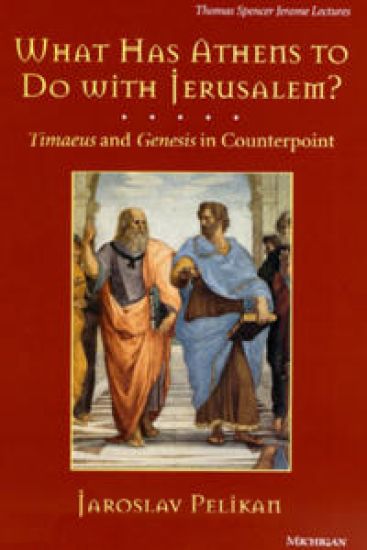
The debate about evolution and creationism is striking evidence of the tensions between biblical and philosophical-scientific explanations of the origins of the universe. For most of the past twenty centuries, important historical context for the debate has been supplied by the relation (or "counterpoint") between two monumental texts: Plato's Timaeus and the Book of Genesis.In What Has Athens to Do with Jerusalem?, Jaroslav Pelikan examines the origins of this counterpoint. He reviews the central philosophical issues of origins as posed in classical Rome by Lucretius, and he then proceeds to an examination of Timaeus and Genesis, with Timaeus' Plato representing Athens and Genesis' Moses representing Jerusalem. He then follows the three most important case studies of the counterpoint--in the Jewish philosophical theology of Alexandria, in the Christian thought of Constantinople, and in the intellectual foundations of the Western Middles Ages represented by Catholic Rome, where Timaeus would be the only Platonic dialogue in general circulation.Whatever Plato may have intended originally in writing Timaeus, it has for most of the intervening period been read in the light of Genesis. Conversely, Genesis has been known, not in the original Hebrew, but in Greek and Latin translations that were seen to bear a distinct resemblance to one another and to the Latin version of Timaeus. Pelikan's study leads to original findings that deal with Christian doctrine in the period of the church fathers, including the Three Cappadocians (Basil of Caesarea, Gregory of Nazianzus, and Gregory of Nyssa) in the East, and in the West, Ambrose, Augustine, and Boethius. All of these vitally important authors addressed the problem of the "counterpoint," and neither they nor these primary texts can become fully intelligible without attention to the central issues being explored here.What Has Athens to Do with Jerusalem? will be of interest to historians, theologians, and philosophers and to anyone with interest in any of the religious traditions addressed herein.
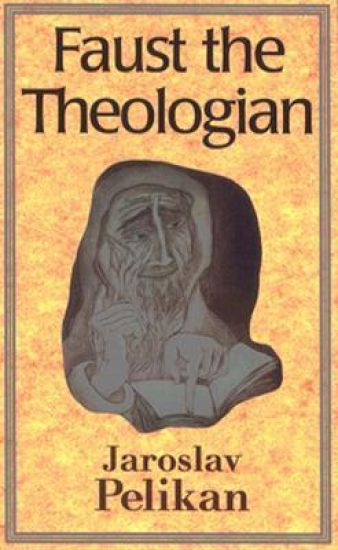
In this erudite and beautifully written book, an eminent scholar meditates on the theological implications of Goethe's Faust. Jaroslav Pelikan reflects on Goethe's statement that he was a pantheist when it came to science, a polytheist in art, and a monotheist in ethics, and he uses it for the first time to analyze Faust's development as a theologian. By so doing, Pelikan enables us to see Goethe's masterpiece in a surprising new light.Pelikan begins by discussing Faust's role as natural scientist or pantheist. He examines Faust's disenchantment with traditional knowledge, considers his interests in geology, oceanography, and optics, and analyzes his perception of nature as a realm inspirited throughout by a single unifying Power. Pelikan next follows Faust on his journeys to the two Walpurgis Nights, where he shows how Faust reveals his delight in the polytheistic extravaganzas of Germanic and especially of Greek mythology. Finally Pelikan describes the operatic finale of the book, where Faust's spirit is drawn upward to salvation by the Eternal Feminine, and he argues that this marks Faust's evolution into moral philosopher and monotheist. Pelikan's analysis thus reveals thematic unities and a dialectical development of Faust's character that have been unnoticed heretofore.