Kirjailija
Jean-Luc Marion
Kirjat ja teokset yhdessä paikassa: 55 kirjaa, julkaisuja vuosilta 1993-2025, suosituimpien joukossa Das Erscheinen Des Unsichtbaren: Fragen Zur Phanomenalitat Der Offenbarung. Vertaile teosten hintoja ja tarkista saatavuus suomalaisista kirjakaupoista.
Mukana myös kirjoitusasut: Jean–luc Marion
55 kirjaa
Kirjojen julkaisuhaarukka 1993-2025.
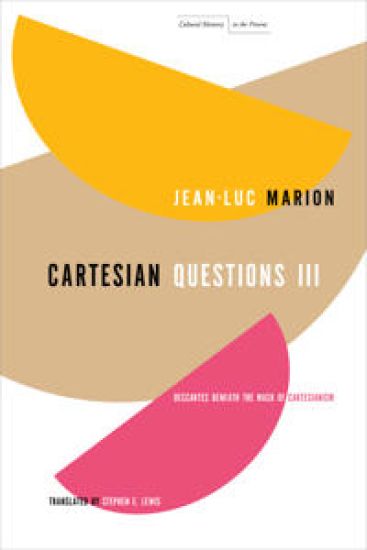
In this masterful work, Jean-Luc Marion shows how some of Descartes' most decisive points remain masked by the various "Cartesianisms" that historiography and convenient simplifications alike have constructed. The book's first half shows how Descartes lines up against Cartesianism, setting forth several closely argued attempts to free up the positive status of skepticism in the Cartesian corpus, the non-substantial (and non-reflexive) character of the ego cogito, the complex elaboration of the idea of the infinite, and the role of esteem as a mode of the cogitatio. Marion then offers a second set of studies examining the work of Montaigne, Hobbes, and Spinoza and seeking to reconstitute some of the ways in which Cartesianism (and non-Cartesianism) become opposed to Descartes. Arising at the pivot point between these two paths of inquiry is a chapter dedicated to Descartes and phenomenology, with particular focus on how Descartes can be understood to have practiced—in his own way and by anticipation—a genuine phenomenological reduction. The final volume in Jean-Luc Marion's erudite trilogy of Cartesian Questions, this authoritative book demonstrates that, rather than belonging strictly to the past, Descartes continues to speak to our future.
In this masterful work, Jean-Luc Marion shows how some of Descartes' most decisive points remain masked by the various "Cartesianisms" that historiography and convenient simplifications alike have constructed. The book's first half shows how Descartes lines up against Cartesianism, setting forth several closely argued attempts to free up the positive status of skepticism in the Cartesian corpus, the non-substantial (and non-reflexive) character of the ego cogito, the complex elaboration of the idea of the infinite, and the role of esteem as a mode of the cogitatio. Marion then offers a second set of studies examining the work of Montaigne, Hobbes, and Spinoza and seeking to reconstitute some of the ways in which Cartesianism (and non-Cartesianism) become opposed to Descartes. Arising at the pivot point between these two paths of inquiry is a chapter dedicated to Descartes and phenomenology, with particular focus on how Descartes can be understood to have practiced—in his own way and by anticipation—a genuine phenomenological reduction. The final volume in Jean-Luc Marion's erudite trilogy of Cartesian Questions, this authoritative book demonstrates that, rather than belonging strictly to the past, Descartes continues to speak to our future.
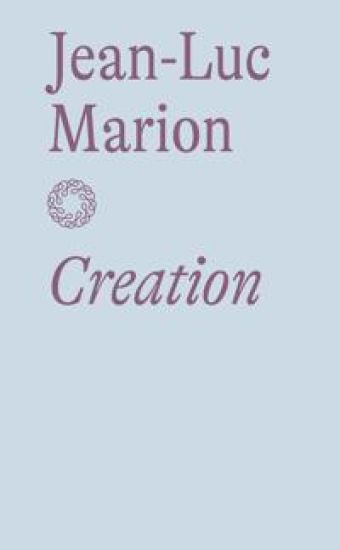
“What are we thinking, when we say ‘creation’?”With this question, Jean-Luc Marion begins an investigation of how the concept has been forged by the history of metaphysics, and how it informs our present view of the power to create. Does art come from the artist or from somewhere else? “Something was writing within me,” Jon Fosse has remarked about his own writing. What is this “something”?Marion sees creation in biblical terms: not in terms of production, but goodness, gift, and love. This presents a new paradigm for artists, framing creation as a way of seeing and listening: «The artist only succeeds in achieving his work by inventing nothing.»This book is the written edition of the 2025 Fosse Lecture. Jean-Luc Marion’s Creation is the first of a planned series of lectures on literature and art – in honour of the fourth Norwegian Nobel Prize laureate in Literature.
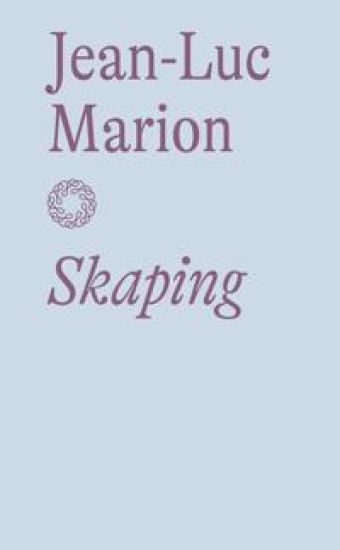
«Kva tenkjer vi på når vi seier skaping?»Med dette spørsmålet startar Jean-Luc Marion ei utforsking av korleis omgrepet har blitt smidd til gjennom den metafysiske historia, og korleis dette påverkar synet vårt på skaparkraft i dag. Kjem kunsten frå kunstnaren sjølv eller frå ein annan stad? «Det var noko som skreiv i meg», har Jon Fosse sagt om eiga skriving. Kva er dette «noko»?Marion ser på skapinga frå ein bibelsk ståstad: ikkje som produksjon, men som godleik, gåve og kjærleik. Dette gir oss eit nytt paradigme der kunstnarleg skaping er ein syns- og lyttemåte: «Kunstnaren lukkast berre i å nå fram til det fullførte verket sitt ved å ikkje finne opp noko.»Denne boka er den skriftlege utgåva av Fosseforedraget 2025. Jean-Luc Marions Skaping er det fyrste bidraget i ei planlagd rekkje med foredrag om litteratur og kunst – ei satsing til ære for den fjerde norske nobelprisvinnaren i litteratur.
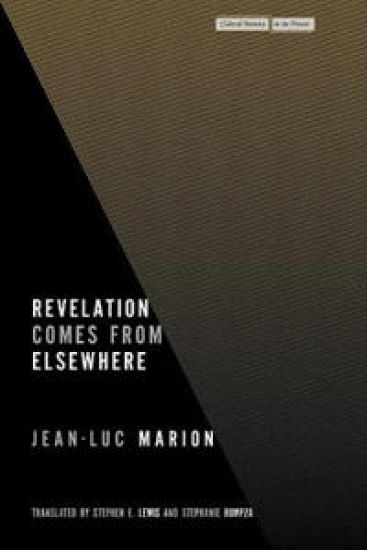
Jean-Luc Marion has long endeavored to broaden our view of truth. In this illuminating new book—his deepest engagement with theology to date—Marion proposes a rigorous new understanding of human and divine revelation in a deeply phenomenological key. Although today considered the central theme of theology, the concept of Revelation was almost entirely unknown to the first millennium of Christian thought. In a penetrating historical deconstruction, Marion traces the development of this term to the rise of metaphysics from Aquinas through Suárez, Descartes, and Kant; formalized into an epistemological framework, this understanding of Revelation has restricted philosophical and theological thinking ever since. To break free from these limits, Marion takes hints from theologians including Barth and Balthasar while mobilizing the phenomenology of givenness to provide a rigorous new understanding of revelation as a mode of uncovering. His extensive study of the Jewish and Christian Scriptures unfolds a logic of Trinitarian phenomenality, worked out in conversation with Basil, Augustine, Hegel, Schelling, and others, that ultimately transforms our very notions of being and time. The result is precisely what we have come to expect from this acclaimed philosopher: masterful historical scholarship working in tandem with daring originality.
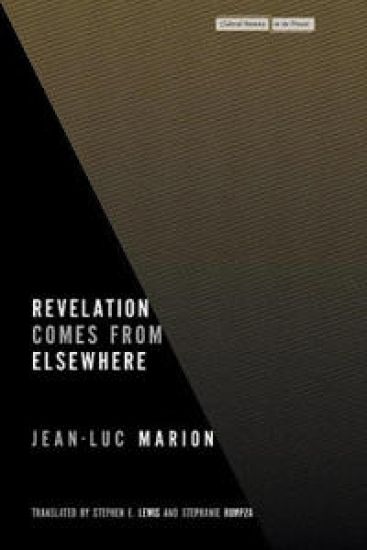
Jean-Luc Marion has long endeavored to broaden our view of truth. In this illuminating new book—his deepest engagement with theology to date—Marion proposes a rigorous new understanding of human and divine revelation in a deeply phenomenological key. Although today considered the central theme of theology, the concept of Revelation was almost entirely unknown to the first millennium of Christian thought. In a penetrating historical deconstruction, Marion traces the development of this term to the rise of metaphysics from Aquinas through Suárez, Descartes, and Kant; formalized into an epistemological framework, this understanding of Revelation has restricted philosophical and theological thinking ever since. To break free from these limits, Marion takes hints from theologians including Barth and Balthasar while mobilizing the phenomenology of givenness to provide a rigorous new understanding of revelation as a mode of uncovering. His extensive study of the Jewish and Christian Scriptures unfolds a logic of Trinitarian phenomenality, worked out in conversation with Basil, Augustine, Hegel, Schelling, and others, that ultimately transforms our very notions of being and time. The result is precisely what we have come to expect from this acclaimed philosopher: masterful historical scholarship working in tandem with daring originality.
At the end of the nineteenth century, German theologians and philosophers rediscovered the Renaissance cardinal Nicholas of Cusa (1401-1464). Immediately they hailed Cusanus as the first modern thinker, a brilliant German rival to the French Descartes. But since the founding of the Cusanus critical edition in 1927 up to its conclusion in 2005, historians have gradually learned that Nicholas was more of a medieval preacher and contemplative than a modern philosopher.Yet over the same century, modern German and French readers were already digging into Nicholas's many works. There they encountered an exciting voice with fresh perspectives about God's immanence in the cosmos and the awesome capacities of the human mind. Leading philosophers and theologians from Erich Przywara to Karl Jaspers to Hans-Georg Gadamer, and from Gilles Deleuze to Jacques Lacan to Michel de Certeau, found their own thinking stimulated by the cardinal's innovative concepts and interdisciplinary style. Even as Nicholas shifted from modern to medieval among historians, he was emerging as a contemporary interlocutor for moderns and postmoderns. Who could have guessed that the first debate between Jean-Luc Marion and Emmanuel Falque would take place over the fifteenth-century mystical dialogue, De visione dei?If Meister Eckhart found his moment amidst Deconstruction in prior decades, Nicholas of Cusa is our thinker for today. His interests anticipate themes in continental philosophy of religion, whether alterity, invisibility, the fold, or the icon. His habit of interweaving philosophy and theology anticipates current debates on the thresholds of phenomenology. Our volume first maps the contours of modern receptions of Nicholas of Cusa in French and German spheres, and then beyond Europe to the Americas and Japan. Then we host the next chapter of engagement by some of today's most original Christian thinkers: Emmanuel Falque, John Milbank, and David Bentley Hart.
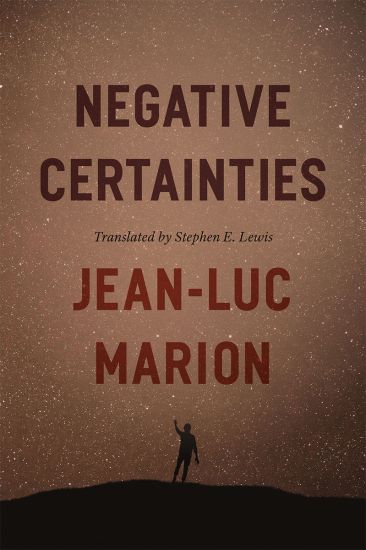
Now in paperback, Jean-Luc Marion's groundbreaking philosophy of human uncertainty. In Negative Certainties, renowned philosopher Jean-Luc Marion challenges some of the most fundamental assumptions we have developed about knowledge: that it is categorical, predicative, and positive. Following Descartes, Kant, and Heidegger, he looks toward our finitude and the limits of our reason. He asks an astonishingly simple—but profoundly provocative—question in order to open up an entirely new way of thinking about knowledge: Isn’t our uncertainty, our finitude, and rational limitations, one of the few things we can be certain about? Marion shows how the assumption of knowledge as positive demands a reductive epistemology that disregards immeasurable or disorderly phenomena. He shows that we have experiences every day that have no identifiable causes or predictable reasons and that these constitute a very real knowledge—a knowledge of the limits of what can be known. Establishing this “negative certainty,” Marion applies it to four aporias, or issues of certain uncertainty: the definition of man; the nature of God; the unconditionality of the gift; and the unpredictability of events. Translated for the first time into English, Negative Certainties is an invigorating work of epistemological inquiry that will take a central place in Marion’s oeuvre.
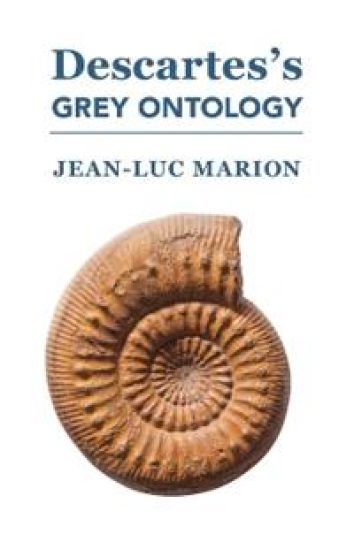
Descartes's Grey Ontology – Cartesian Science and Aristotelian Thought in the Regulae
Jean–luc Marion
ST AUGUSTINE'S PRESS
2022
sidottu

A timely new work by one of France’s premier philosophers, A Brief Apology for a Catholic Moment offers insight into what “catholic” truly means. In this short, accessible book, Jean-Luc Marion braids the sense of catholic as all-embracing and universal into conversation about what it is to be Catholic in the present moment. A Brief Apology for a Catholic Moment tackles complex issues surrounding church-state separation and addresses a larger Catholic audience that transcends national boundaries, social identities, and linguistic differences. Marion insists that Catholic universalism, with its core of communion and community, is not an outmoded worldview, but rather an outlook that has the potential to counter the positivist rationality and nihilism at the core of our current political moment, and can help us address questions surrounding liberalism and religion and what is often presented as tension between “Islam and the West.” As an inviting and sophisticated Catholic take on current political and social realities—realities that are not confined to France alone—A Brief Apology for a Catholic Moment is a valuable contribution to a larger conversation.
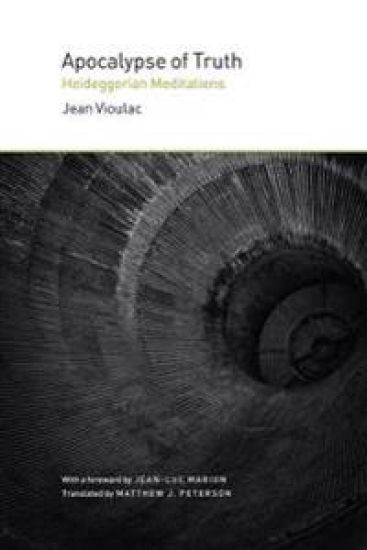
We inhabit a time of crisis—totalitarianism, environmental collapse, and the unquestioned rule of neoliberal capitalism. Philosopher Jean Vioulac is invested in and worried by all of this, but his main concern lies with how these phenomena all represent a crisis within—and a threat to—thinking itself. In his first book to be translated into English, Vioulac radicalizes Heidegger’s understanding of truth as disclosure through the notion of truth as apocalypse. This “apocalypse of truth” works as an unveiling that reveals both the finitude and mystery of truth, allowing a full confrontation with truth-as-absence. Engaging with Heidegger, Marx, and St. Paul, as well as contemporary figures including Giorgio Agamben, Alain Badiou, and Slavoj Žižek, Vioulac’s book presents a subtle, masterful exposition of his analysis before culminating in a powerful vision of “the abyss of the deity.” Here, Vioulac articulates a portrait of Christianity as a religion of mourning, waiting for a god who has already passed by, a form of ever-present eschatology whose end has always already taken place. With a preface by Jean-Luc Marion, Apocalypse of Truth presents a major contemporary French thinker to English-speaking audiences for the first time.
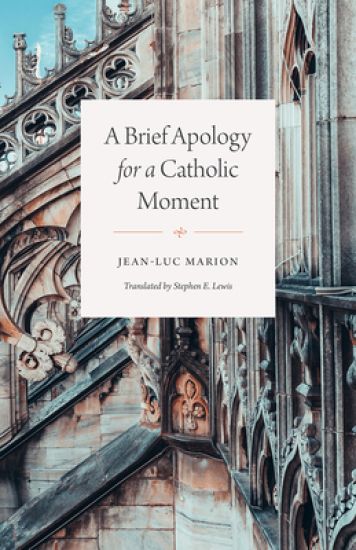
A timely new work by one of France’s premier philosophers, A Brief Apology for a Catholic Moment offers insight into what “catholic” truly means. In this short, accessible book, Jean-Luc Marion braids the sense of catholic as all-embracing and universal into conversation about what it is to be Catholic in the present moment. A Brief Apology for a Catholic Moment tackles complex issues surrounding church-state separation and addresses a larger Catholic audience that transcends national boundaries, social identities, and linguistic differences. Marion insists that Catholic universalism, with its core of communion and community, is not an outmoded worldview, but rather an outlook that has the potential to counter the positivist rationality and nihilism at the core of our current political moment, and can help us address questions surrounding liberalism and religion and what is often presented as tension between “Islam and the West.” As an inviting and sophisticated Catholic take on current political and social realities—realities that are not confined to France alone—A Brief Apology for a Catholic Moment is a valuable contribution to a larger conversation.
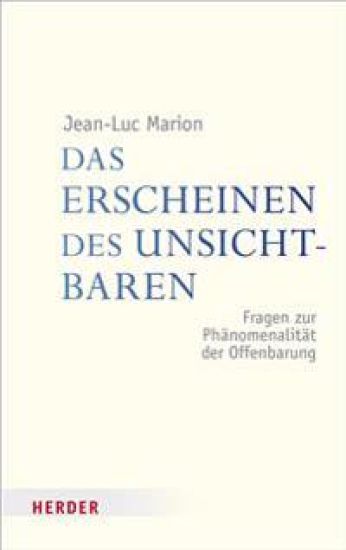
Das Erscheinen Des Unsichtbaren: Fragen Zur Phanomenalitat Der Offenbarung
Jean-Luc Marion
Verlag Herder
2018
nidottu
Am Begriff der Offenbarung scheiden sich Glaube und Vernunft. In beiden geht es um das, was sich in seiner Wahrheit offenbart. Gleichwohl handelt es sich um zwei grundlegend unterschiedene Typen von Offenbarung. Was also sieht und folglich begreift man von dem, was in Glaube und Vernunft zur Erscheinung kommt? Eine Frage, die sich nur im Zuge einer strengen Phanomenologie beantworten lasst.
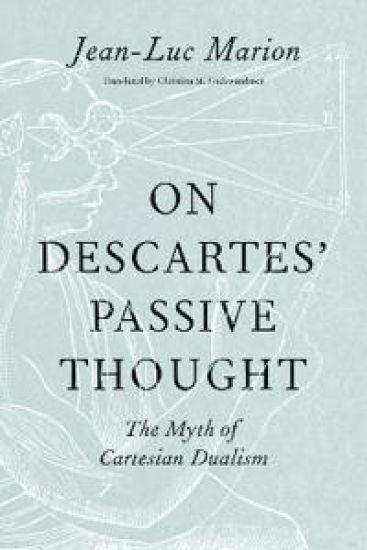
On Descartes’ Passive Thought is the culmination of a life-long reflection on the philosophy of Descartes by one of the most important living French philosophers. In it, Jean-Luc Marion examines anew some of the questions left unresolved in his previous books about Descartes, with a particular focus on Descartes’s theory of morals and the passions. Descartes has long been associated with mind-body dualism, but Marion argues here that this is a historical misattribution, popularized by Malebranche and popular ever since both within the academy and with the general public. Actually, Marion shows, Descartes held a holistic conception of body and mind. He called it the meum corpus, a passive mode of thinking, which implies far more than just pure mind—rather, it signifies a mind directly connected to the body: the human being that I am. Understood in this new light, the Descartes Marion uncovers through close readings of works such as Passions of the Soul resists prominent criticisms leveled at him by twentieth-century figures like Husserl and Heidegger, and even anticipates the non-dualistic, phenomenological concepts of human being discussed today. This is a momentous book that no serious historian of philosophy will be able to ignore.
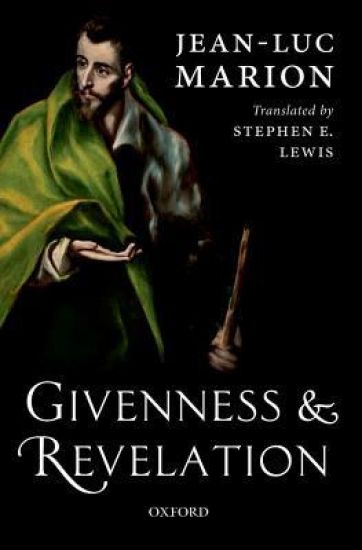
Givenness and Revelation represents both the unity and the deep continuity of Jean-Luc Marions thinking over many decades. This investigation into the origins and evolution of the concept of revelation arises from an initial reappraisal of the tension between natural theology and the revealed knowledge of God or sacra doctrina. Marion draws on the re-definition of the notions of possibility and impossibility, the critique of the reification of the subject, and the unpredictability of the 'event' in its relationship to the phenomenology of the gift. This work begins and ends in the concept of revelation, thus addressing the very heart and soul of Marion's theology, concluding with a phenomenological approach to the Trinity that rests in the Spirit as gift. Givenness and Revelation enhances not only our understanding of religious experience, but enlarges the horizon of possibility of phenomenology itself.

In a series of conversations, Jean-Luc Marion reconstructs a career's path in the history of philosophy, theology, and phenomenology. Discussing such concepts as the event, the gift, and the saturated phenomenon, Marion elaborates the rigor displayed by the things themselves. He discusses the major stages of his work and offers his views on the forces that have driven his thought. The conversation ranges from Marion's engagement with Descartes, to phenomenology and theology, to Marion's intellectual and biographical backgrounds, concluding with illuminating insights on the state of the Catholic Church today and on Judeo-Christian dialogue. Marion also reflects on the relationship of philosophy to history, theology, aesthetics, and literature. At the same time, the book provides an account of French intellectual life in the late twentieth century. In these interviews, Marion's language is more conversational than in his formal writing, but it remains serious and substantive. The book serves as an excellent and comprehensive introduction to Marion's thought and work.

In a series of conversations, Jean-Luc Marion reconstructs a career’s path in the history of philosophy, theology, and phenomenology. Discussing such concepts as the event, the gift, and the saturated phenomenon, Marion elaborates the rigor displayed by the things themselves. He discusses the major stages of his work and offers his views on the forces that have driven his thought. The conversation ranges from Marion’s engagement with Descartes, to phenomenology and theology, to Marion’s intellectual and biographical backgrounds, concluding with illuminating insights on the state of the Catholic Church today and on Judeo-Christian dialogue. Marion also reflects on the relationship of philosophy to history, theology, aesthetics, and literature. At the same time, the book provides an account of French intellectual life in the late twentieth century. In these interviews, Marion’s language is more conversational than in his formal writing, but it remains serious and substantive. The book serves as an excellent and comprehensive introduction to Marion’s thought and work.