Kirjailija
Jean-Luc Nancy
Kirjat ja teokset yhdessä paikassa: 124 kirjaa, julkaisuja vuosilta 1988-2025, suosituimpien joukossa Nus Sommes (La Peau Des Images). Vertaile teosten hintoja ja tarkista saatavuus suomalaisista kirjakaupoista.
Mukana myös kirjoitusasut: Jean–luc Nancy
124 kirjaa
Kirjojen julkaisuhaarukka 1988-2025.
In the past, pandemics were considered divine punishment, but we now understand the biological characteristics of viruses and we know they are spread through social interaction. What used to be divine has become human – all too human, as Nietzsche would say. But while the virus dispels the divine, we are discovering that living beings are more complex and harder to define than we had previously imagined, and also that political power is more complex than we may have thought. And this, argues Nancy, helps us to see why the term ‘biopolitics’ fails to grasp the conditions in which we now find ourselves. Life and politics challenge us together. Our scientific knowledge tells us that we are dependent only on our own technical power, but can we rely on technologies when knowledge itself includes uncertainties? If this is the case for technical power, it is much more so for political power, even when it presents itself as guided by objective data. The virus is a magnifying glass that reveals the contradictions, limitations and frailties of the human condition, calling into question as never before our stubborn belief in progress and our hubristic sense of our own indestructibility as a species.
Certain philosophers of Antiquity compared the world to a large animal; but if the world were an animal, it would have a skin similar to the skin that envelops each living being and gives it unity. The world is neither an animal nor a machine but an interminable jumble whose destination is nothing other than the maelstrom in which the very idea of the world slips away. The world has no skin other than the turbulence that makes histories, customs, moments of grandeur and decadence. Because it is not a skin, this extension of space-time is much more fragile than the skins that are already always fragile, because everything here touches its extremities. The world is everything that passes between us – ourselves and everything that happens to us, everything that becomes of our contacts, our gazes, our movements; and through referrals from skin to skin, from the fleeting to the immemorial, you reach, without even knowing it, the entire actuality of the world: the act of its existence. This act is made up of works and disasters, splendours, horrors, and catastrophes. As long as it is ours, it is the act of an infinite emergence that is all the sense there is: a sense that incessantly goes from skin to skin and is itself never enveloped by anything. The texts in this volume are all oriented by the concern for what is currently happening to us – we, late humanoids – when we arrive at an extremity of our history, whether this extremity should turn out to be a stage, a rupture, or quite simply a last breath.
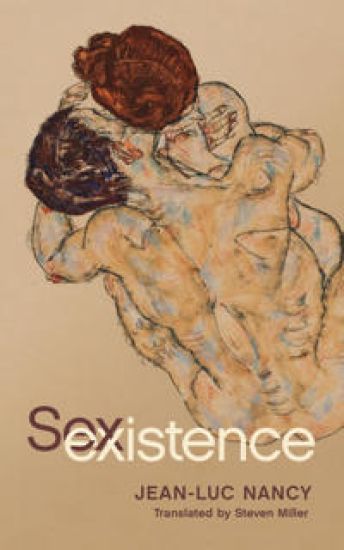
Sex, more than just a part of our experience, troubles our conceptions of existence. Drawing on a fascinating array of sources, ancient and modern, philosophical and literary, Jean-Luc Nancy explores and upholds the form-giving thrust of the drive. Nancy reminds us that we are more comfortable with the drama of prohibitions, ideals, repression, transgression, and destruction, which often hamper thinking about sex and gender, than with the affirmation of an originary trouble at the limits of language that divides being and opens the world. Sexistence develops a new philosophical account of sexuality that resonates with contemporary research on gender and biopolitics. Without attempting to be comprehensive, the book ranges from the ancient world through psychoanalysis to discover the turbulence of the drive at the heart of existence.
Sciamiricerche, n°9, 04/2021 (issn 2532-3830 / isbn 9788894559521)
Marcella Scopelliti; Scopelliti Furquim Werneck Lima; Jean-Luc Nancy
Sciami Edizioni
2021
pokkari
Abbiamo concepito il progetto di questo numero di Sciamiricerche all'inizio dell'estate 2020, un momento in cui i nostri vissuti erano carichi dell'esperienza e delle implicazioni imposte dall'emergenza "Covid", sollecitati a reagire ma anche disorientati da quotidiani interrogativi sulle nostre esistenze; e inevitabilmente sul senso del nostro quotidiano agire entro la dimensione estetica.La proposta giunta da Valentina Valentini di pensare a un numero di Sciami dedicato alla Luce stata l'occasione per riunire voci diverse, orchestrate su motivi consonanti. Le questioni chiamate in causa, sentite prima ancor che pensate, evidenziavano qualit sostanziali dell'evento performativo, i suoi elementi imprescindibili: la condivisione di uno spazio fisico, il respiro comune di una collettivit , la percezione e la sensorialit come ineludibili premesse di ogni evento spettacolare; a contrario, il momento faceva emergere punti critici di un sistema privo di equilibri e di strategie d'orchestrazione, portava a riflettere sulla natura dei teatri... Si evidenziava la continuit esistente tra la dimensione del quotidiano, lo stare dei corpi in un ambiente fisico abitato da altre presenze e la condivisione di uno spazio in un contesto performativo; spazio sempre pervaso da sostanza luminosa anche nella forma dell'oscurit e del buio. La luce fattore essenziale in tutte queste dinamiche, di apertura, di coesione, di isolamento.Nell'invito a contribuire, abbiamo proposto alcune "parole chiave", nelle loro relazioni con la luce, delle coordinate di orientamento nel percorso da costruire insieme per questo numero monografico di Sciami: spazio, condivisione, separazione, aria, gas, atmosfera, sfera, materialit della luce atmosferica, buio.
In Doing, Jean-Luc Nancy, one of the most prominent and lucid articulators of contemporary French theory and philosophy, examines the precarious but urgent relationship between being and doing. His book is not so much a call to action as a summons to more vigorous thinking, the examination and reflection that must precede any effective action. The first section of the book considers this matter tersely: Jean-Luc Nancy’s quickness of language and grace of humor lead the reader carefully past the dangers of oversimplification, toward a general awareness of meaningful being. In the last section, Nancy examines the realities of terrorist actions—specifically those that shocked Paris a few years ago, and more generally the frightening world of politics without conscience, where conscience is the root of all thinking.
Jean-Luc Nancy on yksi ranskalaisen nykyfilosofian ja dekonstruktion perinteen merkittävimmistä nimistä. Singulaarinen pluraalinen oleminen on kunnianhimoinen ontologinen tutkielma, joka pyrkii ajattelemaan uudestaan Martin Heideggerin Olemisessa ja ajassa esittämää olemiskysymystä lähtien liikkeelle ajan sijaan tilasta ja Daseinin sijaan kanssaolemisesta. Nancyn kantava teesi on, että oleminen on lähtökohtaisesti olemista yhdessä, kanssaolemista: “kanssa” ei ole pelkkä lisäys olemiseen vaan jotain, mikä tekee olemisen.Kanssaoleminen on mahdollista vain, kun kaikki olevat jakavat olemisen ja ovat kuitenkin ainutkertaisia ja moninaisia - singulaarisia ja pluraalisia. Tästä seuraa, että ontologia on Nancylle väistämättä myös etiikkaa.Singulaarinen pluraalinen oleminen jatkaa Nancyn ajattelulle ominaista pyrkimystä ajatella yhdessäoloa, yhteisöä ja itseyttä identiteetin jaautenttisuuden kategorioiden ulkopuolella. Teos sisältää yhteensä viisi esseetä, joissa Nancy tarjoaa uusia tapoja ajatella muun muassa valtiollista suvereeniutta, sotaa, tekniikkaa, monikulttuurisuutta sekä globaalia maailmanjärjestystä ja sen edellyttämää globaalia vastuuta.
Immortelle finitude – Sexualité et philosophie
Jean–luc Nancy; Mehdi Belhaj Kacem
Diaphanes
2020
nidottu
Prolongement d' tre et sexuation de Mehdi Belhaj Kacem (2014) et Sexistence de Jean-Luc Nancy (2017), cette premi re conversation entre les deux auteurs - appartenant des g n rations diff rentes - et la jeune crivaine Rapha lle Milone convoque la question de la sexualit et de la philosophie aussi bien au travers des concepts fondateurs de l'histoire de la philosophie que des pratiques les plus contemporaines de la sexualit , dans un dialogue vif et naturel rappelant Le Banquet de Platon. En suivant le mod le encyclop dique de l'entretien con u comme un fructueux change d'id es, ces conversations ( Sexe et V rit , Sexe et Appropriation , D sir et Jouissance ) dessinent un paysage de trajectoires, de pens es, de r cits qui produisent autant de d bats anim s et amus s entre deux philosophes sur leur vision de la sexualit , sa nature, sa d finition, et sur les liens entre philosophie et sexualit - D bats auxquels il faut laisser la chance de se reprendre ailleurs, plus tard, par d'autres ou par nous-m mes devenus autres .
Gandhi and Philosophy presents a breakthrough in philosophy by foregrounding modern and scientific elements in Gandhi’s thought, animating the dazzling materialist concepts in his writings and opening philosophy to the new frontier of nihilism. This scintillating work breaks with the history of Gandhi scholarship, removing him from the postcolonial and Hindu-nationalist axis and disclosing him to be the enemy that the philosopher dreads and needs. Naming the congealing systematicity of Gandhi’s thoughts with the Kantian term hypophysics, Mohan and Dwivedi develop his ideas through a process of reason that awakens the possibilities of concepts beyond the territorial determination of philosophical traditions. The creation of the new method of criticalisation - the augmentation of critique - brings Gandhi’s system to its exterior and release. It shows the points of intersection and infiltration between Gandhian concepts and such issues as will, truth, violence, law, anarchy, value, politics and metaphysics and compels us to imagine Gandhi’s thought anew.
Why does anti-Semitism seem to be so deeply engrained in our societies, our institutions and our attitudes? To answer this question we need to look beyond our current practices and see that anti-Semitism has much deeper roots – that it is woven into the very structures of Western thought. Jean-Luc Nancy argues that anti-Semitism emerged from the conflictual conjunction of two responses to the eclipse of archaic cultures. The Greek and the Jewish responses both affirmed a humanity freed from myth but put forward two very different conceptions of autonomy: on the one hand, the infinite autonomy of knowledge, of logos, and on the other, the paradoxical autonomy of a heteronomy guided by a hidden god. The first excluded the second while simultaneously absorbing and dominating it; the second withdrew into itself and its condition of exclusion and domination. How could the long and terrible history of the hatred of the Jew, masking a self-loathing, be generated by these intrinsically contradictory beginnings? That is the question to which this short book gives a compelling answer.
SPECTRES II RESONANCES
Maryanne Amacher; Chris Corsano; Ellen Fullman; Christina Kubisch; Okkyung Lee; Pali Meursault; Jean-Luc Nancy; David Rosenboom; Tomoko Sauvage; The Caretaker; David Toop
Shelter Press
2020
nidottu
Edited by Angela Condello, Carlo Grassi and Andreas Philippopoulos-Mihalopoulos With an introduction by Carlo GrassiTranslated by Cadenza Academic Translations and Angela CondelloWhat does it mean to judge when there is no general and universal norm to define what is right and what is wrong? Can laws be absent and is law always necessary? This is the first English translation published of Jean- Luc Nancy’s acclaimed consideration of the law’s most pervasive principles in the context of actual systems and contemporary institutions, power, norms, laws. In a world where it is impossible to imagine the realisation of an ideal of justice that corresponds to every person’s ideal of justice, Nancy probes the limits of legal normativity. Moreover, the question is asked: how can legal normativity be legitimised? A legal order based on performativity and formal validity is questionable and other forces than juridical normativity are at the heart of Dies Irae. Such leads inevitably to the processes of inclusion and exclusion that characterise contemporary juridical systems and those issues of identity, hostility and self-representation central to contemporary political and legal debates
Et vigtigt indlæg i debatten om Heidegger og nazismen. Bogen indledes og er oversat af Søren Gosvig Olesen.Diskussionen om Heidegger og nazismen dukker op med jævne mellemrum – senest med baggrund i offentliggørelsen af de notesbøger, der efter farven på omslaget benævnes »de sorte hæfter«. Det er der, Heidegger mest udførligt har begrundet sin tilslutning til nazismen. Det er også der, hvor han mest eftertrykkeligt kritiserer nazismen. Og det er der, hvor han trods sin nazikritik formulerer en slags metafysisk antisemitisme.Jean-Luc Nancys indlæg i diskussionen udmærker sig ved at rumme mere end en mening om Heidegger, nemlig en læsning af Heidegger. Nancy forholder sig til sagen som filosof. Men han forholder sig også til, hvad der sker, når en filosof tilslutter sig en mening, som de fleste andre omkring ham også havde.
The concept of community is tainted by the events of the twentieth century, frequently appropriated by totalitarian regimes for the purposes of exclusion and oppression. In this dialogue with Peter Engelmann, philosopher Jean-Luc Nancy attempts to reframe community as central to a reconceptualization of politics and democracy. Observing that all our interactions are in some way shared experiences, Nancy demonstrates that a common sense of life precedes our existence as individuals: we can only truly make sense of life in a plurality. Democracy is typically concerned with establishing political unity, yet its greater task lies in community: creating a space in which sense can realize itself and circulate. This conversation with one of France’s foremost thinkers will be of great interest to all readers of contemporary philosophy and political theory.
Gandhi and Philosophy presents a breakthrough in philosophy by foregrounding modern and scientific elements in Gandhi’s thought, animating the dazzling materialist concepts in his writings and opening philosophy to the new frontier of nihilism. This scintillating work breaks with the history of Gandhi scholarship, removing him from the postcolonial and Hindu-nationalist axis and disclosing him to be the enemy that the philosopher dreads and needs. Naming the congealing systematicity of Gandhi’s thoughts with the Kantian term hypophysics, Mohan and Dwivedi develop his ideas through a process of reason that awakens the possibilities of concepts beyond the territorial determination of philosophical traditions. The creation of the new method of criticalisation - the augmentation of critique - brings Gandhi’s system to its exterior and release. It shows the points of intersection and infiltration between Gandhian concepts and such issues as will, truth, violence, law, anarchy, value, politics and metaphysics and compels us to imagine Gandhi’s thought anew.