Kirjailija
Jean-Luc Nancy
Kirjat ja teokset yhdessä paikassa: 124 kirjaa, julkaisuja vuosilta 1988-2025, suosituimpien joukossa Nus Sommes (La Peau Des Images). Vertaile teosten hintoja ja tarkista saatavuus suomalaisista kirjakaupoista.
Mukana myös kirjoitusasut: Jean–luc Nancy
124 kirjaa
Kirjojen julkaisuhaarukka 1988-2025.
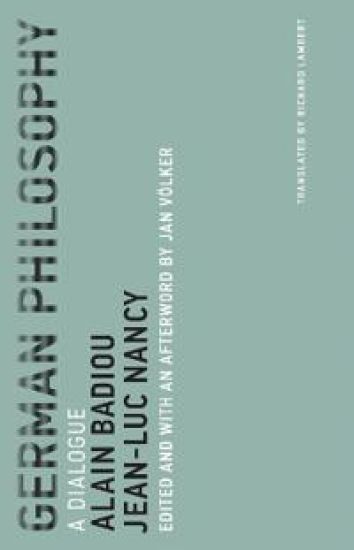
Two eminent French philosophers discuss German philosophy-including the legacy of Kant, Hegel, Nietzsche, Adorno, Fichte, Marx, and Heidegger-from a French perspective.In this book, Alain Badiou and Jean-Luc Nancy, the two most important living philosophers in France, discuss German philosophy from a French perspective. Written in the form of a dialogue, and revised and expanded from a 2016 conversation between the two philosophers at the Universitat der Kunste Berlin, the book offers not only Badiou's and Nancy's reinterpretations of German philosophers and philosophical concepts, but also an accessible introduction to the greatest thinkers of German philosophy. Badiou and Nancy discuss and debate such topics as the legacies of Kant, Hegel, and Marx, as well as Nietzsche, Adorno, Fichte, Schelling, and the unavoidable problem of Heidegger and Nazism. The dialogue is contentious, friendly, and often quotable, with strong-at times passionate-positions taken by both Badiou and Nancy, who find themselves disagreeing over Kant, for example, and in unexpected agreement on Marx, for another.What does it mean, then, to conduct a dialogue on German philosophy from a French perspective? As volume editor Jan Voelker observes, "German philosophy" and "French philosophy" describe complex constellations that, despite the reference to nation-states and languages, above all encompass shared concepts and problems-although these take a range of forms. Perhaps they can reveal their essential import only in translation.
This book examines the practice of portraits as a way in to grasping the paradoxes of subjectivity. To Nancy, the portrait is suspended between likeness and strangeness, identity and distance, representation and presentation, exactitude and forcefulness. It can identify an individual, but it can also express the dynamics by means of which its subject advances and withdraws. The book consists of two extended essays written a decade apart but in close conversation, in which Nancy considers the range of aspirations articulated by the portrait. Heavily illustrated, it includes a newly written preface bringing the two essays together and a substantial Introduction by Jeffrey Librett, which places Nancy's work within the range of thinking of aesthetics and the subject, from religion, to aesthetics, to psychoanalysis. Though undergirded by a powerful grasp of the philosophical and psychoanalytic tradition that has rendered our sense of the subject so problematic, Nancy's book is at heart a delightful, unpretentious reading of three dozen portraits, from ancient drinking mugs to recent experimental or parodic pieces in which the artistic representation of a sitter is made from their blood, germ cultures, or DNA. The contemporary world of ubiquitous photos, Nancy argues, in no way makes the portrait a thing of the past. On the contrary, the forms of appearing that mark the portrait continue to challenge how we see the bodies and representations that dominate our world.
This book examines the practice of portraits as a way in to grasping the paradoxes of subjectivity. To Nancy, the portrait is suspended between likeness and strangeness, identity and distance, representation and presentation, exactitude and forcefulness. It can identify an individual, but it can also express the dynamics by means of which its subject advances and withdraws. The book consists of two extended essays written a decade apart but in close conversation, in which Nancy considers the range of aspirations articulated by the portrait. Heavily illustrated, it includes a newly written preface bringing the two essays together and a substantial Introduction by Jeffrey Librett, which places Nancy’s work within the range of thinking of aesthetics and the subject, from religion, to aesthetics, to psychoanalysis. Though undergirded by a powerful grasp of the philosophical and psychoanalytic tradition that has rendered our sense of the subject so problematic, Nancy’s book is at heart a delightful, unpretentious reading of three dozen portraits, from ancient drinking mugs to recent experimental or parodic pieces in which the artistic representation of a sitter is made from their blood, germ cultures, or DNA. The contemporary world of ubiquitous photos, Nancy argues, in no way makes the portrait a thing of the past. On the contrary, the forms of appearing that mark the portrait continue to challenge how we see the bodies and representations that dominate our world.
Von einer Gemeinschaft, die sich nicht verwirklicht
Jean-Luc Nancy
Turia + Kant, Verlag
2018
nidottu
Expectation is a major volume of Jean-Luc Nancy's writings on literature, written across three decades but, for the most part, previously unavailable in English. More substantial than literary criticism, these essays collectively negotiate literature's relation to philosophy. Nancy pursues such questions as literature's claims to truth, the status of narrative, the relation of poetry and prose, and the unity of a book or of a text, and he addresses a number of major European writers, including Dante, Sterne, Rousseau, Hölderlin, Proust, Joyce, and Blanchot. The final section offers a number of impressive pieces by Nancy that completely merge his concerns for philosophy and literature and philosophy-as-literature. These include a lengthy parody of Valéry's "La Jeune Parque," several original poems by Nancy, and a beautiful prose-poetic discourse on an installation by Italian artist Claudio Parmiggiani that incorporates the Faust theme. Opening with a substantial Introduction by Jean-Michel Rabaté that elaborates Nancy's importance as a literary thinker, this book constitutes the most substantial statement to date by one of today's leading philosophers on a discipline that has been central to his work across his career.
Expectation is a major volume of Jean-Luc Nancy’s writings on literature, written across three decades but, for the most part, previously unavailable in English. More substantial than literary criticism, these essays collectively negotiate literature’s relation to philosophy. Nancy pursues such questions as literature’s claims to truth, the status of narrative, the relation of poetry and prose, and the unity of a book or of a text, and he addresses a number of major European writers, including Dante, Sterne, Rousseau, Hölderlin, Proust, Joyce, and Blanchot. The final section offers a number of impressive pieces by Nancy that completely merge his concerns for philosophy and literature and philosophy-as-literature. These include a lengthy parody of Valéry’s “La Jeune Parque,” several original poems by Nancy, and a beautiful prose-poetic discourse on an installation by Italian artist Claudio Parmiggiani that incorporates the Faust theme. Opening with a substantial Introduction by Jean-Michel Rabaté that elaborates Nancy’s importance as a literary thinker, this book constitutes the most substantial statement to date by one of today’s leading philosophers on a discipline that has been central to his work across his career.
The Possibility of a World
Jean-Luc Nancy; Pierre-Philippe Jandin
Fordham University Press
2017
pokkari
In this series of interviews, Jean-Luc Nancy reviews his life's work. But like Schlegel's historian—"a prophet facing backwards"—Nancy takes this opportunity to rummage through the history of art, philosophy, religion, and politics in search of new possibilities that remain to be thought. This journey through Nancy's thought is interspersed with accounts of places and events and deeply personal details. The result is at once unpretentious and encyclopedic: Concepts are described with remarkable nuance and specificity, but in a language that comes close to that of everyday life. As Nancy surveys his work, he thinks anew about democracy, community, jouissance, love, Christianity, and the arts. In the end, this is a book about the possibility of a world—a world that must be greeted because it is, as Nancy says, already here.
The Possibility of a World
Jean-Luc Nancy; Pierre-philippe Jandin
Fordham University Press
2017
sidottu
In this series of interviews, Jean-Luc Nancy reviews his life's work. But like Schlegel's historian—"a prophet facing backwards"—Nancy takes this opportunity to rummage through the history of art, philosophy, religion, and politics in search of new possibilities that remain to be thought. This journey through Nancy's thought is interspersed with accounts of places and events and deeply personal details. The result is at once unpretentious and encyclopedic: Concepts are described with remarkable nuance and specificity, but in a language that comes close to that of everyday life. As Nancy surveys his work, he thinks anew about democracy, community, jouissance, love, Christianity, and the arts. In the end, this is a book about the possibility of a world—a world that must be greeted because it is, as Nancy says, already here.
Heidegger and Nazism: Ever since the philosopher's public involvement in state politics in 1933, his name has necessarily been a part of this unsavory couple. After the publication in 2014 of the private Black Notebooks, it is now unambiguously part of another: Heidegger and anti-Semitism. What do we learn from analyzing the anti-Semitism of these private writings, together with its sources and grounds, not only for Heidegger's thought, but for the history of the West in which this thought is embedded? Jean-Luc Nancy poses these questions with the depth and rigor we would expect from him. In doing so, he does not go lightly on Heidegger, in whom he finds a philosophical and "historial" anti-Semitism, outlining a clash of "peoples" that must at all costs arrive at "another beginning." If Heidegger's uncritical acceptance of prejudices and long-debunked myths about "world Jewry" shares in the "banality" evoked by Hannah Arendt, this does nothing to lessen the charge. Nancy's purpose, however, is not simply to condemn Heidegger but rather to invite us to think something to which the thinker of being remained blind: anti-Semitism as a self-hatred haunting the history of the West—and of Christianity in its drive toward an auto-foundation that would leave behind its origins in Judaism.
Coming is a lyrical, erudite examination of the French notion of jouissance. How did jouissance evolve from referring to the pleasure of possessing a material thing (property, wealth) to the pleasure of orgasm, from appropriation to dis-appropriation, from consumption to consummation? The philosophers Adèle van Reeth and Jean-Luc Nancy engage in a lively dialogue, ranging from consumerism to video games to mysticism and from Spinoza, Hegel, andAugustine to the Marquis de Sade, Marguerite Duras, and Henry Miller. Four additional essays are new to the American edition.
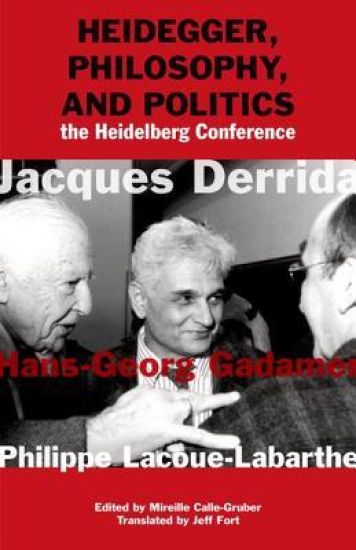
Heidegger, Philosophy, and Politics
Jacques Derrida; Hans-Georg Gadamer; Philippe Lacoue-Labarthe; Jean-Luc Nancy
Fordham University Press
2016
pokkari
In February 1988, philosophers Jacques Derrida, Hans-Georg Gadamer, and Philippe Lacoue-Labarthe came together in Heidelberg before a large audience to discuss the philosophical and political implications of Martin Heidegger's thought. This event took place in the very amphitheater in which, more than fifty years earlier, Heidegger, as rector of the University of Freiburg and a member of the Nazi Party, had given a speech entitled "The University in the New Reich." Heidegger's involvement in Nazism has always been, and will remain, an indelible scandal, but what is its real relation to his work and thought? And what are the responsibilities of those who read this work, who analyze and elaborate this thought? Conversely, what is at stake in the wholesale dismissal of this important but compromised twentieth-century philosopher? In 1988, in the wake of the recent publication of Victor Farias's Heidegger and Nazism, and of the heated debates that ensued, these questions had become more pressing than ever. The reflections presented by three of the most prominent of Heidegger's readers, improvised in French and transcribed here, were an attempt to approach these questions before a broad public, but with a depth of knowledge and a complex sense of the questions at issue that have been often lacking in the press. Ranging over two days and including exchanges with one another and with the audience, the discussions pursued by these major thinkers remain highly relevant today, especially following the publication of Heidegger's already notorious "Black Notebooks," which have added another chapter to the ongoing debates over this contested figure. The present volume recalls a highly charged moment in this history, while also drawing the debate toward its most essential questions.
Heidegger, Philosophy, and Politics
Jacques Derrida; Hans-Georg Gadamer; Philippe Lacoue-Labarthe; Jean-Luc Nancy
Fordham University Press
2016
sidottu
In February 1988, philosophers Jacques Derrida, Hans-Georg Gadamer, and Philippe Lacoue-Labarthe came together in Heidelberg before a large audience to discuss the philosophical and political implications of Martin Heidegger's thought. This event took place in the very amphitheater in which, more than fifty years earlier, Heidegger, as rector of the University of Freiburg and a member of the Nazi Party, had given a speech entitled "The University in the New Reich." Heidegger's involvement in Nazism has always been, and will remain, an indelible scandal, but what is its real relation to his work and thought? And what are the responsibilities of those who read this work, who analyze and elaborate this thought? Conversely, what is at stake in the wholesale dismissal of this important but compromised twentieth-century philosopher? In 1988, in the wake of the recent publication of Victor Farias's Heidegger and Nazism, and of the heated debates that ensued, these questions had become more pressing than ever. The reflections presented by three of the most prominent of Heidegger's readers, improvised in French and transcribed here, were an attempt to approach these questions before a broad public, but with a depth of knowledge and a complex sense of the questions at issue that have been often lacking in the press. Ranging over two days and including exchanges with one another and with the audience, the discussions pursued by these major thinkers remain highly relevant today, especially following the publication of Heidegger's already notorious "Black Notebooks," which have added another chapter to the ongoing debates over this contested figure. The present volume recalls a highly charged moment in this history, while also drawing the debate toward its most essential questions.
Over thirty years after Maurice Blanchot writes The Unavowable Community (1983)—a book that offered a critical response to an early essay by Jean-Luc Nancy on "the inoperative community"—Nancy responds in turn with The Disavowed Community. Stemming from Jean-Christophe Bailly's initial proposal to think community in terms of "number" or the "numerous," and unfolding as a close reading of Blanchot's text, Nancy's new book addresses a range of themes and motifs that mark both his proximity to and distance from Blanchot's thinking, from Bataille's "community of lovers" to the relation between community, communitarianism, and being-in-common; to Marguerite Duras, to the Eucharist. A key rethinking of politics and the political, this exchange opens up a new understanding of community played out as a question of avowal.
No longer able to read community in terms colored by a romantic nostalgia for homogeneity, closeness and sameness, or the myth of rational choice, we nevertheless face an imperative to think the common. The prominent scholars assembled here come together to articulate community while thinking seriously about the tropes, myths, narratives, metaphors, conceits, and shared cultural texts on which any such articulation depends. The result is a major contribution to literary theory, postcolonialism, philosophy, political theory, and sociology.