Kirjojen hintavertailu. Mukana 12 209 549 kirjaa ja 12 kauppaa.

Kirjailija

Joel Spring

Kirjat ja teokset yhdessä paikassa: 54 kirjaa, julkaisuja vuosilta 1996-2026, suosituimpien joukossa The American School. Vertaile teosten hintoja ja tarkista saatavuus suomalaisista kirjakaupoista.

54 kirjaa

Kirjojen julkaisuhaarukka 1996-2026.

Pedagogies of Globalization

Pedagogies of Globalization

Joel Spring

Routledge Member of the Taylor and Francis Group
2006
sidottu
In this ground-breaking book, Joel Spring examines globalization and its worldwide effects on education. A central thesis is that industrial-consumerism is the dominant paradigm in the integration of education and economic planning in modern economic security states.In the twenty-first century, national school systems have similar grades and promotion plans, instructional methods, curriculum organization, and linkages between secondary and higher education. Although there are local variations, the most striking feature is the sameness of educational systems. How did this happen? How was education globalized? Spring explains and analyzes this phenomenon and its consequences for human life and the future improvement of social and economic organizations. Central themes include:*the elements of the educational security state and the industrial-consumer paradigm in relationship to classical forms of education such as Confucianism, Islam, and Christianity, and their concerns with creating a just and ethical society;*the role of the 'other' in the globalization of educational structures as international military and economic rivalries spark competition between educational systems;*the transition from the Confucian village school to Western forms of education as exemplified in the lives of Ho Chi Minh and Mao Zedong;*the effect of the cultural and economic rivalry between the Soviet Union and the United States and its impact on schooling in both countries;*the rise of the educational security state in China, the Soviet Union, and the United States as these countries focus their educational efforts on military and economic development;*the evolution of progressive education as it appeared in revolutionary movements in South America, Cuba, Nicaragua, and El Salvador;*the transition from traditional to Westernized forms of Islamic education against the background of European imperialism, Arab nationalism and wars of liberation, and the uneasy tension between Western educational ideals and Islamic religious values;*socialist education in the Democratic People's Republic of Korea;*current developments in educational security states such as China, Japan, the United States, the new Russia, and the European Union; and*the consequences of English as the global language and the global spread of the industrial-consumer paradigm.Readership for this book includes scholars and students in comparative, international, and multicultural education; educational policy and politics; historical, social, and philosophical foundations of education; and curriculum studies. It is a particularly timely, informative, engaging text for courses in all of these areas.
Pedagogies of Globalization

Pedagogies of Globalization

Joel Spring

Routledge Member of the Taylor and Francis Group
2006
nidottu
In this ground-breaking book, Joel Spring examines globalization and its worldwide effects on education. A central thesis is that industrial-consumerism is the dominant paradigm in the integration of education and economic planning in modern economic security states.In the twenty-first century, national school systems have similar grades and promotion plans, instructional methods, curriculum organization, and linkages between secondary and higher education. Although there are local variations, the most striking feature is the sameness of educational systems. How did this happen? How was education globalized? Spring explains and analyzes this phenomenon and its consequences for human life and the future improvement of social and economic organizations. Central themes include:*the elements of the educational security state and the industrial-consumer paradigm in relationship to classical forms of education such as Confucianism, Islam, and Christianity, and their concerns with creating a just and ethical society;*the role of the 'other' in the globalization of educational structures as international military and economic rivalries spark competition between educational systems;*the transition from the Confucian village school to Western forms of education as exemplified in the lives of Ho Chi Minh and Mao Zedong;*the effect of the cultural and economic rivalry between the Soviet Union and the United States and its impact on schooling in both countries;*the rise of the educational security state in China, the Soviet Union, and the United States as these countries focus their educational efforts on military and economic development;*the evolution of progressive education as it appeared in revolutionary movements in South America, Cuba, Nicaragua, and El Salvador;*the transition from traditional to Westernized forms of Islamic education against the background of European imperialism, Arab nationalism and wars of liberation, and the uneasy tension between Western educational ideals and Islamic religious values;*socialist education in the Democratic People's Republic of Korea;*current developments in educational security states such as China, Japan, the United States, the new Russia, and the European Union; and*the consequences of English as the global language and the global spread of the industrial-consumer paradigm.Readership for this book includes scholars and students in comparative, international, and multicultural education; educational policy and politics; historical, social, and philosophical foundations of education; and curriculum studies. It is a particularly timely, informative, engaging text for courses in all of these areas.
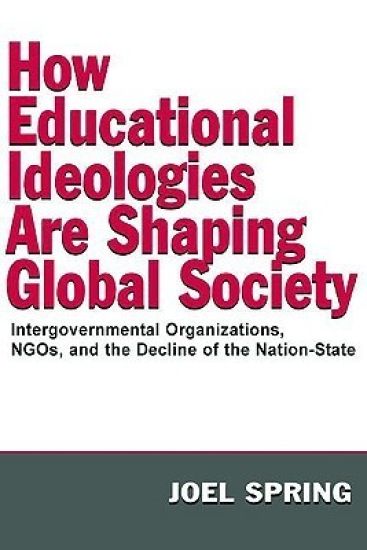
How Educational Ideologies Are Shaping Global Society

How Educational Ideologies Are Shaping Global Society

Joel Spring

Routledge Member of the Taylor and Francis Group
2004
nidottu
In this book Joel Spring explores three major international educational ideologies that are shaping global society: neo-liberal educational ideology, human rights education, and environmentalism. Neo-liberal ideology reflects a rethinking of nationalist forms of education as the nation-state slowly erodes under the power of a growing global civil society. Traditional nationalist education attempts to mold loyal and patriotic citizens who are emotionally attached to symbols of the state, whereas the goal of neo-liberal educational ideology is to change nationalist education to serve the needs of the global economy. These changes are fueling a clash between the ideas of free-market and consumer-based neo-liberals and those of human rights and environmental educators. Human rights education is concerned with creating activist global citizens. It is rooted in the idea that inherent in human rights doctrines is a collective responsibility to ensure the rights of all people. Environmentalism is the most radical of the ideologies because it rejects the industrial and consumerist paradigm that has dominated most economic thought, including capitalism and communism. Spring synthesizes and analyzes the effect of these educational ideologies on shaping the future of the global society. In the concluding section, he compares the effect of these ideologies on global society with the possibility of a world divided between conflicting civilizations. How Educational Ideologies Are Shaping Global Society: Intergovernmental Organizations, NGOs, and the Decline of the Nation-State features: *a critical exploration of the transition of schooling from a function of the nation-state to a globalized economic and political system; *a discussion of the major organizations and trading blocs shaping the future globalization of educational policies; *an analysis of the major competing global ideologies of education--including national and corporate models that emphasize training workers for a competitive global free market; the worldwide network of human rights and peace educators who are teaching a global set of ethics; and the environmental movement's efforts to create a common set of educational standards for sustainable development and sustainable consumption; and *an exploration of the possible future of global educational policy and school organizations. By integrating a wide range of previously scattered information within a bold new framework for understanding educational ideologies and their impact on the global society, Spring raises important questions for researchers, professionals, and students in history and philosophy of education, educational policy, educational studies, comparative education, multicultural education, curriculum studies, critical media studies, global studies, human rights education, and related areas.
How Educational Ideologies Are Shaping Global Society

How Educational Ideologies Are Shaping Global Society

Joel Spring

Routledge Member of the Taylor and Francis Group
2004
sidottu
In this book Joel Spring explores three major international educational ideologies that are shaping global society: neo-liberal educational ideology, human rights education, and environmentalism. Neo-liberal ideology reflects a rethinking of nationalist forms of education as the nation-state slowly erodes under the power of a growing global civil society. Traditional nationalist education attempts to mold loyal and patriotic citizens who are emotionally attached to symbols of the state, whereas the goal of neo-liberal educational ideology is to change nationalist education to serve the needs of the global economy. These changes are fueling a clash between the ideas of free-market and consumer-based neo-liberals and those of human rights and environmental educators. Human rights education is concerned with creating activist global citizens. It is rooted in the idea that inherent in human rights doctrines is a collective responsibility to ensure the rights of all people. Environmentalism is the most radical of the ideologies because it rejects the industrial and consumerist paradigm that has dominated most economic thought, including capitalism and communism. Spring synthesizes and analyzes the effect of these educational ideologies on shaping the future of the global society. In the concluding section, he compares the effect of these ideologies on global society with the possibility of a world divided between conflicting civilizations. How Educational Ideologies Are Shaping Global Society: Intergovernmental Organizations, NGOs, and the Decline of the Nation-State features: *a critical exploration of the transition of schooling from a function of the nation-state to a globalized economic and political system; *a discussion of the major organizations and trading blocs shaping the future globalization of educational policies; *an analysis of the major competing global ideologies of education--including national and corporate models that emphasize training workers for a competitive global free market; the worldwide network of human rights and peace educators who are teaching a global set of ethics; and the environmental movement's efforts to create a common set of educational standards for sustainable development and sustainable consumption; and *an exploration of the possible future of global educational policy and school organizations. By integrating a wide range of previously scattered information within a bold new framework for understanding educational ideologies and their impact on the global society, Spring raises important questions for researchers, professionals, and students in history and philosophy of education, educational policy, educational studies, comparative education, multicultural education, curriculum studies, critical media studies, global studies, human rights education, and related areas.
Educating the Consumer-citizen

Educating the Consumer-citizen

Joel Spring

Routledge Member of the Taylor and Francis Group
2003
sidottu
In Educating the Consumer-Citizen: A History of the Marriage of Schools, Advertising, and Media, Joel Spring charts the rise of consumerism as the dominant American ideology of the 21st century. He documents and analyzes how, from the early 19th century through the present, the combined endeavors of schools, advertising, and media have led to the creation of a consumerist ideology and ensured its central place in American life and global culture. Spring first defines consumerist ideology and consumer-citizen and explores their 19th-century origins in schools, children's literature, the commercialization of American cities, advertising, newspapers, and the development of department stores. He then traces the rise of consumerist ideology in the 20th century by looking closely at: the impact of the home economics profession on the education of women as consumers and the development of an American cuisine based on packaged and processed foods; the influence of advertising images of sports heroes, cowboys, and the clean-shaven businessman in shaping male identity; the outcomes of the growth of the high school as a mass institution on the development of teenage consumer markets; the consequences of commercial radio and television joining with the schools to educate a consumer-oriented population so that, by the 1950s, consumerist images were tied to the Cold War and presented as the "American way of life" in both media and schools; the effects of the civil rights movement on integrating previously excluded groups into the consumer society; the changes the women's movement demanded in textbooks, school curricula, media, and advertising that led to a new image of women in the consumer market; and the ascent of fast food education. Spring carries the story into the 21st century by examining the evolving marriage of schools, advertising, and media and its ongoing role in educating the consumer-citizen and creating an integrated consumer market. This book will be of wide interest to scholars, professionals, and students across foundations of education, history and sociology of education, educational policy, mass communications, American history, and cultural studies. It is highly appropriate as a text for courses in these areas.
Educating the Consumer-citizen

Educating the Consumer-citizen

Joel Spring

Routledge Member of the Taylor and Francis Group
2003
nidottu
In Educating the Consumer-Citizen: A History of the Marriage of Schools, Advertising, and Media, Joel Spring charts the rise of consumerism as the dominant American ideology of the 21st century. He documents and analyzes how, from the early 19th century through the present, the combined endeavors of schools, advertising, and media have led to the creation of a consumerist ideology and ensured its central place in American life and global culture. Spring first defines consumerist ideology and consumer-citizen and explores their 19th-century origins in schools, children's literature, the commercialization of American cities, advertising, newspapers, and the development of department stores. He then traces the rise of consumerist ideology in the 20th century by looking closely at: the impact of the home economics profession on the education of women as consumers and the development of an American cuisine based on packaged and processed foods; the influence of advertising images of sports heroes, cowboys, and the clean-shaven businessman in shaping male identity; the outcomes of the growth of the high school as a mass institution on the development of teenage consumer markets; the consequences of commercial radio and television joining with the schools to educate a consumer-oriented population so that, by the 1950s, consumerist images were tied to the Cold War and presented as the "American way of life" in both media and schools; the effects of the civil rights movement on integrating previously excluded groups into the consumer society; the changes the women's movement demanded in textbooks, school curricula, media, and advertising that led to a new image of women in the consumer market; and the ascent of fast food education. Spring carries the story into the 21st century by examining the evolving marriage of schools, advertising, and media and its ongoing role in educating the consumer-citizen and creating an integrated consumer market. This book will be of wide interest to scholars, professionals, and students across foundations of education, history and sociology of education, educational policy, mass communications, American history, and cultural studies. It is highly appropriate as a text for courses in these areas.
Globalization and Educational Rights

Globalization and Educational Rights

Joel Spring

Routledge Member of the Taylor and Francis Group
2001
nidottu
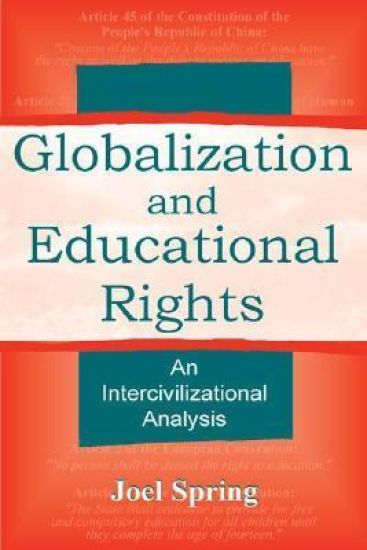
This is the first book to explore the meaning of equality and freedom of education in a global context and their relationship to the universal right to education. It also proposes evaluating school systems according to their achievement of equality and freedom. Education in the 21st century is widely viewed as a necessary condition for the promotion of human welfare, and thus identified as a basic human right. Educational rights are included in many national constitutions written since the global spread of human rights ideas after World War II. But as a global idea, the meaning of educational rights varies between civilizations. In this book, which builds on the concept of the universal right to education set forth in Spring's The Universal Right to Education: Justification, Definition, and Guidelines, his intercivilizational analysis of educational rights focuses on four of the world's major civilizations: Confucian, Islamic, Western, and Hindu. Spring begins by considering educational rights as part of the global flow of ideas and the global culture of schooling. He also considers the tension this generates within different civilizational traditions. Next, he proceeds to: *examine the meaning of educational rights in the Confucian tradition, in the recent history of China, and in the Chinese Constitution; *look at educational rights in the context of Islamic civilization and as presented in the constitutions of Islamic countries, including an analysis of the sharp contrast between the religious orientation of Islamic educational rights and those of China and the West; *explore the problems created by the Western natural rights tradition and the eventual acceptance of educational rights as represented in European constitutions, with a focus on the development and prominence given in the West to the relationship between schooling and equality of opportunity; and, *investigate the effect of global culture on India and the blend of Western and Hindu ideas in the Indian constitution, highlighting the obstacles to fulfillment of educational rights created by centuries of discrimination against women and lower castes. In his conclusion, Spring presents an educational rights statement based on his intercivilizational analysis and his examination of national constitutions. This statement is intended to serve as a model for the inclusion of educational rights in national constitutions.
Globalization and Educational Rights

Globalization and Educational Rights

Joel Spring

Routledge Member of the Taylor and Francis Group
2001
sidottu
This is the first book to explore the meaning of equality and freedom of education in a global context and their relationship to the universal right to education. It also proposes evaluating school systems according to their achievement of equality and freedom. Education in the 21st century is widely viewed as a necessary condition for the promotion of human welfare, and thus identified as a basic human right. Educational rights are included in many national constitutions written since the global spread of human rights ideas after World War II. But as a global idea, the meaning of educational rights varies between civilizations. In this book, which builds on the concept of the universal right to education set forth in Spring's The Universal Right to Education: Justification, Definition, and Guidelines, his intercivilizational analysis of educational rights focuses on four of the world's major civilizations: Confucian, Islamic, Western, and Hindu. Spring begins by considering educational rights as part of the global flow of ideas and the global culture of schooling. He also considers the tension this generates within different civilizational traditions. Next, he proceeds to: *examine the meaning of educational rights in the Confucian tradition, in the recent history of China, and in the Chinese Constitution; *look at educational rights in the context of Islamic civilization and as presented in the constitutions of Islamic countries, including an analysis of the sharp contrast between the religious orientation of Islamic educational rights and those of China and the West; *explore the problems created by the Western natural rights tradition and the eventual acceptance of educational rights as represented in European constitutions, with a focus on the development and prominence given in the West to the relationship between schooling and equality of opportunity; and, *investigate the effect of global culture on India and the blend of Western and Hindu ideas in the Indian constitution, highlighting the obstacles to fulfillment of educational rights created by centuries of discrimination against women and lower castes. In his conclusion, Spring presents an educational rights statement based on his intercivilizational analysis and his examination of national constitutions. This statement is intended to serve as a model for the inclusion of educational rights in national constitutions.
The Universal Right to Education

The Universal Right to Education

Joel Spring

Routledge Member of the Taylor and Francis Group
2000
nidottu
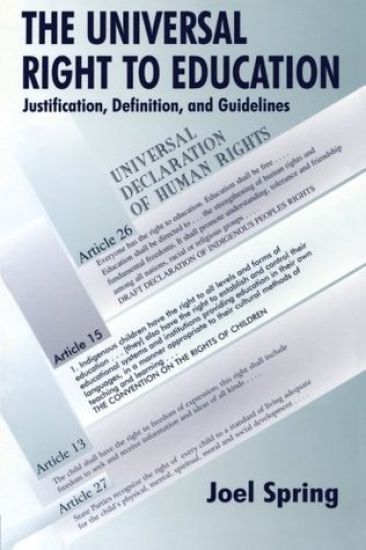
In this book, Joel Spring offers a powerful and closely reasoned justification and definition for the universal right to education--applicable to all cultures--as provided for in Article 26 of the United Nation's Universal Declaration of Human Rights. One sixth of the world's population, nearly 855 million people, are functionally illiterate, and 130 million children in developing countries are without access to basic education. Spring argues that in our crowded global economy, educational deprivation has dire consequences for human welfare. Such deprivation diminishes political power. Education is essential for providing citizens with the tools for resisting totalitarian and repressive governments and economic exploitation. What is to be done? The historically grounded, highly original analysis and proposals Spring sets forth in this book go a long way toward answering this urgent question. Spring first looks at the debates leading up to the Universal Declaration of Human Rights in 1948, to see how the various writers dealt with the issue of cultural differences. These discussions provide a framework for examining the problem of reconciling cultural differences with universal concepts. He next expands on the issue of education and cultural differences by proposing a justification for education that is applicable to indigenous peoples and minority cultures and languages. This justification is then applied to all people within the current global economy. Acknowledging that the right to an education is inseparable from children's rights, he uses the concept of a universal right to education to justify children's rights, and, in turn, applies his definition of children's liberty rights to the concept of education. His synthesis of cultural, language, and children's rights provides the basis for a universal justification and definition for the right to education -- which, in the concluding chapters, Spring uses to propose universal guidelines for human rights education, and instruction in literacy, numeracy, cultural centeredness, and moral economy.
Education and the Rise of the Global Economy

Education and the Rise of the Global Economy

Joel Spring

Routledge Member of the Taylor and Francis Group
1998
sidottu
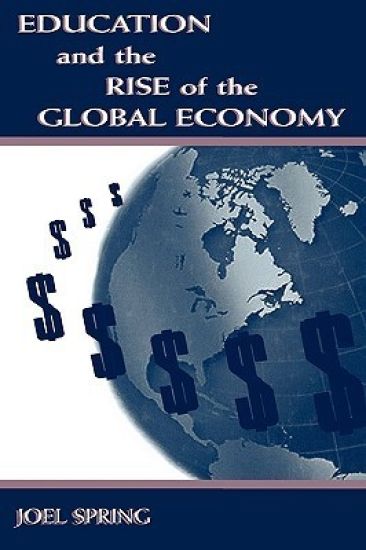
Joel Spring investigates the role of educational policy in the evolving global economy, and the consequences of school systems around the world adapting to meet the needs of international corporations. The new global model for education addresses problems of technological change, the quick exchange of capital, and free markets; policies to resolve these problems include "lifelong learning," "learning societies," international and national accreditation of work skills; international and national standards and tests; school choice; multiculturalism; and economic nationalism. The distinctive contribution Spring makes is to offer an original interpretive framework for examining and understanding the interconnections among education, imperialism and colonialism, and the rise of the global economy. He offers a unique comparison of the educational policies of the World Bank, the United Nations, the European Union, and the Organization for Economic Development and Cooperation. Additionally, he provides and weaves together important historical and current information on education in the context of the expansion of international capitalism; much of this information, gathered from many diverse sources, is otherwise not easily available to readers of this book. In the concluding chapters of the volume, Spring presents a thoughtful analysis and a powerful argument emphasizing the importance of human rights education in a global economy. This volume is a sequel to Spring's earlier book, Education and the Rise of the Corporate State (1972), continuing the work he has been engaged in since the 1970s to describe and analyze the relationship between political, economic, and historical forces and educational policy.
Education and the Rise of the Global Economy

Education and the Rise of the Global Economy

Joel Spring

Routledge Member of the Taylor and Francis Group
1998
nidottu
Joel Spring investigates the role of educational policy in the evolving global economy, and the consequences of school systems around the world adapting to meet the needs of international corporations. The new global model for education addresses problems of technological change, the quick exchange of capital, and free markets; policies to resolve these problems include "lifelong learning," "learning societies," international and national accreditation of work skills; international and national standards and tests; school choice; multiculturalism; and economic nationalism. The distinctive contribution Spring makes is to offer an original interpretive framework for examining and understanding the interconnections among education, imperialism and colonialism, and the rise of the global economy. He offers a unique comparison of the educational policies of the World Bank, the United Nations, the European Union, and the Organization for Economic Development and Cooperation. Additionally, he provides and weaves together important historical and current information on education in the context of the expansion of international capitalism; much of this information, gathered from many diverse sources, is otherwise not easily available to readers of this book. In the concluding chapters of the volume, Spring presents a thoughtful analysis and a powerful argument emphasizing the importance of human rights education in a global economy. This volume is a sequel to Spring's earlier book, Education and the Rise of the Corporate State (1972), continuing the work he has been engaged in since the 1970s to describe and analyze the relationship between political, economic, and historical forces and educational policy.
The Cultural Transformation of A Native American Family and Its Tribe 1763-1995

The Cultural Transformation of A Native American Family and Its Tribe 1763-1995

Joel Spring

Routledge Member of the Taylor and Francis Group
1996
sidottu
This book describes the impact of U.S. government civilization and education policies on a Native American family and its tribe from 1763 to 1995. While engaged in a personal quest for his family's roots in Choctaw tribal history, the author discovered a direct relationship between educational policies and their impact on his family and tribe. Combining personal narrative with traditional historical methodology, the author details how federal education policies concentrated power in a tribal elite that controlled its own school system in which students were segregated by social class and race. The book begins with the cultural differences that existed between Native Americans and European colonists. The civilization policies discussed begin in the 1790s when both Presidents George Washington and Thomas Jefferson searched for a means of gaining the lands occupied by the southern tribes, including the Choctaws. The story involves a complicated interaction between government policies, the agenda of white educators, and the desires of Native Americans. In a broader context, it is a study of the evolution of an American family from the extended support of the community and clan of the past, to the present world of single parents adrift without community or family safety nets.
The Cultural Transformation of A Native American Family and Its Tribe 1763-1995

The Cultural Transformation of A Native American Family and Its Tribe 1763-1995

Joel Spring

Routledge Member of the Taylor and Francis Group
1996
nidottu
This book describes the impact of U.S. government civilization and education policies on a Native American family and its tribe from 1763 to 1995. While engaged in a personal quest for his family's roots in Choctaw tribal history, the author discovered a direct relationship between educational policies and their impact on his family and tribe. Combining personal narrative with traditional historical methodology, the author details how federal education policies concentrated power in a tribal elite that controlled its own school system in which students were segregated by social class and race. The book begins with the cultural differences that existed between Native Americans and European colonists. The civilization policies discussed begin in the 1790s when both Presidents George Washington and Thomas Jefferson searched for a means of gaining the lands occupied by the southern tribes, including the Choctaws. The story involves a complicated interaction between government policies, the agenda of white educators, and the desires of Native Americans. In a broader context, it is a study of the evolution of an American family from the extended support of the community and clan of the past, to the present world of single parents adrift without community or family safety nets.