Kirjojen hintavertailu. Mukana 12 595 353 kirjaa ja 12 kauppaa.

Kirjailija

John Hunt

Kirjat ja teokset yhdessä paikassa: 168 kirjaa, julkaisuja vuosilta 1995-2026, suosituimpien joukossa Conductors on the Yellow Label (Deutsche Grammophon), Discographies Fritz Lehmann, Ferdinand Leitner, Ferenc Fricsay, Eugen Jochum, Leopold Ludwig, Artur Rother, Franz Konwitschny, Igor Markevitch. Vertaile teosten hintoja ja tarkista saatavuus suomalaisista kirjakaupoista.

168 kirjaa

Kirjojen julkaisuhaarukka 1995-2026.

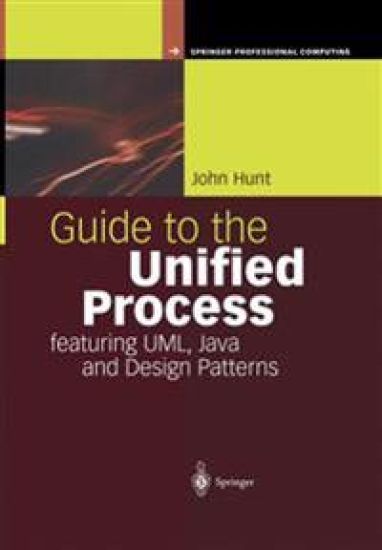
Guide to the Unified Process featuring UML, Java and Design Patterns
1.1 Introduction This book introduces and guides the you through the use of the Unified Modeling Language (UML) and the Unified Process (both originally devised by Grady Booch,James Rumbaugh and Ivar Jacobson) and their application to Java systems.This means that the book will present you, thereader,withthenotationusedintheUMLandthestepsdescribedbytheUnifiedProcesswith particular reference to the Java environment (including the classes and the syntax). The book itself is structured in three parts. Part 1 introduces object-oriented analysis and design and the Unified Process. The UML is introduced, as necessary, to support the Unified Process steps.Part 2 discusses the topic of design patterns,while Part 3 looks at the UnifiedProcessandUMLintherealworld. The first part of the book is structured in the following manner: Chapter 2: Object -Oriented Analysis and Design This chapter surveys the most significant object-oriented design and analysis methods to emerge since the late 1980s. Chapter 3: An Introduction to the UML and the Unified Process This chapter provides the background to the UML and the Unified Process. It also presents a summary of both. Chapter 4: Software Architecture and Object-Oriented Design This chapter explains and justifies why an architecture is essential to the successful design and implementation of a large object-oriented system. Chapter 5: Requirements Discipline: Use Case Analysis Thischapterintroducestherequirementsdiscipline(whichmayalsobeknownasUseCaseAna- sis).Thisdisciplineattemptstoidentifywhatthefunctionalityofthesystemwillbe.Theseusecases will be essential as the backbone to the whole design process.

Scala Design Patterns

Scala Design Patterns

John Hunt

Springer International Publishing AG
2013
sidottu
Scala is a new and exciting programming language that is a hybrid between object oriented languages such as Java and functional languages such as Haskell. As such it has its own programming idioms and development styles.Scala Design Patterns looks at how code reuse can be successfully achieved in Scala. A major aspect of this is the reinterpretation of the original Gang of Four design patterns in terms of Scala and its language structures (that is the use of Traits, Classes, Objects and Functions). It includes an exploration of functional design patterns and considers how these can be interpreted in Scala's uniquely hybrid style.A key aspect of the book is the many code examples that accompany each design pattern, allowing the reader to understand not just the design pattern but also to explore powerful and flexible Scala language features. Including numerous source code examples, this book will be of value to professionals and practitioners working in the field of software engineering.
Accountability is the Key

Accountability is the Key

John Hunt

Rowman Littlefield Education
2013
sidottu
School administration is more difficult today than at any time in our history. Whether addressing the needs of students, parents or staff at the building level, or facing the questions posed by the board of education, the media or the general public at the district level, administrators face constant calls for accountability. Demands for administrative accountability have steadily increased since the publication of A Nation at Risk in 1983. The most recent trend has been to tie administrative evaluations to student performance, increasing stress among administrators at all levels. The cumulative effect of three decades of challenges to administrative authority has undermined the publics view of educational administrators as experts. The author examines the current state of public education, including the influence of private individuals and foundations, and alternative approaches to the educational delivery model and then highlights successful examples of public education. He concludes by considering input of current administrators and school board members and presents a strategy which educational administrators can employ to win back public confidence and support.
Accountability is the Key

Accountability is the Key

John Hunt

Rowman Littlefield Education
2013
nidottu
School administration is more difficult today than at any time in our history. Whether addressing the needs of students, parents or staff at the building level, or facing the questions posed by the board of education, the media or the general public at the district level, administrators face constant calls for accountability. Demands for administrative accountability have steadily increased since the publication of A Nation at Risk in 1983. The most recent trend has been to tie administrative evaluations to student performance, increasing stress among administrators at all levels. The cumulative effect of three decades of challenges to administrative authority has undermined the publics view of educational administrators as experts. The author examines the current state of public education, including the influence of private individuals and foundations, and alternative approaches to the educational delivery model and then highlights successful examples of public education. He concludes by considering input of current administrators and school board members and presents a strategy which educational administrators can employ to win back public confidence and support.
Ascent of Everest

Ascent of Everest

John Hunt

Hodder Paperback
2013
pokkari
'This is the story of how, on 29 May, 1953, two men, both endowed with outstanding stamina and skill, reached the top of Everest and came back unscathed to rejoin their comrades. 'Yet this will not be the whole story, for the ascent of Everest was not the work of one day, nor even of those few anxious, unforgettable weeks in which we prepared and climbed this summer. It is, in fact, a tale of sustained and tenacious endeavour by many, over a long period of time... We of the 1953 Everest Expedition are proud to share the glory with our predecessors.'Sir John Hunt
Guide to J2EE: Enterprise Java

Guide to J2EE: Enterprise Java

John Hunt; Chris Loftus

Springer London Ltd
2012
nidottu
In this book, John Hunt and Chris Loftus take you through the core technologies that make up the Enterprise Edition of the Java 2 platform (J2EE). They cover all the aspects of J2EE that both professionals and students need to know to build multi-tier enterprise applications in Java - the technologies, the design methodology and design patterns. Whether you are a professional or student, this book will help equip you with the skills you need to build enterprise wide applications in Java. Key Topics Includes design issues using J2EE patterns Covers all parts of the enterprise application J2EE Uses an integrated example that spans the chapters to be built up by the reader More accessible and less daunting than a lot of the competition A coherent whole, rather than independent separate chapters (as with some rivals) Features and Benefits Provides an overview of J2EE technologies and their benefits. Discusses architectural design issues using J2EE patterns. Looks at the issues of designing and building multi-tier J2EE applications. Includes fully worked examples, built up throughout the book, which enable you to quickly develop your own multi-tier applications. About the Authors: Dr. John Hunt is Technical Director at JayDeeTechnology Ltd. He runs industrial courses, including server-side Java technologies. He also leads development projects for government and blue chip organisations using Java, J2EE, XML and C#. Chris Loftus is a Teaching Fellow at the Department of Computer Science at the University of Wales, Aberystwyth. He has taught Java-based courses, including J2EE, both in university and industry.
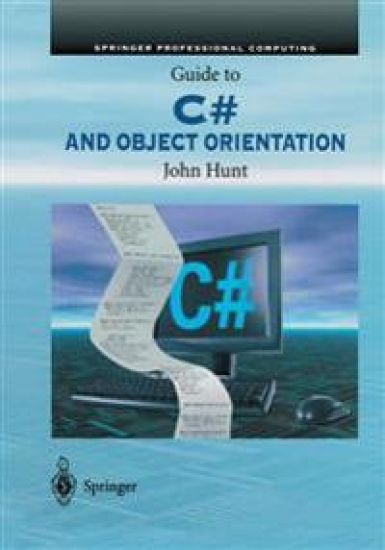
Guide to C# and Object Orientation

Guide to C# and Object Orientation

John Hunt

Springer London Ltd
2012
nidottu
This book shows readers how to get the most out of C# using Object Orientation. The author takes a hands-on approach to learning C# and object orientation, using lots of worked examples. The text provides an ideal base from which to start programming. After introducing the C# language and object orientation, John Hunt goes on to explain: how to construct a user interface for a simple editor; how to obtain information on files and directories and how objects can be stored and restored using serialization...-Presents C# and object-orientation as a coherent whole, using one to strengthen the presentation of the other -Includes lots of complete and worked examples to clarify readers'understanding -The source code for the examples is available at: http://www.guide-to-csharp.net -Hunt is a successful Springer author, and this book is written in the same style as his Java for Practitioners
Two Times Dead... Not Really a Love Story
Two Times Dead is a hard hitting mystery with many unexpected twist and turns created to provide the reader with a suspense filled ride leading to complete enjoyment. Hard hitting in your face action draws the reader into the fray with his own opinions.Life / love and death; who is right and wrong hides within these pages. No one see things the same way and being wrong can mean losing your life.You can ride along with these characters and make up your own mind but remember wrong can be the last opinion you have. Figue it out, watch for the clues and see if you can beat the Chief to the right conclusions before he and his team are lost! When you leave these pages I hope you will leave with a different perspective.