

Kirjailija
John Maynard Keynes
Kirjat ja teokset yhdessä paikassa: 184 kirjaa, julkaisuja vuosilta 1919-2026, suosituimpien joukossa A Treatise on Money. Vertaile teosten hintoja ja tarkista saatavuus suomalaisista kirjakaupoista.
184 kirjaa
Kirjojen julkaisuhaarukka 1919-2026.



Keynes on International Economic Relations
John Maynard Keynes; Seymour E. Harris
Kessinger Pub
2005
pokkari
"The power to become habituated to his surroundings is a marked characteristic of mankind. Very few of us realise with conviction the intensely unusual, unstable, complicated, unreliable, temporary nature of the economic organisation by which Western Europe has lived for the last half century." - CHAPTER I-INTRODUCTORY As the most important figures in the history of economics, the work of John Maynard Keynes is nearly without precedent in the history of economics. THE ECONOMIC CONSEQUENCES OF PEACE, first published in 1919, achieved great notoriety due of its contemptuous critique of the French premier as well as President Woodrow Wilson. Keynes criticized the Allied victors for signing the Treaty of Versailles in 1920, which would have ruinous consequences for Europe. At the time, few world and economic leaders appreciated his criticisms as Keynes saw his worst fears realized in the rise of Adolf Hitler and the resulting devastation of World War II. JOHN MAYNARD KEYNES, 1883-1946, was born into an academic family. His father, John Nevile Keynes, was a lecturer at the University of Cambridge where he taught logic and political economy while his son was educated at Eton and Cambridge. Most importantly, Keynes revolutionized economics with his classic book, The General Theory of Employment, Interest and Money (1936). This work is generally regarded as perhaps the most influential social science treatise of the 20th Century, as it quickly and permanently changed the scope of economic thought. Interestingly, Keynes was a central member of the Bloomsbury Group, a collection of upper-class Edwardian aesthetes that served as his life outside of economics, which included Virginia Woolf, Clive Bell, and Lytton Strachey.


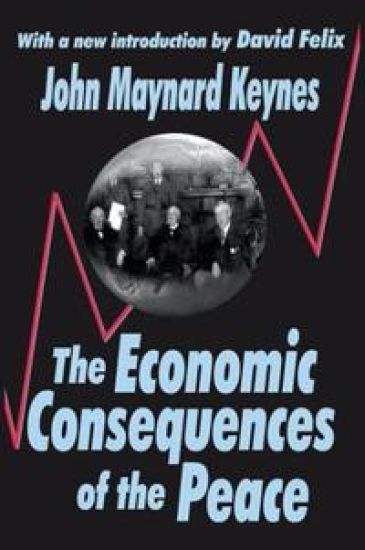
John Maynard Keynes, then a rising young economist, participated in the Paris Peace Conference in 1919 as chief representative of the British Treasury and advisor to Prime Minister David Lloyd George. He resigned after desperately trying and failing to reduce the huge demands for reparations being made on Germany. The Economic Consequences of the Peace is Keynes' brilliant and prophetic analysis of the effects that the peace treaty would have both on Germany and, even more fatefully, the world. A popular lecturer of economics at Cambridge University and editor of the Economic Journal, Keynes made The Economic Consequences of the Peace a major step in his career. It was translated into a dozen languages and sold 100,000 copies in six months. Taken seriously even by those who were opposed to his claims, the book helped lift economics to a new, higher level of recognition and acceptance.This volume, with its insightful portraits of Lloyd George, Georges Clemenceau, and Woodrow Wilson, remains one of the great works of political economy of our time. In a penetrating introduction written for this new edition, David Felix explores Keynes' reasons for writing the book, analyzes the author's arguments, and paints an historical backdrop of the period during which it was written.

Allgemeine Theorie der Beschäftigung, des Zinses und des Geldes.
John Maynard Keynes
Duncker Humblot GmbH
2002
nidottu
Ein Traktat Uber Wahrungsreform: In Der Einzig Autorisierten Ubersetzung Von Ernst Kocherthaler
John Maynard Keynes
Duncker Humblot
1997
nidottu
The General Theory of Employment, Interest, and Money
John Maynard Keynes
PROMETHEUS BOOKS UK
1997
pokkari
Distinguished British economist John Maynard Keynes (1883-1946) set off a series of movements that drastically altered the ways in which economists view the world. In his most important work, The General Theory of Employment, Interest, and Money (1936), Keynes critiqued the laissez-faire policies of his day, particularly the proposition that a normally functioning market economy would bring full employment. Keynes's forward-looking work transformed economics from merely a descriptive and analytic discipline into one that is policy oriented. For Keynes, enlightened government intervention in a nation's economic life was essential to curbing what he saw as the inherent inequalities and instabilities of unregulated capitalism.
One of the most important economic documents of the 20th century John Maynard Keynes, at the time a rising young economist, abruptly resigned his position as adviser to the British delegation negotiating the peace treaty ending World War I. Frustrated and angered by the Allies' focus on German war guilt, Keynes predicted that the vindictive reparations policy, which locked Germany into long-term payments, would not only stifle the German economy for another generation but leave Europe in ruins. Published in 1919, Keynes's The Economic Consequences of the Peace aroused heated debates throughout Europe; his remarkably prescient conclusions were frequently cited by German leaders during the decades between the wars. Keynes's well-reasoned yet impassioned arguments, peppered with biting portraits of the statesen involved in the peace treaty--including Llyod George, Georges Clemenceau, and Woodrow Wilson--brought him immediate fame. For more than seventy years, Penguin has been the leading publisher of classic literature in the English-speaking world. With more than 1,700 titles, Penguin Classics represents a global bookshelf of the best works throughout history and across genres and disciplines. Readers trust the series to provide authoritative texts enhanced by introductions and notes by distinguished scholars and contemporary authors, as well as up-to-date translations by award-winning translators.
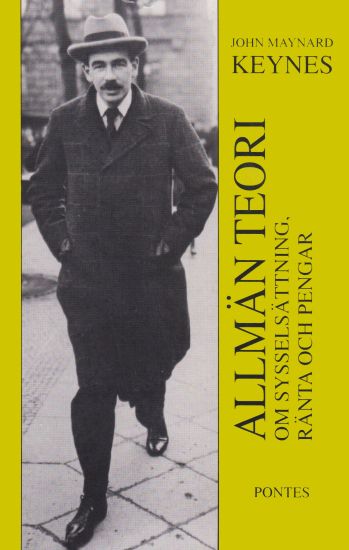
Allmän teori om sysselsättning, ränta och pengar
John Maynard Keynes; Lars Herlitz
Pontes
1994
nidottu
1936 publicerades århundradets mest uppmärksammade bok i ämnet nationalekonomi, ”The General Theorry of Employment, Interest and Money”. I den angrep John Maynard Keynes arbetslöshetsproblemet och penning- och finanspolitiken på ett nytt sätt. Han menade att marknaden inte kunde lösa sysselsättningsproblemet och att staten måste ingripa med lågräntepolitik och offentliga investeringar. Boken har diskuterats livligt alltsedan den kom ut, och den tycks ständigt få ny aktualitet. Detta är den första kompletta svenska utgåvan. Lars Herlitz har skrivit en utförlig orienterande inledning.
Part I Fundamental ideasCHAPTER I The Meaning of ProbabilityCHAPTER II Probability in Relation to the Theory of Knowledge CHAPTER III The Measurement of Probabilities CHAPTER IV The Principle of IndifferenceCHAPTER V Other Methods of Determining Probabilities CHAPTER VI The Weight of ArgumentsCHAPTER VII Historical Retrospect CHAPTER VIII The Frequency Theory of Probability CHAPTER IX The Constructive Theory of Part I. SummarizedPART II Fundamental TheoremsCHAPTER X Introductory CHAPTER XI The Theory of Groups, with special reference to Logical Consistence, Inference, and Logical Priority.CHAPTER XII The Definitions and Axioms of Inference and ProbabilityCHAPTER XIII The Fundamental Theorems of Necessary InferenceCHAPTER XIV The Fundamental Theorems of Probable Inference CHAPTER XV Numerical Measurement and Approximation of ProbabilitiesCHAPTER XVI Observations on the Theorems of Chapter XIV. and their Developments, including Testimony CHAPTER XVII Some Problems in Inverse Probability, including Averages PART IIIInduction and AnalogyCHAPTER XVIII Introduction CHAPTER XIX The Nature of Argument by Analogy CHAPTER XX The Value of Multiplication of Instances, or Pure InductionCHAPTER XXI The Nature of Inductive Argument ContinuedCHAPTER XXII The Justification of these MethodsCHAPTER XXIII Some Historical Notes on Induction PART IVSome Philosophical Applications of ProbabilityCHAPTER XXIV The Meanings of Objective Chance, and of RandomnessCHAPTER XXV Some Problems arising out of the Discussion of Chance CHAPTER XXVI The Application of Probability to ConductPART VThe Foundations of Statistical InferenceCHAPTER XXVII The Nature of Statistical InferenceCHAPTER XXVIII The Law of Great Numbers CHAPTER XXIX The Use of priori Probabilities for the Prediction of Statistical Frequency-the Theorems of Bernoulli, Poisson, and TchebycheffCHAPTER XXX The Mathematical use of Statistical Frequencies for the Determination of Probability posteriori-the Methods of LaplaceCHAPTER XXXI The Inversion of Bernoulli's TheoremCHAPTER XXXII The Inductive use of Statistical Frequencies for the Determination of Probability posteriori-the Methods of Lexis CHAPTER XXXIII Outline of a Constructive Theory