

Kirjailija
John Michell
Kirjat ja teokset yhdessä paikassa: 32 kirjaa, julkaisuja vuosilta 1999-2026, suosituimpien joukossa All That Glitters. Vertaile teosten hintoja ja tarkista saatavuus suomalaisista kirjakaupoista.
32 kirjaa
Kirjojen julkaisuhaarukka 1999-2026.


The Far Grass is less a traditional Cold War spy fiction novel than it is the life story of a British spy during the time of the Cold War, a taut psychological study of personality and motivation told in first person by the book's central character, Joe Lambert. Lambert is an emotionally isolated man, an antihero unburdened by outrageous talents, on whom deep cynicism is visited. He progresses from his recruitment into Britain's Secret Intelligence Service (MI6) in an 1970s accident of UK political history through to his failures as a lover, resultant career zealotry and, after finding love only for it to be wrenched away, later transformation into an obsessed avenger. Along the way, Lambert locks in mortal conflict not only with the KGB but also with his own Service and hostile colleagues within, the CIA and ultimately himself. Stealthily addictive; thoughtful; sometimes sad, sometimes funny, The Far Grass is a former diplomat's tale of spying intrigue, human imperfection and the cut and thrust of bureaucratic politics. It is a book that offers readers a new slant on the Cold War spy fiction genre through a story that reaches its surprise conclusion in 1990 as the Soviet Union prepares to implode and the end of the Cold War nears.

Dublin Zoo is a dynamic thriller blurring fact with fiction as it seamlessly weaves its three distinct stories into one, yet also a novel that grounds the reader before beginning to stretch imagination. The book is further notable for its "teaser text" technique, whereby its first and second stories are dotted with the lead character Harold Bradshaw's reflections from its third part, ahead of this third limb taking over and steering the narrative through to its gripping conclusion.Harold's parents, Albert and Rita Bradshaw, are an Englishman from Newcastle upon Tyne and a Frenchwoman from Marseille. As a World War I soldier, Albert meets and marries Rita while in France. Faced with Rita's hostile family, her brother Axel especially, Albert, Rita and baby Harold settle in England after the war where Albert embarks on building a business empire. This first part features Harold's growth into adulthood in Scunthorpe in England's northeast midlands during the inter-war years. It is a tale dominated by Albert's rise from rags to riches and back to rags again, and concurrently, Rita's slide into mental illness. It also introduces the young lawyer who represented Albert when he was court-martialled during the Great War, saving his life, and who later becomes the guiding hand behind the establishment of Albert's business empire. The segment graphically depicts the global recovery from the First War, the period of prosperity following, and key events preceding the world's slide into the Great Depression and economic catastrophe.The first stage concludes with the death of Harold's parents - murder in his mother's case and his father's related demise - and Harold taking revenge for their deaths. With that, the young Harold is forced to flee to London, launching the novel's second act. Once in the capital, he embarks on a series of action-packed exploits as he seeks to find his place in the world. Harold's destiny is shaped by a unique ability to calmly and calculatedly inflict violence and his ever-present worry of being called to account for taking matters into his own hands when avenging the death of his parents. Shortly after arriving in London, Harold meets Katrina, an older woman with whom he falls in love. But his affair with Katrina is as brief as it is intense. It comes to an end in 1937 when British justice miscarries and Harold is convicted of two murders. In an ironic twist, the judge who hands down his lengthy prison sentence (in the book's opening scene, in fact) is the same man who, as a young lawyer, years earlier saved Albert's life in France and later guided the birth of his business empire. This second story concludes with Harold incarcerated and facing at least eighteen years in prison, while concurrently war clouds build over Europe.The final stanza opens with the onset of World War II. Harold is released from prison when he is recruited by a secretive British unit ostensibly to undertake a mission in his mother's birthplace of Marseille, primarily because of his flawless French language skills learnt at her knee as a child in Scunthorpe. But Harold is in fact an unwitting pawn in a higher stakes game entailing a secret British plan to exploit a traitor within the French Resistance in pursuit of a critical strategic objective. Thus ensues a gripping story of intrigue, double cross, Harold's surprise romance with another older woman, and an unshakable male friendship. Events climax in Marseille in an engrossing, edge of your seat characterization of the book's Dublin Zoo title.
Conjectures Concerning the Cause, and Observations Upon the Phænomena, of Earthquakes; Particularly of That Great Earthquake of the First of November 1755, Which Proved so Fatal to the City of Lisbon, ... By ... John Michell,
John Michell
Gale Ecco, Print Editions
2018
sidottu
The 18th century was a wealth of knowledge, exploration and rapidly growing technology and expanding record-keeping made possible by advances in the printing press. In its determination to preserve the century of revolution, Gale initiated a revolution of its own: digitization of epic proportions to preserve these invaluable works in the largest archive of its kind. Now for the first time these high-quality digital copies of original 18th century manuscripts are available in print, making them highly accessible to libraries, undergraduate students, and independent scholars.Medical theory and practice of the 1700s developed rapidly, as is evidenced by the extensive collection, which includes descriptions of diseases, their conditions, and treatments. Books on science and technology, agriculture, military technology, natural philosophy, even cookbooks, are all contained here.++++The below data was compiled from various identification fields in the bibliographic record of this title. This data is provided as an additional tool in helping to insure edition identification: ++++British LibraryT031203London: printed in the year, 1760. 71, 1]p., plate; 4
On the Means of Discovering the Distance, Magnitude, &c. of the Fixed Stars, in Consequence of the Diminution of the Velocity of Their Light, ... By the Rev. John Michell, ... Read at the Royal Society, Nov.27, 1783
John Michell
Gale Ecco, Print Editions
2018
sidottu
The 18th century was a wealth of knowledge, exploration and rapidly growing technology and expanding record-keeping made possible by advances in the printing press. In its determination to preserve the century of revolution, Gale initiated a revolution of its own: digitization of epic proportions to preserve these invaluable works in the largest archive of its kind. Now for the first time these high-quality digital copies of original 18th century manuscripts are available in print, making them highly accessible to libraries, undergraduate students, and independent scholars.Medical theory and practice of the 1700s developed rapidly, as is evidenced by the extensive collection, which includes descriptions of diseases, their conditions, and treatments. Books on science and technology, agriculture, military technology, natural philosophy, even cookbooks, are all contained here.++++The below data was compiled from various identification fields in the bibliographic record of this title. This data is provided as an additional tool in helping to insure edition identification: ++++British LibraryT128508Vertical chain lines.London: printed by J. Nichols, 1784. 25, 1]p., plate; 4
A Treatise of Artificial Magnets; in Which is Shewn an Easy and Expeditious Method of Making Them, Superior to the Best Natural Ones
John Michell
Gale Ecco, Print Editions
2018
sidottu
The 18th century was a wealth of knowledge, exploration and rapidly growing technology and expanding record-keeping made possible by advances in the printing press. In its determination to preserve the century of revolution, Gale initiated a revolution of its own: digitization of epic proportions to preserve these invaluable works in the largest archive of its kind. Now for the first time these high-quality digital copies of original 18th century manuscripts are available in print, making them highly accessible to libraries, undergraduate students, and independent scholars.Medical theory and practice of the 1700s developed rapidly, as is evidenced by the extensive collection, which includes descriptions of diseases, their conditions, and treatments. Books on science and technology, agriculture, military technology, natural philosophy, even cookbooks, are all contained here.++++The below data was compiled from various identification fields in the bibliographic record of this title. This data is provided as an additional tool in helping to insure edition identification: ++++British LibraryT125473Cambridge: printed by Joseph Bentham; and sold by W. and J. Mount, and T. Page, J. & P. Knapton, C. Bathurst, J. Beecroft, London; W. Thurlbourn, and T. Merrill, in Cambridge; J. Fletcher, at Oxford; and J. Hildyard, at York, 1751. 2],78p., plate; 8
An Inquiry Into the Probable Parallax, and Magnitude of the Fixed Stars, From the Quantity of Light Which They Afford us, and the Particular Circumstances of Their Situation. By the Rev. John Michell,
John Michell
Gale Ecco, Print Editions
2018
sidottu
The 18th century was a wealth of knowledge, exploration and rapidly growing technology and expanding record-keeping made possible by advances in the printing press. In its determination to preserve the century of revolution, Gale initiated a revolution of its own: digitization of epic proportions to preserve these invaluable works in the largest archive of its kind. Now for the first time these high-quality digital copies of original 18th century manuscripts are available in print, making them highly accessible to libraries, undergraduate students, and independent scholars.Medical theory and practice of the 1700s developed rapidly, as is evidenced by the extensive collection, which includes descriptions of diseases, their conditions, and treatments. Books on science and technology, agriculture, military technology, natural philosophy, even cookbooks, are all contained here.++++The below data was compiled from various identification fields in the bibliographic record of this title. This data is provided as an additional tool in helping to insure edition identification: ++++British LibraryT125486With a half-title.London: printed in the year, 1768. 35, 1]p.; 4
"Erudite and insightful, yet most of all practical. Don't step out in London without it." -The British Pilgrimage Trust Beneath the carapace of busy London lie relics of an old enchantment, whem Guildhall was the palace of Trojan kings and Westminster Abbey was the holy of holies, secluded on Thorney Island. Follow the itineraries or dip into pages at will, and Sacred London will let you see the capital in a new light. Bathed in the gleam of saints and angels, discover a city of river worship, ancient stones, and holy wells. Visit places of sanctuary and haunts of peace, picked out from the scrum of the modern city, quiet churches and forgotten wildernesses, in the very heart of London.

The Russians in Central Asia
John Michell; Robert Michell; Mikhail Ivanovich Venyukov
Hansebooks
2017
pokkari
Trivium: The Classical Liberal Arts of Grammar, Logic, & Rhetoric
John Michell; Rachel Grenon; Earl Fontainelle
Bloomsbury USA
2016
sidottu
Following the success of Quadrivium, Sciencia, and Designa in the acclaimed Wooden Books series, Trivium is a compendium of writings on the classical subjects at the heart of a liberal education, bringing the wisdom of the past into the twenty-first century. The trivium refers to the three liberal arts considered in classical Greece to be the pillars of critical thought: grammar, logic, and rhetoric. Following on the success of Quadrivium and Sciencia, Trivium gathers six Wooden Books titles together into a beautiful six-color package that presents ancient wisdom in an accessible way. Trivium will include the books Euphonics, Grammar, Logic, Rhetoric, Poetic Meter and Form, and Ethics. Wooden Books was founded in 1999 by designer John Martineau near Hay-on-Wye. The aim was to produce a beautiful series of recycled books based on the classical philosophies, arts and sciences. Using the Beatrix Potter formula of text facing picture pages, and old-styles fonts, along with hand-drawn illustrations and 19th century engravings, the books are designed not to date. Small but stuffed with information. Eco friendly and educational. Big ideas in a tiny space. There are over 1,000,000 Wooden Books now in print worldwide and growing.
The modern guide to ancient arts of language.
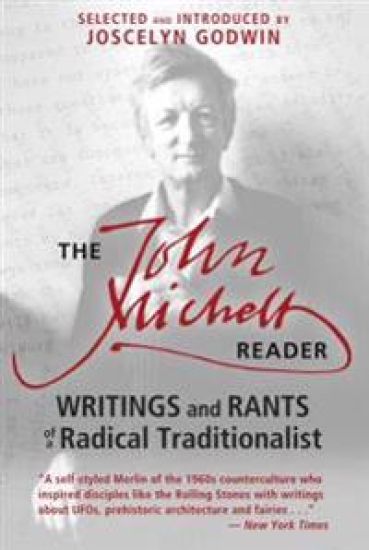
A countercultural icon of the 1960s, John Michell (1933-2009) was perhaps best known for his books on sacred geometry, Earth mysteries, and unusual phenomena. He was also beloved and reviled for his radical, idealistic, yet classically traditional views on a wide range of heretical topics, from sacred practices of the Stone Age to the evils of the metric system to the madness of modernity and the unfolding apocalypse. Carefully selecting 108 of Michell's most insightful, erudite, witty, and occasionally scathing essays from his column in the monthly magazine The Oldie, esoteric scholar Joscelyn Godwin presents a colorful collection of Michell's writings and rants that cover nearly every aspect of society, history, and traditional wisdom. In these short essays, Michell takes on agribusiness, Darwinism, superstition, Stonehenge, the insanity of modern society, UFOs, Jesus, fairies, the Grail legend, among many other topics. No matter how small the topic under consideration, Michell always takes a larger view on it, illuminating it with light from above. Godwin's artful selection and ordering of essays reveals Michell's overarching grand view of the world at large. We glimpse the heart of Michell as idealistic Platonist and radical traditionalist, absorb his common sense lessons for living in tune with the divine order, and are reminded that the elusive "paradise of the philosophers" of ancient times is still within reach for those with the strength of vision to see it.
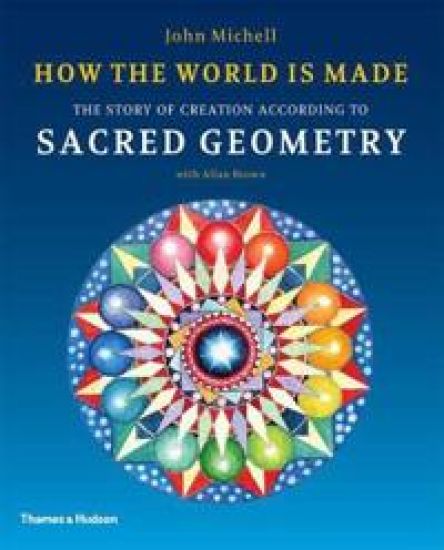
Explores how ancient people who grasped the timeless principles of sacred geometry were able to create flourishing societies. This title features more than 300 colour illustrations that reveal the secret code within the geometrical figures and shows how they express the spiritual meanings in the key numbers of 1 through 12.
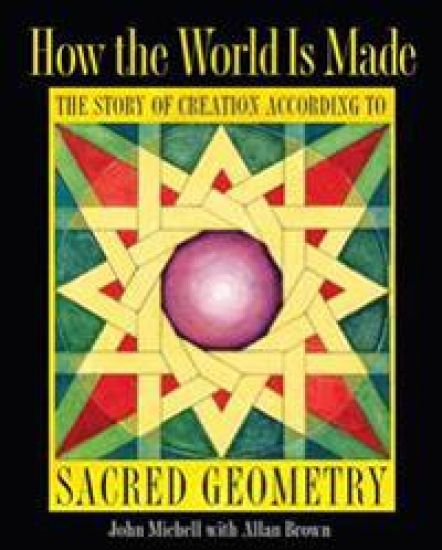
How the World Is Made: The Story of Creation According to Sacred Geometry
John Michell
INNER TRADITIONS INTERNATIONAL
2012
nidottu
Understanding the role of sacred geometry in cosmology and human affairs - Explains how ancient societies that grasped the timeless principles of sacred geometry were able to create flourishing societies - Illustrates the social and spiritual values in the natural progression of number - Contains more than 300 full-color drawings showing the interplay of number and sacred geometry Galileo described the universe as a large book written in the language of mathematics, which can only be read by those with knowledge of its characters--triangles, circles, and other geometrical figures. The laws of geometry are not human inventions. They are found ready-made in nature and hold a truth that is the same in all times and all places and is older than the world itself. In How the World Is Made John Michell explains how ancient societies that grasped the timeless principles of sacred geometry were able to create flourishing societies. His more than 300 full-color illustrations reveal the secret code within these geometrical figures and how they express the spiritual meanings in the key numbers of 1 through 12. For example, the number 8 and its octagon are symbols of peace and stability, the holy 7 and its seven-sided figure are connected to the world-soul. He identifies the various regular shapes and shows their constructions; their natural symbolism; their meetings, matings, and ways of breeding; and their functions within the universal order. Some are musical and structural, others relate to life and humanity. In the process of making these discoveries, Michell helps us see the world in a new light. Disparate shapes and their corresponding numbers are woven together, resolving themselves into an all-inclusive world image--that "pattern in the heavens," as Socrates called it, "which anyone can find and establish within themselves."

A Treatise of Artificial Magnets; In Which Is Shewn an Easy and Expeditious Method of Making Them, Superior to the Best Natural Ones
John Michell
Gale Ecco, Print Editions
2010
pokkari