Kirjojen hintavertailu. Mukana 12 595 353 kirjaa ja 12 kauppaa.

Kirjailija

John Stuart Mill

Kirjat ja teokset yhdessä paikassa: 869 kirjaa, julkaisuja vuosilta 1850-2026, suosituimpien joukossa Sosialismin hyödyt ja haitat. Vertaile teosten hintoja ja tarkista saatavuus suomalaisista kirjakaupoista.

869 kirjaa

Kirjojen julkaisuhaarukka 1850-2026.

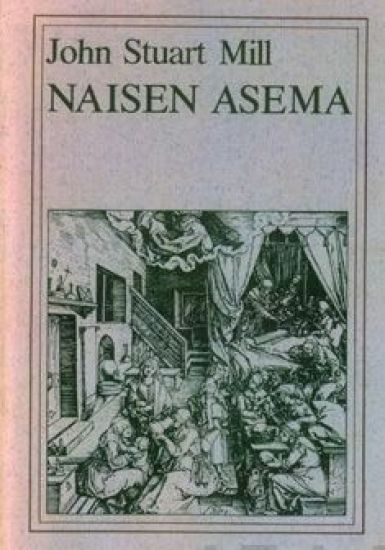
Naisen asema

Naisen asema

John Stuart Mill

Ntamo
2012
nidottu
Yhteiskuntafilosofian klassikko, joka herätti ilmestyessään 1869 valtavaa huomiota vaatimuksellaan naisten täydellisestä tasa-arvosta miesten rinnalla. Kirjoittaja katsoo naisen olevan oikeutettu sekä korkeampaan opetukseen että yhteskunnallisesti merkittäviin virkoihin. Mill vastustaa myös voimakkaasti aikansa kirkollista taantumusta ja ennakkoluuloja. Naisen asema ilmesty ensimmäisen kerran suomeksi vuonna 1906. Saman vuoden eduskuntauudistuksessa Suomen naiset saivat yleisen äänioikeuden ensimmäisinä Euroopassa. Suom. Lyyli Viherluoto, kieliasun tarkistanut ja osittain ajanmukaistanut Reima T. A. Luoto.
On Liberty

On Liberty

John Stuart Mill

Cambridge University Press
2011
pokkari
British philosopher and economist John Stuart Mill (1806–73) is the author of several essays, including Utilitarianism (1863) - a defence of Jeremy Bentham's principle applied to the field of ethics - and The Subjection of Women (1869), which advocates legal equality between the sexes. This work, arguably his most famous contribution to political philosophy and theory, was first published in 1859, and remains a major influence upon contemporary liberal political thought. In it, Mill argues for a limitation of the power of government and society (democracy's 'tyranny of the majority') over the individual, and defines liberty as an absolute individual right. According to the still much debated 'harm principle', power against the individual can only be exercised to prevent harm to others. Full of contemporary relevance, this essay also defends freedom of speech as a necessary condition of social and intellectual progress.
A System of Logic, Ratiocinative and Inductive

A System of Logic, Ratiocinative and Inductive

John Stuart Mill

Cambridge University Press
2011
pokkari
This two-volume work, first published in 1843, was John Stuart Mill's first major book. It reinvented the modern study of logic and laid the foundations for his later work in the areas of political economy, women's rights and representative government. In clear, systematic prose, Mill (1806–73) disentangles syllogistic logic from its origins in Aristotle and scholasticism and grounds it instead in processes of inductive reasoning. An important attempt at integrating empiricism within a more general theory of human knowledge, the work constitutes essential reading for anyone seeking a full understanding of Mill's thought. Continuing the discussion of induction, Volume 2 concludes with Book VI, 'On the Logic of the Moral Sciences', in which Mill applies empirical reasoning to human behaviour. A crucial early formulation of his thinking regarding free will and necessity, this book establishes the centrality of 'the social science' to Mill's philosophy.
A System of Logic, Ratiocinative and Inductive

A System of Logic, Ratiocinative and Inductive

John Stuart Mill

Cambridge University Press
2011
pokkari
This two-volume work, first published in 1843, was John Stuart Mill's first major book. It reinvented the modern study of logic and laid the foundations for his later work in the areas of political economy, women's rights and representative government. In clear, systematic prose, Mill (1806–73) disentangles syllogistic logic from its origins in Aristotle and scholasticism and grounds it instead in processes of inductive reasoning. An important attempt at integrating empiricism within a more general theory of human knowledge, the work constitutes essential reading for anyone seeking a full understanding of Mill's thought. Volume 1 contains Mill's introduction, which elaborates upon his definition of logic as 'not the science of Belief, but the science of Proof, or Evidence'. It also features discussions of the central components of logical reasoning - propositions and syllogisms - in relation to Mill's theories of inductive reasoning and experimental method.
On Liberty

On Liberty

John Stuart Mill

Createspace Independent Publishing Platform
2011
nidottu
A philosophical work by British philosopher John Stuart Mill, On Liberty's support for moral and economic freedom of individuals from the state made it a radical work in its time and a timeless piece, still relevant today.
Principles of Political Economy

Principles of Political Economy

J. Laurence Laughlin Ph. D.; John Stuart Mill

Createspace Independent Publishing Platform
2011
nidottu
The standard economics textbook for more than a generation, PRINCIPLES OF POLITICAL ECONOMY illustrates how significant economic concepts can and should be applied in real world circumstances.
On Liberty

On Liberty

John Stuart Mill

Indoeuropeanpublishing.com
2011
pokkari
On Liberty (1859) is a philosophical work by British philosopher John Stuart Mill. It was a radical work to the Victorian readers of the time because it supported individuals' moral and economic freedom from the state.Perhaps the most memorable point made by Mill in this work, and his basis for liberty, is that "over himself, over his own body and mind, the individual is sovereign." Mill is compelled to make this assertion in opposition to what he calls the "tyranny of the majority," wherein through control of etiquette and morality, society is an unelected power that can do horrific things. Mill's work could be considered a reaction to this social control by the majority and his advocacy of individual decision-making over the self. The famous Harm Principle, or the principle of liberty, is also articulated in this work: people can do anything they like as long as it does not harm others. All branches of liberalism-as well as other political ideologies-consider this to be one of their core principles. However, they often disagree on what exactly constitutes harm. (wikipedia.org)