Kirjojen hintavertailu. Mukana 12 595 353 kirjaa ja 12 kauppaa.

Kirjailija

John Stuart Mill

Kirjat ja teokset yhdessä paikassa: 869 kirjaa, julkaisuja vuosilta 1850-2026, suosituimpien joukossa Sosialismin hyödyt ja haitat. Vertaile teosten hintoja ja tarkista saatavuus suomalaisista kirjakaupoista.

869 kirjaa

Kirjojen julkaisuhaarukka 1850-2026.

Essays on Sex Equality

Essays on Sex Equality

John Stuart Mill; Harriet Taylor Mill

University of Chicago Press
1970
nidottu
This volume brings together for the first time all the writings of John Stuart Mill and Harriet Taylor Mill on equality between the sexes, including John Stuart Mill's The Subjection of Women, a classic in the history of the women's rights movement since its publication one hundred years ago. Also contained in this volume is a major interpretative essay by Alice S. Rossi on Mill and Harriet Taylor which describes and analyzes their long personal and intellectual relationship.
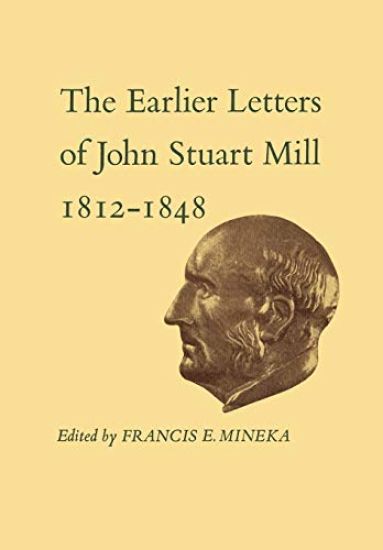
XII-XIIIThe Earlier Letters of John Stuart Mill 1812-1848

XII-XIIIThe Earlier Letters of John Stuart Mill 1812-1848

John Stuart Mill

University of Toronto Press
1963
pokkari
These volumes of Mill's letters have been awaited eagerly by all scholars in the field of nineteenth-century studies. They inaugurate most auspiciously the edition of the Collected Works of John Stuart Mill planned and directed by an editorial committee appointed from the Faculty of Arts and Science of the University of Toronto and from the University of Toronto Press. In this collection of 537 letters and excerpts of letters are included all the personal letters available. It contains 238 hitherto unpublished letters and 72 letters with previously unpublished passages. Letters previously published have been recollated whenever possible. All are meticulously edited and annotated.
The Subjection of Women

The Subjection of Women

John Stuart Mill

12th Media Services
1869
sidottu
Written in 1861 and published eight years later, this influential essay by the great English philosopher and economist is still relevant and its arguments significant. Believing that the subjugation of women was primarily political and psychological in origin, Mill urged the establishment of "complete equality in all legal, political, social, and domestic relations between men and women." Arguing for both legal reforms and a social revolution, he focuses on women's exclusion from the political process, their lack of any rights in marriage, and the benefits to be obtained by their liberation. Moreover, if they are to share the freedoms enjoyed by men, equal opportunities for employment and education for women are also necessary. For its time, the work was radical and far-reaching in its demands; but despite its repeated emphasis on forms of oppression and recognition of the difficulties endured by women, it is essentially an optimistic work maintaining a firm belief that increased equality and liberty for women were inevitable. Carefully researched and clearly expressed with great logic and consistency, the book remains a landmark in the struggle for human rights. In this inexpensive edition, it will certainly be welcomed by feminists but will also appeal to anyone interested in the philosophical, human, and social issues underlying the idea of freedom and equality for all people, regardless of gender.
On Liberty

On Liberty

John Stuart Mill

Binker North
1859
pokkari
On Liberty is a philosophical essay by the English philosopher John Stuart Mill. Published in 1859, it applies Mill's ethical system of utilitarianism to society and state. 1] 2] Mill suggests standards for the relationship between authority and liberty. He emphasizes the importance of individuality, which he considers prerequisite to the higher pleasures--the summum bonum of utilitarianism. Furthermore, Mill asserts that democratic ideals may result in the tyranny of the majority. Among the standards proposed are Mill's three basic liberties of individuals, his three legitimate objections to government intervention, and his two maxims regarding the relationship of the individual to society.On Liberty was a greatly influential and well-received work. Some classical liberals and libertarians have criticized it for its apparent discontinuity specify] with Utilitarianism, and vagueness in defining the arena within which individuals can contest government infringements on their personal freedom of action. 3] The ideas presented in On Liberty have remained the basis of much political thought. It has remained in print since its initial publication. A copy of On Liberty is passed to the president of the British Liberal Democrats as a symbol of office. 4]Mill's marriage to Harriet Taylor Mill greatly influenced the concepts in On Liberty, which was published shortly after she died.According to Mill in his autobiography, On Liberty was first conceived as a short essay in 1854. As the ideas developed, the essay was expanded, rewritten and "sedulously" corrected by Mill and his wife, Harriet Taylor. Mill, after suffering a mental breakdown and eventually meeting and subsequently marrying Harriet, changed many of his beliefs on moral life and women's rights. Mill states that On Liberty "was more directly and literally our joint production than anything else which bears my name."The final draft was nearly complete when his wife died suddenly in 1858. 5] 6] Mill suggests that he made no alterations to the text at this point and that one of his first acts after her death was to publish it and to "consecrate it to her memory." 5] The composition of this work was also indebted to the work of the German thinker Wilhelm von Humboldt, especially his essay On the Limits of State Action. 5] 7] Finally published in 1858, On Liberty was one of Mill's two most influential books (the other being Utilitarianism).
The Negro Question

The Negro Question

John Stuart Mill

Cosimo Classics
1850
pokkari
"A person may cause evil to others not only by his actions but by his inaction, and in either case he is justly accountable to them for the injury."-John Stuart MillThe Negro Question (1850) is an essay by John Stuart Mill that the author originally sent as an anonymous letter to Fraser's Magazine for Town and Country. It was written as a rebuttal to an article in support of slavery and argued for the abolition of slavery in the United States. Mill based his opposition not only on morality but also on the legal principle that certain property rights should neither be recognized nor protected.