Kirjojen hintavertailu. Mukana 12 595 353 kirjaa ja 12 kauppaa.

Kirjailija

John Stuart Mill

Kirjat ja teokset yhdessä paikassa: 869 kirjaa, julkaisuja vuosilta 1850-2026, suosituimpien joukossa Sosialismin hyödyt ja haitat. Vertaile teosten hintoja ja tarkista saatavuus suomalaisista kirjakaupoista.

869 kirjaa

Kirjojen julkaisuhaarukka 1850-2026.

XXXIMiscellaneous Writings

XXXIMiscellaneous Writings

John Stuart Mill

University of Toronto Press
1989
sidottu
The interests and activities of John Stuart Mill (1806–73) were so wide-ranging that even the varied subjects of thirty previously published volumes of Collected Works cannot encompass them all. In this volume are brought together diverse and interesting instances of his polymathic career, none before republished and some previously unpublished. Neatly framing Mill’s writing career are his editorial prefaces and extensive notes to Jeremy Bentham;s Rationale of Judicial Evidence (1827) and James Mill’s Analysis of the Phenomena of the Human Mind (1869). Both demonstrate his extraordinary powers of mind and diligence as well as his fealty. His constant avocation, field botany, is shown in his botanical writings, which open a window on an almost unknown activity that sustained and delighted him. Brief comments on two medical works hint at another interest. Two articles of which he was co-author demonstrate his work as editor of the London and Westminster Review, and a calendar of his contributions to the Political Economy Club provides yet another glimpse into his chosen activities and concerns. Published for the first time are Mill’s English and French wills, providing still further biographical detail.
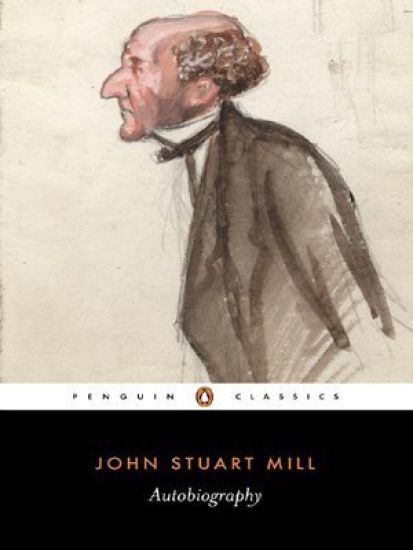
Autobiography

Autobiography

John Robson; John Stuart Mill

Penguin Classics
1989
pokkari
One of the greatest prodigies of his era, John Stuart Mill (1806-73) was studying arithmetic and Greek by the age of three, as part of an astonishingly intense education at his father's hand. Intellectually brilliant, fearless and profound, he became a leading Victorian liberal thinker, whose works - including On Liberty, Utilitarianism, The Subjection of Women and this Autobiography - are among the crowning achievements of the age. Here he describes the pressures placed on him by his childhood, the mental breakdown he suffered as a young man, his struggle to understand a world of feelings and emotions far removed from his father's strict didacticism, and the later development of his own radical beliefs. A moving account of an extraordinary life, this great autobiography reveals a man of deep integrity, constantly searching for truth.
Public and Parliamentary Speeches

Public and Parliamentary Speeches

John Stuart Mill

University of Toronto Press
1988
sidottu
Mill’s experience in Parliament is reflected in his public political activities from 1865 through 1868: campaign speeches; support in the House of Commons for women’s and working-class suffrage and personal representation; involvement in pressing issues such as Ireland, Jamaica, extradition, metropolitan government, the prevention of electoral corruption, and much else; motion and amendments; interventions and rebuttals; and extra-parliamentary speeches. His performance is for the first time made accessible in these volumes, which allow us to place Mill firmly in a political landscape whose features were undergoing a bewilderingly swift metamorphosis, to capture the complexity and fluidity of the situation, and to evaluate his purposes and means. In the historical introduction, Bruce L. Kinzer describes the political forces and personal aspirations that shaped Mill’s parliamentary career and illuminated its consistency and integrity. In the textual introduction, John M. Robson discusses the editorial problems raised by the texts, and explains the principles that have been applied to them.
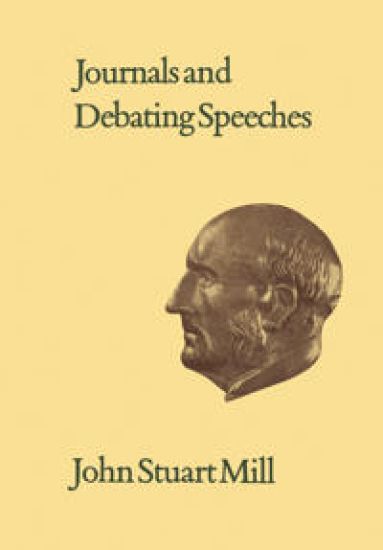
XXVI-XXVIIJournals and Debating Speeches

XXVI-XXVIIJournals and Debating Speeches

John Stuart Mill

University of Toronto Press
1988
pokkari
One of the constant fascinations Mill holds for the general public as well as scholars derives from the early flowering of his genius. This development is seen in detail in the journal and notebook he kept in France during his fifteenth year, and in the debating speeches and walking-tour journals dating from his eighteenth to twenty-fourth years. This was the period when he first adopted Benthamism as 'a religion,' worked intensively as a propagandist for the faith, and then began the painful reassessment that led to his independent mature thought and action. Some of the results of that reassessment are seen in the diary entries from 1854, written for his wife, which reveal in personal form many of their most passionately held ideas. These materials have never before been gathered, and almost all appear here for the first time in scholarly form. They throw light on contemporary social interests and behavior, and will encourage new assessments of Mill’s life and thought. The texts, the great majority drawn from manuscripts, are presented in critical form, collated, with explanatory and textual notes. The Introduction gives the personal and historical context, with an analysis of content and rhetoric; the Textual Introduction supplies information about the nature and history of the documents, while Appendices provide ancillary materials. Both bibliographic and analytic indexes are included.
Subjection of Women

Subjection of Women

John Stuart Mill

Hackett Publishing Co, Inc
1988
sidottu
Reasonably priced and beautifully produced. A clear and helpful introduction by Susan Okin, one of the leading feminist scholars of our generation, as well as a useful bibliography and chronology of Mill's life...Invaluable for teaching and scholarship alike. --Ian Shapiro, Yale University
Subjection of Women

Subjection of Women

John Stuart Mill

Hackett Publishing Co, Inc
1988
pokkari
"Reasonably priced and beautifully produced. A clear and helpful introduction by Susan Okin, one of the leading feminist scholars of our generation, as well as a useful bibliography and chronology of Mill's life. . . . Invaluable for teaching and scholarship alike." --Ian Shapiro, Yale University
XXII-XXVNewspaper Writings

XXII-XXVNewspaper Writings

John Stuart Mill

University of Toronto Press
1986
pokkari
For just over fifty years John Stuart Mill contributed articles and letters to the newspapers, setting before the public a radical position on contemporary events. From 1822 to 1873, in newspapers as widely read as The Times and the Morning Chronicle, and as narrowly circulated as the True Sun and the New Times, he praised his friends and damned his opponents, while commenting on a while range of issues at home and abroad, from banking to Ireland, from wife-beating to land nationalization. His main series of newspaper writings concerned France (especially during the first four years of the Revolution of 1830) and Ireland (especially during December 1846 and January 1847, when various proposals for relief of the starving cottiers were being debated). Mill felt himself peculiarly fitted to explain French affairs and Irish solutions to the non-comprehending and wrong-headed English. But his pen was wielded wherever he say stupidity and narrowness, and he found them in astonishingly varied areas. He tried to explain to his obdurate countrymen the first principles of law reform, political economy, relations between the sexes, democracy, international law, and much more. Virtually none of these texts have been reprinted before this volume. The Introduction by Ann Robson sets the items in their historical and personal perspective, and draws out the implications for Mill's life and thought. The Textual Introduction by John Robson gives an account of the sources of the texts, and lays out principles and methods followed in the editing. The Mill that emerges from these pages is a fighting journalist, uninhibited, forthright, and often brilliantly satirical, testing his theoretical opinions in the real world, gradually maturing and developing a practical philosophy whose influence has been felt well into our own time.
XXII-XXVNewspaper Writings

XXII-XXVNewspaper Writings

John Stuart Mill

University of Toronto Press
1986
sidottu
For just over fifty years John Stuart Mill contributed articles and letters to the newspapers, setting before the public a radical position on contemporary events. From 1822 to 1873, in newspapers as widely read as The Times and the Morning Chronicle, and as narrowly circulated as the True Sun and the New Times, he praised his friends and damned his opponents, while commenting on a while range of issues at home and abroad, from banking to Ireland, from wife-beating to land nationalization. His main series of newspaper writings concerned France (especially during the first four years of the Revolution of 1830) and Ireland (especially during December 1846 and January 1847, when various proposals for relief of the starving cottiers were being debated). Mill felt himself peculiarly fitted to explain French affairs and Irish solutions to the non-comprehending and wrong-headed English. But his pen was wielded wherever he say stupidity and narrowness, and he found them in astonishingly varied areas. He tried to explain to his obdurate countrymen the first principles of law reform, political economy, relations between the sexes, democracy, international law, and much more. Virtually none of these texts have been reprinted before this volume. The Introduction by Ann Robson sets the items in their historical and personal perspective, and draws out the implications for Mill's life and thought. The Textual Introduction by John Robson gives an account of the sources of the texts, and lays out principles and methods followed in the editing. The Mill that emerges from these pages is a fighting journalist, uninhibited, forthright, and often brilliantly satirical, testing his theoretical opinions in the real world, gradually maturing and developing a practical philosophy whose influence has been felt well into our own time.
On Liberty

On Liberty

John Stuart Mill

Prometheus Books
1986
pokkari
In the rich history of political philosophy, great minds have sought to define the nature and extent of human freedom, with careful justifications offered for the principles proposed. This tradition experienced a heightened degree of enthusiastic intensity upon the publication of On Liberty in England during the nineteenth century. In this, his most powerful essay, John Stuart Mill defends individual liberty against both social and political encroachment, by daring to suggest that lines of demarcation be drawn to outline the proper role of government with respect to individual freedom. Apropriate spheres of action are offered for individuals, society, and the state; basic rules are established to deal with those cases in which human action may need to be restrained or limited. Mill's eloquence and his unwavering dedication to the cause of freedom permeate every page.
The Subjection of Women

The Subjection of Women

John Stuart Mill

Prometheus Books
1986
nidottu
Since Old Testament days discrimination against minorities and other groups has been the rule in history rather than the exception. Chief among these repressive attitudes has been the inferior social and political status of women. Mill offers compelling arguments against the disenfranchisement of women, the infringement of their property rights, and the second-class status they experienced within marriage. One of England's most influential social philosophers, Mill sets the keen sights of his critical, analytic eye on the socio-political justifications for gender supremacy in nineteenth-century Britain and, in doing so, he strikes a powerful blow for women's rights, the reverberations of which are still being felt today. A remarkable work, The Subjection of Women uses reason and common sense to take sexual discrimination to task.
XXEssays on French History and Historians

XXEssays on French History and Historians

John Stuart Mill

University of Toronto Press
1985
pokkari
J.S. Mill's deep interest in French intellectual, political, and social affairs began in 1820 when, in his fourteenth year, he went to France to live for a year with the family of Sir Samuel Bentham. French became his second language, and France his second home, where he died and was buried in 1873. His interest in history began even earlier when, as a child of seven, he tried to imitate his father's labours on the History of British India; though he never wrote a history in his maturity, study of the past remained a passion and helped shape the philosophy of history that informed his views of society and ethics. His intense interest in contemporary French politics also led him to seek connections between historical developments and present trends, both seen by his from a Radical perspective approproate to what he believed to be an age of transition. The English historians of France, including Walter Scott and Thomas Carlyle, as well as the French, some of whom were themselves political figures, are judged by their historical methods, but those methods are seen as having practical effects in shaping as well as revealing the mind of the times. This volume brings together for the first time the essays, running from 1826 to 1849, that meld these abiding interests. They give as well insights into Mill's personal aspirations, his developing view of comparative politics and sociology, his concern for freedom, and his feminism. During these years Mill worked on a published his System of Logic, Book VI of which shows in condensed form the results of the speculations here developed; reading these essays with that work, which made his reputation as a philosopher, enables one to see the effects of romanticism on analytic thought in a way not as clearly evident even in Mill's Autobiography. Independently important, then, the essays in this volume also enable us to interpret anew the practical and theoretical concerns fundamental to his formative years and maturity. John C. Cairns' Introduction demonstrates how the essays reveal, through their reactions to the Revolutions of 1789, 1830, and 1848, and to French historiography, politics, and thought, the effect of France on Mill's ideas, and also the way in which his other concerns influenced his reactions to France. The texts, with the variants and notes that are the hallmark of this edition, are described in John M. Robson's Textual Introduction, which explains the editorial principles and methods.
XXIEssays Equality Law Education

XXIEssays Equality Law Education

John Stuart Mill

University of Toronto Press
1984
sidottu
Of John Stuart Mill's major commitments, none was more passionately pursued than equality; it marks his writings throughout his life, and serves as a uniting force in his comments on many subjects, especially lawand education. This volume presents, in scholarly form for the first time, writings that reveal his goals and methods in diverse circumstances. They begin with his precocious essay on the law of libel and include his influential Subjection of Women, his major essays on slavery, his Inaugural Address at St Andrews (a surprisingly succinct summary of his thought), and his contributionsin the struggle to being Governor Eyre of Jamaica to trial. A variety of shorter essays is also presented: such personal documents as his declaration just before amrriage renouncing all legal rights over his wife, and his and Harriett Taylor's companion pieces on marriage, newly edited from manuscript. Also included is Mill's evidence before parliamentary committees on education (1866) and the Contagious Diseases Acts (1870). The appendices include ancillary texts (such as Harriett Taylor's "Emancipation of Women") and a bibliographic index listing all works and persons mentioned or quoted in the essays. An analytic index gives easy access to the full range of Mill's ideas in these important essays.
Mill on Bentham and Coleridge

Mill on Bentham and Coleridge

John Stuart Mill

Praeger Publishers Inc
1983
sidottu
Even if [Bentham and Coleridge] had had no great influence they would still have been the classical examples they are of two great opposing types of mind. . . . And as we follow Mill's analysis, exposition and evaluation of this pair of opposites we are at the same time, we realize, forming a close acquaintance with a mind different from either. From the introduction
VIEssays on England, Ireland, and Empire

VIEssays on England, Ireland, and Empire

John Stuart Mill

University of Toronto Press
1982
pokkari
John Stuart Mill's political essays are a blend of the practical and the theoretical. In this volume are gathered together those in which the practical emphasis is more marked; those in which theory is predominant are found in Essays on Politics and Society, Vols XVIII and XIX of the Collected Works. The Essays on England, Ireland, and the Empire are mainly from Mill's early career as a propagandist for the Philosophic Radicals (a term he himself coined). They provide a contemporary running account of British political issues at home and abroad, with a vigorous and sometimes acerbic commentary. Historians as well as political scientists will find interesting details of the view from the radical side, and all students of Mill will welcome the further elucidation of his development. Of special interest are his precocious if tendentious attack on Hume's History of England, and his reactions to Canadian and Irish issues, the latter being the subject of a previously unpublished manuscript. The textual apparatus includes a collation of the manuscript materials and identification of Mill's quotations and references.
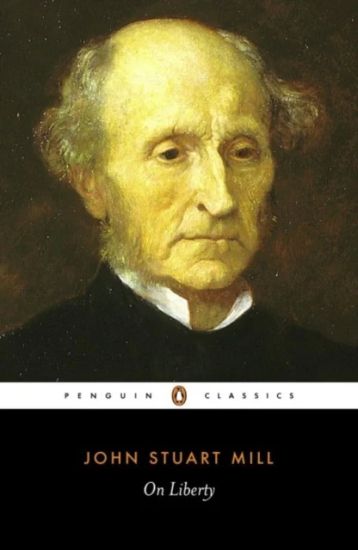
On Liberty

On Liberty

John Stuart Mill

Penguin Classics
1982
pokkari
'Over himself, over his own body and mind, the individual is sovereign.' To this 'one very simple principle' the whole of Mill's essay On Liberty is dedicated. While many of his immediate predecessors and contemporaries, from Adam Smith to Godwin and Thoreau, had celebrated liberty, it was Mill who organized the idea into a philosophy, and put it into the form in which it is generally known today. The editor of this essay, Gertrude Himmelfarb records responses to Mill's books and comments on his fear of 'the tyranny of the majority'. Dr Himmelfarb concludes that the same inconsistencies which underlie On Liberty continue to complicate the moral and political stance of liberals today.
IXAn Examination of Sir William Hamilton's Philosophy

IXAn Examination of Sir William Hamilton's Philosophy

John Stuart Mill

University of Toronto Press
1979
pokkari
An Examination of Sir William Hamilton's Philosophy, first published in 1865, with a second edition in the same year, and third and fourth editions in 1867 and 1872, has long been out of print. The Examination was, for his contemporaries, a most significant and popular work, presenting an extended treatment of some matters central to empiricism that found little space in Mill's Logic, the best known being his treatment of matter and mind from a psychological viewpoint. Appearing just before his successful parliamentary candidature, the Examination, with its deliberate and explicit onslaught on the intuitionists who were, in Mill's view, allied with anti-progressive political and religious forces, brought his beliefs into the public arena in a new way. Some of those who supported him politically found themselves viciously attacked because they had associated themselves with one who assailed settled religious beliefs. Other religionists who rejected many of Mill's attitudes strong expressed their admiration of the Examination because of its exposure to what they, with him, saw as dangerous theological and moral positions. Alan Ryan's analytical and historial introduction dwells on the most significant philosophical elements in the work, placing them in perspective and showing their relations to other aspects of Mill's thought. The textual introduction, by John M. Robson, examines the treatise in context of Mill's life in the 1860s, outlines its composition, and discusses, among other matters, the importance of the extensive revisions Mill made, mostly in response to critics. These revisions appear in full in the textual apparatus. Also provided are a bibliographical index, which gives a guide to the literature on the subject, and a collation of Mill's quotations, an analytical index, and appendices giving the reading of manuscript fragments and listing textual emendations.
IXAn Examination of Sir William Hamilton's Philosophy

IXAn Examination of Sir William Hamilton's Philosophy

John Stuart Mill

University of Toronto Press
1979
sidottu
An Examination of Sir William Hamilton's Philosophy, first published in 1865, with a second edition in the same year, and third and fourth editions in 1867 and 1872, has long been out of print. The Examination was, for his contemporaries, a most significant and popular work, presenting an extended treatment of some matters central to empiricism that found little space in Mill's Logic, the best known being his treatment of matter and mind from a psychological viewpoint. Appearing just before his successful parliamentary candidature, the Examination, with its deliberate and explicit onslaught on the intuitionists who were, in Mill's view, allied with anti-progressive political and religious forces, brought his beliefs into the public arena in a new way. Some of those who supported him politically found themselves viciously attacked because they had associated themselves with one who assailed settled religious beliefs. Other religionists who rejected many of Mill's attitudes strong expressed their admiration of the Examination because of its exposure to what they, with him, saw as dangerous theological and moral positions. Alan Ryan's analytical and historial introduction dwells on the most significant philosophical elements in the work, placing them in perspective and showing their relations to other aspects of Mill's thought. The textual introduction, by John M. Robson, examines the treatise in context of Mill's life in the 1860s, outlines its composition, and discusses, among other matters, the importance of the extensive revisions Mill made, mostly in response to critics. These revisions appear in full in the textual apparatus. Also provided are a bibliographical index, which gives a guide to the literature on the subject, and a collation of Mill's quotations, an analytical index, and appendices giving the reading of manuscript fragments and listing textual emendations.
On Liberty

On Liberty

John Stuart Mill

Hackett Publishing Co, Inc
1978
pokkari
Contents include a selected bibliography and an editor's Introduction broken into two sections. The first section provides a brief sketch of the historical, social, and biographical context in which Mill wrote and the second traces the central line of argument in the text to aid in the comprehension of the essay's structure, method, and major theses.
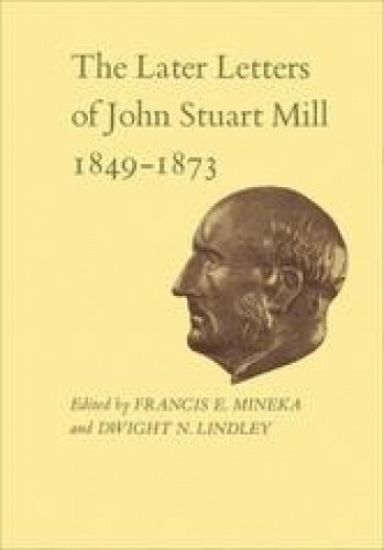
XIV-XVIIThe Later Letters of John Stuart Mill 1849-1873

XIV-XVIIThe Later Letters of John Stuart Mill 1849-1873

John Stuart Mill

University of Toronto Press
1972
pokkari
The Earlier Letters of John Stuart Mill, published in two volumes in 1963, were well received by critics and scholars alike. The publication of these four volumes of later letters completes this edition of Mill's personal correspondence. These volumes contain over 1,800 letters, most never before published, and some sixty earlier letters that have come to light since the publication of the first two volumes of correspondence. The letters have been assembled from widely dispersed collections in the libraries of fifty-eight institutions and of some thirty private collections in Britain and in other countries of the Commonwealth, Europe, and North America. In addition, many personal letters of which no originals survived have been located in contemporary periodicals or biographies of Mill's correspondence.