Kirjojen hintavertailu. Mukana 12 390 323 kirjaa ja 12 kauppaa.

Kirjailija

Joni Salminen

Kirjat ja teokset yhdessä paikassa: 4 kirjaa, julkaisuja vuosilta 2010-2024, suosituimpien joukossa Understanding Audiences, Customers, and Users via Analytics. Vertaile teosten hintoja ja tarkista saatavuus suomalaisista kirjakaupoista.

4 kirjaa

Kirjojen julkaisuhaarukka 2010-2024.

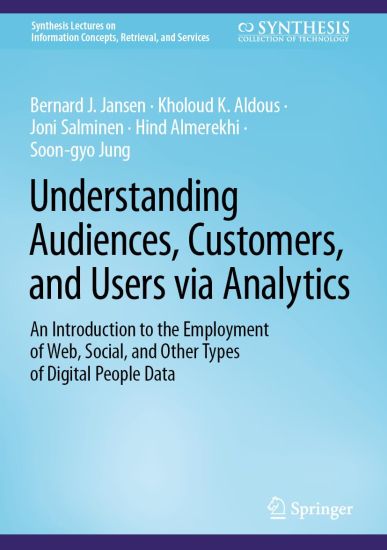
Understanding Audiences, Customers, and Users via Analytics

Understanding Audiences, Customers, and Users via Analytics

Bernard J. Jansen; Kholoud K. Aldous; Joni Salminen; Hind Almerekhi; Soon-gyo Jung

Springer International Publishing AG
2023
sidottu
This book presents the foundations of using analytics from the laboratory, social media platforms, and the web. The authors cover key topics including analytics strategy, data gathering approaches, data preprocessing, data quality assessment, analytical methods, tools, and validation methods. The book includes chapters explaining web analytics, social media analytics, and how to create an analytics strategy. The authors also cover on data sources, such as online surveys, crowdsourcing, eye tracking, mouse tracking, social media APIs, search logs, and analytics triangulation. The book also discusses analytical tools for social media analytics, search analytics, persona analytics, user studies, and website analytics. The authors conclude by examining the validity of online analytics.
Understanding Audiences, Customers, and Users via Analytics

Understanding Audiences, Customers, and Users via Analytics

Bernard J. Jansen; Kholoud K. Aldous; Joni Salminen; Hind Almerekhi; Soon-gyo Jung

Springer International Publishing AG
2024
nidottu
This book presents the foundations of using analytics from the laboratory, social media platforms, and the web. The authors cover key topics including analytics strategy, data gathering approaches, data preprocessing, data quality assessment, analytical methods, tools, and validation methods. The book includes chapters explaining web analytics, social media analytics, and how to create an analytics strategy. The authors also cover on data sources, such as online surveys, crowdsourcing, eye tracking, mouse tracking, social media APIs, search logs, and analytics triangulation. The book also discusses analytical tools for social media analytics, search analytics, persona analytics, user studies, and website analytics. The authors conclude by examining the validity of online analytics.
Data-Driven Personas

Data-Driven Personas

Bernard J. Jansen; Joni Salminen; Soon-gyo Jung; Kathleen Guan

Springer International Publishing AG
2021
nidottu
Data-driven personas are a significant advancement in the fields of human-centered informatics and human-computer interaction. Data-driven personas enhance user understanding by combining the empathy inherent with personas with the rationality inherent in analytics using computational methods. Via the employment of these computational methods, the data-driven persona method permits the use of large-scale user data, which is a novel advancement in persona creation. A common approach for increasing stakeholder engagement about audiences, customers, or users, persona creation remained relatively unchanged for several decades. However, the availability of digital user data, data science algorithms, and easy access to analytics platforms provide avenues and opportunities to enhance personas from often sketchy representations of user segments to precise, actionable, interactive decision-making tools—data-driven personas! Using the data-driven approach, the persona profile can serve as an interface to a fully functional analytics system that can present user representation at various levels of information granularity for more task-aligned user insights. We trace the techniques that have enabled the development of data-driven personas and then conceptually frame how one can leverage data-driven personas as tools for both empathizing with and understanding of users. Presenting a conceptual framework consisting of (a) persona benefits, (b) analytics benefits, and (c) decision-making outcomes, we illustrate applying this framework via practical use cases in areas of system design, digital marketing, and content creation to demonstrate the application of data-driven personas in practical applied situations. We then present an overview of a fully functional data-driven persona system as an example of multi-level information aggregation needed for decision making about users. We demonstrate that data-driven personas systems can provide critical, empathetic, and user understandingfunctionalities for anyone needing such insights.