Kirjojen hintavertailu. Mukana 12 390 323 kirjaa ja 12 kauppaa.

Kirjailija

Josef Pieper

Kirjat ja teokset yhdessä paikassa: 65 kirjaa, julkaisuja vuosilta 1955-2025, suosituimpien joukossa Festschrift der Arbeitsgemeinschaft für Forschung des Landes Nordrhein-Westfalen zu Ehren des Herrn Ministerpräsidenten Karl Arnold. Vertaile teosten hintoja ja tarkista saatavuus suomalaisista kirjakaupoista.

65 kirjaa

Kirjojen julkaisuhaarukka 1955-2025.

Festschrift der Arbeitsgemeinschaft für Forschung des Landes Nordrhein-Westfalen zu Ehren des Herrn Ministerpräsidenten Karl Arnold

Festschrift der Arbeitsgemeinschaft für Forschung des Landes Nordrhein-Westfalen zu Ehren des Herrn Ministerpräsidenten Karl Arnold

Richard Alewyn; Herbert Von Einem; Joseph Höffner; Günther Jachmann; Gerhard Kegel; Josef Kroll; Thomas Ohm; Hans Peters; Josef Pieper; Karl Heinrich Rengstorf; Fritz Schalk; Georg Schreiber; Friedrich Karl Schumann; Franz Steinbach; Hans Erich Stier; Jost Trier; Leo Weisgerber; Harry Westermann; Hans J. Wolff; Leo Brandt; Kurt Alder; Volker Aschoff; Friedrich Becker; Heinrich Behnke; Theodor Beste; Hans Braun; Wilhelm Fucks; Wilhelm Groth; Fritz Gummert; Burckhardt Helferich; Walther G. Hoffmann; Walter Kikuth; Bruno Kuske

Vs Verlag Fur Sozialwissenschaften
1955
nidottu
Funf Jahre Arbeitsgemeinschaft fur wissenschaftliche Forschung in den vielfaltigen Bezirken der Naturwissenschaften und Technik, seit einigen Jahren notwendig und wirksam erganzt durch die Forschung auf geistes wissenschaftlichem Gebiet, ist zu einem Begriff fur deutsche Forschung und hervorragende Forschungsergebnisse nicht nur in Nordrhein-Westfalen, ihrem Wurzel- und Nahrboden, sondern weit daruber hinaus im Bereich unseres gesamten Vaterlandes geworden, sogar mit Ausstrahlungen in die ganze Welt und Resonanz aus der ganzen Welt. Ein Beweis dafur, dass die Insti tution, die gar keine Institution im engeren und regelnden Sinne ist und auch nicht sein sollte, sondern ein freiwilliger Zusammenschluss namhafter Wissen schaftler und Forscher aus allen Gebieten der wissenschaftlichen Disziplinen, in Plan und Anlage richtig war und sich sinnvoll und zweckdienlich ent faltet hat. Was heisst in diesem Falle "zweckdienlich"? Dem Zweck des Austausches, der gegenseitigen Befruchtung von Forschern der verschiedensten Species in Rede und Aussprache dienen, um der Gefahr der Einseitigkeit, der jeder Spezialwissenschaftler ausgesetzt ist, zu begegnen und zu entgehen, um teilzuhaben an den Aufgaben, Erkenntnissen und Ergebnissen des Kollegen der benachbarten, aber und besonders auch der entfernteren wissenschaft lichen Bereiche. Die Arbeitsgemeinschaft fur Forschung hat in ihren regelmassigen Sitzun gen und durch ihre zahlreichen Veroffentlichungen einen Reichtum aus " ... Wort und Widerwort und wieder Wort ... " wie es auf der Beschriftung des Vogel Phonix von Ewald Mathare in der Vorhalle des Landtags heisst, gewonnen, eine Fulle von Erkenntnissen geschaffen, wie sie in dieser Reich weite und Tiefe kaum auf andere Weise zu erzielen sind als in einer solchen wissenschaftlichen "Societat.""
What Catholics Believe

What Catholics Believe

Josef Pieper; Heinz Raskop

St. Augustine's Press
2025
nidottu
The authors give, in brief and simple form, a summary of the fundamental teachings of the Catholic Church, and of the fruits of the faith contained in the teachings. The first part, The Faith of the Christian, outlines the basic teachings as embodied in the Apostles Creed, followed by chapters on the Seven Sacraments and the Liturgical Year. The second part, entitled The Life of the Christian, is concerned with the fruits of faith, treats Christian virtues. No similar book covers so much ground, in such simple terms, in one brief work. What Catholics Believe was written before the liturgical changes implemented by the Second Vatican Council, but its theology and anthropology remain as relevant today as they did a half-century ago, and its impact is all the more startling for the clear, direct, orthodox approach it takes. This edition adds explanatory notes that cross-reference the text with contemporary rubrics for the benefit of modern readers.
The Human Wisdom of St. Thomas: A Breviary of Philosophy from the Works of St. Thomas Aquinas
Josef Pieper has attached no commentary to the texts brought together in this breviary of the philosophy of St. Thomas, preferring that the reader should encounter them, "on his own". His work has been one of selection, in which he has sought to assemble such passages as will provide an introduction to the form and design of the whole Thomistic system. Yet he has so ordered his texts as to impress upon the reader a special feature of St. Thomas's thought, what he calls its double aspect: St. Thomas sees the whole scheme of reality ordered and penetrable by reason; yet the mystery of Being itself remains: "The effort of human thought has not been able to track down the essence of a single gnat." Author Josef Pieper himself was one of the most highly regarded Thomistic philosophers of the twentieth century.
A Journey to Point Omega – Autobiography from 1964

A Journey to Point Omega – Autobiography from 1964

Josef Pieper; Dan Farrelly

ST AUGUSTINE'S PRESS
2020
sidottu
This volume, the original version of which was published in 1988, brings to a close the autobiographical writings of a modern Christian philosopher who lived through the two World Wars and the ecclesiastical upheaval in the Catholic Church in the context of the Second Vatican Council. What stamps this philosopher throughout the course of his life – with all its social and political uncertainties – is his constant dedication to truth and his manifest unswerving integrity. Themes with which the reader of his previous works would be well acquainted recur in this volume. The dedicated Catholic philosopher, who preferred his independence as a trainer of teachers to the less independent role of a professor in a Catholic university, was quite prepared to criticize developments in the Church which resulted from Vatican II. In his defense of the sacred, which he deemed threatened by popularizing trends in the Church, he criticized what he saw as the watered down language in modern German translations of Church liturgical texts; the growing preference for secular garb; and the compromising developments which saw the sacramental signs – surrounding baptism, for instance – being reduced to such an extent that they no longer had the power to signify their sacred meaning even to a well-intentioned congregation. A great lover of the philosophy of Plato, Augustine, and Aquinas – among many others –, Pieper highlighted the need for living a life of truth. He did not consider truth to be merely something abstract but as something to be lived existentially. While he could explain his philosophy in clear rational terms, something which especially stood to him in his post-war lectures to eager students who were hungry for intellectual guidance and leadership, the great interest of his philosophy was, possibly, his preoccupation with mystery – that which impinges on our inner lives but frustrates all our attempts to account for it in purely rational terms. As a philosopher – one might say a Christian philosopher – Pieper seems to have observed the traditional boundaries drawn between philosophy and theology. His generation was exposed to the modernist debates in the Church. It would have been deemed heretical to say that the Divine could be grasped by our purely human thought processes – access to the Divine being only possible through faith and grace. Pieper was no heretic. But he was also not altogether conservative. In fact, his philosophy, closely allied to existentialism – despite his care, for instance, to distance himself from the negative existentialism of Sartre – focused on the individual’s inner existential grasp of the most profound reality. Truth is to be found within us, even if it remains a mystery. What lies beyond death is, for the individual, the ultimate mystery.
A Journey to Point Omega – Autobiography from 1964

A Journey to Point Omega – Autobiography from 1964

Josef Pieper; Dan Farrelly

ST AUGUSTINE'S PRESS
2020
nidottu
This volume, the original version of which was published in 1988, brings to a close the autobiographical writings of a modern Christian philosopher who lived through the two World Wars and the ecclesiastical upheaval in the Catholic Church in the context of the Second Vatican Council. What stamps this philosopher throughout the course of his life – with all its social and political uncertainties – is his constant dedication to truth and his manifest unswerving integrity. Themes with which the reader of his previous works would be well acquainted recur in this volume. The dedicated Catholic philosopher, who preferred his independence as a trainer of teachers to the less independent role of a professor in a Catholic university, was quite prepared to criticize developments in the Church which resulted from Vatican II. In his defense of the sacred, which he deemed threatened by popularizing trends in the Church, he criticized what he saw as the watered down language in modern German translations of Church liturgical texts; the growing preference for secular garb; and the compromising developments which saw the sacramental signs – surrounding baptism, for instance – being reduced to such an extent that they no longer had the power to signify their sacred meaning even to a well-intentioned congregation. A great lover of the philosophy of Plato, Augustine, and Aquinas – among many others –, Pieper highlighted the need for living a life of truth. He did not consider truth to be merely something abstract but as something to be lived existentially. While he could explain his philosophy in clear rational terms, something which especially stood to him in his post-war lectures to eager students who were hungry for intellectual guidance and leadership, the great interest of his philosophy was, possibly, his preoccupation with mystery – that which impinges on our inner lives but frustrates all our attempts to account for it in purely rational terms. As a philosopher – one might say a Christian philosopher – Pieper seems to have observed the traditional boundaries drawn between philosophy and theology. His generation was exposed to the modernist debates in the Church. It would have been deemed heretical to say that the Divine could be grasped by our purely human thought processes – access to the Divine being only possible through faith and grace. Pieper was no heretic. But he was also not altogether conservative. In fact, his philosophy, closely allied to existentialism – despite his care, for instance, to distance himself from the negative existentialism of Sartre – focused on the individual’s inner existential grasp of the most profound reality. Truth is to be found within us, even if it remains a mystery. What lies beyond death is, for the individual, the ultimate mystery.
Exercises in the Elements – Essays, Speeches, Notes
This title, which at first sight seems curious, shows Pieper’s philosophical work as rooted in the basics. He takes his inspiration from Plato – and his Socrates – and Thomas Aquinas. With them, he is interested in philosophy as pure theory, the theoretical being precisely the non-practical. The philosophizer wants to know what all existence is fundamentally about, what “reality” “really” means. With Plato, Pieper eschews the use of language to convince an audience of anything which is not the truth. If Plato was opposed to the sophists – amongst them the politicians –, Pieper is likewise opposed to discourse that leads to the “use” of philosophy to bolster a totalitarian regime or any political or economic system. A fundamental issue for Pieper is “createdness.” He sees this as the fundamental truth of our being – all being – and the fundamental virtue we can practise is the striving to live according to our perception of real truth in any given situation. The strength and attraction of Pieper’s writing is its direct and intuitive character which is independent of abstract systematization. He advocates staying in touch with the “real” as we experience it deep within ourselves. Openness to the totality of being – in no matter what context being reveals itself – and the affirmation of all that is founded in this totality are central pillars of all his thinking. Given the “simplicity” of this stance, it is no surprise that much of it is communicated – and successfully – through his gift for illustration by anecdote. Like Plato, this philosopher is a story-teller and, like him, very readable.
Exercises in the Elements – Essays, Speeches, Notes
This title, which at first sight seems curious, shows Pieper’s philosophical work as rooted in the basics. He takes his inspiration from Plato – and his Socrates – and Thomas Aquinas. With them, he is interested in philosophy as pure theory, the theoretical being precisely the non-practical. The philosophizer wants to know what all existence is fundamentally about, what “reality” “really” means. With Plato, Pieper eschews the use of language to convince an audience of anything which is not the truth. If Plato was opposed to the sophists – amongst them the politicians –, Pieper is likewise opposed to discourse that leads to the “use” of philosophy to bolster a totalitarian regime or any political or economic system. A fundamental issue for Pieper is “createdness.” He sees this as the fundamental truth of our being – all being – and the fundamental virtue we can practise is the striving to live according to our perception of real truth in any given situation. The strength and attraction of Pieper’s writing is its direct and intuitive character which is independent of abstract systematization. He advocates staying in touch with the “real” as we experience it deep within ourselves. Openness to the totality of being – in no matter what context being reveals itself – and the affirmation of all that is founded in this totality are central pillars of all his thinking. Given the “simplicity” of this stance, it is no surprise that much of it is communicated – and successfully – through his gift for illustration by anecdote. Like Plato, this philosopher is a story-teller and, like him, very readable.
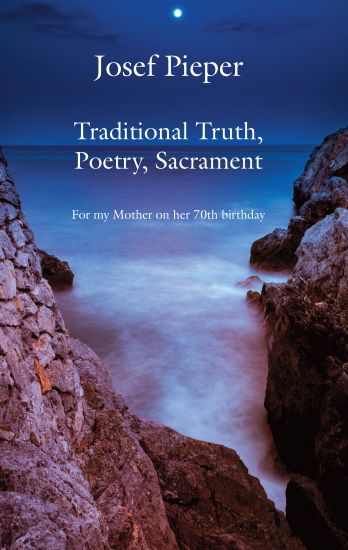
Traditional Truth, Poetry, Sacrament – For My Mother, on Her 70th Birthday
Pieper collects his contributions to radio programs and to a number of journals and periodicals. The book also includes a selection of notes and comments. The contributions fall into two main groups: the period which encompasses the immediate pre-war period as well as the war period itself, and the post-war period up to 1953.The reader becomes witness, first, to Pieper’s problems with the National Socialist regime and, second, to his problems with the ensuing challenges to religious life as it is exposed to increasing secularization.As with his later works, Pieper draws on traditional wisdom which, for him, dates back to Plato and Aristotle, and in these contributions we also see his early preoccupation with the wisdom of St. Thomas Aquinas. The normal boundaries between philosophy and theology are here not clearly drawn. Pieper is preoccupied with the mystery of our world and its importance as a source of symbols signifying deeper levels of reality. He sees the sacraments as achieving their fundamental effect from divine intervention, but he also highlights the need for careful observance of the rituals, so that their meaning is not obscured. Proper execution of the sacrament should enable the faithful to enjoy the existential fruits of their participation in the ritual. This work manifests the organic cohesion of Pieper’s thinking, and it reflects his profound awareness of the role to be played not so much by the professional (academic) philosopher as by the existential Philosophizer.
Traditional Truth, Poetry, Sacrament – For My Mother, on Her 70th Birthday
Pieper collects his contributions to radio programs and to a number of journals and periodicals. The book also includes a selection of notes and comments. The contributions fall into two main groups: the period which encompasses the immediate pre-war period as well as the war period itself, and the post-war period up to 1953.The reader becomes witness, first, to Pieper’s problems with the National Socialist regime and, second, to his problems with the ensuing challenges to religious life as it is exposed to increasing secularization.As with his later works, Pieper draws on traditional wisdom which, for him, dates back to Plato and Aristotle, and in these contributions we also see his early preoccupation with the wisdom of St. Thomas Aquinas. The normal boundaries between philosophy and theology are here not clearly drawn. Pieper is preoccupied with the mystery of our world and its importance as a source of symbols signifying deeper levels of reality. He sees the sacraments as achieving their fundamental effect from divine intervention, but he also highlights the need for careful observance of the rituals, so that their meaning is not obscured. Proper execution of the sacrament should enable the faithful to enjoy the existential fruits of their participation in the ritual. This work manifests the organic cohesion of Pieper’s thinking, and it reflects his profound awareness of the role to be played not so much by the professional (academic) philosopher as by the existential Philosophizer.
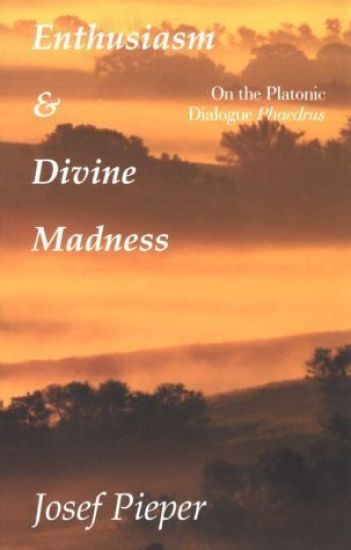
Enthusiasm And Divine Madness

Enthusiasm And Divine Madness

Josef Pieper

St Augustine's Press
2019
nidottu
Brings the actual situation in the dialogue - Athens and its intellectuals engaged in spirited debate - alive. Equally alive is the discussions of ideas, which are brought to bear on contemporary experience and made to prove the perennial validity of Socratic wisdom, and its power to excite the mind. The main thesis - that in poetry and in love man is "beside himself," that is, divinely inspired - is discussed with reference to modern poets, novelists, and modern psychology.
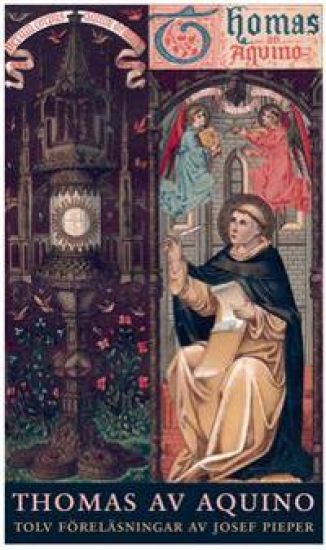
Thomas av Aquino : tolv föreläsningar

Thomas av Aquino : tolv föreläsningar

Josef Pieper

Veritas Förlag
2019
nidottu
Han var portalfiguren under det århundrade då det moderna Europa började ta form, med dess fruktbara legering av intellektuell nyfikenhet, djärv stridslystnad och livskraftiga institutioner och system. Han var »den änglalike doktorn«, kyrkans store lärare, den helige Thomas av Aquino (1225–1274). Men han är också en tänkare för vår tid – systematikern, apologeten, polemikern som befann sig mitt i en för varje dag allt brokigare och stormigare värld av nya upptäckter, idéer och övertygelser, tankar och tvivel. Denna bok vänder sig till katolska bekännare som vill fördjupa sin bekantskap med ett av kyrkans stora helgon, till den som vill veta mer om skolastikens tidevarv och en av dess främsta representanter, till den som är förtrogen med hjärtats och förnuftets längtan efter större kunskap om Gud. Josef Pieper (1904–1997) var katolsk professor i filosofi i Münster. Hans tolv föreläsningar om Thomas av Aquino är en genomgripande och inspirerande översikt av Thomas liv, verk och tid. Boken utkom på svenska 1960 i översättning av Alf Ahlberg. I denna utgåva ingår även en tidigare på svenska opublicerad studie av S:t Thomas och latinet, översatt av Stefan Jarl som också bearbetat och moderniserat hela texten.
Not Yet the Twilight – An Autobiography 1945–1964

Not Yet the Twilight – An Autobiography 1945–1964

Josef Pieper; Dan Farrelly; Una Farrelly

ST AUGUSTINE'S PRESS
2017
sidottu
Volume 2 of Josef Pieper’s three-part autobiography is here presented for the first time in English translation. The volume represents not just a simple continuation of a seamless story. The first volume dealt with Pieper’s life from his birth in 1904 to the time of World War 2. The current volume deals with the post-war years, 1945–1964, offering a personal documentation of the institutional rubble through which an emerging academic and philosopher had to find his way. This included finding work, re-establishing himself in the family home, completing his academic education, and beginning to teach philosophy in a climate of despair and disillusionment. In this context, the quintessential Pieper emerges. His positive philosophy of being, firmly based on Plato and Thomas Aquinas, finds extraordinary resonance with students, who flock to his lectures in surprising numbers — seeking and finding a positive way forward. His dedication to training teachers sees him declining higher academic posts in Germany in favor of work which, though less lucrative and more obscure, he considered more fruitful. These years are also marked by his fiercely independent stance over against the Catholic hierarchy — despite his staunch adherence to the tradition values of Christianity. His popularity as a philosopher and teacher quickly spread to America, where he was invited to teach at famous universities. His fame led to further travels — to Switzerland, England, France, Spain, India, China, Saigon, and Thailand. Such travels enriched his thinking and nourished the open-mindedness of the Western philosopher.
Not Yet the Twilight – An Autobiography 1945–1964

Not Yet the Twilight – An Autobiography 1945–1964

Josef Pieper; Dan Farrelly; Una Farrelly

ST AUGUSTINE'S PRESS
2017
nidottu
Volume 2 of Josef Pieper’s three-part autobiography is here presented for the first time in English translation. The volume represents not just a simple continuation of a seamless story. The first volume dealt with Pieper’s life from his birth in 1904 to the time of World War 2. The current volume deals with the post-war years, 1945–1964, offering a personal documentation of the institutional rubble through which an emerging academic and philosopher had to find his way. This included finding work, re-establishing himself in the family home, completing his academic education, and beginning to teach philosophy in a climate of despair and disillusionment. In this context, the quintessential Pieper emerges. His positive philosophy of being, firmly based on Plato and Thomas Aquinas, finds extraordinary resonance with students, who flock to his lectures in surprising numbers — seeking and finding a positive way forward. His dedication to training teachers sees him declining higher academic posts in Germany in favor of work which, though less lucrative and more obscure, he considered more fruitful. These years are also marked by his fiercely independent stance over against the Catholic hierarchy — despite his staunch adherence to the tradition values of Christianity. His popularity as a philosopher and teacher quickly spread to America, where he was invited to teach at famous universities. His fame led to further travels — to Switzerland, England, France, Spain, India, China, Saigon, and Thailand. Such travels enriched his thinking and nourished the open-mindedness of the Western philosopher.