Kirjojen hintavertailu. Mukana 12 101 475 kirjaa ja 12 kauppaa.

Kirjailija

Jürgen Jost

Kirjat ja teokset yhdessä paikassa: 50 kirjaa, julkaisuja vuosilta 1984-2026, suosituimpien joukossa Mathematical Principles of Topological and Geometric Data Analysis. Vertaile teosten hintoja ja tarkista saatavuus suomalaisista kirjakaupoista.

Mukana myös kirjoitusasut: Jurgen Jost

50 kirjaa

Kirjojen julkaisuhaarukka 1984-2026.

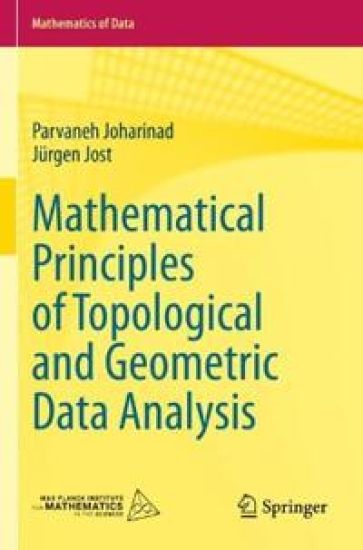
Mathematical Principles of Topological and Geometric Data Analysis

Mathematical Principles of Topological and Geometric Data Analysis

Parvaneh Joharinad; Jürgen Jost

Springer International Publishing AG
2024
nidottu
This book explores and demonstrates how geometric tools can be used in data analysis. Beginning with a systematic exposition of the mathematical prerequisites, covering topics ranging from category theory to algebraic topology, Riemannian geometry, operator theory and network analysis, it goes on to describe and analyze some of the most important machine learning techniques for dimension reduction, including the different types of manifold learning and kernel methods. It also develops a new notion of curvature of generalized metric spaces, based on the notion of hyperconvexity, which can be used for the topological representation of geometric information. In recent years there has been a fascinating development: concepts and methods originally created in the context of research in pure mathematics, and in particular in geometry, have become powerful tools in machine learning for the analysis of data. The underlying reason for this is that data are typically equipped with somekind of notion of distance, quantifying the differences between data points. Of course, to be successfully applied, the geometric tools usually need to be redefined, generalized, or extended appropriately. Primarily aimed at mathematicians seeking an overview of the geometric concepts and methods that are useful for data analysis, the book will also be of interest to researchers in machine learning and data analysis who want to see a systematic mathematical foundation of the methods that they use.

Lavoisier

Lavoisier

Jan Frercks; Jürgen Jost

Springer Fachmedien Wiesbaden
2023
nidottu
Schon bald nach dem Erscheinen von Lavoisiers Hauptwerk Traité élémentaire de chimie im Jahre 1789 sprach man von einer Chemischen Revolution, und diese Einschätzung bleibt auch heute noch gültig. Lavoisiers Erklärung des Verbrennungsvorgangs und der Rolle des Sauerstoffs auch bei anderen chemischen Vorgängen wie auch seine quantitative Bilanzmethode und seine systematische chemische Nomenklatur haben die seinerzeitige Chemie revolutioniert und die weitere Entwicklung dieser Wissenschaft geprägt. Eine deutsche Übersetzung erschien 1792. Jan Frercks hat aus der 2.Auflage von 1803 die wesentlichen Teile ausgewählt, durchgesehen und behutsam überarbeitet. Sein Kommentar erschließt nicht nur heutigen Leserinnen und Lesern den theoretischen und historischen Horizont des Werkes, sondern stellt auch selbst eine bedeutende wissenschaftsgeschichtliche Leistung dar. Mit dieser Ausgabe wird ein zentraler Text der modernen Naturwissenschaft einem heutigen Publikum zugänglich gemacht.
Mathematical Principles of Topological and Geometric Data Analysis

Mathematical Principles of Topological and Geometric Data Analysis

Parvaneh Joharinad; Jürgen Jost

Springer International Publishing AG
2023
sidottu
This book explores and demonstrates how geometric tools can be used in data analysis. Beginning with a systematic exposition of the mathematical prerequisites, covering topics ranging from category theory to algebraic topology, Riemannian geometry, operator theory and network analysis, it goes on to describe and analyze some of the most important machine learning techniques for dimension reduction, including the different types of manifold learning and kernel methods. It also develops a new notion of curvature of generalized metric spaces, based on the notion of hyperconvexity, which can be used for the topological representation of geometric information.In recent years there has been a fascinating development: concepts and methods originally created in the context of research in pure mathematics, and in particular in geometry, have become powerful tools in machine learning for the analysis of data. The underlying reason for this is that data are typically equipped with somekind of notion of distance, quantifying the differences between data points. Of course, to be successfully applied, the geometric tools usually need to be redefined, generalized, or extended appropriately.Primarily aimed at mathematicians seeking an overview of the geometric concepts and methods that are useful for data analysis, the book will also be of interest to researchers in machine learning and data analysis who want to see a systematic mathematical foundation of the methods that they use.
Information Geometry

Information Geometry

Nihat Ay; Jürgen Jost; Hông Vân Lê; Lorenz Schwachhöfer

Springer International Publishing AG
2018
nidottu
The book provides a comprehensive introduction and a novel mathematical foundation of the field of information geometry with complete proofs and detailed background material on measure theory, Riemannian geometry and Banach space theory. Parametrised measure models are defined as fundamental geometric objects, which can be both finite or infinite dimensional. Based on these models, canonical tensor fields are introduced and further studied, including the Fisher metric and the Amari-Chentsov tensor, and embeddings of statistical manifolds are investigated.This novel foundation then leads to application highlights, such as generalizations and extensions of the classical uniqueness result of Chentsov or the Cramér-Rao inequality. Additionally, several new application fields of information geometry are highlighted, for instance hierarchical and graphical models, complexity theory, population genetics, or Markov Chain Monte Carlo. The book will be of interest to mathematicians who are interested in geometry, information theory, or the foundations of statistics, to statisticians as well as to scientists interested in the mathematical foundations of complex systems.
Information Geometry and Population Genetics

Information Geometry and Population Genetics

Julian Hofrichter; Jürgen Jost; Tat Dat Tran

Springer International Publishing AG
2018
nidottu
The present monograph develops a versatile and profound mathematical perspective of the Wright--Fisher model of population genetics. This well-known and intensively studied model carries a rich and beautiful mathematical structure, which is uncovered here in a systematic manner. In addition to approaches by means of analysis, combinatorics and PDE, a geometric perspective is brought in through Amari's and Chentsov's information geometry. This concept allows us to calculate many quantities of interest systematically; likewise, the employed global perspective elucidates the stratification of the model in an unprecedented manner. Furthermore, the links to statistical mechanics and large deviation theory are explored and developed into powerful tools. Altogether, the manuscript provides a solid and broad working basis for graduate students and researchers interested in this field.
Information Geometry

Information Geometry

Nihat Ay; Jürgen Jost; Hông Vân Lê; Lorenz Schwachhöfer

Springer International Publishing AG
2017
sidottu
The book provides a comprehensive introduction and a novel mathematical foundation of the field of information geometry with complete proofs and detailed background material on measure theory, Riemannian geometry and Banach space theory. Parametrised measure models are defined as fundamental geometric objects, which can be both finite or infinite dimensional. Based on these models, canonical tensor fields are introduced and further studied, including the Fisher metric and the Amari-Chentsov tensor, and embeddings of statistical manifolds are investigated.This novel foundation then leads to application highlights, such as generalizations and extensions of the classical uniqueness result of Chentsov or the Cramér-Rao inequality. Additionally, several new application fields of information geometry are highlighted, for instance hierarchical and graphical models, complexity theory, population genetics, or Markov Chain Monte Carlo. The book will be of interest to mathematicians who are interested in geometry, information theory, or the foundations of statistics, to statisticians as well as to scientists interested in the mathematical foundations of complex systems.
Information Geometry and Population Genetics

Information Geometry and Population Genetics

Julian Hofrichter; Jürgen Jost; Tat Dat Tran

Springer International Publishing AG
2017
sidottu
The present monograph develops a versatile and profound mathematical perspective of the Wright--Fisher model of population genetics. This well-known and intensively studied model carries a rich and beautiful mathematical structure, which is uncovered here in a systematic manner. In addition to approaches by means of analysis, combinatorics and PDE, a geometric perspective is brought in through Amari's and Chentsov's information geometry. This concept allows us to calculate many quantities of interest systematically; likewise, the employed global perspective elucidates the stratification of the model in an unprecedented manner. Furthermore, the links to statistical mechanics and large deviation theory are explored and developed into powerful tools. Altogether, the manuscript provides a solid and broad working basis for graduate students and researchers interested in this field.
Partial Differential Equations

Partial Differential Equations

Jürgen Jost

Springer-Verlag New York Inc.
2014
nidottu
This book offers an ideal graduate-level introduction to the theory of partial differential equations. The first part of the book describes the basic mathematical problems and structures associated with elliptic, parabolic, and hyperbolic partial differential equations, and explores the connections between these fundamental types. Aspects of Brownian motion or pattern formation processes are also presented. The second part focuses on existence schemes and develops estimates for solutions of elliptic equations, such as Sobolev space theory, weak and strong solutions, Schauder estimates, and Moser iteration. In particular, the reader will learn the basic techniques underlying current research in elliptic partial differential equations. This revised and expanded third edition is enhanced with many additional examples that will help motivate the reader. New features include a reorganized and extended chapter on hyperbolic equations, as well as a new chapter on the relations between different types of partial differential equations, including first-order hyperbolic systems, Langevin and Fokker-Planck equations, viscosity solutions for elliptic PDEs, and much more. Also, the new edition contains additional material on systems of elliptic partial differential equations, and it explains in more detail how the Harnack inequality can be used for the regularity of solutions.
Nonlinear Methods in Riemannian and Kählerian Geometry
In this book, I present an expanded version of the contents of my lectures at a Seminar of the DMV (Deutsche Mathematiker Vereinigung) in Düsseldorf, June, 1986. The title "Nonlinear methods in complex geometry" already indicates a combination of techniques from nonlinear partial differential equations and geometric concepts. In older geometric investigations, usually the local aspects attracted more attention than the global ones as differential geometry in its foundations provides approximations of local phenomena through infinitesimal or differential constructions. Here, all equations are linear. If one wants to consider global aspects, however, usually the presence of curvature Ieads to a nonlinearity in the equations. The simplest case is the one of geodesics which are described by a system of second ordernonlinear ODE; their linearizations are the Jacobi fields. More recently, nonlinear PDE played a more and more pro~inent röle in geometry. Let us Iist some of the most important ones: - harmonic maps between Riemannian and Kählerian manifolds - minimal surfaces in Riemannian manifolds - Monge-Ampere equations on Kähler manifolds - Yang-Mills equations in vector bundles over manifolds. While the solution of these equations usually is nontrivial, it can Iead to very signifi­ cant results in geometry, as solutions provide maps, submanifolds, metrics, or connections which are distinguished by geometric properties in a given context. All these equations are elliptic, but often parabolic equations are used as an auxiliary tool to solve the elliptic ones.
Differentialgeometrie und Minimalflächen

Differentialgeometrie und Minimalflächen

Jost-Hinrich Eschenburg; Jürgen Jost

Springer-Verlag Berlin and Heidelberg GmbH Co. K
2013
nidottu
Das vorliegende Lehrbuch bietet eine moderne Einführung in die Differenzialgeometrie - etwa im Umfang einer einsemestrigen Vorlesung. Zunächst behandelt es die Geometrie von Flächen im Raum. Viele Beispiele schulen Leser in geometrischer Anschauung, deren wichtigste Klasse die Minimalflächen bilden. Zu ihrem Studium entwickeln die Autoren analytische Methoden und lösen in diesem Zusammenhang das Plateausche Problem. Es besteht darin, eine Minimalfläche mit vorgegebener Berandung zu finden. Als Beispiel einer globalen Aussage der Differenzialgeometrie beweisen sie den Bernsteinschen Satz. Weitere Kapitel behandeln die innere Geometrie von Flächen einschließlich des Satzes von Gauss-Bonnet, und stellen die hyperbolische Geometrie ausführlich dar. Die Autoren verknüpfen geometrische Konstruktionen und analytische Methoden und folgen damit einem zentralen Trend der modernen mathematischen Forschung. Verschiedene geistesgeschichtliche Bemerkungen runden den Text ab. Die Neuauflage wurde überarbeitet und aktualisiert.Hinweise und Errata auf Webseite des Autors: https://myweb.rz.uni-augsburg.de/~eschenbu/
Partial Differential Equations

Partial Differential Equations

Jürgen Jost

Springer-Verlag New York Inc.
2012
sidottu
This book offers an ideal graduate-level introduction to the theory of partial differential equations. The first part of the book describes the basic mathematical problems and structures associated with elliptic, parabolic, and hyperbolic partial differential equations, and explores the connections between these fundamental types. Aspects of Brownian motion or pattern formation processes are also presented. The second part focuses on existence schemes and develops estimates for solutions of elliptic equations, such as Sobolev space theory, weak and strong solutions, Schauder estimates, and Moser iteration. In particular, the reader will learn the basic techniques underlying current research in elliptic partial differential equations. This revised and expanded third edition is enhanced with many additional examples that will help motivate the reader. New features include a reorganized and extended chapter on hyperbolic equations, as well as a new chapter on the relations between different types of partial differential equations, including first-order hyperbolic systems, Langevin and Fokker-Planck equations, viscosity solutions for elliptic PDEs, and much more. Also, the new edition contains additional material on systems of elliptic partial differential equations, and it explains in more detail how the Harnack inequality can be used for the regularity of solutions.
Spectra of Discrete Structures

Spectra of Discrete Structures

Jürgen Jost; Raffaella Mulas; Dong Zhang

Cambridge University Press
2026
sidottu
Addressing the active and challenging field of spectral theory, this book develops the general theory of spectra of discrete structures, on graphs, simplicial complexes, and hypergraphs. In fact, hypergraphs have long been neglected in mathematical research, but due to the discovery of Laplace operators that can probe their structure, and their manifold applications from chemical reaction networks to social interactions, they now constitute one of the hottest topics of interdisciplinary research. The authors' analysis of spectra of discrete structures embeds intuitive and easily visualized examples, which are often quite subtle, within a general mathematical framework. They highlight novel research on Cheeger type inequalities which connect spectral estimates with the geometry, more precisely the cohesion, of the underlying structure. Establishing mathematical foundations and demonstrating applications, this book will be of interest to graduate students and researchers in mathematics working on the spectral theory of operators on discrete structures.
Bernhard Riemann

Bernhard Riemann

Jürgen Jost

Springer Fachmedien Wiesbaden
2025
nidottu
Die Geburtsstunde der modernen Geometrie war am 10.06.1854, als Bernhard Riemann in seinem Habilitationsvortrag differenzierbare Mannigfaltigkeiten, Riemannsche Metriken, Schnittkrümmungen und Normalkoordinaten einführte. Die Riemannsche Geometrie ist nicht nur eines der wichtigsten Forschungsgebiete der heutigen Mathematik, sondern führte auch zu einem völlig neuen Raumverständnis und bildet die Grundlage der modernen Physik, von der Allgemeinen Relativitätstheorie Einsteins bis zur Quantenfeldtheorie. Die Riemannsche Geometrie inspiriert auch wichtige Verfahren des Maschinellen Lernens. Im vorliegenden Werk wird dieser klassische Text der Mathematik umfassend historisch, mathematisch, physikalisch und philosophisch kommentiert und in die gesamte Entwicklung dieser Disziplinen eingeordnet. Bernhard Riemann wurde 1826 geboren und starb 1866 im Alter von 39 Jahren. Während seines kurzen Lebens prägte er die moderne Mathematik wie sonst nur noch Gauß. Sein Konzept der Riemannschen Fläche fasste in genialer Weise die komplexe Analysis und die Theorie der elliptischen Integrale zusammen und war gleichzeitig der Ausgangspunkt für die Entwicklung der Topologie und der modernen algebraischen Geometrie und führte zudem noch neuartige analytische Werkzeuge in die Funktionentheorie ein. Sein Werk lieferte auch wichtige Anregungen für die mathematische Physik. Die Riemannsche Vermutung in der Zahlentheorie gilt auch fast 150 Jahre nach ihrer Formulierung als das schwierigste und tiefste offene Problem der gesamten Mathematik. Jürgen Jost schloss sein 1975 begonnenes Studium der Mathematik, Physik, Volkswirtschaft und Philosophie an der Universität Bonn 1980 mit der Promotion ab. 1984 wurde er als Professor für Mathematik an die Ruhr-Universität Bochum berufen. Seit 1996 ist er als Direktor am Max-Planck-Institut für Mathematik in den Naturwissenschaften in Leipzig tätig. Neben seinen mathematischen Schwerpunkten in der Geometrie und Analysis arbeitet er auch in der mathematischen und theoretischen Physik, Biologie und Neurobiologie und zur Theorie der komplexen Systeme sowie zur Geschichte und Philosophie der Wissenschaften. Er ist Autor von mehr als 20 Monographien und Fachbüchern und mehr als 500 wissenschaftlichen Publikationen. Seine Forschungen wurden mit dem Gottfried-Wilhelm-Leibniz-Preis der DFG (1993) und einem ERC Advanced Grant (2010) ausgezeichnet.
Data Visualization with Category Theory and Geometry

Data Visualization with Category Theory and Geometry

Lukas Silvester Barth; Hannaneh Fahimi; Parvaneh Joharinad; Jürgen Jost; Janis Keck

Springer International Publishing AG
2025
sidottu
This open access book provides a robust exposition of the mathematical foundations of data representation, focusing on two essential pillars of dimensionality reduction methods, namely geometry in general and Riemannian geometry in particular, and category theory. Presenting a list of examples consisting of both geometric objects and empirical datasets, this book provides insights into the different effects of dimensionality reduction techniques on data representation and visualization, with the aim of guiding the reader in understanding the expected results specific to each method in such scenarios. As a showcase, the dimensionality reduction method of “Uniform Manifold Approximation and Projection” (UMAP) has been used in this book, as it is built on theoretical foundations from all the areas we want to highlight here. Thus, this book also aims to systematically present the details of constructing a metric representation of a locally distorted metric space, which is essentially the problem that UMAP is trying to address, from a more general perspective. Explaining how UMAP fits into this broader framework, while critically evaluating the underlying ideas, this book finally introduces an alternative algorithm to UMAP. This algorithm, called IsUMap, retains many of the positive features of UMAP, while improving on some of its drawbacks.
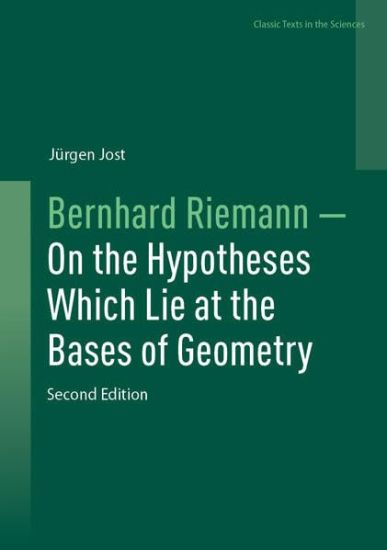
Bernhard Riemann — On the Hypotheses Which Lie at the Bases of Geometry
This book presents William Clifford’s English translation of Bernhard Riemann’s seminal text, accompanied by detailed mathematical, historical, and philosophical commentary. It explores Riemann’s revolutionary ideas on space, placing them within the broader framework developed by later thinkers such as Helmholtz, Ricci, Weyl, and Einstein. A historical introduction situates Riemann’s work in its 19th-century context, while subsequent chapters trace the evolution of the concept of space across philosophy, physics, and mathematics, and examine its enduring influence up to modern research. The second edition includes expanded mathematical commentary, a new section on metric geometry and machine learning, a systematic bibliography, and numerous updates throughout. Appealing to mathematicians, historians, and readers with an interest in physics or philosophy, this book provides a comprehensive perspective on Riemann’s groundbreaking contributions and their lasting impact.
Die Taunus-Ermittler Band 14 Exitus

Die Taunus-Ermittler Band 14 Exitus

Jürgen Jost; Gabriele Jost

BoD - Books on Demand
2024
pokkari
Annika Stettner und ihr Sohn Sven n hern sich wieder an, nachdem Sven nach einem Streit neun Monate zuvor wutentbrannt das Elternhaus verlassen hatte. Bei einem Treffen in Bad F ssing, wo Sven mit seinem neuen Freund wohnt, geraten Peter und Annika in einen ungerechtfertigten Polizeieinsatz, bei dem Svens Freund Michael von der Polizei erschossen wird. Sven muss unter dem Verdacht des Rauschgifthandels fliehen. Aber nicht nur die Polizei ist hinter ihm her, irgendjemand will den Tod von Michael r chen und alle t ten, die er f r seinen Tod verantwortlich macht. Er zieht eine Schneise der Verw stung durch Bad F ssing, Bayern und Hessen. Als auch noch die Taunus-Ermittler auf seine Abschussliste geraten wird es brenzlig.
Die Taunus-Ermittler Band 13 Treffpunkt "La Seu"

Die Taunus-Ermittler Band 13 Treffpunkt "La Seu"

Jürgen Jost; Gabriele Jost

Books on Demand
2023
pokkari
Kommissar Hernandez in Not: Intrigen bis hin zum unbegr ndeten Korruptionsverdacht machen dem mallorquinischen Beamten das Leben schwer. In seiner Verzweiflung ruft er sogar seinen fr heren Intimfeind - Peter Stettner von den Taunus-Ermittlern - zu Hilfe. Der rechnet anfangs mit einem Bagatellfall, den er w hrend des Sommerurlaubs im Vorbeigehen aufkl ren kann. Doch schnell eskaliert die Angelegenheit und zieht mehrere Morde nach sich. Als Peter selbst unter Mordverdacht im Gef ngnis landet, muss sein jugendlicher Stiefsohn den Fall bernehmen - und wird mit einer kriminellen Organisation konfrontiert, deren Macht sich ber die ganze Insel zu erstrecken scheint.
The Evolution of Chemical Knowledge

The Evolution of Chemical Knowledge

Jürgen Jost; Guillermo Restrepo

Springer International Publishing AG
2022
nidottu
Chemistry shapes and creates the disposition of the world's resources and provides novel substances for the welfare and hazard of our civilisation at an exponential rate. Can we model the evolution of chemical knowledge? This book not only provides a positive answer to the question, it provides the formal models and available data to model chemical knowledge as a complex dynamical system based on the mutual interaction of the social, semiotic and material systems of chemistry. These systems, which have evolved over the history, include the scientists and institutions supporting chemical knowledge (social system); theories, concepts and forms of communication (semiotic system) and the substances, reactions and technologies (material system) central for the chemical practice. These three systems, which have traditionally been mostly studied in isolation, are brought together in this book in a grand historical narrative, on the basis of comprehensive data sets and supplemented by appropriate tools for their formal analysis. We thereby develop a comprehensive picture of the evolution of chemistry, needed for better understanding the past, present and future of chemistry as a discipline. The interdisciplinary character of this book and its non-technical language make it an ideal complement to more traditional material in undergraduate and graduate courses in chemistry, history of science and digital humanities.